What Does an Event AV Project Manager Do? A Clear Guide
What if the biggest risk to an event’s technical delivery isn’t the equipment, but gaps between people, plans and deadlines? If you’re asking what does an event AV project manager do, the short answer is that they turn your event requirements into a coordinated plan, then keep the moving parts aligned from early discussions through show day.
It’s reasonable to expect the technical details to be handled, but less clear who connects the brief, schedule, equipment and crew. An AV project manager coordinates those details with you and the technical team, communicates changes and tracks who needs to act. Technicians and operators can then focus on preparing and running their systems.
This guide explains the role before, during and after an event, and how a project manager’s responsibilities differ from those of a technical director or on-site technician. It also shows when technical production management may be useful. The aim is to clarify who does what, so important details stay connected from the first plan to the final cue.
Table of Contents
What does an event AV project manager do on an event?
If you’re asking what does an event AV project manager do, the role is to coordinate the technical requirements, people, schedules and delivery for a live event. They turn the event brief into a practical production plan and keep technical coordination on track from early planning through show day.
This is a live-event role, not simply a permanent AV installation project or a technician assigned to operate equipment. The project manager oversees how the event’s technical elements fit together, while specialists design and operate their systems. For organisers, that means clearer responsibility for details such as who shares a revised presentation, who updates the run sheet and who needs to know about a timing change.
Consider a conference speaker whose presentation needs to appear on a screen while their voice is heard clearly in the room. The project manager helps align the speaker’s requirements, screen content, sound arrangements and run sheet. The relevant people can then prepare for the right cues at the right time. The operator still runs the equipment; the project manager keeps the wider delivery coordinated.
What is an event AV project manager responsible for?
The work begins with the event’s objectives. A project manager translates what the organiser wants to achieve into technical requirements and a delivery plan shaped by the event format and venue. That could mean coordinating audio, video, lighting and camera requirements for a conference, or a different combination for an exhibition or outdoor production.
As details develop, the project manager keeps relevant stakeholders informed. Organisers, presenters, venue contacts and technical specialists may each hold information that affects the plan. The project manager brings those details together, identifies dependencies and communicates changes to the people affected. This is coordination and oversight, not personally mixing audio, operating cameras or programming lighting cues.
That distinction sits within the broader scope of Event management, where planning and execution involve many connected elements. An AV project manager focuses on the technical production side, helping it work in step with the event programme.
Why does an event need AV project coordination?
Technical details depend on one another. A late change to a presentation can affect screen content, rehearsal timing and the show-day run sheet. If the update reaches one team but not another, setup may be harder to manage and the rehearsal may not reflect the final plan. A coordination point helps get the change to the people who need it before it becomes a last-minute surprise.
Early decisions give specialists time to prepare, coordinate setup and use rehearsals to work through the planned sequence. The project manager can’t prevent every change or challenge, but can help make sure changes are understood and acted on across the technical team. A clear flow of information supports a more organised handover from planning to delivery.
An event AV project manager connects the brief, technical specialists and schedule so each part of production is ready to support the event. With full technical production, planning, equipment and on-site technicians or operators can be coordinated as one delivery approach. The organiser has a clearer view of progress, while each specialist can focus on their part of the show.
Which responsibilities does an event AV project manager handle?
The responsibilities stretch across the event lifecycle, not just the hours when guests are in the room. An AV project manager tracks what has been agreed, who is responsible, when decisions are needed and how changes affect technical delivery. The plan is tailored to the brief, venue and event format. A livestream, exhibition and corporate gathering can each call for a different mix of systems and coordination.
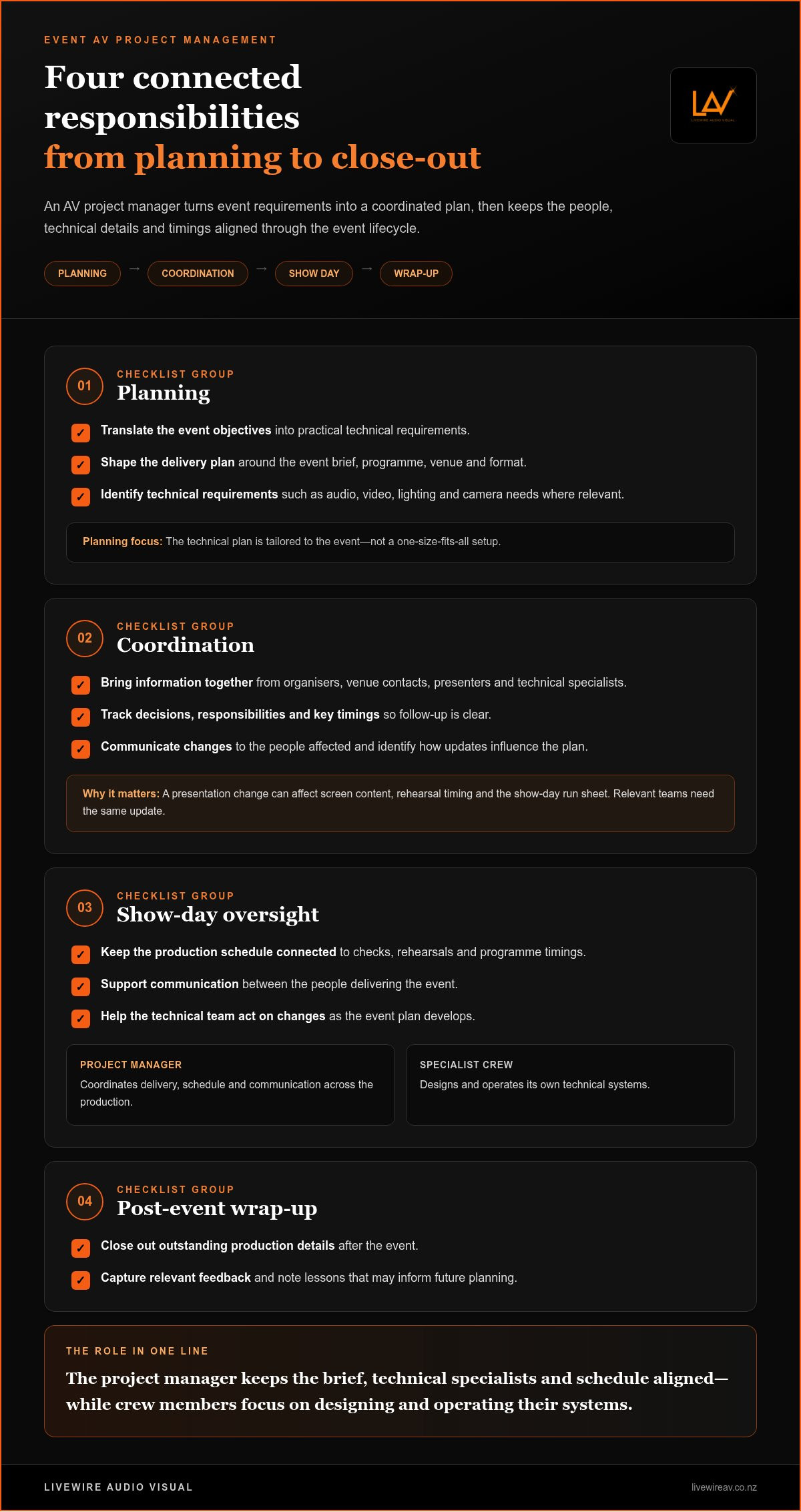
In practical terms, the role often covers four connected areas:
Planning: Turn the event objectives and programme into technical requirements, key timings and a delivery plan.
Coordination: Keep organisers, venue contacts, presenters and technical crew aligned as information or requirements change.
Show-day oversight: Coordinate the production schedule, checks, rehearsals and communication between the people delivering the event.
Post-event wrap-up: Close out outstanding production details, capture relevant feedback and note lessons that can inform future planning.
The project manager keeps technical plans, people and timings aligned, while specialist crew members design and operate their systems. That distinction is central to understanding what does an event AV project manager do: the manager oversees coordination and delivery, not every technical task personally.
How does the project manager coordinate people and requirements?
Different stakeholders hold different pieces of the plan. The organiser may confirm the programme, a venue contact may provide room information, and presenters may supply content or request changes. The project manager records decisions, assigns follow-up and shares relevant updates with the people affected. For example, if an exhibition stand’s screen content changes, the update may affect the content handover and the timing of a technical check. Keeping the team on the same version of the plan helps avoid duplicated work and missed updates.
What happens on event day?
On the day, the project manager helps keep setup, system checks, rehearsals and programme timings connected. They support communication as the schedule moves from preparation to live delivery, and help organise responses when a change needs a decision. The technical crew and operators remain responsible for running their specialist equipment and systems. The project manager focuses on the wider picture: making sure the right people know what’s happening and when.
After the event, close-out can include reviewing unresolved items, gathering production feedback and recording changes that affected the plan. This gives organisers and the technical team a clearer starting point for future events, rather than relying on memory alone.
Where an event brings together audio, video, lighting and on-site operators, full technical production connects planning with delivery through one coordinated approach. LivewireAV provides full technical production for events, with the level of oversight shaped around the event’s requirements.
How is an event AV project manager different from a technical director?
The project manager and technical director work towards the same event, but their focus is different. The project manager coordinates delivery across the brief, schedule, people and technical departments. The technical director focuses on the technical approach, including how systems are designed to work together. Technicians and operators then run their specialist equipment and systems.
That division isn’t fixed for every production. Event scale, team structure and agreed responsibilities affect where one role ends and another begins. The useful question isn’t just what does an event AV project manager do, but who owns each decision and how information moves between the people making it.
Project manager, technical director and AV technician: who does what?
Think of the roles as connected, not competing. The project manager keeps an overview of delivery and coordinates information between people. The technical director applies technical expertise to system design and integration. Technicians and operators handle their specialist systems, such as sound, screens, cameras or lighting. Broader technical director responsibilities for events sit within that production context, alongside project coordination and hands-on operation.
A project manager may flag a decision that affects timing or scope, but shouldn’t be assumed to make every technical call. The relevant specialist provides technical guidance, and the agreed team structure determines who signs off or communicates the decision. Clear boundaries keep responsibility visible without isolating each role from the others.
Can one person cover more than one event AV role?
Yes. On a smaller production or within a leaner team, one person may take on overlapping responsibilities. A technical lead might also help coordinate delivery, for example. On a larger or more complex production, separate roles can give clearer focus to planning, system design and operation. The event plan should state who owns each task, who communicates changes and who makes technical decisions. That clarity helps the whole team work from the same plan.
Full technical production brings planning, equipment and on-site technical personnel into one coordinated approach. Whatever the team structure, agreed responsibilities give organisers a clearer picture of who is coordinating delivery and who is guiding or operating each technical system.
What does the event AV project management process look like?
The process is a sequence of decisions and handovers, not a single show-day checklist. Each stage produces information the next stage needs, helping organisers see how the event brief becomes a practical production plan. The detail varies with the event format, venue conditions and agreed technical requirements. For a conference, audio visual planning for large conferences may involve different considerations from an exhibition or outdoor production.
Brief: Establish the event’s objectives, audience, programme and expectations for the technical production. This gives the team a shared starting point and highlights information still needed before planning can progress.
Planning: Turn the brief into an outline of technical requirements, equipment, people, timings and logistics. Venue information and dependencies between production elements help shape a plan that fits the event, rather than a generic equipment list.
Coordination: Share the agreed plan with relevant stakeholders and connect details across the programme and technical work. Track responsibilities, schedules and changes so updates reach the people whose preparation or work may be affected.
Delivery: Use the plan to guide setup, checks, rehearsals and show delivery. The production team works to the agreed schedule, while clear communication and handovers support an organised response if the programme or requirements change.
Close-out: Coordinate the wrap-up of production activity and capture useful feedback or lessons. This closes the loop on the event and gives future planning a clearer record of what was delivered and what may need attention next time.
How does the role develop from the event brief to setup?
At the outset, the event’s objectives, audience and programme help define what the production needs to support. The team then develops those requirements around the venue and approved plan. For example, room layout and event format can influence equipment positions and the time needed for setup and checks. The resulting production information gives crew members a practical basis for preparation, while making dependencies visible before they affect delivery.
How does an AV project manager support show delivery and close-out?
As the event approaches, rehearsals and cue coordination test the sequence against the programme. During delivery, the agreed team structure helps route questions, changes and operational issues to the right people. After the event, orderly handovers and pack-down coordination bring production activity to a close, while feedback can inform future work. The project process keeps each transition connected, from preparation to final wrap-up.
Full technical production for your event brings planning and delivery together in a coordinated production approach.
When is an event AV project manager valuable, and what comes next?
Dedicated coordination is most useful when technical elements depend on one another, several groups need to share information, or the programme may change. The benefit isn’t an extra layer for its own sake. It’s a clear way to track decisions, responsibilities and timing so updates don’t fall between teams. Project management can reduce confusion, but it can’t remove every event risk or guarantee a flawless delivery.
Which events benefit from dedicated AV project management?
Event type alone doesn’t determine how much coordination is needed. A conference may involve presenters, screen content, sound and a tightly timed programme. An exhibition or corporate gathering may bring together different spaces, stakeholders and technical needs. Sporting events and outdoor productions can also involve programme dependencies that need careful planning. The deciding factor is how many elements must work together, and how a change in one area affects the others.
For a hybrid event, the in-room experience and livestream need to be considered together. A programme adjustment may affect more than one audience or team. Hybrid conference AV production is one example of a format with additional coordination needs. By contrast, a simpler event with few technical elements and stakeholders may suit a lighter coordination structure. Match the level of oversight to the actual dependencies, not the event’s size alone.
How can organisers prepare for a production conversation?
Start with the information already available. You don’t need a perfect brief; clear priorities and known details help shape the planning conversation. Gather what you can and note what is still undecided.
Event brief: Set out the event’s purpose, audience and desired experience.
Programme: Share timings, session formats, transitions and important dependencies.
Venue information: Include available room details, layouts and relevant access or setup information.
Presentation needs: Note speaker requirements, screen content, sound needs, camera use or livestream expectations.
Known changes: Flag decisions still in progress and explain which priorities should guide the plan.
These details help the production team see how the event fits together and where requirements may affect one another. They also help you judge whether a dedicated coordination structure would be useful. If responsibilities, timings or changes are becoming difficult to track, coordinated technical production can bring those moving parts into one plan.
In practice, an event AV project manager connects requirements with people and delivery, without claiming that every uncertainty can be eliminated. LivewireAV provides full technical production, bringing planning, equipment and on-site technical personnel together for events across New Zealand. Explore LivewireAV event production for coordinated technical support.
Give your event brief a clear next step
Make the production conversation specific before plans are locked in. Identify what the audience needs to experience, which parts of the programme rely on technical support, and where a change could affect other people or timings. That gives the production team a practical basis for shaping the work around your event, rather than starting with assumptions.
Understanding what does an event AV project manager do can help you decide how much coordination your event needs. The role is most useful when someone needs to keep technical planning connected to delivery while specialists focus on their systems. It won’t remove every uncertainty, but clear priorities and shared responsibilities can help the team respond in an organised way.
LivewireAV provides full technical production for events across New Zealand, bringing AV planning, equipment and on-site technical personnel together. To discuss a coordinated technical approach for your event, explore LivewireAV event production.
Frequently Asked Questions
What is the difference between an event AV project manager and an event planner?
An event planner typically coordinates the broader event, while an AV project manager focuses on the technical production requirements. The planner may oversee the venue, catering, guest experience and programme; the AV project manager works through how technical elements support that programme. Their responsibilities can overlap in communication and scheduling, so agreeing who owns each decision helps prevent gaps, such as a session change reaching the organiser but not the production team.
Does an event AV project manager operate the sound and lighting equipment?
Usually, specialist technicians or operators run the sound and lighting systems. The project manager focuses on coordinating the production plan and communication, rather than personally mixing audio or operating lighting controls. For example, if a speaker’s presentation timing shifts, the manager can relay the change to the people responsible for the relevant cues. The system operators then carry out the technical work within their roles and the agreed show plan.
When should an event organiser bring an AV project manager into planning?
Bring one into planning while you’re shaping the programme and technical requirements, especially before key decisions become difficult to change. Early involvement gives the production team a chance to consider how session timings, venue details and presentation needs fit together. For example, if a conference includes streamed sessions, that requirement can inform planning before the agenda and room arrangements are finalised. A settled brief still helps, but early conversations can reveal dependencies sooner.
Can an event AV project manager help with a hybrid event?
Yes. Hybrid events combine an in-room programme with a remote audience, so planning needs to account for both experiences. An AV project manager can coordinate requirements across the event schedule and technical team, including how sessions, speakers and changes affect the production plan. For instance, a presenter joining remotely needs to be considered alongside in-room speakers. Technical specialists determine and operate the systems needed for the agreed format.
What information does an AV project manager need before planning begins?
An AV project manager can start with the essentials, even if some details are still being confirmed. Share the event purpose, audience, draft programme, venue information and any known presentation or production requirements. Flag priorities too, such as which sessions need camera coverage or whether participants will join remotely. Note open decisions clearly. This helps the team distinguish firm requirements from assumptions and identify what information is needed next.
Is an AV project manager needed for a small corporate event?
Not necessarily; the event’s coordination needs matter more than its size. A short presentation in one room with few technical requirements may need a straightforward plan. A smaller corporate event can still become complex if it includes several presenters, a livestream, multiple content changes or tight session transitions. Consider whether someone can keep decisions and responsibilities clear. If the organiser is juggling technical details alongside other event tasks, added coordination may be useful.
What happens if the event programme or technical requirements change?
Share the change with the people whose work it may affect, then assess it against the current production plan. If a session moves, for example, the team may need to review presentation order, content readiness and the timing of technical cues. The project manager helps coordinate that communication; specialists advise on system implications and make technical adjustments within their roles. Prompt, clear updates help the team respond in an organised way, though they can’t remove every risk.
Comments