Professional Multi-Screen Event Setups: The 2026 Technical Guide
- 11 minutes ago
- 12 min read
A multi-screen setup is not a decorative choice. It is a strategic architecture designed for information flow and attendee engagement. When you are managing a large-scale event, the distance between your message and your audience is your greatest risk. Visual dead zones in deep or wide venues don't just hinder sightlines; they dilute the impact of your brand. You likely understand the pressure of ensuring every delegate, whether in the front row or the back of the hall, has a clear view of the content. It's about more than just visibility; it's about composure and technical control.
Finding reliable breakout room AV solutions NZ wide requires a shift from simple equipment hire to comprehensive technical design. This 2026 guide provides the architecture you need to deliver seamless visual transitions and zero-failure execution. We will cover the transition from projection to modern LED walls, the logistics of complex vision switching, and the safety standards required for New Zealand venues. You'll learn how to organise a visual environment that is stable, precise, and professional. By the end of this article, you will have the roadmap to transform technical complexity into a calm, high-impact experience for every attendee.
Table of Contents
Beyond the Display: Breakout Room AV Solutions NZ
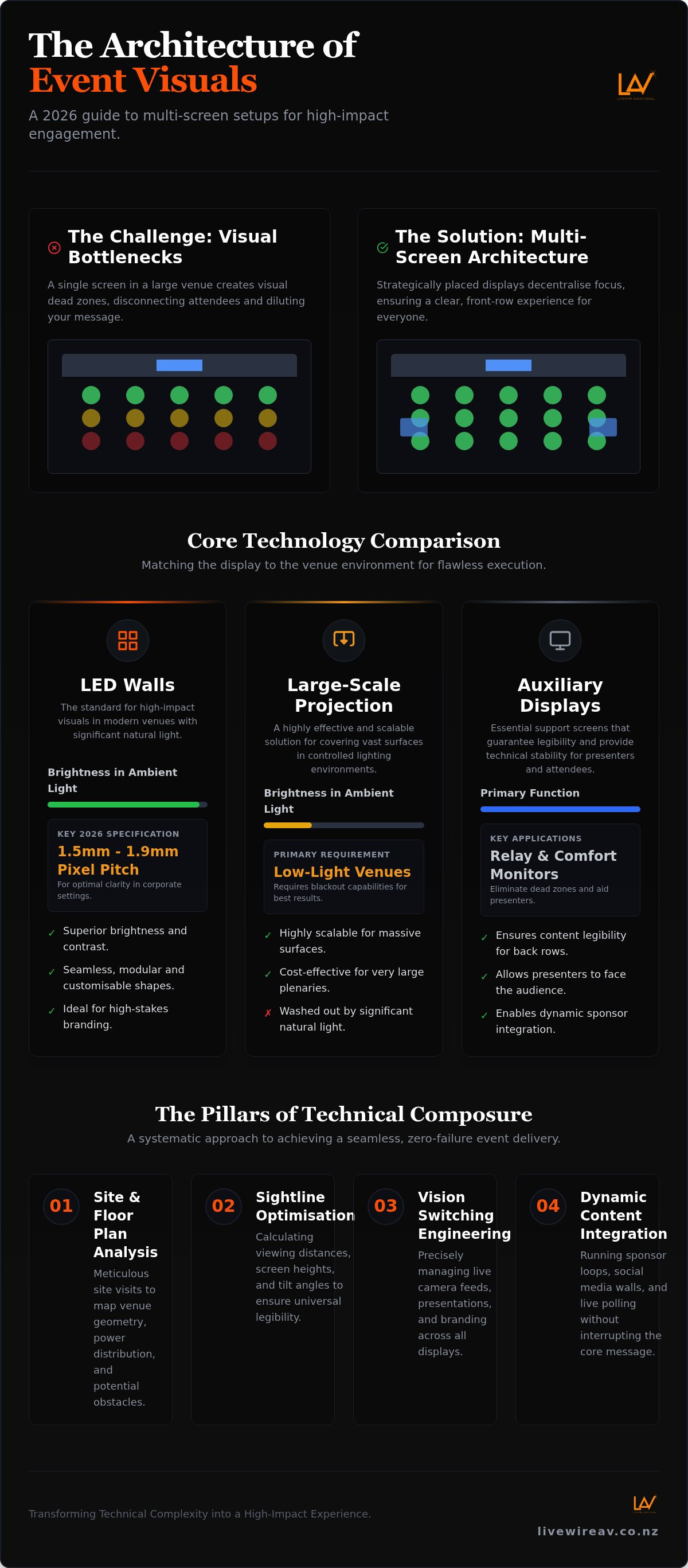
Large-scale New Zealand function centres often present a common challenge: the visual bottleneck. When a single screen is the only source of information, guests at the back of a deep room or those seated behind structural pillars lose their connection to the speaker. This disconnection leads to immediate disengagement. Professional breakout room AV solutions NZ focus on decentralising visual focus. We move away from the idea of a single focal point. Instead, we create a technical architecture that distributes content across multiple displays. This ensures the message remains accessible. It's about stability. It's about precision. It's about composure.
By eliminating visual dead zones, we remove the physical barriers to communication. A multi-screen setup isn't just about adding more hardware; it's about strategic placement that accounts for the specific geometry of the venue. Whether you're hosting a conference in a wide plenary or a deep ballroom, the goal is to provide a front-row experience for every guest. This approach alleviates the stress of seating arrangements and ensures that your brand's visual representation is consistent across every inch of the room.
Visibility and Sightline Optimisation
Visibility is a precise science. For text-heavy corporate presentations, we calculate the maximum viewing distance based on font size and screen resolution to ensure legibility. In many New Zealand venues, low ceilings or support pillars create significant visual obstacles that necessitate the use of relay screens. These secondary displays bridge the gap for attendees in the back rows. We also prioritise the ergonomics of the setup. We carefully manage screen height and tilt angles to prevent neck strain and fatigue. A well-designed layout ensures that every attendee has a clear, unobstructed view, which is the foundation of a professional event environment.
Dynamic Branding and Sponsorship Integration
Secondary screens offer a strategic advantage for sponsorship and attendee interaction. You can maintain persistent sponsor recognition on auxiliary displays while the main screen focuses entirely on the speaker's content. This prevents branding from feeling intrusive or interrupting the flow of the presentation. We use a Vision mixer to manage these distinct feeds with total technical control. This allows us to run dedicated social media walls or live-polling displays alongside primary presentation content. The result is a cohesive environment where brand messaging and technical execution work in perfect harmony to drive engagement without sacrificing the clarity of the core message.
Technical Configurations: Comparing LED Walls, Projection, and Auxiliary Displays
Choosing the right display technology requires a pragmatic assessment of the venue's environment. In New Zealand, many modern event spaces feature significant natural light. This makes traditional projection difficult without total blackout capabilities. LED walls have become the standard for high-ambient light environments because they provide superior brightness and contrast. Conversely, projection remains a highly effective, scalable solution for darkened plenaries where large-scale visual coverage is required. The key is matching the technical output to the specific lighting conditions of the room to ensure clarity and professional brand representation.
The role of auxiliary displays shouldn't be overlooked in long-format corporate events. LCD comfort monitors, often placed at the base of the stage, allow presenters to see their notes and upcoming slides without turning away from the audience. This maintains the flow of the presentation. In larger configurations, relay screens ensure that delegates at the back of the room receive the same high-resolution experience as those in the front row. This tiered approach to visual architecture provides the stability needed for high-stakes environments.
LED Wall Technology for High-Impact Visuals
For 2026, pixel pitch standards have tightened. For corporate environments where the audience is often within three to five metres of the screen, a pixel pitch of 1.5mm to 1.9mm is now the baseline for clarity. These modular systems allow for custom shapes and seamless branding beyond the standard 16:9 ratio. Reliability is maintained through professional calibration. This ensures that every panel in the wall displays identical colour temperatures and brightness levels. If you're looking for full technical production that prioritises this level of detail, LED technology offers the most stable platform for modern branding.
Strategic Projection Mapping and Relay Screens
Projection still holds a vital place in the mix of breakout room AV solutions NZ. It's particularly useful for creating wide-format backdrops or secondary atmospheric surfaces that enhance the room's energy. In tight breakout spaces, rear-projection is often the preferred choice. It hides the hardware behind the screen to save floor space and prevent shadows from presenters. For massive venues, we deploy relay screens to ensure information parity. These screens receive the same feed as the main display but are positioned strategically down the hall. This ensures that technical execution remains flawless and that the attendee experience is uniform across the entire floor plan.
The Engineering of Vision Switching: Managing Complex Signal Paths
The vision switcher acts as the central brain of any professional multi-screen architecture. It's the point where technical preparation meets live execution. When designing complex breakout room AV solutions NZ venues require, the signal path is the most critical variable. High-stakes environments leave no room for ambiguity. A central switcher allows a technician to manage multiple inputs, including live camera feeds, PowerPoint presentations, and high-resolution video playback, from a single control point. This ensures that the transition between a keynote speaker and a promotional video is instantaneous and clean.
Technical composure is maintained through this centralised control. Our professional technicians don't just push buttons; they manage the flow of information to ensure brand consistency. They anticipate the needs of the presenter and the audience. Precise. Reassuring. Stable. This methodical approach ensures that even as the complexity of the event grows, the visual output remains steady. By managing all feeds through a dedicated hardware switcher rather than software-based alternatives, we provide the hardware-level reliability that corporate clients expect.
Managing Multiple Feeds and Layers
Modern event design often requires more than just a full-screen slide. We use Picture-in-Picture (PiP) to layer content, such as displaying a live camera feed of the presenter alongside their presentation deck. This is essential for both in-room engagement and hybrid guests who need to see facial expressions and body language. Synchronising these feeds across disparate screen types, from large LED walls to smaller LCD relay monitors, requires careful resolution management. For large-scale New Zealand events, Image Magnification (IMAG) is often necessary to ensure that those at the back of the room have a clear view of the speaker's nuances, maintaining a sense of intimacy in a large space.
Signal Architecture and Redundancy
Reliability is built into the signal architecture. We choose between SDI, HDMI, and fibre optic distribution based on the physical requirements of the venue. SDI is our standard for long cable runs due to its locking connectors and signal stability. For massive distances where traditional copper cables lose integrity, we deploy fibre optic solutions. We implement fail-safe protocols by running redundant signal paths and maintaining backup playback sources. Signal latency is the delay between a live action and its display on screen, which must be minimised for effective IMAG. By prioritising low-latency hardware and redundant paths, we eliminate the risk of blackouts or technical stutters during critical keynote moments.
Planning Your Visual Architecture: Sightlines, Resolution, and Venue Logistics
Effective visual architecture is built on meticulous preparation. It begins long before the gear arrives at the loading dock. We conduct technical site visits to map the venue's physical and electrical limitations. This proactive approach ensures that every breakout room AV solutions NZ deployment is grounded in reality. We analyse floor plans to determine the most effective screen placements, ensuring that sightlines are clear and that no attendee is left in a visual dead zone. The stability of your event depends on this initial technical alignment.
Rigging and weight loads are critical considerations in professional spaces. We assess the structural integrity of the venue to determine where and how screens can be safely suspended. This is not just a matter of aesthetics; it is a fundamental safety requirement. Cable management is equally vital to the professional look and safety of the event. We plan cable runs to avoid interference with other signals and to eliminate trip hazards in high-traffic areas, ensuring a tidy and secure environment for all guests.
Technical Site Visits and Venue Analysis
Power requirements are a primary focus during our venue assessments. Large LED wall deployments draw significant current. We map out the venue's electrical distribution to avoid circuit overloads that could lead to mid-event failures. We also identify structural rigging points and ceiling height constraints. These factors dictate the maximum possible screen size and the safest method of installation. By understanding these constraints early, we eliminate the stress of last-minute technical adjustments during the bump-in phase.
Resolution and Content Management
Content must be designed for the specific displays being used. Modern multi-screen setups often involve non-standard aspect ratios that go beyond the typical 16:9 format. We coordinate directly with your content creators or creative agency to ensure that all graphics and videos are rendered at the correct resolution. This prevents stretching or pixelation that can undermine your brand's authority. We perform resolution testing on-site to verify text legibility across the entire network. This collaborative workflow ensures that the technical execution matches the creative vision perfectly. For events that require this level of meticulous planning, you can contact LivewireAV for full technical production.
Achieving Technical Composure with LivewireAV’s Production Management
Precision. Reliability. Composure. These are the standards LivewireAV brings to every production. Managing complex multi-screen setups requires more than just high-end hardware; it demands a disciplined approach to technical management. We provide the steady hand required for high-stakes New Zealand events, ensuring that every signal path is verified and every transition is seamless. Our team prioritises reliability over flashiness, focusing on a methodical workflow that eliminates the stress of live technical execution. This allows your work to take centre stage while we maintain total technical control behind the scenes.
Our professional technicians act as the quiet experts in the room. They possess the deep technical knowledge required to handle complexity without being intrusive. From initial design and technical site visits to on-site execution, we manage the entire production lifecycle. This end-to-end management ensures that the visual architecture is grounded in the physical realities of the venue. New Zealand event organisers trust us because we treat excellence as a standard requirement rather than an occasional achievement. We thrive under pressure, valuing clear, honest communication and meticulous preparation above all else.
Bespoke Solutions for Every Venue
We don't provide generic, off-the-shelf equipment lists. Every event has unique requirements that demand a tailored approach. We customise our breakout room AV solutions NZ to match the specific dimensions, lighting conditions, and acoustic properties of your venue. By integrating Intelligent Lighting Design and Audio Line Array Systems with our visual architecture, we deliver a holistic production. This integrated approach ensures that the audio, lighting, and vision work in perfect harmony. Planned. Verified. Executed. This meticulousness provides the peace of mind that every detail has been accounted for long before the first guest arrives.
Next Steps for Your Multi-Screen Event
The technical planning process for your next New Zealand production should begin with a clear assessment of your visual goals and venue constraints. We recommend starting with a technical site visit to map out power requirements and rigging points. Once these logistics are clear, we can provide a tailored proposal based on your specific audience size and content requirements. This disciplined approach ensures your event is supported by a stable, modern technical foundation. For more information on managing high-capacity productions, you can explore our resource on Audio Visual for Large Conferences.
Mastering Technical Precision for Your Next Event
Successful events depend on the invisible architecture of technical production. We've explored how strategic multi-screen placement and vision switching engineering transform a venue into a cohesive environment. It's about moving beyond simple displays to a system that prioritises attendee sightlines and signal stability. Meticulous site visits and rigorous resolution testing are the foundations of this approach. When you're implementing professional breakout room AV solutions NZ wide, the difference lies in the details of signal redundancy and venue-aware design.
For over 10 years, LivewireAV has provided the technical composure required for high-stakes New Zealand productions. Our experienced on-site operators use state-of-the-art vision switching and LED gear to ensure your brand is represented with total precision. We handle the complexity so you can focus on the message. Excellence. Stability. Control. These are the standards we bring to every project. You can contact LivewireAV for a tailored multi-screen production proposal to begin the planning process. Professional execution isn't an occasional achievement; it's a standard requirement. We look forward to helping you deliver a flawless visual experience for your attendees.
Frequently Asked Questions
What is the best display for a multi-screen event setup?
The best display for a multi-screen setup depends on the ambient light and venue dimensions. LED walls are the standard for high-brightness environments where clarity and contrast are essential. In darkened plenaries, large-scale projection offers cost-effective coverage for wide surfaces. We assess each space during a technical site visit to determine the most stable solution. This ensures your brand representation is consistent and professional across all surfaces, regardless of the room's specific lighting challenges.
How many screens do I need for an event with 500 attendees?
For an event with 500 attendees, a minimum of two large primary screens is standard to ensure visibility from the sides. However, the venue's depth often necessitates additional relay screens positioned halfway down the room. These secondary displays ensure that delegates in the back rows have the same front-row experience as those at the front. We analyse floor plans to identify visual dead zones and calculate the exact number of screens required to provide total coverage.
Can I show different content on each screen simultaneously?
Yes, you can display different content on each screen simultaneously by using a professional hardware vision switcher. This allows for complex layering, such as showing a speaker on one screen and presentation slides on another. It is a vital feature of modern breakout room AV solutions NZ organisers use to drive engagement. Our technicians manage these distinct feeds with total technical control, ensuring seamless transitions between live cameras, video playback, and social media walls.
What is vision switching and why is it necessary for my event?
Vision switching is the process of managing and directing multiple video sources to various displays through a central hardware brain. It is necessary for clean transitions between presenters, videos, and live camera feeds. Without a switcher, your visual output is limited to a single source at a time. Professional switching provides the composure and reliability needed for high-stakes environments, ensuring that your content flows logically and without technical stutters or blackouts during the production.
How do I ensure everyone in the venue has a clear sightline?
Clear sightlines are achieved through meticulous planning and venue analysis. We conduct site visits to identify obstacles like support pillars or low ceilings that might block views. Optimal screen height and angle are calculated to prevent neck strain for guests. When a venue is particularly deep or wide, we deploy relay screens to bridge the gap. This strategic architecture ensures that every attendee has an unobstructed view of the content, maintaining a high level of engagement.
What technical requirements are needed for live camera feeds (IMAG)?
Live camera feeds, or Image Magnification (IMAG), require a professional camera package and a high-performance vision switcher. Low-latency signal paths are essential to ensure the action on screen matches the live speaker perfectly. We use SDI or fibre optic cabling for stability over long distances. Our technicians manage these feeds to provide a clear, intimate view of the presenter, which is especially important for maintaining attendee connection in large-scale New Zealand function centres.
How far in advance should I plan the visual setup for a large event?
You should begin technical planning at least three to six months in advance for large-scale productions. This lead time allows for thorough site visits, equipment allocation, and coordination with creative agencies. Meticulous preparation is the foundation of a zero-failure event. Early engagement ensures that we can account for venue-specific constraints and power requirements long before the first guest arrives. It provides the stability required for complex breakout room AV solutions NZ deployments.
Is an LED wall better than projection for a multi-screen setup?
LED walls are generally superior for high-impact visuals due to their superior brightness and contrast. They do not suffer from the faded look that projection can face in rooms with natural light or high ambient brightness. However, projection remains a valid, cost-effective choice for massive surfaces in controlled, dark environments. We evaluate the specific light levels and budget of your event to recommend the technology that provides the most reliable and professional result for your brand.


Comments