Exhibition Stand Lighting Design NZ: The 2026 Technical Execution Guide
- 2 days ago
- 11 min read
The most sophisticated exhibition stand is only as effective as the technical discipline behind its illumination. Mastering exhibition stand lighting design NZ in 2026 requires a shift from simple brightness to a meticulous, zero-failure strategy that aligns with New Zealand's updated safety standards and the latest digital trends. Precision. Composure. Reliability. These are the benchmarks of a successful activation in a high-stakes environment where there is no room for technical ambiguity.
We understand the pressure you face when integrating large-scale LED walls with complex lighting rigs, especially when consistent branding is a priority across different venues. It's a challenge that demands a steady hand and deep technical knowledge. This guide provides a comprehensive technical execution roadmap to ensure your next show is immersive, compliant, and flawlessly delivered. You'll learn how to navigate the transition to DALI-2 control systems, implement human-centric lighting strategies, and manage the delicate balance between digital content and physical light to attract maximum foot traffic.
Table of Contents
The Strategic Value of Exhibition Stand Lighting Design NZ in 2026
In the high-stakes environment of a national trade show, lighting serves as more than a utility. It's a strategic asset. By 2026, the industry has moved beyond simple illumination toward immersive sensory experiences that define a brand's physical presence. Effective exhibition stand lighting design NZ acts as a silent narrator. It dictates where a visitor looks, how they move through the space, and how long they choose to stay. Precision. Composure. Reliability.
This approach relies on the fundamental principles of stage lighting to create depth and focus. When executed with meticulous detail, light doesn't just show a product; it tells a story. It highlights the quality of your offering and provides the technical stability required for premium event production New Zealand. By treating lighting as a core branding element rather than an afterthought, you ensure your stand remains a focal point in a crowded exhibition hall.
From Basic Visibility to Immersive Atmosphere
The shift from static floodlighting to dynamic, intelligent environments is now a standard requirement for high-tier exhibitors. Standard lighting often creates a flat, uninviting space that fails to hold attention. In contrast, intelligent exhibition stand lighting design NZ allows for subtle shifts in intensity and temperature that influence visitor psychology. Research into dwell time suggests that warmer, focused pools of light encourage longer interactions compared to the harsh glare of venue-wide overheads. We focus on creating a cohesive visual experience. This ensures your corporate identity is felt through the atmosphere, not just seen on a banner.
Ensuring Brand Consistency Across Every Venue
Maintaining brand integrity across multiple New Zealand venues is a common pain point for event organisers. A corporate blue that looks perfect in one convention centre can appear washed out or greenish in another due to varying ambient light levels. Technical precision is the only solution. We utilise intelligent fixtures to match corporate colour palettes exactly, regardless of the venue's existing conditions. This level of control eliminates the risk of branding "drift" between different shows.
A unified design is particularly critical for national roadshows. It ensures your message remains stable and your brand remains recognisable. By using light to highlight specific messaging zones and product reveals, we create a clear hierarchy of information. This guides the visitor's journey with purpose. It's about total technical control. Every fixture is programmed to support the brand, ensuring a seamless transition from the digital content on your screens to the physical environment of your stand.
Technical Infrastructure for High-Impact Trade Shows
The hardware rig for 2026 is defined by high-output efficiency and meticulous safety. Professional exhibition stand lighting design NZ requires a foundation of compliant hardware that performs under pressure. Stability. Safety. Performance. As of 2026, high-output LED technology has completely replaced traditional discharge lamps across the industry. This shift isn't just about sustainability; it's about total technical control. Modern 200-watt LED fixtures consume 56% less electricity than older 400-watt models while providing superior colour rendering and thermal management. This allows for more complex rigs without overloading venue power limits or creating excessive heat on the stand.
A professional exhibition rig typically includes:
High-output LED moving heads for precise product highlighting.
Compact LED wash fixtures for uniform ambient coverage.
DALI-2 compliant control interfaces for seamless integration.
Integrated safety cabling and secondary suspension points for every fixture.
Intelligent Fixtures and Moving Heads
Integrating spots, washes, and beams into a single cohesive rig provides the flexibility needed for multi-day events. These fixtures allow for automated cues that change based on the time of day or specific stand activations. By applying the Key Principles of Effective Illumination, we use moving heads to create task-based layers that highlight products without cluttering the stand with floor-based equipment. This reduces the physical footprint of the rig. It keeps the floor clear for visitor flow. It ensures the technology remains invisible while the outcome remains striking. For those planning high-stakes activations, choosing a partner with intelligent lighting design expertise ensures that every structural detail is accounted for long before the doors open.
Rigging Safety and Structural Integrity
Safety is the non-negotiable baseline of any design. In 2026, compliance with the updated Electricity (Safety) Regulations 2010 is mandatory for all new installations, including those work-staged after the November 13, 2026 deadline. This includes rigorous adherence to weight load limits and trussing protocols. Every overhead installation must be managed by certified technicians who understand the specific structural constraints of New Zealand's major event venues. We prioritise safety cabling and secondary fail-safes for every fixture. This level of technical discipline ensures zero-failure execution from the moment the rig is raised. While international standards like IEC 63494-1 guide energy performance, local AS/NZS standards dictate the structural requirements that keep your team and your visitors safe.
Integrating Lighting with LED Walls and Digital Content
The integration of high-resolution digital vision and physical light is where many exhibition stands falter. High-intensity LED walls produce significant ambient light that can easily wash out your primary stand lighting if not managed with technical discipline. Achieving a professional balance requires strict adherence to Illuminating Engineering Society (IES) standards regarding contrast ratios and task illuminance. When you invest in conference LED screen hire NZ, the objective is to create a seamless visual field where the screen and the stand lighting complement rather than compete. Balance. Contrast. Clarity. This unified approach ensures your brand message remains the focal point without being overwhelmed by digital glare.
Lighting for the Lens: Broadcast Standards
In 2026, every high-stakes exhibition stand functions as a temporary broadcast studio. If you are managing a hybrid conference AV setup NZ, your exhibition stand lighting design NZ must be camera-safe. We adjust colour temperatures, measured in Kelvin, to align precisely with the sensors of high-definition cameras used for livestreams and social media captures. This meticulous calibration prevents the flickering or "banding" effects that occur when lighting frequencies and screen refresh rates are out of sync. We provide sufficient front-fill to ensure presenters look natural while maintaining the deep black levels and high contrast necessary for the LED wall to pop. It's a delicate technical equilibrium that requires a seasoned hand at the console.
Synchronised Multi-Sensory Cues
The most effective stands in 2026 utilise time-coded cues to create a unified narrative. This means your lighting, audio, and video triggers are programmed to fire simultaneously for maximum impact. During complex multi-camera vision switching, the lighting acts as a guide, subtly shifting the audience's eye to the most relevant product or presenter. A single technical director oversees this entire ecosystem. This oversight eliminates the friction often found between separate lighting and vision departments. By consolidating these roles under a unified technical team, we ensure zero-failure delivery. Every reveal is crisp. Every transition is smooth. Every technical detail is accounted for long before the show floor opens to the public.
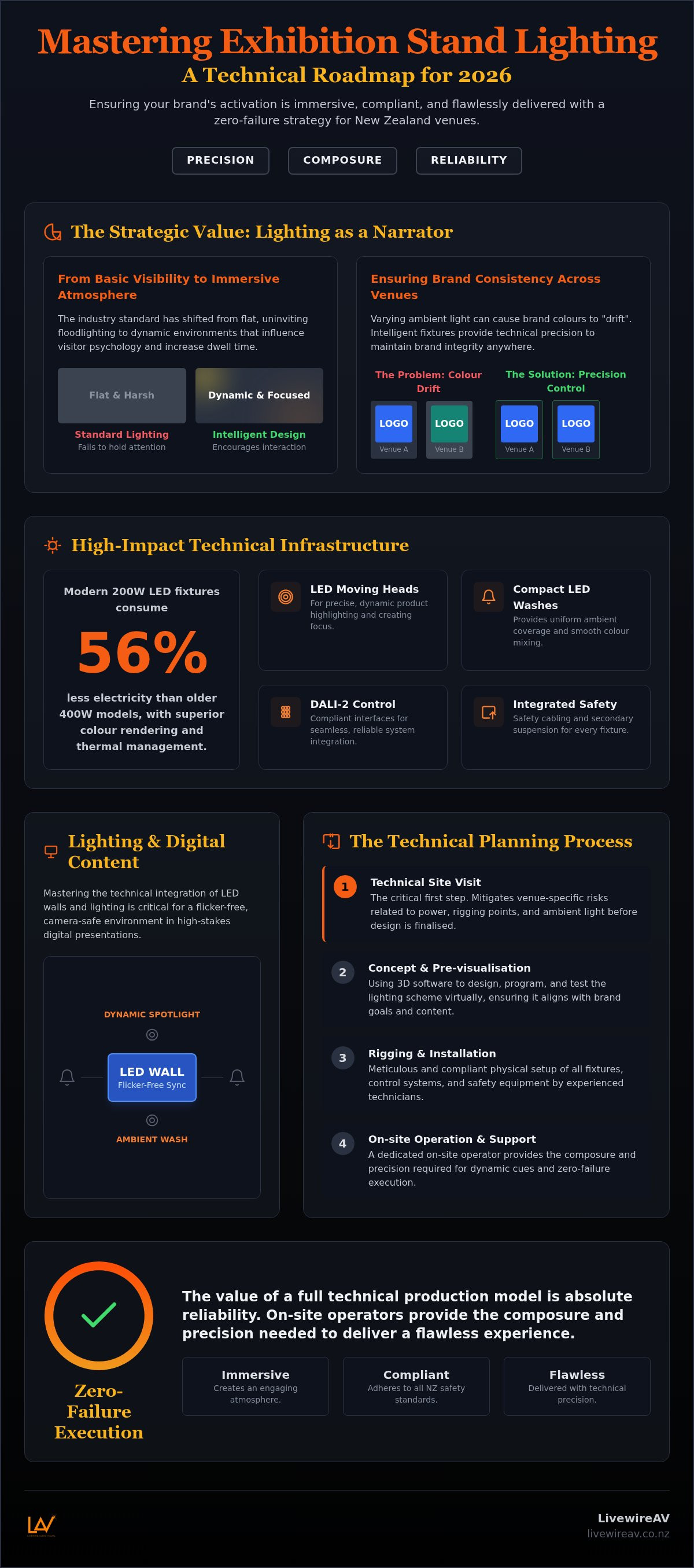
The Technical Planning Process: From Concept to Rigging
A disciplined technical planning process is the only way to ensure zero-failure execution. In high-stakes environments, hope is not a strategy. We replace uncertainty with a methodical five-step framework that transforms a creative concept into a functional, compliant reality. For most major New Zealand events, we recommend engaging a specialist 8 to 12 weeks before the doors open. This lead time allows for thorough brief development, concept design, and meticulous documentation. Preparation. Precision. Composure.
The process follows a logical flow:
Step 1: Define the core narrative and brand objectives to ensure the light supports the story.
Step 2: Conduct technical site visits to identify venue-specific constraints and power limits.
Step 3: Create detailed 3D lighting plots and CAD drawings for stakeholder approval.
Step 4: Develop a comprehensive cue sheet that synchronises with the overall event run-sheet.
Step 5: Execute on-site rigging, focusing, and rehearsals to ensure every transition is sharp.
The Importance of Technical Site Visits
Conducting an early site visit is a critical step in exhibition stand lighting design NZ. Every venue has unique characteristics, from the height of the ceiling to the specific location of rigging points and power distribution boards. By identifying these variables early, we prevent costly on-day equipment additions or last-minute changes. We collaborate directly with venue managers to organise logistics well in advance. This proactive approach ensures that when the technical team arrives, every structural and electrical detail is already accounted for. It's about total technical control.
Pre-Visualisation: Seeing the Stand Before the Rig
We use advanced 3D software to create high-fidelity pre-visualisations of your stand. This allows stakeholders to see exactly how the light interacts with physical surfaces and digital screens before any equipment leaves the warehouse. During this phase, we adjust the design based on the audio visual for large conferences requirements, ensuring the lighting rig doesn't obstruct sightlines or interfere with projection paths. Finalising the equipment list in a digital environment leads to more efficient transport and setup. If you are ready to begin the planning phase for your next activation, our team is ready to provide intelligent lighting design solutions that guarantee a stress-free experience.
Zero-Failure Execution with a Professional Technical Partner
High-end hardware provides the potential for success, but the presence of an on-site technician provides the guarantee. In the high-pressure environment of a major trade show, exhibition stand lighting design NZ relies on the quiet confidence of experts who handle complexity without visible effort. We believe that professional equipment is only half the battle. The true value lies in the technical discipline of a team that remains composed when the stakes are highest. By choosing a full technical production model, you transfer the burden of technical management to a partner who understands the intricacies of the venue and the technology. Stability. Precision. Composure.
Adopting a single-source provider for audio, video, and lighting creates a more cohesive environment. It eliminates the communication gaps that occur when multiple vendors attempt to share limited power and rigging resources. This unified approach ensures that your lighting cues are perfectly synchronised with your digital content, as discussed in our previous analysis of LED wall integration. When one team oversees the entire technical ecosystem, the risk of technical friction disappears. We focus on meticulous preparation so that excellence is a standard requirement rather than an occasional achievement. This is how we ensure a zero-failure environment for the most prestigious exhibitions in the country.
The Calm Professional Advantage
Composure is a technical requirement in our line of work. A professional technical team alleviates organiser anxiety by projecting total control over the environment. We provide dedicated operators for every technical discipline on your stand. This means that if a last-minute adjustment is needed for a product reveal or a guest speaker, the response is immediate and invisible to your audience. We build redundancy into every design as a standard practice. Whether it is backup control consoles or secondary power paths, we account for every variable long before the first guest arrives. Real-time problem solving is not about luck; it is about the deep technical knowledge required to handle complexity under pressure.
National Consistency for Exhibition Roadshows
Maintaining brand integrity across a national exhibition series requires a partner who can provide the same high standard of lighting design at any venue nationwide. We streamline the logistics for multi-city conference and exhibition series by maintaining a unified design intent. You don't have to re-explain your corporate colour palettes or technical requirements at every new location. We manage the transition between venues with the same level of meticulousness that we apply to the initial rig. This consistency ensures your brand remains stable and your message remains clear throughout the entire tour. To ensure your next high-stakes activation is flawlessly delivered, partner with LivewireAV for your next high-stakes event lighting design.
Securing Flawless Technical Execution for Your Next Activation
Effective exhibition stand lighting design NZ in 2026 is defined by the seamless integration of physical light and digital vision. We have explored how a disciplined technical planning process, from early site visits to 3D pre-visualisation, eliminates the risk of on-day failures. Success requires more than just high-output hardware; it demands the composure of a unified technical team capable of managing complex DALI-2 systems and camera-safe broadcast standards. Precision. Composure. Reliability.
By prioritising technical discipline over simple visibility, you ensure your brand remains the focal point of the show floor. With over 10 years of technical production expertise and a team of expert on-site operators, we provide the stability required for high-stakes environments across New Zealand. Our focus remains on meticulous preparation and clear communication to deliver a stress-free experience from the first rig to the final pack-out. Contact LivewireAV for a tailored exhibition lighting proposal and secure a zero-failure environment for your next high-stakes show.
Frequently Asked Questions
What is the difference between basic stand lighting and professional lighting design?
Basic lighting focuses on general visibility using standard floodlights. Professional exhibition stand lighting design NZ uses light as a strategic narrative tool. It layers ambient, task, and accent lighting to guide visitor focus toward specific products. This approach creates depth and mood, transforming a flat booth into an immersive environment. It's about technical precision rather than just brightness, ensuring your brand stands out in a crowded hall with total composure and technical control.
Why do I need a professional lighting designer for an exhibition stand?
A professional designer manages the complex intersection of aesthetics, safety, and venue logistics. They ensure every fixture is positioned to eliminate glare and shadows while maintaining brand integrity across different New Zealand venues. Designers also handle the technical documentation required for venue approval. This expertise prevents costly on-day errors and ensures the rig is both visually striking and structurally compliant, allowing you to focus on your visitors with the quiet confidence of an expert.
How does lighting affect the quality of my exhibition livestream or recording?
Professional lighting ensures your stand is camera-ready for high-definition sensors. We calibrate colour temperatures to prevent the blue or orange tints common in amateur setups. We also use high-frequency dimming to eliminate flickering on screen. By balancing front-fill for presenters with the contrast levels of your LED walls, we maintain visual clarity for hybrid events. This meticulous calibration ensures your digital content and physical stand look consistent for both on-site and remote audiences.
What are the safety requirements for rigging lighting at New Zealand venues?
Rigging in New Zealand must comply with strict AS/NZS safety standards and the updated Electricity (Safety) Regulations. Every overhead installation requires certified technicians to manage weight loads and secure secondary safety cabling. Venues often require detailed rigging plots and load calculations before approval. Our team ensures all equipment is tested and tagged, and every trussing protocol is followed precisely. This commitment to safety provides a zero-failure foundation for your entire exhibition presence.
Can lighting design help with brand alignment and corporate identity?
Yes, lighting is a primary tool for maintaining corporate identity. We use intelligent fixtures to match your specific brand colours exactly, regardless of the venue's ambient light. By highlighting key messaging zones and product reveals, we create a visual hierarchy that reflects your brand's narrative. This level of exhibition stand lighting design NZ ensures that your corporate palette remains stable and recognisable across a national tour, reinforcing brand authority through consistent and meticulous technical execution.
What is intelligent lighting, and is it necessary for my trade show booth?
Intelligent lighting refers to automated fixtures, such as moving heads, that offer remote control over colour, direction, and intensity. While not strictly mandatory for every booth, it is necessary for high-impact stands requiring dynamic show modes or precise product highlighting. These fixtures allow for programmable cues that change throughout the day, creating a versatile environment without the need for a large physical rig. It offers the flexibility and stability needed for sophisticated, modern activations.
How far in advance should I start planning the lighting for my exhibition?
For a high-stakes exhibition stand, we recommend starting the technical planning process 8 to 12 weeks before the event. This lead time allows for detailed site visits, 3D pre-visualisations, and coordination with venue managers. Early planning ensures that rigging points and power requirements are secured before they are exhausted by other exhibitors. It also provides sufficient time to refine the cue sheets and synchronise all digital content for a flawless and stress-free technical execution.
Does LivewireAV provide on-site technicians to manage the lighting during the show?
LivewireAV provides full technical management, which includes expert on-site technicians and dedicated operators for every show. We don't just rig the equipment; we manage the consoles and monitor the systems throughout the event hours. This approach ensures immediate response to any real-time requirements or last-minute schedule changes. Our technicians act as the steady hand behind the scenes, allowing you to host your visitors with total composure and the confidence that every technical detail is handled.


Comments