Outdoor LED Screen Hire NZ: The 2026 Guide to High-Impact Event Visuals
- 2 days ago
- 12 min read
An outdoor event in New Zealand is a direct negotiation with the elements. Precise. Resilient. Visible. While many organisers focus on the scale of the display, the real challenge lies in the technical engineering required to withstand a sudden downpour or the harsh midday glare of a local summer. You shouldn't have to spend your event checking the weather radar or worrying about screen visibility ruining the experience for your attendees.
Securing the right outdoor LED screen hire NZ involves more than just booking hardware. It requires a deep understanding of IP65 weatherproofing, high-nit brightness levels, and structural stability. This 2026 guide simplifies the complexity of high-impact visuals. We'll examine the critical specifications for daytime clarity, the logistics of site-specific installation, and how professional technical management ensures your content remains the focus, not the equipment. You'll gain the clarity needed to deliver a flawless visual experience that remains steady under pressure.
Table of Contents
The Impact of Large-Scale Outdoor LED Screens for New Zealand Events
Outdoor LED screens are not merely large televisions; they are sophisticated modular systems designed to deliver clarity under the most demanding conditions. Unlike traditional projection, which washes out under even moderate ambient light, LED display technology uses light-emitting diodes to generate its own illumination. This self-emissive property makes it the only viable option for daytime events. Whether configured as a massive scoreboard for a stadium or a backdrop for a corporate gala, the modular nature of these screens allows for custom dimensions tailored to the specific venue.
Professional outdoor LED screen hire NZ prioritises reliability. It's about more than just the panels; it's about the technical production framework that supports them. A successful display requires a stable power supply, robust structural rigging, and a precise signal chain. Stable. Robust. Precise. Without this foundation, even the highest-resolution screen is prone to failure.
Why Outdoor Environments Demand Specialist Hardware
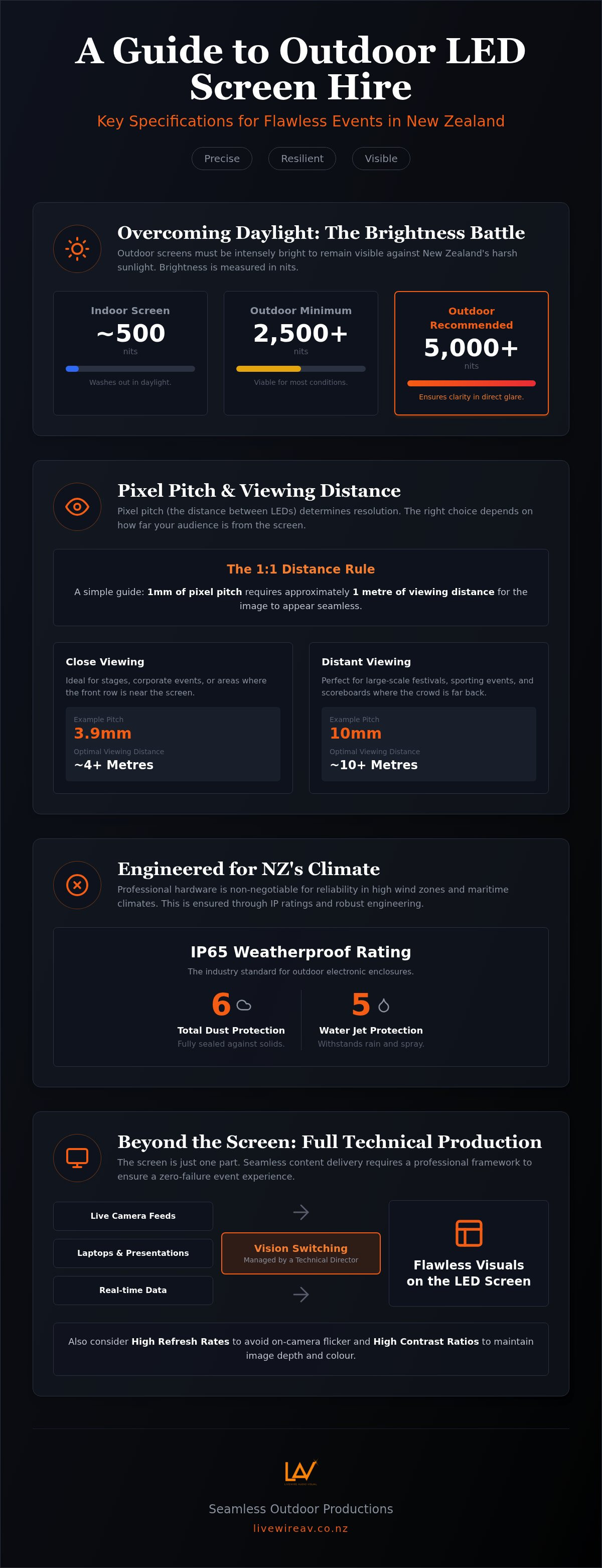
Direct sunlight in New Zealand is notoriously intense. To remain visible, an outdoor screen must produce a minimum of 2500 nits, though 5000 nits is often required for true clarity in high-glare environments. Indoor panels simply cannot compete; they lack the brightness and the ruggedised pixel protection needed to survive the exposure. When planning outdoor LED screen hire NZ, the distinction between consumer-grade and tour-grade hardware becomes clear through its performance in the field.
Low-end setups often fail due to thermal issues or poor signal processing. High-quality outdoor hardware is built with advanced cooling systems and weather-sealed components. These features prevent the common pitfalls of DIY attempts, such as overheating, flickering, or complete signal loss during a critical moment. Reliable equipment ensures the technology remains invisible so the message can lead.
The Shift from Standalone Screens to Integrated Visuals
A screen is a canvas, but the content delivery system is the engine. Modern events demand more than just a static loop; they require live camera feeds, real-time data, and seamless transitions. Achieving this level of sophistication requires premium event production New Zealand organisers can trust for high-stakes environments.
The technical director manages the complexity of vision switching to ensure that every feed arrives on screen at the correct moment. This integrated approach transforms a standalone screen into a cohesive part of the event aesthetic. By coordinating multiple visual sources, we ensure that the technical execution is flawless, allowing the client's work to take centre stage without distraction.
Navigating Technical Specifications: Pixel Pitch and Brightness
Pixel pitch is the distance, measured in millimetres, between the centres of two adjacent LED pixels. This measurement determines the resolution and the minimum viewing distance of the display. For outdoor LED screen hire NZ, selecting the correct pitch is a balance of visual clarity and logistical efficiency. While a smaller pitch offers higher resolution, it isn't always the superior choice for massive outdoor environments where the audience is positioned dozens of metres away.
Beyond resolution, refresh rates are a critical consideration for any event intended for broadcast or social media. Low refresh rates cause flickering on camera, which ruins the quality of a livestream or recorded recap. We prioritise high-refresh-rate panels to ensure that the image remains stable and flicker-free. High-contrast ratios also play a vital role, as they maintain image depth and prevent colours from appearing washed out when competing with ambient light. Adhering to digital signage best practices ensures that these technical elements remain secure and operationally sound throughout your event.
Choosing the Right Pixel Pitch for Your Audience
The "Distance Rule" is a pragmatic framework: for every 1mm of pixel pitch, you require approximately one metre of viewing distance for the image to appear seamless. A 3.9mm screen is ideal for stages where the front row is close, whereas a 10mm pitch is perfectly adequate for large-scale festivals where the crowd is further back. Choosing a 3.9mm pitch for a distant scoreboard adds unnecessary weight and power requirements without providing a perceptible benefit to the viewer. Clear. Purposeful. Efficient. If you are unsure which specification fits your venue, our team can help you evaluate your technical requirements for a tailored solution.
Understanding Nits: Competing with the Southern Sun
Luminance is measured in "nits", and for outdoor visibility in direct sunlight, this is the critical metric. While indoor screens often operate at 1,000 nits, the standard for outdoor hire is at least 5,000 nits to overcome the intensity of the New Zealand sun. This ensures your content remains legible even during the brightest part of the afternoon. Nits are the critical metric for outdoor visibility in direct sunlight.
Modern systems also utilise auto-dimming sensors. These sensors detect changes in ambient light, automatically adjusting the screen's output as the sun sets. This prevents the display from becoming blindingly bright as the evening progresses, protecting the audience's experience and ensuring the screen remains a professional backdrop rather than a distraction. This level of technical control is what separates a standard rental from a managed production.
Weatherproofing and Structural Integrity in the New Zealand Climate
New Zealand’s maritime climate presents a unique set of challenges for any external display. High wind zones, salt-heavy air, and sudden squalls are standard variables that must be managed through precise engineering. When engaging in outdoor LED screen hire NZ, the structural integrity of the build is as important as the visual output. A screen that fails during a coastal gale or a heavy downpour is a liability. We mitigate these risks through rigorous adherence to audiovisual industry standards, ensuring every installation is built to withstand local conditions.
IP Ratings and Moisture Protection
IP65 ratings are the non-negotiable benchmark for outdoor equipment. This rating ensures the internal electronics are dust-tight and protected against low-pressure water jets from any direction. It's not just the panels that require this protection; the entire signal chain, including power distribution and cabling, must be ruggedised. This level of preparation is why we prioritise outdoor event production NZ standards for every project we undertake. Reliable. Sealed. Durable. These standards prevent the humidity-related failures that often plague inferior hardware in coastal environments.
Wind Loading and Structural Safety
Safe. Stable. Certified. Structural safety is the most critical logistical concern for large-scale displays. An LED wall acts as a massive sail, catching wind and exerting significant force on the support structure. Whether ground-stacked on a stage or flown from a truss, these systems require massive ballast and professional engineering sign-offs. We don't guess when it comes to safety; we use calculated weight distributions to ensure the screen remains stationary even in high-gust environments.
Our technicians monitor wind speeds in real-time using on-site anemometers. If speeds exceed safe thresholds, we have established protocols to secure or demount the screen immediately. This proactive approach ensures the safety of both the equipment and the public. By treating the installation as a feat of engineering rather than just a rental, we provide the quiet confidence that your event will proceed without incident.
Signal redundancy is the final layer of our zero-failure philosophy. We run primary and backup signal loops to every panel. If a single cable or processor fails, the backup takes over instantaneously without the audience ever seeing a blackout. Redundant. Seamless. Invisible. This dual-loop system is essential for high-stakes environments where a technical glitch is not an option.
Integrating Visuals: Technical Management and Content Delivery
The physical display is merely the canvas. The content delivery system is the engine that drives the entire visual experience. For successful outdoor LED screen hire NZ, the focus must shift from the panels themselves to the technical management occurring behind the scenes. High-impact visuals require a sophisticated signal chain to ensure that every frame is delivered with precision and clarity. Precise. Reliable. Seamless.
On-site technicians play a vital role in this process. They manage signal integrity and maintain colour balance across the modular panels, ensuring the wall appears as a single, unified image rather than a collection of separate blocks. This meticulous attention to detail prevents technical distractions from overshadowing your message. We also manage custom resolutions, as outdoor walls are frequently built in wide or tall configurations. Our technicians calculate these pixel-perfect resolutions during the planning phase to ensure your content is never stretched or distorted.
The Vision Switching Process
Seamless transitions are the hallmark of a professional production. Vision switching allows for the integration of live camera feeds, presentation decks, and pre-recorded video without the audience ever seeing a desktop background or a loading icon. This level of control is essential for maintaining the flow of the event. It's about projecting total technical control at every moment.
Utilising event vision switching services ensures that your production remains dynamic and engaging. By managing multiple inputs through a dedicated switcher, we can cut or fade between sources instantaneously. This process creates a polished, television-quality aesthetic that keeps the audience focused on the content rather than the transitions. It provides the quiet confidence that the visual feed will remain steady throughout the show.
Content Best Practices for Outdoor Screens
Designing for outdoor displays requires a specific approach to colour and contrast. High-contrast text and bold, saturated colours perform best when competing with ambient light. Fine details can sometimes be lost in direct sunlight, so we recommend bold graphics that maintain their impact from a distance. We also verify that frame rates are synchronised across the entire system to ensure smooth motion during fast-paced video playback.
For events being recorded or streamed, the "Moire effect" is a significant concern. This visual interference occurs when the camera's sensor conflicts with the pixel grid of the LED wall. Properly managing this requires a hybrid conference AV setup NZ organisers rely on to ensure the screen looks as good on a remote viewer's device as it does in person. Our team handles the technical complexity so you can focus on your presentation. If you're ready to plan your next event, you can contact our technical specialists to discuss a customised visual strategy.
Partnering with LivewireAV for Seamless Outdoor Productions
High-stakes events demand a level of precision that goes beyond simple equipment rental. When you engage in outdoor LED screen hire NZ, you aren't just booking a screen; you're securing the technical stability of your entire visual programme. We position ourselves as the steady hand behind the scenes. Our team provides the deep technical knowledge required to handle complex environments while remaining invisible enough to let your work take centre stage. Composed. Pragmatic. Reliable.
We maintain a strict "No Dry Hire" policy. This commitment to zero-failure execution means that every piece of equipment we deploy is accompanied by our own expert technicians. We don't believe in leaving the success of your event to chance or unverified third-party operators. By managing the full technical production, we take complete responsibility for the signal integrity, structural safety, and visual output of the display. This approach ensures that excellence is a standard requirement rather than an occasional achievement.
Our Approach to Technical Excellence
Reliability. Composure. Precision. These are the anchors of our service. In high-pressure environments, the ability to remain calm and focused is as valuable as the hardware itself. Our technicians act as a seamless extension of your event team, working collaboratively to solve logistical hurdles before they become problems. This process begins with meticulous planning and site-specific technical assessments. We evaluate power requirements, ground stability, and line-of-sight variables long before the first guest arrives, creating a direct cause-and-effect relationship between our preparation and your peace of mind.
Comprehensive Support Across New Zealand
Managing large-scale visual deployments requires a partner with national capability. We provide consistent technical standards across the country, ensuring that whether your event is in a coastal stadium or a rural field, the quality of execution remains identical. Having a single point of contact for audio, lighting, and LED walls simplifies the planning process and reduces the risk of communication breakdowns between different vendors. This holistic management style allows us to maintain total technical control over the environment. If you are ready to ensure your next project is handled with expert care, you can organise a technical consultation for your outdoor event to discuss your specific requirements.
Delivering Visual Excellence in High-Stakes Environments
Achieving a high-impact visual display requires more than just hardware; it demands a deep understanding of luminance, weatherproofing, and structural safety. By selecting panels with appropriate pixel pitches and ensuring robust IP65 protection, you build a foundation of reliability that withstands New Zealand's unpredictable conditions. Precision. Composure. Control. These elements ensure your content remains the focus, regardless of the environment.
When planning your next project, remember that the technical management behind the screen is what ensures a seamless experience. We bring over 10 years of technical event production expertise to every build, offering national service and dedicated on-site support. This integrated approach to outdoor LED screen hire NZ removes the burden of technical coordination from your shoulders, allowing you to focus on your attendees. It's a partnership built on consistent execution and clear communication.
Enquire about professional outdoor LED screen hire to begin your collaborative planning process today. We are ready to help you deliver a flawless event that resonates with your audience and leaves a lasting impression.
Frequently Asked Questions
Is an outdoor LED screen visible in direct sunlight?
Yes, outdoor screens are specifically engineered to remain visible even in direct sunlight. While standard indoor displays often reach 1,000 nits, professional outdoor LED screen hire NZ requires a minimum of 5,000 nits to overcome the intensity of the sun. This high luminance ensures that your content remains clear and legible without appearing washed out. We use modern, high-brightness inventory that maintains colour depth and contrast throughout the brightest parts of the day.
What happens if it rains during my outdoor event?
Rain does not interrupt the operation of an outdoor LED wall because the equipment is IP65 rated. This rating indicates the panels are sealed against dust and water jets from any direction. Our technicians also use weatherproofed power distribution and signal cabling to ensure the entire system remains secure. We monitor local weather patterns closely to manage any secondary risks, such as high winds, ensuring the show continues safely regardless of a sudden downpour.
How much power does a large outdoor LED wall require?
Large outdoor displays require a substantial and stable power supply, typically involving 3-phase power or dedicated on-site generators. A standard large-scale screen can draw significant current during peak brightness periods. We conduct a thorough technical assessment of your venue's power capacity during the planning phase. If the existing infrastructure is insufficient, we integrate silent, high-capacity generators into the technical production plan to ensure a constant and reliable energy source.
What is the difference between a mobile LED trailer and a modular LED wall?
A mobile LED trailer is a pre-built screen on a vehicle, while a modular LED wall consists of individual panels assembled into a custom size. Trailers offer rapid deployment but are limited to fixed dimensions and heights. Modular walls provide greater flexibility, allowing for massive scales and specific aspect ratios tailored to your stage design. We specialise in modular configurations because they offer the structural stability and visual impact required for high-stakes professional environments.
Can I use an indoor LED screen for an outdoor event if the weather looks clear?
Using an indoor screen for an outdoor event is not recommended, even if the forecast is clear. Indoor panels lack the 5,000-nit brightness needed to compete with daylight and are not moisture-sealed. Even high humidity or morning dew can cause catastrophic failure in non-rated equipment. Reliability is our standard, so we only deploy IP65-rated outdoor inventory for external environments to guarantee zero-failure execution and protect your event's visual integrity.
Do I need to provide the content for the LED screen, or can you help with design?
You typically provide the content, but we provide the technical specifications required to ensure it looks its best. We guide your design team on aspect ratios, pixel-perfect resolutions, and colour contrast for outdoor visibility. Our role is to manage the technical delivery, ensuring your files are correctly formatted for our vision switching systems. This collaborative process ensures your creative work is translated accurately onto the large-scale canvas without technical distortion.
What is the typical setup time for a large-scale outdoor LED display?
The setup time for a large-scale outdoor display generally ranges between four and eight hours, depending on the complexity of the rigging and site access. This duration includes the physical assembly of the modular panels, structural ballast installation, and the configuration of redundant signal loops. We arrive well in advance of your first guest to conduct thorough testing and colour balancing. Meticulous preparation is essential for achieving a seamless, stress-free visual experience.
Do you provide technicians to operate the screen during the event?
Yes, on-site technical management is included with every hire as part of our commitment to zero-failure execution. We do not offer dry hire because professional outdoor LED screen hire NZ requires expert oversight to maintain signal integrity and structural safety. Our technicians remain on-site throughout the event to operate the vision switching, monitor wind speeds, and ensure the display performs perfectly. You receive full technical support with zero oversight required from your side.


Comments