Professional Event Streaming Services NZ: The Technical Guide to Broadcast Quality
- Aug 12
- 12 min read
A live stream isn't a success just because the "On Air" light is red; it's a success only when the technology becomes invisible. For those seeking professional event streaming services NZ wide, the goal is always the same: a broadcast that feels as stable as a nightly news bulletin. You understand the high-stakes pressure of a national event. You know that a single technical dropout or a moment of distorted audio can instantly break the connection with your remote audience. It is a stressful, complex environment where there is no second chance to get it right.
This technical guide details how to execute a zero-failure, broadcast-grade stream that connects your audience with absolute precision. We will outline the essential requirements for venue connectivity, high-definition vision switching, and the meticulous planning needed to manage remote and in-person feeds simultaneously. By focusing on reliability, stability, and focus, you can ensure your next event delivers a seamless experience that keeps every participant engaged. No matter the scale or location of your event, be it a keynote or a multi-site symposium, the right technical framework turns potential risks into a polished, professional reality.
Key Takeaways
Understand the critical difference between basic webcasting and TV-grade production, where multi-camera vision switching creates a truly professional broadcast.
Learn how to establish a zero-failure signal path through rigorous redundancy protocols when engaging event streaming services NZ providers.
Discover the technical requirements for successful hybrid events, ensuring remote participants can interact with the live room through bidirectional audio and video.
Master the essential planning steps, including technical site visits to assess venue bandwidth and infrastructure long before the first guest arrives.
Identify the value of a technical partner who manages the entire cue-to-cue process, providing the composure and control needed for high-stakes environments.
Table of Contents
What are Professional Event Streaming Services in NZ?
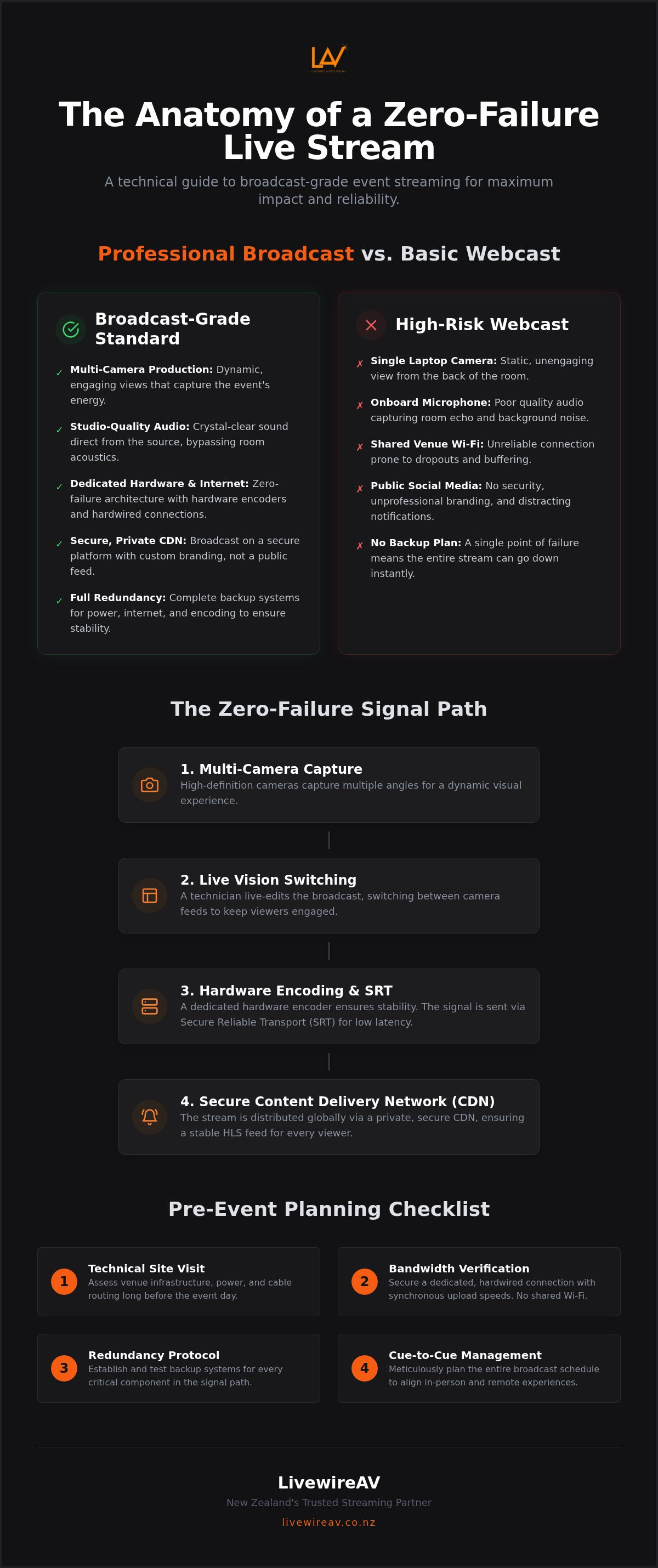
Professional event streaming is the real-time broadcast of a live event using TV-grade production standards. It's not just "going live" on a social platform; it's a disciplined technical exercise. In the New Zealand market, the standard for corporate communication has shifted. Stakeholders no longer accept a shaky laptop on a tripod at the back of the room. They expect high-definition visuals and studio-quality sound. Choosing professional event streaming services NZ ensures that your message is delivered with the same authority as a televised news broadcast. Precision, composure, and control are the foundations of this approach.
The Core Components of a Professional Broadcast
A professional broadcast relies on three pillars: multi-camera packages, vision switching, and integrated audio. Single-camera feeds often feel static and unengaging. By using multiple angles, we capture the energy of the room, from the speaker's facial expressions to the audience's reactions. Vision switching acts as the live-edit process, allowing a technician to cut between these angles in real time. This keeps the remote viewer focused. Finally, integrated audio bypasses the poor acoustics of a large hall, delivering crystal clear sound directly into the stream. Reliability, stability, and focus are maintained throughout the entire cue-to-cue process.
Differentiating Corporate Streaming from Consumer Platforms
It's a common misconception that "streaming services" refers to entertainment platforms like Netflix or Neon. In a business context, the requirements are vastly different. Security is paramount. Rather than broadcasting to a public social feed, professional event streaming services NZ utilise private, secure Content Delivery Networks (CDNs). These platforms often use the HTTP Live Streaming (HLS) protocol to ensure a stable, adaptive bitrate experience for every viewer. This technical foundation allows for custom landing pages and interactive overlays that reinforce your brand identity while keeping sensitive corporate data behind a secure digital wall.
The outcome of this technical precision is three-fold. First, you achieve high engagement. Remote participants stay tuned in because the content is visually dynamic. Second, you build brand authority. A polished stream signals a professional organisation. Third, the broadcast becomes a permanent digital asset. You aren't just streaming for the moment; you're creating a high-quality recording that can be repurposed for training, marketing, or internal archives. This level of execution transforms a simple meeting into a significant corporate event. Excellence, authority, and longevity are the results of a well-managed broadcast.
The Technical Architecture of a Zero-Failure Stream
A zero-failure broadcast begins with a rigorous understanding of the signal path. This journey starts at the camera lens and concludes on the end-user's device. To ensure total stability, professional event streaming services NZ providers must prioritise dedicated bandwidth. Shared venue Wi-Fi is a significant risk. We advocate for a hardwired, dedicated connection with a synchronous upload speed. Technical site visits are mandatory. These visits allow us to map the infrastructure, identify potential bottlenecks, and verify the physical routing of cables. Meticulous cue management ensures that the live room and the virtual feed remain perfectly aligned. This prevents the cognitive dissonance caused by audio or visual lag.
Encoding and Signal Stability
Reliability is found in hardware. While software encoders are flexible, they are prone to operating system crashes or CPU spikes. We utilise dedicated hardware encoders for maximum stability. Bitrate management is a delicate balance. We aim for high-definition visuals without exceeding the viewer's connectivity limits. For delivery across New Zealand, we employ Secure Reliable Transport (SRT) links. SRT provides low-latency delivery even over unpredictable networks. Adhering to technical best practices for streaming ensures that the signal remains robust from the encoder to the Content Delivery Network (CDN). This methodical approach keeps the broadcast fluid and focused.
Redundancy and Backup Systems
Redundancy is the hallmark of a professional operation. We don't just hope for the best; we prepare for the worst. This involves dual-path streaming. We send two simultaneous signals via different network routes. If one path fails, the other continues uninterrupted. All critical broadcast hardware is protected by Uninterruptible Power Supplies (UPS). This prevents a local power surge or outage from taking the stream offline. Failover is the automated transition to a backup feed in the event of a primary signal loss. This transition must be invisible to the viewer. When planning your next high-stakes broadcast, partnering with a team that provides full technical production and redundancy planning is essential for peace of mind.
The technical architecture of a stream is invisible when it works perfectly. It requires a steady hand and deep technical knowledge to manage this complexity behind the scenes. By focusing on hardware reliability and signal redundancy, we remove the stress of potential technical dropouts. This allows your presenters to speak with confidence, knowing the digital link to their audience is secure. Precision, composure, and control are not just goals. They are the standard requirements for every broadcast we manage across the country.
Hybrid Events: Integrating In-Person and Virtual Audiences
Hybrid events represent a unique technical challenge. They require a dual focus that most traditional broadcasts ignore. You must engage the person in the front row and the person on a laptop in Christchurch simultaneously. Professional event streaming services NZ providers understand that the virtual audience must be participants, not just observers. This is a growing priority; 87% of enterprise event planners are now prioritising hybrid options for their major conferences in 2026. True integration requires bidirectional audio and video. This means the room can see and hear the remote guest, and the remote guest can see and hear the room with absolute clarity.
Technical synchronisation is the most demanding part of this process. We manage the inherent latency of digital networks to ensure that Q&A sessions feel natural and immediate. There is nothing more damaging to the flow of a presentation than a five-second delay between a question and an answer. For a deeper look at the specific hardware required for these environments, see our guide on hybrid conference AV setup NZ. Precision, integration, and engagement are the results of this focused approach.
Bringing Remote Speakers into the Room
High-stakes presentations often involve international VIPs who cannot travel. We integrate Zoom or Microsoft Teams feeds directly into the live LED wall display. This creates a physical presence in the room that feels substantial. To prevent the distracting echo that often plagues remote calls, we use mix-minus audio routing. This technical setup ensures the remote speaker hears the full room mix except their own voice. Our technicians also provide direct pre-event support to remote VIPs. We check their framing, lighting, and connection stability long before they are cued to appear. This meticulous preparation ensures a broadcast-ready appearance that maintains the professional standard of your brand.
Audience Interaction and Engagement Tools
A unified experience relies on shared participation. Live polling and Q&A tools must bridge both audiences to be effective. When a question is asked online, it should appear on the venue's screens instantly. Social media walls and interactive graphics help build a sense of community between the physical and digital spaces. A virtual MC or moderator plays a vital role in this ecosystem. They act as the dedicated voice of the remote participants, ensuring their questions are prioritised and answered. This approach removes the digital wall that often isolates remote viewers. It creates a single, cohesive event where everyone is an active participant. Reliability, stability, and focus are maintained across both channels.
Planning Checklist for High-Impact Event Streaming
Planning a high-stakes broadcast requires more than just showing up on the day; it's a methodical process that prioritises reliability. When engaging event streaming services NZ providers, the preparation phase often dictates the final quality of the stream. We approach every project with a "zero-failure" mindset, ensuring that every variable is accounted for long before the first guest arrives. This disciplined framework allows our team to maintain total technical control, even in high-pressure environments. Precision, composure, and control are the foundations of a successful event.
Step 1: Define your broadcast goals and audience size. Knowing whether you're reaching 50 stakeholders or 5,000 national viewers determines the technical scale.
Step 2: Conduct a technical site visit to assess venue infrastructure. Meticulous planning starts with a physical walk-through to map electrical capacity and network topology. For a comprehensive look at this process, see our guide on Technical site visits for events.
Step 3: Organise dedicated internet with a hardwired connection. Wi-Fi is inherently unstable for high-bitrate video. We insist on a dedicated VLAN or a separate fibre drop to ensure the signal remains uninterrupted.
Step 4: Finalise the 'Run of Show'. This document must include integrated technical cues for vision switching, audio levels, and slide transitions to keep the broadcast fluid.
Step 5: Execute a full 'dry run'. This is a complete rehearsal with all cameras and remote feeds active, ensuring every technician understands their role.
Connectivity and Bandwidth Requirements
Bandwidth is the lifeline of your broadcast. To ensure stability, you must calculate the required upload speeds based on your resolution. A 1080p High Definition stream typically requires a stable 10Mbps upload, whereas 4K broadcasts demand at least 25Mbps to maintain quality. Shared venue Wi-Fi is a significant risk because other guests can consume the bandwidth you need for the stream. We always recommend a dedicated, hardwired connection. This removes the unpredictability of wireless signals and ensures a steady, secure, and professional feed for your national audience.
Vision and Lighting for the Camera
Standard room lighting is designed for the human eye, but it often fails on a professional stream. Cameras require specific light levels and colour temperatures to produce a natural look. Without professional intervention, presenters can appear washed out or shrouded in shadows. We adjust colour temperatures to ensure skin tones look accurate on screen, often using Live event lighting design techniques to separate the speaker from the background. This creates depth and keeps the remote audience focused. If you are ready to secure a reliable partner for your next broadcast, we offer full technical production tailored to your specific goals.
Why LivewireAV is New Zealand’s Trusted Streaming Partner
In high-stakes corporate environments, precision is the only acceptable standard. We position ourselves as the steady hand behind the scenes, providing the deep technical knowledge required to handle complex broadcasts. Our approach to event streaming services NZ wide is rooted in a quiet confidence. We understand that our role is to remain invisible, allowing your organisation's message to take centre stage. This "Calm Professional" mindset ensures that even under significant pressure, the technical delivery remains fluid and focused. Reliability, stability, and focus are not just goals; they are the baseline for every project we undertake.
National capability is a core pillar of our service. Whether your event is in a dedicated conference centre in Auckland or a bespoke venue in Queenstown, we provide consistent production standards across the country. We manage the entire technical ecosystem, including audio line array systems, intelligent lighting design, and vision switching. This end-to-end management removes the stress of coordinating multiple vendors. You deal with one partner who handles the logistical "why" behind every technical decision. Excellence, authority, and longevity are guaranteed through our meticulous planning process.
Expert Technicians and Modern Equipment
Our team brings over 10 years of experience to every production. We manage the entire cue-to-cue process with a disciplined focus on detail. We utilise the latest camera packages and hardware vision switchers to ensure a broadcast that rivals traditional television. Our technicians are venue-aware and detail-oriented, thriving in environments where there is no room for error. We use modern LED walls and projection systems to create a visually striking environment that translates perfectly to the digital feed. The technology serves the story. Seamlessness, experience, and meticulousness define our technical execution.
A Partner, Not Just a Provider
We believe in collaborative partnership rather than distant, corporate transactions. This begins with the initial concept and continues through to the final delivery. Our planning phase is thorough and well-considered, leaving nothing to chance. Once the broadcast concludes, our support continues. We provide high-quality master recordings of your event, ensuring you have a permanent digital asset for future training or marketing purposes. This comprehensive approach ensures your peace of mind from start to finish. If you are ready to execute a zero-failure broadcast, organise a technical consultation with LivewireAV today. We provide the steady hand your next major event requires.
Securing Your National Broadcast Quality
Executing a high-stakes digital event requires more than just high-speed internet. It demands a disciplined technical framework where every signal path and redundancy protocol is managed with absolute precision. By prioritising hardware reliability and bidirectional engagement, you turn a standard meeting into a polished corporate asset. Professional event streaming services NZ providers bridge the gap between in-person and remote audiences, ensuring that every participant feels part of the room.
LivewireAV brings over 10 years of high-stakes technical management to every production. Our team provides full-service audio, video, and lighting integration with comprehensive national New Zealand coverage. We manage the complexity behind the scenes so your presenters can focus on their delivery. This methodical approach removes the stress of technical failure, replacing it with the quiet confidence of an expert-led broadcast. Reliability, stability, and focus are maintained because every detail is accounted for long before the first guest arrives.
Request a tailored proposal for your next NZ event broadcast to ensure your message is delivered with total technical control. Your audience deserves a seamless, broadcast-grade experience.
Frequently Asked Questions
What internet speed do I need for professional event streaming in NZ?
You need a minimum synchronous upload speed of 10Mbps for a 1080p high-definition broadcast. For 4K requirements, this increases to 25Mbps. It's critical to use a dedicated, hardwired fibre connection rather than shared venue Wi-Fi. This ensures the signal remains stable and unaffected by other users in the building. Our technicians always verify these speeds during a technical site visit to ensure absolute precision.
Can you stream to multiple platforms like YouTube and LinkedIn at the same time?
Yes, we can broadcast to multiple platforms simultaneously using professional vision switching and restreaming technology. This allows your event to reach audiences on YouTube, LinkedIn, and private corporate portals at the same time. Using event streaming services NZ providers with hardware-based encoders ensures that multi-platform delivery doesn't compromise the stability of the primary feed. It's an efficient way to maximise your national reach.
How do you handle audio for hybrid events to prevent echo?
We use mix-minus audio routing to prevent echo and feedback during hybrid events. This technical setup ensures that remote speakers hear the full room mix without hearing a delayed version of their own voice. When integrated with professional audio line array systems, this creates a seamless experience for both in-person and virtual participants. It allows for natural, real-time conversation without the technical distractions common in basic webcasts.
What happens if the venue internet fails during the livestream?
We mitigate internet failure through rigorous redundancy and automated failover protocols. This often involves dual-path streaming, where we send signals over two different network connections simultaneously. If the primary venue fibre fails, the system automatically switches to a backup 4G, 5G, or secondary satellite link. This transition is invisible to the viewer. It's part of our zero-failure mindset to ensure the broadcast remains live regardless of local infrastructure issues.
Do I need special lighting for a broadcast-quality stream?
Broadcast-quality streams require specific lighting to ensure presenters look natural on camera. Standard venue lighting often has a colour temperature that makes skin tones appear sickly or washed out. We use intelligent lighting design to create depth and separate the speaker from the background. This ensures the remote audience stays focused on the content. Proper lighting is a standard requirement for any professional production, not an optional extra.
How many cameras do I need for a corporate conference stream?
A professional corporate stream typically requires a minimum of two to three cameras. A single camera angle feels static and often fails to keep a remote audience engaged for long periods. Using multiple cameras allows for vision switching between wide shots of the stage and tight shots of the presenter or their presentation slides. This creates a visually dynamic experience that mirrors the quality of a televised news broadcast.
Can you record the stream for later use or editing?
Yes, we provide high-resolution master recordings of every stream for your future use. These recordings are captured locally on our hardware, ensuring they aren't affected by any temporary internet fluctuations that might have occurred during the live broadcast. You can use these files for internal training, marketing highlights, or as a permanent digital archive. Having a high-quality asset after the event provides significant long-term value for your organisation.
Is it possible to include remote speakers in a live event broadcast?
It's entirely possible to include remote speakers in a live broadcast with absolute technical precision. We integrate remote feeds from platforms like Zoom or Teams directly into our vision switchers. The remote speaker is then displayed on the venue's LED walls and included in the stream. This allows for bidirectional interaction where the remote guest can see and hear the live audience, making them a full participant in the event.


Comments