Outdoor Event Technical Production: The 2026 Professional Engineering Guide
- Aug 11
- 12 min read
An outdoor stage is not merely a platform for a performance; it is a complex intersection of engineering and environmental variables where the elements always have the home-ground advantage. When managing outdoor event technical production, the margin for error is non-existent. Precise. Reliable. Seamless. You understand the pressure of watching a cloudless sky, not for its beauty, but for the direct sunlight that threatens to wash out your visuals. You feel the wind shift and know instinctively that your audio coverage is at risk of drifting away from the back of the crowd. These are the logistical realities that demand more than just equipment; they require a disciplined, engineering-first approach.
It's true that remote sites and unpredictable weather make technical perfection difficult to achieve. However, this guide provides the professional framework needed to ensure your next large-scale project results in a zero-failure execution. We will explore the precise requirements for high-impact LED visibility in daylight, the physics of line array systems for crystal clear sound, and the essential standards for temporary power and wind-loading safety in New Zealand. By the end of this guide, you will have the technical confidence to master the complexities of any environment, ensuring your production remains stable, vibrant, and entirely composed.
Table of Contents
Why Outdoor Event Technical Production Requires a Different Engineering Approach
An outdoor venue lacks the structural boundaries that provide acoustic reinforcement and light control. In a ballroom, walls reflect sound and curtains block the sun. Outside, you are contending with the infinite. Efficient. Controlled. Meticulous. Successful outdoor event technical production begins by acknowledging that the environment is an active participant in the engineering process, not just a backdrop. Technical certainty starts with a comprehensive site map and a signal chain that accounts for every metre of cable and every wireless frequency across the site.
The Challenge of Sound Dissipation
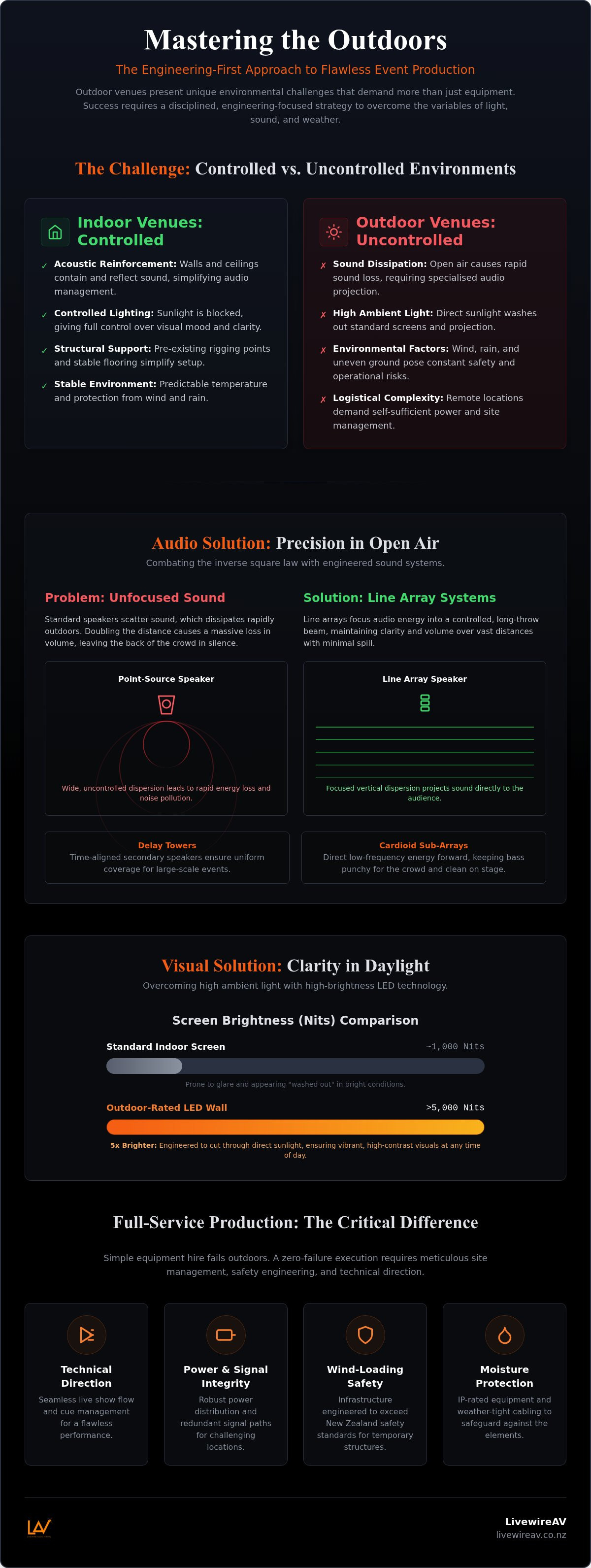
In an open field, sound follows the inverse square law with brutal efficiency. Every time you double the distance from the source, you lose a massive amount of sound pressure. Simply pushing more volume through a standard speaker won't solve the problem; it merely creates a wall of noise at the front while leaving the back of the crowd in silence. Professional sound reinforcement systems designed for the outdoors rely on line array technology to project audio with precision. For large-scale national event footprints, we deploy delay towers. These secondary speaker clusters are time-aligned to the millisecond, ensuring the person at the very back hears the same crisp audio as the front row without any disorienting echo or lag.
Visual Clarity in High Ambient Light
Daylight is the natural enemy of traditional projection. Even the most powerful projectors struggle against the New Zealand sun, resulting in washed-out images that fail to engage an audience. We prioritise high-brightness LED walls measured in Nits, a unit of visible light intensity. While a standard indoor screen might hover around 1,000 Nits, outdoor-rated panels typically exceed 5,000 Nits to maintain high contrast ratios in direct glare. This engineering choice ensures that your branding and video content remain vibrant from every viewing angle, regardless of the time of day. It's about providing high-impact visuals that don't just compete with the sun but overcome it entirely.
Managing an "uncontrolled" venue requires a disciplined approach to acoustics and vision. Without a ceiling to contain sound or walls to block light, every piece of equipment must be selected for its specific environmental performance. We map every power drop and signal path to ensure stability under pressure. This level of detail accounts for the logistical realities of an outdoor site, from ground elevation changes to potential signal interference. By treating the venue as a precision environment rather than just a park, we maintain total technical control over the entire production footprint from the first cue to the final exit.
High-Performance Audio and Visuals: Mastering Open-Air Environments
High-performance output in an open-air environment is a matter of calculated precision. Reliable. Durable. Precise. In outdoor event technical production, the hardware must be configured to overcome environmental interference while maintaining a cohesive experience for the audience. This requires a shift from standard setups to engineered systems that can handle the scale and unpredictability of the New Zealand landscape.
Audio Engineering with Line Array Systems
A Line Array is a system of identical loudspeaker units coupled for high-pressure output. Unlike traditional point-source speakers that scatter sound in all directions, line arrays allow for meticulous control over vertical sound dispersion. By focusing the audio energy directly at the audience, we significantly reduce sound spill into non-event areas or nearby residential zones. This directional control is vital for maintaining clarity over vast distances. Sub-bass management is equally critical; in open spaces, low frequencies lack the boundary reinforcement provided by walls. We deploy cardioid sub-arrays to ensure the bass remains punchy and present for the crowd without muddying the sound on stage or causing unnecessary noise complaints from kilometres away.
LED Walls and Vision Management
Visual impact outdoors depends on modularity and weather-tightness. Modern LED wall technology is designed to withstand the elements while providing the brightness necessary to cut through daylight. Pixel pitch is a primary consideration here. For most large-scale outdoor events where the audience is at least 15 to 20 metres from the screen, a pixel pitch of 3.9mm to 4.8mm offers the perfect balance of clarity and processing efficiency. Following international safety standards, such as those outlined in The Purple Guide, ensures that these massive structures are as secure as they are impactful.
Vision switching adds the final layer of professional polish. By blending live camera feeds with pre-recorded content and real-time graphics, we create a dynamic visual narrative that keeps the back of the crowd engaged. To ensure a zero-failure delivery, we build signal redundancy into every vision chain. If a primary feed is interrupted, the system automatically switches to a secondary path without the audience ever noticing a flicker. For those seeking a partner to manage these complexities, our team provides full-service technical production tailored to the specific demands of the New Zealand climate.
As the sun sets, the technical requirements shift again. Intelligent lighting design must be programmed to transition seamlessly from the high-contrast needs of the afternoon to the atmospheric requirements of the evening. We use IP65-rated fixtures that are fully protected against dust and moisture, ensuring the show continues regardless of a sudden change in the weather. This methodical approach to audio, vision, and lighting creates a stable environment where the technology supports the event rather than distracting from it.
Technical Site Management: Why "Dry Hire" Fails in the Great Outdoors
Possessing high-end equipment is not the same as mastering a high-stakes environment. Composed. Prepared. Decisive. In outdoor event technical production, the equipment is merely the baseline. The real value lies in the technical management that ensures every component functions as a unified system under pressure. While a dry hire model might appear cost-effective on paper, it leaves the event organiser responsible for complex signal routing and environmental troubleshooting that can derail a production in minutes. A managed approach replaces guesswork with engineering certainty.
The Role of the Technical Crew
A Technical Director acts as the steady hand behind the scenes, bridging the gap between the creative vision and the physical signal chain. Front of House (FOH) engineers do more than monitor volume; they actively compensate for shifting wind patterns that can alter audio perception across the site. Vision directors craft the narrative on the big screens, seamlessly switching between live camera packages and pre-recorded content to keep the audience focused. Meanwhile, stage management in an open space requires a different level of discipline to coordinate presenters and performers who are often far removed from the primary technical hub. This coordination is what maintains the "show flow" and ensures every cue is met with precision.
Comparing Hire Models
Choosing between a gear-only hire and full production is a choice between managing risk and ensuring execution. The following table outlines the fundamental differences in service and security.
Troubleshooting in real-time is where experienced technicians provide their best insurance. On a remote or public site in New Zealand, the logistics of "bump in" and "pack down" involve more than just moving boxes. It requires managing site access, power distribution, and public safety in areas that were never designed for large-scale AV. Our team manages these variables invisibly, allowing the client to focus on their guests while we maintain total control of the technical environment. This methodical approach ensures that excellence is a standard requirement, not an occasional achievement.
Weather Mitigation and Power Logistics: Safeguarding Your Show
Outdoor events in New Zealand are defined by their environmental volatility. Coastal salt spray, sudden afternoon squalls, and high-velocity winds are not just inconveniences; they are engineering challenges. Stable. Secure. Redundant. In the context of outdoor event technical production, safeguarding the show means moving beyond basic waterproofing to a comprehensive logistics strategy that accounts for the physics of the site. Success is found in the meticulous preparation that happens weeks before the first generator arrives on-site.
Engineering for the NZ Climate
We utilise equipment with high Ingress Protection (IP) ratings, specifically IP65 or higher, to ensure that lighting fixtures and LED modules remain operational during heavy rain. However, the sun presents an equal risk to technical stability. Servers and vision processors generate significant heat; we employ active cooling solutions and ventilated housing to prevent thermal shutdown during peak daylight hours. Technical site visits are a necessity for conducting wind-path analysis to determine the exact structural ballast required for LED towers and truss lines. This data-driven approach ensures that structures are safely secured against the specific gust profiles of the venue, providing a composed environment for both crew and audience.
Reliable Power Infrastructure
Power is the lifeblood of any production, yet it is often the most overlooked component in remote or public sites. Calculating the total KVA (kilovolt-ampere) requirements involves more than just adding up the wattage of the speakers. We engineer power distribution systems that maintain balanced loads across three-phase generators to prevent circuit instability and equipment damage. Proper earth grounding is non-negotiable for both safety and signal purity, particularly when sensitive digital audio networks are involved.
For high-stakes broadcast or livestreaming, we implement redundant power paths using Uninterruptible Power Supplies (UPS). These systems provide an instantaneous bridge if a primary generator fails, ensuring the signal remains live while secondary power is engaged. This level of contingency planning is a standard requirement for outdoor event technical production at a professional level. By managing these logistical variables with a disciplined focus, we eliminate the stress of the unknown for our clients.
A "Show Must Go On" framework is built into our standard operating procedure, including physical protection like custom-fitted rain cowls for moving lights and moisture-wicking cable looms. Every detail is accounted for to ensure environmental variables don't dictate the quality of the execution. If you are planning a large-scale project and require technical certainty, contact LivewireAV for full-service technical production that prioritises reliability in any environment.
Partnering with LivewireAV for National Technical Certainty
Partnering with LivewireAV means securing a steady hand for your most complex projects. Disciplined. Composed. Experienced. We understand that in high-stakes environments, technical precision is the only currency that matters. Our approach to outdoor event technical production prioritises reliability over flashiness, ensuring that the technology remains invisible while your event takes centre stage. With over 10 years of experience in technical management, we have built a reputation as the reliable expert who thrives under the pressure of live, open-air environments.
Tailored Proposals for Unique Events
A successful production is the result of meticulous preparation long before the first guest arrives. We work as a collaborative partner with your event management team to translate a creative vision into a robust, engineered site plan. This involves mapping signal paths, calculating power loads, and conducting wind-path analysis to ensure every structure is safely secured. Every detail is accounted for to prevent the technical glitches that often plague less prepared productions. For those requiring a deeper look at our standards, our guide to Premium Event Production New Zealand outlines our commitment to flawless technical execution.
Your National Event Partner
LivewireAV operates as a national partner, providing consistent quality across every region of the country. Whether your event is in a central city park or a remote coastal location, you receive access to the same calibre of modern, well-maintained equipment and senior technicians. We don't just provide gear; we provide technical certainty. Our team manages the logistical "dark arts" of site access and environmental mitigation so you don't have to. You can learn more about our specific regional capabilities in our resource on Outdoor Event Production NZ.
Our commitment is to a zero-failure execution. We value clear, honest communication and methodical planning above all else. By choosing LivewireAV, you are partnering with a specialist who views excellence as a standard requirement rather than an occasional achievement. We take the time to understand the unique variables of your venue and audience, delivering a bespoke technical design that ensures your production remains stable, vibrant, and entirely under control. This steady, matter-of-fact delivery of service is why we are trusted with some of the most significant outdoor event technical production projects across New Zealand.
Ensuring Technical Certainty for Your Next Outdoor Project
Mastering the complexities of the open air requires a shift from simple equipment hire to a disciplined engineering approach. We have explored how specialised line array systems overcome sound dissipation and why high-brightness LED walls are the only viable solution for maintaining visual impact in direct sunlight. Beyond the hardware, the success of your project rests on rigorous site management and weather mitigation strategies that account for the unique New Zealand climate. These variables demand a partner who prioritises reliability over flashiness.
With over 10 years of technical excellence and a modern inventory of high-performance equipment, we provide national service across New Zealand to ensure your outdoor event technical production is executed with total composure. Our team is ready to manage the logistical complexities and environmental risks so you can focus on your audience. If you are ready to move from uncertainty to technical control, discuss your upcoming outdoor event with our technical experts. We look forward to delivering a seamless and high-impact production together.
Frequently Asked Questions
How is outdoor event technical production different from indoor setups?
Outdoor production must account for the lack of acoustic and structural boundaries found in indoor venues. Indoor equipment often fails outdoors because it isn't designed to handle the inverse square law of sound dissipation or the high-ambient light of the sun. We engineer systems specifically for these variables, ensuring that audio coverage remains uniform and visuals remain vibrant without the assistance of walls or ceilings to contain them.
Can LED walls be seen clearly in direct Australian or New Zealand sunlight?
Yes, modern LED walls are engineered specifically for high-visibility in direct sunlight. While standard indoor screens are washed out by solar glare, our outdoor-rated panels feature high-brightness output, often exceeding 5,000 Nits. This ensures that your content maintains sharp contrast and vibrant colours even in peak afternoon conditions, providing high-impact visuals that remain clearly legible to your entire audience regardless of the sun's position.
What happens to the technical equipment if it starts raining during the event?
We use IP65-rated equipment designed to remain fully operational in wet conditions. Our technical team also employs physical safeguards such as custom rain cowls for moving lights and moisture-protected cable looms. If a squall occurs, these engineering measures ensure the show continues without interruption. This proactive approach to outdoor event technical production minimises the risk of equipment failure caused by New Zealand's unpredictable weather patterns.
Do I need to provide a power source for the outdoor AV production?
You don't necessarily need to provide an on-site power source as we can engineer a complete temporary power infrastructure. For remote or public sites, we deploy silenced generators and Uninterruptible Power Supplies (UPS) to ensure a stable, redundant energy feed. We calculate the exact KVA requirements and manage load balancing across the site, ensuring all AV systems have the consistent voltage required for a zero-failure execution.
What is an audio line array and why is it better for outdoor events?
An audio line array is a system of identical loudspeaker units coupled to control vertical sound dispersion. This technology is superior for outdoor events because it projects sound with precision over vast distances while reducing spill into non-event areas. By focusing the audio energy directly at the audience, we maintain crystal-clear speech and music fidelity at the back of the crowd without needing excessive, distorted volume at the front.
How do you manage the technical cues for a large outdoor awards ceremony?
We manage complex cues through a dedicated Technical Director and a disciplined communication network. For an awards ceremony, this involves coordinating vision switching between live camera feeds and graphics, while stage managers ensure presenters are in position. Our "Calm Professional" approach ensures that every transition is seamless and every cue is hit with precision, regardless of the scale or technical complexity of the outdoor environment and its unique distractions.
What are the safety requirements for rigging LED screens outdoors?
Rigging LED screens outdoors requires strict adherence to New Zealand wind-loading safety standards. We perform site-specific engineering calculations to determine the required ballast and structural support needed to keep the screen stable in high winds. This process involves a thorough wind-path analysis during the site visit, ensuring that every truss and screen is safely secured against the specific environmental risks and gust profiles of the chosen venue.
Can LivewireAV manage the livestreaming of our outdoor event to a global audience?
Yes, we provide full-service livestreaming and hybrid event packages designed for global delivery. Our technicians manage the entire vision chain, from multi-camera packages to redundant internet uplinks. By integrating vision switching with high-quality audio feeds, we ensure your remote audience receives the same high-impact experience as those on-site. This allows you to extend the reach of your outdoor event technical production with total confidence in the signal stability.


Comments