NZ Corporate AV: Guide to Technical Production Excellence
Updated: 2 days ago
The lowest AV quote can carry the highest event risk. When comparing corporate AV providers NZ-wide, an equipment list alone won’t show who plans, operates and takes responsibility for technical delivery. That distinction matters when a keynote needs to run smoothly or a roadshow has to work across multiple venues.
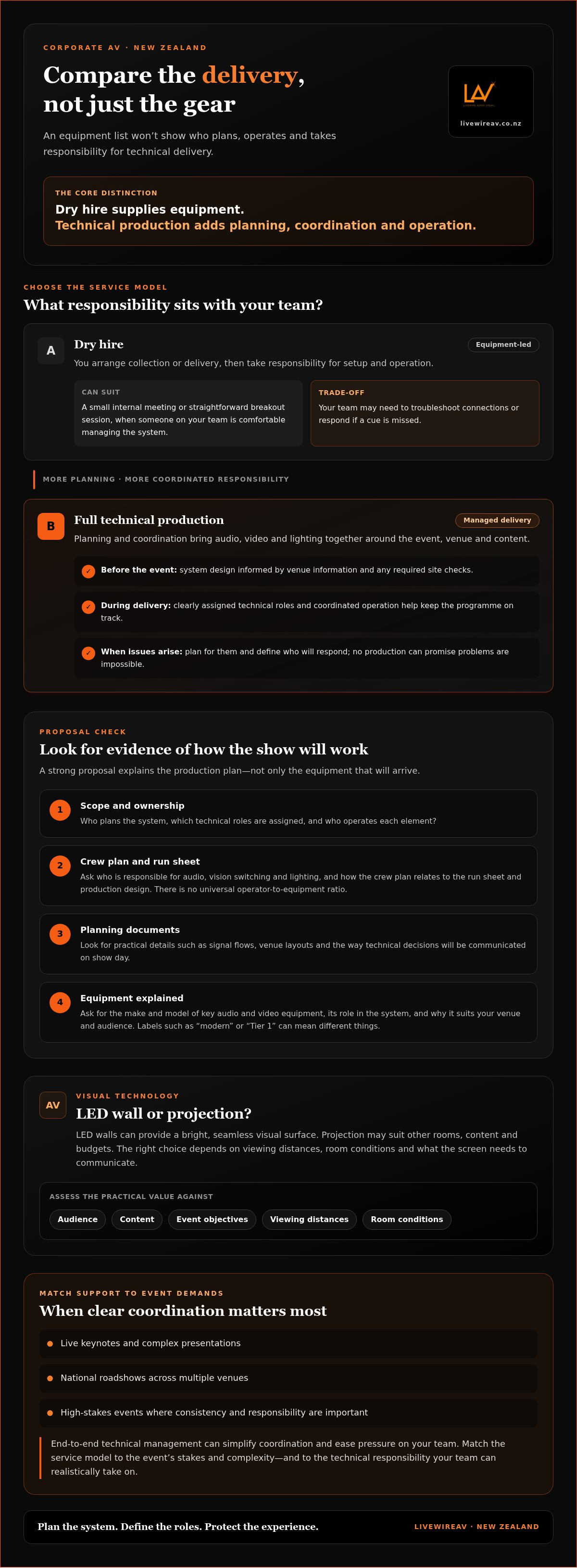
It’s understandable to focus on price when proposals look similar on paper. But dry hire and full technical production aren’t like-for-like options: one supplies equipment, while the other also covers planning and the expertise needed to bring the production together. For a high-stakes event, a clear scope, experienced technicians and well-defined coordination can help your team prepare for a smooth show.
This guide explains how to assess providers beyond the gear list, compare the support included in each proposal and decide whether visual technology such as an LED wall suits your event. You’ll also find practical questions to ask when planning a national roadshow and choosing a partner to manage the technical details from design through to execution.
Table of Contents
Comparing Corporate AV Providers NZ: Hire vs Production
New Zealand’s corporate AV market includes equipment-hire businesses and production companies that plan and manage technical delivery nationally. The labels can sound similar, but the scope may differ significantly. “AV hire” often means access to hardware, while technical production adds the planning and coordination needed to make the equipment work as one system. For a neutral overview of what audiovisual (AV) means, consider how sound and visual elements combine to communicate with an audience.
That distinction matters when comparing corporate AV providers NZ. A list of speakers, screens and lights tells you what may be supplied, but not who designs the setup, manages cues or responds if something doesn’t work as expected. Technical production brings audio, video and lighting together around the event format, venue and content. Careful planning and skilled operation can reduce avoidable technical uncertainty and help protect the audience’s experience.
The Gear-Centric Approach: Dry Hire
With dry hire, the client typically arranges collection or delivery of equipment such as speakers, projectors and basic lighting, then takes responsibility for setup and operation. This can suit a small internal meeting or a straightforward breakout session when someone on the team is comfortable managing the system. The trade-off is responsibility: if a connection needs troubleshooting or a cue is missed, the client may need to resolve it.
The Managed Production Approach
Full technical production involves more than supplying equipment. A technical director can help shape the system around the event, while venue information and any required site checks inform the design. During delivery, clearly assigned technical roles and coordinated operation help keep the programme on track. The aim is to plan for issues and define who will respond, not to promise that problems are impossible.
This model is especially relevant for a live keynote, complex presentations or a national roadshow, where consistency and clear responsibility matter. Event production in New Zealand is built around preparation and managed delivery, rather than a gear list alone. LivewireAV provides end-to-end technical management across New Zealand, bringing audio, video and lighting together so clients can focus on the event itself.
Use the scope of work to check what you’re actually comparing: who plans the system, which roles are assigned and who operates the technical elements. A lower equipment-only quote and a managed production proposal aren’t equivalent offers. Match the service model to the event’s stakes and complexity, and to the technical responsibility your team can realistically take on.
Key Benchmarks for Evaluating NZ Event Technology Partners
A strong proposal explains how the production will work, not just what equipment will arrive. As you compare corporate AV providers NZ-wide, look for clear answers about signal flow, staffing, venue planning and the reasons for the proposed technology. These details help you assess whether a provider has considered the demands of a live event, where a technical issue can affect a keynote or programme timing.
Assessing Technical Management and Labour
The lead technician needs to understand how the system fits together and what to do if a cue or signal doesn’t behave as planned. Ask who is responsible for audio, vision switching and lighting, and whether the proposed operators can manage both the equipment and programme demands. There’s no universal operator-to-equipment ratio, so ask the provider to explain its crew plan in relation to your run sheet and production design.
A Technical Director can translate the event’s creative and business objectives into a workable technical plan, coordinating system design with the people who will operate it. Ask who holds that responsibility and how decisions will be communicated on show day. For a reference point on training pathways, Entertainment Technology New Zealand outlines national qualifications for event technology.
Modern Equipment Standards
“Modern” or “Tier 1” can mean different things between proposals. Rather than relying on labels, ask for the make and model of key audio and video equipment, its role in the system and why it suits your venue and audience. A provider should be able to explain the trade-offs clearly.
LED walls can offer a bright, seamless visual surface, while projection may suit other rooms, content and budgets. The right choice depends on viewing distances, room conditions and what the screen needs to communicate. For large conferences, line arrays need to be designed for the space and audience coverage, not simply listed as equipment. See this guide to audio visual for large conferences for more on the production considerations.
Venue Knowledge and Composure
National touring adds another test: can the provider plan around each venue’s layout, access and technical conditions, rather than assume one setup will fit every stop? Ask how site information is gathered and how the design adapts across locations. This helps identify practical constraints before they become show-day problems.
Assess the people as well as the plan. Clear communication, defined cue ownership and considered answers to technical questions are useful signs of a well-organised team. To explore how LivewireAV approaches end-to-end technical production across New Zealand, visit LivewireAV’s technical production services.
Service Models: Dry Hire vs. Full Technical Production
The right service model depends on how much technical responsibility your team can take on and how much risk the event can reasonably carry. Use this framework when comparing corporate AV providers NZ-wide. Dry hire can suit a simple session with someone experienced available to set up and operate the equipment. Full technical production is generally better suited to events that need dedicated planning and operation.
The lowest quote isn’t necessarily the best value if it leaves your team to coordinate setup, manage cues and troubleshoot technical issues. Compare the full scope and responsibilities, not just the equipment list. Also clarify how production planning fits with your event’s health and safety arrangements. WorkSafe New Zealand provides guidance on official health and safety responsibilities for event management.
When to Choose a Full-Service Partner
Consider full production for a function with 200 or more attendees, external stakeholders, livestreaming or a tightly timed programme. These are decision prompts, not universal thresholds: complexity and consequences matter as much as audience size. A product launch or awards gala depends on well-managed visual and audio cues, so leaving operation to an unprepared team can add avoidable risk. For remote participation, a planned hybrid conference AV setup can connect in-person and online audiences as part of the production design.
Logistics and National Delivery
For a tour across New Zealand, ask how the provider will coordinate equipment transport, setup and technical standards at each venue. Confirm who owns the schedule, what information is needed from each site and how the system will adapt to different spaces. For a large-scale production, a site visit may be a practical planning step. Agree its purpose and timing with the provider before finalising the plan.
If your team needs one partner for technical planning and delivery, review LivewireAV’s full technical production as an option for events across New Zealand.
Red Flags and Reassurances: What to Look for in a Proposal
A proposal should show how the production will be managed, not just list equipment. When comparing corporate AV providers NZ-wide, check that responsibilities, system design and contingency planning are clear enough for your team to understand what to expect on show day.
A quote that names one “AV Technician” without defining the role leaves important questions unanswered. Is that person mixing audio, switching presentation content or managing several tasks at once? Ask for relevant roles, such as Audio Engineer and Vision Switcher, to be identified and for the proposed crew to match the programme’s needs.
Look for a signal-flow diagram or CAD floor plan showing how sources, screens, audio and control positions connect. If you want to explore the engineering standards behind robust audiovisual and ICT system design, visit AVC Principles. A venue-aware quote should also account for the site’s power and rigging constraints, based on the information available and any required venue checks.
Contingency planning matters. Ask what the crew would do if the primary video feed failed: is there an alternative source or route, and who would make the switch? The proposal should explain the response rather than suggest technical issues can never occur.
Decoding the Equipment List
Equipment names need context. A line array may suit a large room where sound needs to reach a broad audience, while point-source speakers can work for a more contained setup. Ask the provider to explain why the proposed system fits your room. For an LED wall, request the pixel pitch and ask how it relates to viewing distance and content, rather than accepting “high resolution” as a complete specification. If cameras or livestreaming are involved, check that lighting design is coordinated with the vision plan for clear, consistent images.
The Value of Pre-Production
A provider who doesn’t ask for a technical rider may not yet have enough information to design the system properly. The rider helps clarify presentation formats, playback needs, microphones, camera requirements and cue details. For a multi-operator show, ask whether comms, or intercom, is planned so crew can coordinate cues without relying on shouted instructions.
Good pre-production is practical: confirm the run sheet, venue details, signal paths, crew roles and fallback approach before event day. That preparation means key decisions are addressed before the room fills and the programme begins.
Review LivewireAV’s technical production approach when assessing how a provider can plan and manage audio, video and lighting for your event.
Why LivewireAV is the Choice for High-Stakes National Events
After comparing scope, crew roles and planning detail, the key question is who can take responsibility for bringing the technical plan together. LivewireAV provides full technical production for corporate events across New Zealand, managing audio, video and lighting from design through to execution. Its approach centres on clear planning and experienced technicians, with the technical production designed around the event.
Live events can involve tight cues, changing conditions and important messages that need to reach the room clearly. A technical partner can prepare for those demands, communicate plainly and keep the production focused on the programme. The goal is considered delivery that supports the event, rather than technology for its own sake.
LivewireAV’s equipment includes LED walls, audio line array systems and intelligent lighting. These technologies can be selected and combined to suit an event’s requirements, whether the priority is clear sound across a large audience, a strong visual presentation or coordinated lighting for the room. National service coverage and venue-aware planning support technical delivery across events in New Zealand.
A Partner, Not a Vendor
LivewireAV’s end-to-end technical management means clients can work with a production partner from design through execution, rather than having to join up an equipment list themselves. The team brings 10+ years of experience in high-pressure environments, helping translate event requirements into a workable production plan. This can mean fewer technical details for the client to coordinate alone and clearer ownership of technical delivery.
Preparation starts before guests arrive. Understanding the programme, venue and technical requirements gives the team a basis for planning the system and preparing for important cues. The aim is a composed, well-managed show, with the client free to focus on speakers, stakeholders and the audience.
Next Steps for Your NZ Event
For a useful proposal, share your event format, audience, venues, run sheet, presentation needs and any livestreaming requirements. Ask for a clear scope explaining the proposed system, crew roles, planning process and technical responsibilities. If your event involves a national roadshow or complex visual design, engage early so venue differences and system requirements can be considered during planning.
If you’re comparing corporate AV providers NZ-wide, use those details to assess who can offer the right level of technical ownership for your event. Contact LivewireAV about national event production to discuss your requirements and request a tailored proposal.
Choose a Steady Hand for Your Next Event
When comparing corporate AV providers NZ-wide, look beyond the equipment list. Compare who plans the system, which technical roles are assigned and how the proposal accounts for your venue and event cues. Dry hire and full technical production carry different responsibilities, so choose the model that matches your event’s complexity and your team’s capacity.
For high-stakes corporate functions, a partner who takes technical ownership can ease the coordination burden and help keep the programme on track. LivewireAV brings 10+ years of experience in high-pressure events, national coverage across New Zealand and equipment including LED walls and audio line array systems. The approach is practical: plan carefully, communicate clearly and keep the production focused on the event.
Share your event format, venues, run sheet and technical requirements to request a proposal that goes beyond a gear list. Request a tailored technical proposal from LivewireAV and discuss the technical support your event needs. With the right production plan in place, you can focus on your guests and programme.
Frequently Asked Questions
How do I compare AV quotes when the equipment lists look identical?
Compare the scope, crew roles and technical management, not just the equipment names. Ask who designs the system, operates each element and manages cues, and whether planning, setup and on-site operation are included. Check how the proposal addresses your venue and event format, and ask what the crew would do if a key signal failed. When comparing corporate AV providers NZ-wide, a detailed scope makes it easier to see whether quotes cover the same level of responsibility.
What is the difference between an AV technician and a Technical Director?
An AV technician generally operates or supports specific equipment, while a Technical Director oversees how the technical elements work together. For example, a technician may manage audio or vision switching, while a Technical Director coordinates the overall technical design and delivery against the event plan. Titles can vary between providers, so ask each one to define roles, responsibilities and decision-making in its proposal.
Does LivewireAV provide services outside of the main metropolitan centres?
Yes. LivewireAV provides event production services nationally across New Zealand, rather than limiting its coverage to metropolitan centres. Its services include full technical production, audio, video and lighting for corporate events, conferences and other event formats. For an event at a different venue or across multiple locations, share the schedule and site details so the proposed production can account for the delivery requirements.
Why is full technical production more expensive than basic equipment hire?
Full technical production includes more than equipment. It can involve system design, technical planning, equipment provision, setup and experienced technicians or operators managing cues and equipment during the event. Basic equipment hire generally leaves more of those responsibilities with the client. Compare the complete scope and workload before judging value. The right model depends on the event’s complexity and how much technical coordination your team can take on.
Can you manage the technical requirements for a hybrid or livestreamed event?
Yes. LivewireAV offers Hybrid & Livestream Events, including the technical elements needed to bring in-person and remote audiences together. The setup depends on your programme, venue, content and audience requirements. In your brief, explain how remote participants will take part, what needs to be seen or heard, and whether presentations or cameras are involved. This helps the production team shape a suitable technical plan.
What information do I need to provide to get an accurate technical production quote?
Share the event format, date, venue or venues, run sheet, audience details and any presentation, audio, lighting or livestreaming requirements. Include a technical rider if you have one, plus available venue plans and details about important content or cues. For a roadshow, outline the schedule and locations across New Zealand. Clear information helps the provider define the system, crew roles and scope in its proposal.
How does LivewireAV handle technical contingencies during a live event?
LivewireAV provides full technical production with on-site technicians and operators to manage cues and equipment during high-pressure events. Ask the team how contingencies for your production will be identified and documented, including who responds if a source or signal fails and what alternatives are planned. Arrangements depend on the event design, so request clear details in the technical proposal rather than assuming a particular backup is included.
Is a technical site visit necessary if the venue already has an AV floor plan?
Not always, but a floor plan may not show every detail that affects your production or reflect the room’s current configuration. For a complex event, multiple venues or a significant visual setup, discuss whether a site visit would help confirm the plan and identify practical constraints. Share the floor plan with the provider first, then ask what can be established remotely and what needs to be checked in person.


Comments