How to Organise a Multi-Camera Event Production: The Professional’s Guide
A successful multi-camera setup is not defined by the number of lenses in the room, but by the discipline of the system behind them. Precision. Composure. Reliability. You likely understand that a single, static camera angle often fails to capture the true scale of a premium event. However, the prospect of managing a complex multi camera event production brings its own set of anxieties. The fear of a technical failure during a live broadcast or the confusion of coordinating multiple operators is a common hurdle for even the most seasoned event organisers.
It's possible to achieve a broadcast-quality recording without the usual stress. We'll provide the technical roadmap you need to plan, execute, and manage a high-stakes production with total confidence. This guide explores the essential steps of venue-aware planning, gear selection, and team management. You'll learn how to replace technical uncertainty with a methodical approach that ensures your brand's presence is elevated and every detail is accounted for well before the first guest arrives. Our goal is to provide the peace of mind that comes from knowing the technicals are handled with quiet, expert precision.
Table of Contents
What is Multi-Camera Event Production and Why Does it Matter?
A multi camera event production is more than just several lenses pointed at a stage. It is a coordinated system of capture and live switching that transforms a simple presentation into a professional broadcast experience. Rooted in the historical development of the multiple-camera setup, this approach allows for real-time visual storytelling that mirrors high-end television standards. Precision matters. Reliability follows. By using a disciplined system of technical management, you eliminate the single points of failure that often plague basic recordings.
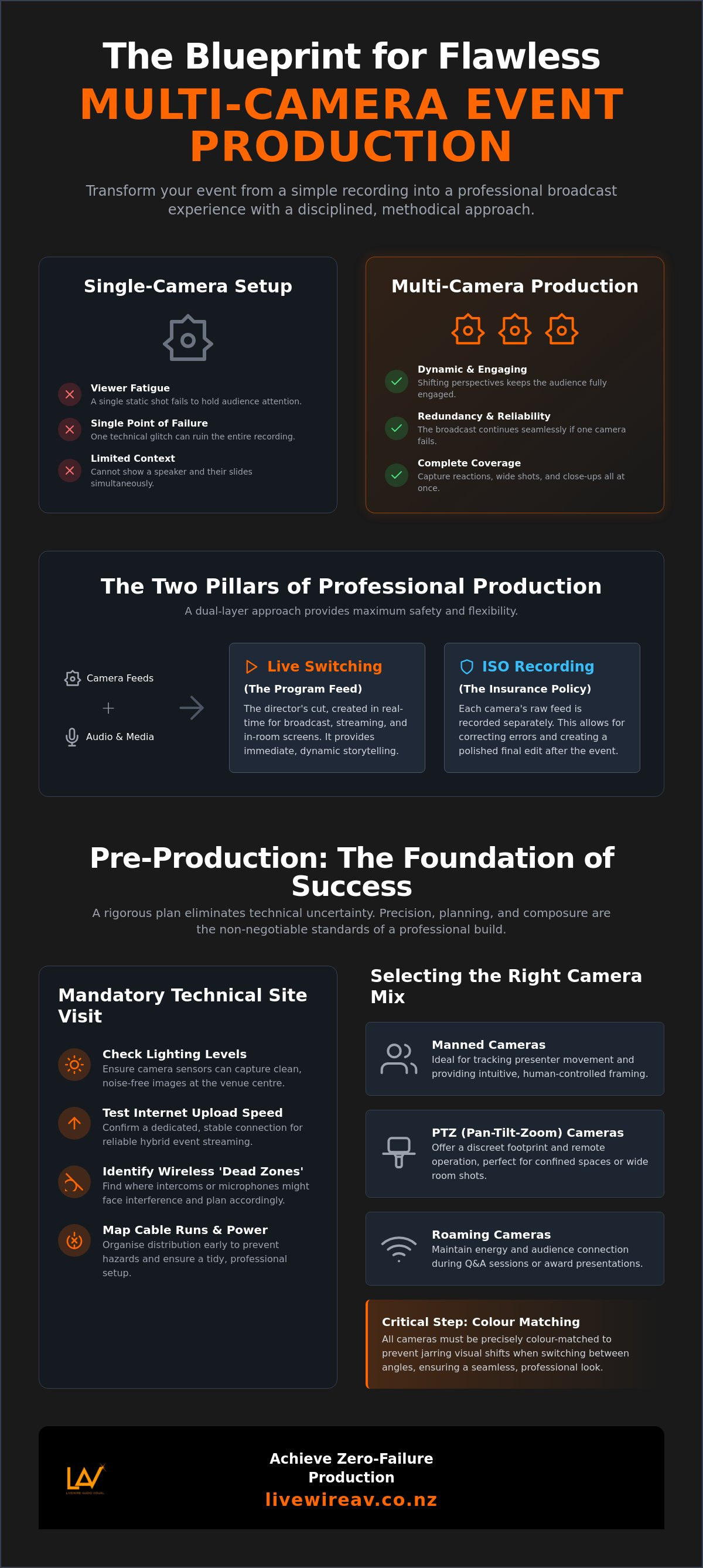
Static, 'locked-off' shots often lead to viewer fatigue. When an audience is forced to stare at a single wide angle for an hour, their attention naturally drifts. A professional multi camera event production introduces a dynamic rhythm. It keeps both remote and in-room attendees engaged by shifting perspective at critical moments. Reliability is the core benefit here. In high-stakes environments, redundancy is not a luxury; it's a requirement. If a single camera suffers a technical glitch or a lens flare, the production continues seamlessly. The Technical Director simply switches to another feed. This ensures there is never a black hole in your broadcast.
The Difference Between ISO Recording and Live Switching
ISO, or Isolated recording, captures the raw feed from each individual camera onto its own storage. This is your insurance policy. Live Switching, often called the Program feed, is the director's cut created in real-time as the event unfolds. Professional productions always execute both. This dual-layer approach provides maximum safety. It allows for post-event refinements if the live environment presented unexpected hurdles. You get the immediacy of a live stream with the security of a backup.
How Multiple Angles Solve Common Event Challenges
A single camera cannot be in two places at once. Multiple angles allow you to capture a speaker's emotional impact through a close-up while simultaneously showing the context of the entire room with a wide shot. It also solves the logistical challenge of integrating visual aids. Instead of choosing between the presenter's face and their PowerPoint slides, a vision mixer allows you to display both in a professional, side-by-side layout. This ensures the audience never misses a key data point or a subtle reaction. Every detail is captured. Nothing is left to chance.
This degree of technical sophistication is essential for high-level corporate and government communications. Specialists like Digital Content Studios exemplify this approach, providing professional video production that ensures every key message is delivered with broadcast-quality precision, particularly within the corporate and government sectors.
Pre-Production: How to Organise Your Technical Vision
Success in the field is never an accident. A flawless multi camera event production is built on a foundation of rigorous pre-production. This phase is where you translate a creative vision into a practical, technical reality. It requires a steady hand and a detail-oriented mindset to ensure that when the lights go up, the system is already proven. Precision. Planning. Composure. These are the non-negotiable standards of a professional build.
Conducting a Technical Site Visit
Assessing a venue from a floor plan is rarely enough. A physical technical site visit is mandatory for any multi camera event production to identify the logistical nuances that a brochure might overlook. You must check the lighting levels at the venue centre to ensure the camera sensors can capture clean, noise-free images. Testing the internet upload speed is equally critical for hybrid events. You need a dedicated, stable connection rather than shared guest Wi-Fi. This visit is also the time to identify 'dead zones' where wireless intercoms or microphones might face interference. Mapping out cable runs and power distribution early prevents hazardous setups and ensures a tidy, professional environment.
Selecting the Right Camera Mix
Your equipment package must be tailored to the specific demands of the room. Manned cameras are ideal for tracking movement and providing human intuition, whereas PTZ (Pan-Tilt-Zoom) cameras offer a discreet footprint and efficiency in confined spaces. For any multi-cam video project, ensuring all units are colour-matched is vital. This consistency prevents jarring visual shifts when switching between angles. A roaming camera is often included for Q&A sessions or award presentations to maintain a sense of energy and proximity. If you are preparing for a high-stakes corporate gathering, our team offers full technical production to manage these complexities on your behalf.
The final stage of pre-production involves drafting a 'run of show' or technical cue sheet. This document serves as the single source of truth for the technical team. It ensures every operator knows their role and their specific vantage points. It also guarantees clear lines of sight and accounts for potential obstructions like pillars or stage decor. By identifying these best vantage points during the planning stage, you eliminate the need for reactive adjustments during the live broadcast. Every detail is accounted for long before the first guest arrives.
The Role of the Vision Mixer
The vision mixer is the hardware used to execute transitions between feeds. Whether using sharp cuts for high-energy segments or soft dissolves for more formal moments, the mixer provides the tactile control required for a polished finish. It also handles complex tasks like 'Picture-in-Picture' (PiP). This is essential for showing a presenter alongside their slides without losing visual context. A critical component of this setup is the preview monitor. It allows the director to see exactly what is on the next camera before it goes live, eliminating the guesswork from the switching process.
Communication: The Technical Director's Secret Weapon
Post-Production and Hybrid Integration
The value of a multi camera event production extends well beyond the final applause. While the live cut provides immediate engagement, the post-production phase secures the event's legacy. This stage is where technical discipline meets strategic content management. By collaborating with specialists like Kynda Creative to craft social media content from your event, you ensure that every dollar spent on production continues to work for your brand long after the venue has been cleared. Precision. Longevity. Impact. By treating post-production as a planned phase rather than an afterthought, you maximise the return on your technical investment.
Bridging the Gap for Hybrid Events
A professional production must cater to two distinct audiences simultaneously. For those joining via digital platforms, the goal is to provide the 'best seat in the house'. This is achieved by integrating the high-definition vision mixer output directly into hybrid platforms like Zoom or Teams. By managing low-latency feeds, we ensure that remote participants can interact in real-time without the jarring delays that often disrupt virtual meetings. This seamless integration is a core component of successful hybrid event production New Zealand, where technical control is the primary driver of audience retention.
Using ISO recordings is the professional's method for achieving a flawless final deliverable. As discussed earlier, these isolated feeds capture every camera angle independently. If a minor error occurred during the live switch, an editor can simply reach into the ISO files and substitute the preferred shot. This results in a 'clean' edit that is perfect for public release or internal archives. Having a finalised program cut available immediately after the event also offers significant logistical benefits. It allows for rapid turnaround times, ensuring your message reaches your wider audience while the topic is still current.
Maximising ROI on Your Footage
One day of filming can generate months of marketing material. By capturing a wide variety of angles, you create a rich library of footage that can be repurposed into 'bite-sized' social media clips or high-energy highlight reels. These professional visuals are also invaluable for enhancing outdoor event production NZ recaps, providing a polished contrast to the scale of a large-scale exterior build. Whether you're archiving the full production for internal training or creating promotional content for next year's event, the quality of the raw capture remains the deciding factor in the final result. If you need a partner to manage these technical layers, our team provides comprehensive hybrid & livestream events support to ensure your content is captured with total composure.
Achieving Zero-Failure Production with LivewireAV
Professional technical management is the anchor of any high-stakes corporate environment. It's the silent force that ensures your message isn't overshadowed by technical noise. A multi camera event production demands more than just equipment; it requires a disciplined system of management that eliminates single points of failure. At LivewireAV, we provide the steady hand required to navigate these complexities. Precision. Composure. Reliability. These are the commodities we value most when the pressure is at its peak.
Our approach is venue-aware and detail-oriented. We don't believe in flashiness for its own sake. Instead, we focus on the pragmatic execution of your vision. By deploying modern camera packages and experienced technicians, we take the technical burden off your plate. This allows you to stand on stage with the total confidence that every angle, cut, and audio level is being managed with quiet expertise. Excellence is our standard requirement. It's the direct result of our preparation and your peace of mind.
Our Commitment to Meticulous Planning
Every successful project is born in the pre-production phase. We start with a tailored proposal that addresses the specific logistical challenges of your chosen space. A thorough site assessment follows. This isn't a cursory glance; it's a deep dive into power distribution, cable paths, and signal integrity. We provide a unified production environment where audio line arrays, intelligent lighting, and vision switching work in perfect harmony. This seamless integration ensures a stable, focused environment for both your presenters and your audience. We are the disciplined specialists behind the scenes.
Ready to Elevate Your Next Event?
Choosing a technical partner is about more than hiring gear. It's about securing a collaborative partnership with a seasoned specialist who thrives under pressure. We bring a zero-failure mindset to every scale of production, from intimate executive briefings to large-scale hybrid conferences. You deserve the peace of mind that comes from knowing every detail has been accounted for long before the first guest arrives. Our communication is methodical. Our execution is direct. Our results are consistent.
Contact us today to discuss a bespoke technical production plan that meets your specific needs. Let us provide the professional anchor your brand deserves. Experience the confidence of having a team that prioritises reliability above all else.
and experience the difference that disciplined execution makes.
Elevating Your Production with Technical Confidence
A successful multi camera event production relies on a disciplined roadmap that spans from the initial site visit to the final post-event edit. You now have the framework to transition from basic recording to a polished, broadcast-quality experience. By prioritising meticulous pre-production and a calm approach to live switching, you eliminate technical uncertainty. This methodical process ensures your brand's presence is elevated while providing every audience member with the best seat in the house.
With 10+ years of technical event management experience, LivewireAV provides the steady hand required for high-pressure environments. We offer specialised camera packages and vision switching alongside expert technicians who thrive under pressure. Our focus remains on delivering precision and reliability so your work can take centre stage without distraction. Excellence is our standard requirement, not an occasional achievement.
Book a Technical Consultation for Your Multi-Camera Event to begin planning your next seamless production. We look forward to helping you achieve total technical control and peace of mind.
Frequently Asked Questions
What is the minimum number of cameras needed for a professional production?
Three cameras are typically the baseline for a professional multi camera event production. This configuration allows for a wide master shot to establish context, a tight shot on the presenter for emotional connection, and a third angle for audience reactions or visual aids. While two cameras can work in smaller settings, a three-camera system provides the redundancy and visual variety required for a high-quality broadcast feel.
Can we use multi-camera production for small hybrid meetings?
Multi-camera setups are highly effective for small hybrid meetings. Even a modest two-camera configuration ensures that remote participants don't feel isolated by a single, static view. By switching between a wide shot of the boardroom and a close-up of the speaker, you maintain a sense of presence and engagement. This approach transforms a basic video call into a professional corporate communication.
What is the difference between a vision switcher and a stream deck?
A vision switcher is the dedicated hardware that processes and transitions between video signals, whereas a Stream Deck is a customisable controller used to trigger software commands. Professional environments rely on hardware switchers for their low latency and reliability. While a Stream Deck can assist with graphics or macros, it doesn't replace the robust processing power of a high-end vision mixer in a complex production.
How much space does a multi-camera production crew need at the venue?
A standard technical control hub usually requires a footprint of approximately three by three metres. This space accommodates the vision mixer, audio console, and streaming hardware. In addition to this central hub, you'll need to account for the physical placement of camera tripods or PTZ mounts. We always assess these space requirements during our technical site visit to ensure a tidy, safe environment.
Do I need a separate person for audio if I have multiple cameras?
Dedicated audio management is essential for any professional multi camera event production. While cameras capture the vision, the audio engineer ensures that the sound is crisp, balanced, and free from interference. Relying on camera microphones or a single operator to manage both feeds often leads to technical compromise. A separate engineer allows for real-time monitoring and adjustment of the broadcast mix.
What happens if a camera cable gets unplugged during the live event?
Our systems are designed with inherent redundancy to handle unexpected hardware issues. If a camera cable is disconnected, the Technical Director immediately switches to an alternative feed. Because we record ISO files for each camera, any lost footage can often be recovered or masked in the post-production edit. This disciplined approach ensures that the live stream continues without the audience ever noticing a glitch.
How long does it take to set up a professional multi-camera rig?
Setup times typically range from three to six hours depending on the venue's complexity. This duration allows for cable runs, camera positioning, and thorough signal testing before the event begins. For larger productions with LED walls or complex lighting, we often recommend a pre-rig day. This methodical pace ensures that every piece of equipment is verified and that the team is composed before the first guest arrives.
Can multi-camera production be used for outdoor events in New Zealand?
Multi-camera production is frequently used for outdoor events across New Zealand, provided there is adequate weather protection. We use specialised enclosures and high-brightness monitors to manage the challenges of wind, rain, and sunlight. Whether it's a corporate retreat or a community festival, our team remains venue-aware and prepared for local conditions. Reliable power and stable internet remain the primary logistical requirements for these exterior builds.


Comments