15 Key Questions for Your 2026 AV Provider
- Aug 13
- 11 min read
Your 2026 event reputation rests entirely on the technical infrastructure supporting it. Gear is a commodity, but seamless execution is a deliberate choice. You've likely felt that familiar tightening in your chest when the house lights dim, wondering if the LED wall will flicker or if the audio will drop out during a critical keynote. It's a rational fear. A single technical glitch can instantly dismantle months of meticulous planning and brand positioning. Precise. Composed. Reliable. These are the standards your production must meet.
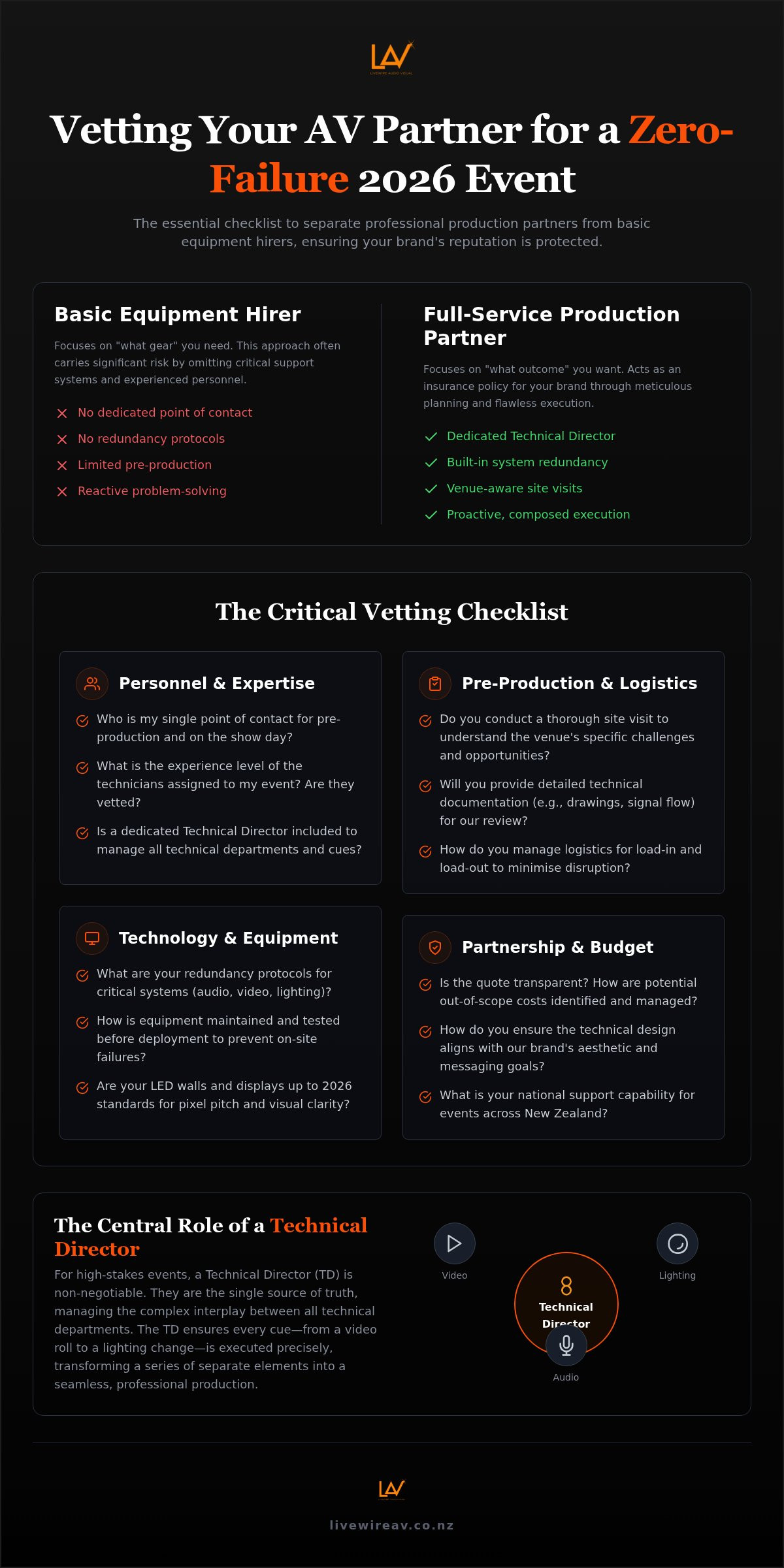
We understand the pressure of high-stakes environments. You need more than just a list of equipment; you need a partner who offers total technical control. This guide outlines the essential questions to ask an AV provider before hiring to help you separate professional production partners from basic equipment hirers. We'll examine fifteen critical vetting areas, including redundancy protocols, transparent quoting, and venue-aware logistics. By the end, you'll have the framework required to ensure a seamless, zero-failure experience that keeps your brand at the centre of the stage.
Table of Contents
Why the Right Questions Prevent Event-Day Disasters
Equipment is a tool, not a solution. Many organisers approach event planning by asking what gear they need, but the more productive approach is asking what outcome they want to achieve. A full-service production partner within the professional audiovisual industry focuses on the latter. They don't just supply microphones; they ensure the message is heard clearly by every attendee. Preparation. Precision. Performance.
Choosing a provider based solely on the lowest quote is a significant risk in the New Zealand market. These estimates often omit redundant systems and experienced technicians. In high-stakes corporate environments, these omissions lead to failure. Reliable production requires a steady hand. Meticulous. Disciplined. Composed. When you shift your focus from "what gear" to "what outcome," you begin to see AV as an insurance policy for your brand reputation rather than a mere line item on a budget.
The Real Cost of Technical Failure
When a screen flickers or a microphone cuts out during a keynote, the audience disconnects immediately. This loss of engagement is difficult to recover. For large-scale conferences, technical delays also have a tangible financial impact on venue hire and catering schedules. A zero-failure production is the only acceptable benchmark for 2026 events, where every technical detail is stress-tested before the first guest arrives. It's about protecting the reputations of your executive team and the integrity of your brand's message.
Vetting for Reliability over Flashiness
Technical skill is a baseline requirement, but professional composure is what saves a show. The "Calm Professional" approach prioritises stability over flashiness. When you're considering your options, the questions to ask an AV provider before hiring should focus on their methodology rather than just their equipment list. You need to understand how they handle pressure and what their pre-production process entails.
A partner who conducts site visits and provides detailed technical drawings demonstrates a commitment to precision. They act as the invisible support that allows your team to lead with confidence. Their presence should be felt in the quality of the experience, not the visibility of the problems they're solving. Moving beyond the quote allows you to find a partner who values clear, honest communication and consistent execution over a quick, low-cost transaction.
Personnel and Expertise: Who is Actually Running Your Show?
High-stakes events demand more than just technical ability. They require a cohesive team led by a single point of authority. When considering the questions to ask an AV provider before hiring, start with the people. Knowing who will be your primary point of contact during pre-production and on the actual show day is vital for continuity. You shouldn't be introduced to your lead technician five minutes before the opening address. Inquire about the specific experience levels of the crew assigned to your event. Experienced. Qualified. Vetted. These are the traits of a team that can manage a multi-day conference without losing focus.
Ask if a dedicated Technical Director is included for larger productions. This role serves as the single source of truth for every technical cue. Without one, communication between the lighting, audio, and video departments can become fragmented. A unified team ensures that when the vision switcher cuts to a video, the audio follows instantly and the lighting transitions perfectly. If you are planning a high-profile event, it's worth discussing how full technical production can safeguard your brand's reputation.
The Role of the Technical Director
A Technical Director manages the complex interplay of various departments. They are responsible for The Role of a Technical Director in High-Stakes Events, ensuring every multimedia segment and speaker transition occurs without a hitch. This oversight is what separates a chaotic stage from a professional production. They act as the steady hand behind the scenes, managing the timing and execution of every cue to ensure the audience remains fully engaged with your message.
On-Site Composure and Professionalism
Technical skill is only half the requirement. Your crew must possess the professional composure to interact with high-level executives and speakers. A "show-ready" attitude begins at the load-in. It reflects in their appearance, their punctuality, and their ability to stay calm when a speaker provides a last-minute slide deck. Precision. Composure. Control. These qualities ensure that even when the script changes at the eleventh hour, the audience never notices. Professional technicians don't just fix problems; they prevent them through meticulous planning and a disciplined approach to on-site management. This level of service ensures your event maintains its momentum from the first guest's arrival until the final pack-down.
Pre-Production and Logistics: Ensuring a Flawless Setup
A professional production doesn't happen by accident. It's the result of disciplined, methodical planning that begins months before the first flight case arrives at the venue. When evaluating your options, the questions to ask an AV provider before hiring must address the pre-production phase. You need to know how they document their process and how they test your content. Will they run your slides and videos through the actual vision switcher they intend to use? Testing. Verification. Validation. These steps ensure that technical glitches don't disrupt your presenters during critical moments.
National events, especially those spanning diverse venues or multiple locations, present unique logistical challenges. Ensuring consistent quality, whether it's for a ballroom presentation or a large conference centre setup, requires a provider who understands the nuances of varied venue infrastructure. Ask how they manage these logistics and what their process is for ensuring the same level of quality across different venues. Meticulous planning is the only way to avoid the hidden costs of last-minute freight or local equipment sourcing. Clear, honest communication during this phase sets the foundation for a successful partnership.
The Necessity of Technical Site Visits
A technical site visit is a non-negotiable step in the planning process. Identifying power constraints, rigging points, and line-of-sight issues early prevents costly on-site adjustments and unnecessary stress. Venue-aware planning allows the team to account for the physical limitations of the space long before the load-in begins. Meticulous technical site visits for events allow technicians to map the space with precision, ensuring the equipment specified is actually fit for purpose. This proactive approach reduces the risk of overtime costs and ensures the setup is completed on schedule.
Contingency Planning and Risk Mitigation
Ask about "Plan B" for every mission-critical component. What happens if a primary laptop fails during a keynote or a signal cable is damaged? A professional provider will have redundant signal paths and backup power in place. LivewireAV organises "hot backups" for mission-critical components, meaning a secondary system is running in parallel and can take over instantly without the audience noticing a thing. This level of redundancy is what separates a professional production from a basic equipment hire. It's about providing the quiet confidence that the show will continue, regardless of technical challenges. Total technical control requires thinking three steps ahead of any potential failure.
Technology and Equipment: Modern Solutions for 2026
The quality of your hardware determines the ceiling of your event's success. As you evaluate potential partners, the questions to ask an AV provider before hiring must focus on the standard of their inventory. Ask if their equipment is suitable for high-definition broadcast and how often it is serviced. Modern. Maintained. Reliable. These standards are essential for 2026 events where digital integration is no longer optional. You need a partner who invests in current technology rather than relying on ageing stock that might fail under the demands of a modern production.
Hybrid events and professional livestreaming require specific technical capabilities. You need to know if your provider can handle complex vision switching and multi-camera packages. This ensures that remote participants receive the same high-quality experience as those in the room. If your event requires a global reach, consider how professional technical production can bridge the gap between physical and digital audiences. Total technical control allows you to deliver a consistent message across all platforms without compromising on quality or reliability.
Visual Excellence with LED Walls and Vision Switching
LED video walls have become the industry standard for mid-to-large-scale corporate events across New Zealand. When choosing a screen, you must understand the relationship between pixel pitch and viewing distance. A fine-pitch LED wall is necessary for close-range viewing to ensure text remains legible and images stay sharp. For detailed technical specifications on choosing the right display, refer to this guide on Conference LED Screen Hire NZ. Vision switching adds another layer of professionalism, allowing for dynamic, seamless transitions between presenters, slides, and live video feeds.
Audio Precision with Line Array Systems
Standard speakers on stands often fail to provide even coverage in large conference halls. They are prone to feedback and volume drop-offs at the back of the room, which leads to audience fatigue. Audio line array systems solve this by projecting sound more efficiently over long distances. This ensures crystal-clear speech intelligibility for every attendee, regardless of where they are seated. You can find more sound engineering insights in this resource on Audio Visual for Large Conferences. Precision in audio design is the difference between a disengaged audience and a captivated one. Meticulous. Clear. Powerful. These are the hallmarks of a well-engineered sound system that respects the importance of your message.
The Partnership: Alignment, Budget, and National Support
A successful event is built on a foundation of trust and shared vision. When you reach the final stages of vetting, the questions to ask an AV provider before hiring should pivot toward long-term alignment and financial transparency. You need to know how their technical design will reflect your brand aesthetic. It's not enough to have working equipment; the visual and auditory environment must reinforce your corporate identity. Precision. Alignment. Consistency. These are the markers of a provider that views themselves as a partner rather than a vendor.
Budgetary clarity is equally critical. One of the most important questions to ask an AV provider before hiring is whether there are potential "out-of-scope" costs hidden in the fine print. Professional proposals should be comprehensive, covering everything from crew travel and per diems to late-night pack-down fees. Understanding these variables early prevents friction during the post-event reconciliation. A transparent partner provides a clear roadmap of costs, ensuring there are no surprises when the final invoice arrives. Honest communication about the budget allows you to allocate resources where they will have the most significant impact on the attendee experience.
Brand Alignment and Creative Integration
The technical setup should never feel like an afterthought. It must be an extension of your brand's story. Lighting design, for instance, should do more than just illuminate a stage; it should enhance the mood of a gala or the energy of a product launch. Whether it's through specific colour palettes or intelligent lighting movements, the AV team must understand the "why" behind your event. This level of creative integration ensures the technology serves the message, creating a cohesive experience that resonates with your audience long after the final session concludes.
National Scalability and Seamless Execution
For organisations running a series of events across New Zealand, consistency is the greatest challenge. Transitioning between different venues often leads to variations in quality and execution. Partnering with a provider capable of managing logistics nationally eliminates this risk. LivewireAV maintains a standard of excellence across diverse New Zealand venues, ensuring that your production in Wellington feels identical to your production in Auckland. This national scalability provides the steady hand required to manage complex tours with composure. If you are ready to secure a reliable partner for your next project, enquire about your next national event production with LivewireAV. A disciplined approach to national logistics ensures every detail is accounted for, regardless of the location.
Securing Your Technical Legacy in 2026
The success of a high-stakes event depends on the invisible work conducted months before the first guest arrives. By mastering the essential questions to ask an AV provider before hiring, you transition from a position of hope to one of total technical certainty. You now understand that a dedicated Technical Director, meticulous site visits, and modern LED wall standards are the non-negotiable pillars of a professional production. These elements ensure your brand remains the focus, supported by a steady hand behind the scenes. Precision. Composure. Control.
Reliability is earned through consistent execution and deep industry knowledge. With over 10 years of experience in high-stakes environments, we specialise in the complex logistics of national New Zealand tours, LED wall integration, and hybrid production. We provide the composure required to handle technical complexity while letting your work take centre stage. Partner with the calm professionals at LivewireAV for your next event and experience the peace of mind that comes from meticulous preparation. Your vision deserves a production partner that values precision as much as you do.
Frequently Asked Questions
How early should I involve an AV provider in the event planning process?
You should engage an AV provider at least 12 weeks before your event date to secure the best rates and equipment availability. Early involvement allows for better negotiation with New Zealand venues regarding outside vendor access and fees. Planning. Preparation. Precision. This lead time ensures your technical partner can conduct site visits and integrate with your creative team before the event schedule becomes fixed.
What is the difference between a venue’s in-house AV and an external production company?
In-house AV providers often operate under commission-based agreements with the venue, which can lead to higher costs for standardised equipment. External production companies provide bespoke solutions tailored to your specific brand goals and executive requirements. They offer a dedicated team that remains consistent across different venues. This provides a level of technical control and redundancy that in-house services may not match for high-stakes corporate events.
Do I need a separate livestreaming team if I already have an AV provider?
A full-service production partner should manage both the in-room technicals and the digital broadcast to ensure total system harmony. Having a single team handle audio, vision, and livestreaming reduces the risk of communication failures between different vendors. It ensures a seamless experience for both physical and remote attendees. This unified approach is one of the key questions to ask an AV provider before hiring to ensure they have the internal expertise to manage hybrid complexity.
What technical information do I need to provide for an accurate AV quote?
Provide your provider with the venue name, expected audience size, a draft run-sheet, and your visual preferences, such as LED walls or projection. Clear. Detailed. Accurate. Mentioning specific requirements like the number of presenters and the type of content being shown helps technicians specify the right hardware. This transparency prevents budget overruns and ensures the initial quote reflects the actual technical scope required for a zero-failure event.
How do AV providers handle last-minute changes to the event schedule?
Professional providers manage schedule shifts through a dedicated Technical Director who oversees all department cues. They use digital run-sheets that update in real-time across the lighting, audio, and vision desks to maintain synchronisation. This methodical approach ensures transitions remain smooth even when a speaker finishes early or a session runs over. Composure under pressure is a standard requirement for technicians handling high-stakes environments where precision is paramount.
Can an AV provider help with the creative design of the stage and lighting?
Full technical production includes the creative integration of lighting and visual elements to reflect your corporate identity. Technicians use intelligent lighting design and LED wall configurations to enhance the stage aesthetic and audience engagement. This ensures the technical design aligns with your brand's mood and event goals. A collaborative partnership allows the AV team to suggest modern solutions that elevate the overall brand experience beyond basic equipment hire.
What are the most common "hidden costs" in AV hire contracts?
Labour overtime, venue power charges, and freight for last-minute equipment additions are common costs that may not appear in an initial basic quote. It's important to include these in your list of questions to ask an AV provider before hiring to ensure total financial transparency. A professional proposal should account for technical site visits and rehearsals to prevent unexpected line items. Clear communication regarding the full scope of work protects your budget.
Why is a technical site visit necessary if the venue says they have "everything ready"?
Venue claims of being "ready" often refer to general infrastructure rather than your specific production requirements. A technical site visit allows your team to verify power distribution, rigging points, and line-of-sight for LED walls. Meticulous. Venue-aware. Detailed. This proactive step identifies physical constraints before the load-in, reducing the risk of on-site delays. It ensures the equipment specified is perfectly fit for the unique environment of the chosen space.


Comments