The Invisible Architecture: How Professional AV Impacts Attendee Engagement
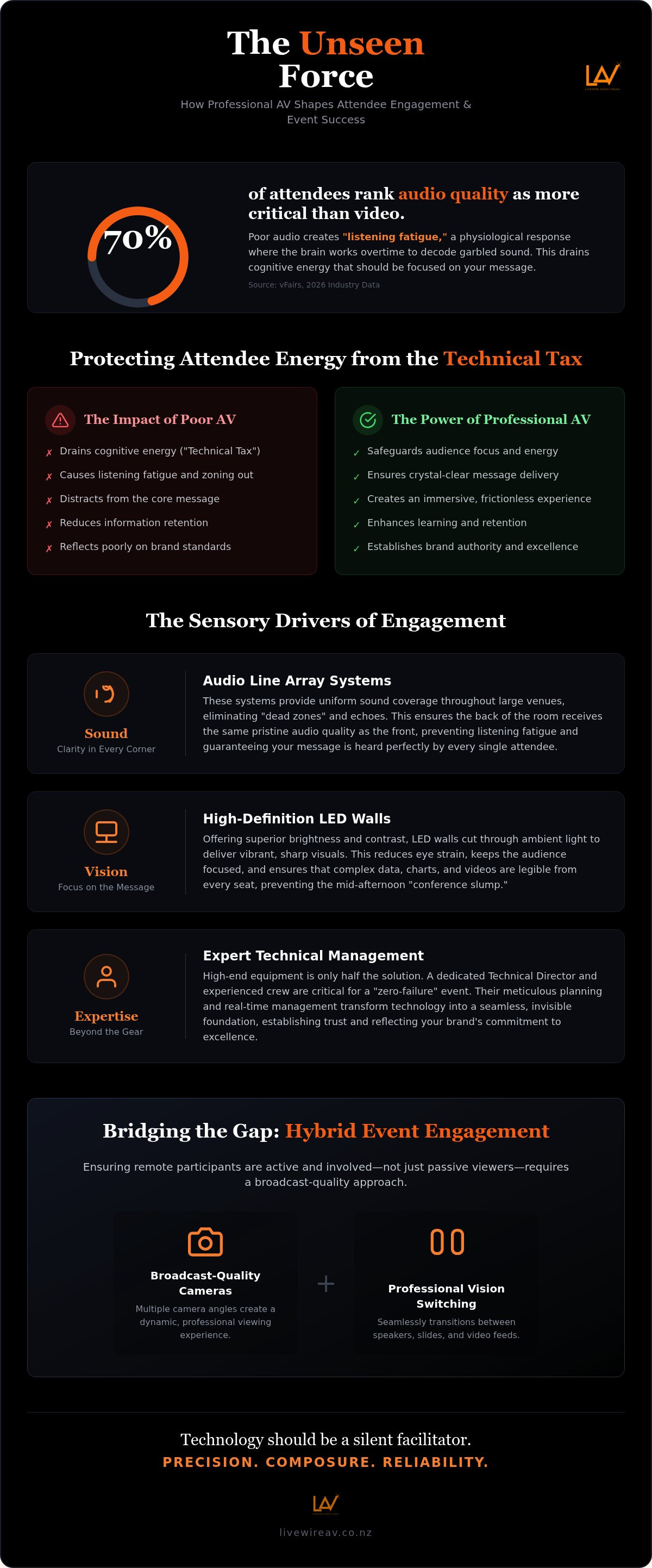
According to 2026 industry data from vFairs, 70% of attendees believe that audio quality is more important than video for a successful event experience. It's a reality that every event organiser understands instinctively. You've likely felt the stress of a high-stakes keynote, worrying whether a technical glitch will distract from your speaker's message or cause your audience to zone out. Understanding how professional AV impacts attendee engagement is the first step toward moving beyond these fears. Technology should be a silent facilitator. Precision. Composure. Reliability.
We agree that justifying the investment in high-end LED walls or line array systems shouldn't be a struggle. You want a seamless event where the equipment is invisible but the impact is undeniable. In this article, you'll discover the psychological and technical links between high-calibre production and the success of your national event. We'll preview how meticulous planning and a reliable technical partner can eliminate audience fatigue and ensure high satisfaction. This approach creates a day where you can finally focus on your guests and your message rather than the gear.
Table of Contents
The Psychology of Presence: Why Professional AV is Non-Negotiable
Attendee engagement is not an infinite resource. It's a finite cognitive energy that must be protected throughout the duration of your event. Every time a microphone pops, a slide flickers, or a speaker is poorly lit, your audience pays a "technical tax." They use valuable mental effort to filter out distractions rather than absorbing your message. This is how professional AV impacts attendee engagement at its most fundamental level; it safeguards the audience's energy. Precision. Composure. Reliability. These aren't just technical goals; they're the pillars of a frictionless experience.
When audio quality is poor, the brain enters a state known as "listening fatigue." It's a physiological response where the prefrontal cortex works overtime to decode garbled speech and fill in missing syllables. By the time your keynote reaches their most important point, the audience is often too mentally exhausted to care. Professional systems eliminate this struggle. They allow the message to land with clarity. Technology should be the invisible architecture of your event, supporting the speaker without ever becoming the focus of the room.
Reducing Cognitive Friction for Better Retention
The link between crystal-clear sound and information retention is well-documented. Principles of Audiovisual education demonstrate that when sensory inputs are synchronised and high-fidelity, the brain organises and stores that data more effectively. High-definition visuals on LED walls play an equally vital role. They reduce the eye strain that often leads to the dreaded mid-afternoon "conference slump." When attendees don't have to squint to see a chart or strain to hear a whisper, they remain in a "flow state." This seamless transition between speakers and segments keeps the momentum of the day moving forward without interruption.
Establishing Brand Authority through Technical Excellence
A "zero-failure" environment is essential for maintaining corporate reputation. When a national event runs without a single technical hitch, it sends a powerful message about your brand's meticulousness and standards. High-end production values translate directly to perceived brand value. If you invest in the quality of the delivery, the audience assumes the content is equally valuable. It establishes immediate authority for the person on stage, allowing them to lead with confidence rather than worrying about their equipment. In the context of high-fidelity AV, attendee engagement serves as a catalyst for emotional connection by bridging the gap between a speaker's passion and the audience's understanding.
Sound, Vision, and Atmosphere: The Sensory Drivers of Engagement
High-stakes events require more than just functioning equipment. They demand a curated sensory environment where every element works in unison to support your objectives. Understanding how professional AV impacts attendee engagement involves looking at the specific hardware that bridges the gap between a speaker and their audience. When sound, vision, and lighting are synchronised, they create an immersive "world" that commands attention. This technical synergy ensures that your message isn't just heard, but experienced. Precision in these areas removes the barriers to communication.
Audio Line Arrays: Ensuring Every Seat is the Best House
Large venues often present significant acoustic challenges, such as "dead zones" or "echo chambers" that swallow speech. Traditional point-source speakers often struggle to provide consistent coverage in these spaces. Audio Line Array Systems solve this by vertically aligning multiple speaker modules to control sound dispersion. This ensures that the back of the room receives the same clarity and volume as the front. Proper sound engineering is about managing these acoustics with meticulousness. For a deeper look at the technical requirements of these setups, refer to our resource on audio visual for large conferences.
LED Walls and Projection: Keeping Eyes on the Message
Visual clarity is non-negotiable for maintaining focus. While traditional projection has its place, LED walls offer superior brightness and contrast, especially in New Zealand venues with high levels of ambient light. They provide a vibrant, high-definition canvas that remains legible from any angle. The dynamic nature of your presentation is further supported by professional vision switching, which allows for seamless transitions between slide decks, live camera feeds, and video content. When considering conference LED screen hire NZ, choosing the correct pixel pitch is vital for ensuring your visuals remain sharp for every attendee, regardless of their proximity to the stage.
Intelligent lighting design completes this sensory trio by directing the audience's focus. It signals emotional shifts in the programme, such as moving from an upbeat opening to a serious panel discussion. These technical tools allow planners to personalize learning and drive engagement by transforming passive listening into an active, focused experience. When you partner with a specialist for your next national event, you ensure these elements are managed with the quiet confidence of an expert who values reliability above all else.
Beyond the Gear: How Expert Technical Management Secures Trust
Equipment alone doesn't guarantee a successful event. It's the disciplined technical management behind the scenes that creates a foundation of trust between the stage and the audience. When you consider how professional AV impacts attendee engagement, the "human factor" is what prevents technical friction from reaching the room. A speaker who feels supported by a composed, expert team will always deliver a more compelling keynote. This confidence is contagious; when the person on stage is at ease, the audience is far more likely to lean in and listen.
Our approach prioritises meticulous planning, starting with pre-event site visits. These visits are essential for identifying potential engagement-killers before they have a chance to manifest. Whether it's a structural pillar blocking sightlines or local radio frequency interference that could compromise a wireless microphone, these variables must be accounted for early. Addressing these details in the planning phase is a practical example of how professional AV impacts attendee engagement by removing the technical barriers that cause an audience to disconnect.
The Role of the Technical Director
A Technical Director (TD) acts as the central point of control for the entire production. They manage the "heartbeat" of the programme, ensuring every cue for audio, vision, and lighting is executed with total precision. Rather than dealing with fragmented suppliers who may have conflicting priorities, a unified technical team works under a single TD to maintain a consistent standard of quality. This level of coordination is what defines premium event production New Zealand standards. It transforms a series of separate technical tasks into a single, cohesive experience for the attendee.
On-Site Operators: The Human Shield Against Glitches
Expert vision switchers and sound engineers are non-negotiable for large-scale crowds. Their work involves constant, invisible monitoring of the event's technical health. This includes managing complex wireless frequency environments to avoid audio dropouts and maintaining redundant signal backups for high-stakes visual presentations. Their composure under pressure is a critical asset for any organiser. If a speaker encounters a minor issue, a calm technician resolves it before the audience even notices. This level of reliability maintains the audience’s confidence in the event, allowing them to focus entirely on the message without distraction.
Bridging the Gap: Maintaining Engagement in Hybrid Environments
Hybrid events create a distinct set of hurdles. Remote attendees aren't just watching; they're competing with household distractions and the mental drain of "Zoom fatigue." This reality is a major part of how professional AV impacts attendee engagement. If the digital experience feels secondary or technically inferior, your remote audience won't stay connected for long. We prioritise a broadcast-standard approach that bridges the physical and digital divide through technical precision. Reliability in the stream is just as vital as reliability in the room.
Integrating in-person and virtual feeds requires more than just a stable internet connection. It demands low-latency streaming to facilitate real-time Q&A and polls without the awkward delays that kill momentum. By synchronising these feeds, we ensure remote guests feel "in the room" rather than just observing from the outside. This level of technical control keeps the energy high for everyone involved, regardless of their location. When the technology is seamless, the distance between the stage and the screen disappears.
Broadcast Quality vs. Webcam Streaming
Remote viewers require a higher level of visual stimulation to maintain focus over long periods. Broadcast-quality camera packages and multi-angle vision switching are essential for creating a dynamic feed that mimics professional television rather than a static meeting. Professional lighting design is also critical; it ensures the livestream feed is crisp and clear, avoiding the graininess that leads to visual exhaustion. You can find detailed checklists for these high-stakes requirements in our resource on hybrid conference AV setup NZ.
Interactive Technicals for Remote Participation
Managing interactive elements like live polls or remote Q&A requires a dedicated streaming technician who monitors the remote experience in real-time. This role is separate from the in-room sound and vision operators, focusing entirely on the advocate for the virtual guest. They ensure that the virtual audience has a voice that is heard clearly and promptly in the physical venue. Multi-camera production transforms a static lecture into a dynamic broadcast that captures the nuances of the stage and the reactions of the crowd. This sophisticated approach is a practical demonstration of how professional AV impacts attendee engagement by fostering a sense of shared community across both platforms.
To ensure your next hybrid event is delivered with total technical control and maximum impact, book a consultation with our livestreaming experts.
Maximising Event ROI through Strategic AV Planning
Professional AV is often categorised as a logistical cost, but it's more accurately viewed as a strategic investment in your event’s core objectives. Whether your goal is to drive sales, deliver education, or build brand authority, the technical delivery is the conduit for your message. Understanding how professional AV impacts attendee engagement allows you to move beyond simple equipment hire toward a partnership that prioritises results. A tailored proposal should match specific technical solutions, such as high-fidelity audio line arrays or vibrant LED walls, to your engagement goals. Precision. Composure. Reliability. These qualities ensure that your investment translates into a focused, satisfied audience.
Early Collaboration and Technical Design
Involving your technical production partner at the concept stage is a practical step that prevents costly last-minute "fixes." When we're involved early, we can design the technical layout to complement the venue’s natural acoustics and sightlines. This collaboration allows for technical designs that "gamify" engagement or create shareable "social media moments" that extend your event's reach. Venue-aware partners understand the specific logistical constraints of New Zealand's national event spaces, from power requirements to load-in schedules. This foresight ensures that the technology remains invisible while the impact is felt by every guest in the room.
The LivewireAV Approach: Calm, Professional, Precise
At LivewireAV, we bring over 10 years of experience in high-pressure environments to every project. Our approach is defined by meticulous preparation and a commitment to zero-failure execution. We don't just provide gear; we take full ownership of the technical production, allowing you to focus on your guests. By providing an in-house team of experienced technicians and operators, we ensure that every cue is hit with the quiet confidence of an expert. Planning. Communication. Execution. This end-to-end management is how professional AV impacts attendee engagement most effectively, by creating a stress-free environment where excellence is the standard requirement.
Contact LivewireAV to discuss your next high-stakes event.
Executing with Total Technical Control
Event success relies on the seamless integration of technology and human expertise. We've explored how high-fidelity audio prevents listening fatigue and how broadcast-quality vision switching bridges the gap for remote participants. These aren't just technical details; they're the building blocks of a frictionless experience. When you prioritise strategic planning and technical design, you protect your audience's cognitive energy. Understanding how professional AV impacts attendee engagement ensures your message reaches every seat in the house without distortion or distraction.
Meticulousness. Precision. Composure. With over 10 years of high-stakes event experience, LivewireAV specialises in large-scale national productions where failure is not an option. We provide full end-to-end technical management to take the stress off your team and ensure every cue is hit with total technical control. Secure your event’s success with LivewireAV’s professional technical production. We look forward to helping you deliver a flawless experience that your attendees will remember for the right reasons.
Frequently Asked Questions
How does professional audio impact attendee engagement specifically?
High-quality audio prevents listening fatigue. When attendees can hear every word without straining, they retain more information and stay focused longer. This is a primary way how professional AV impacts attendee engagement. Poor sound forces the brain to work harder to decode speech, leading to mental exhaustion. Professional line array systems ensure even sound distribution, so every guest receives the same clear message regardless of where they're seated.
Why is lighting considered a strategic tool for event engagement?
Intelligent lighting directs the audience's focus and signals transitions in the programme. It highlights the speaker, making them the clear centre of attention. Beyond visibility, lighting sets the emotional tone of a room. It can shift from a bright, energising environment for workshops to a sophisticated, warm atmosphere for gala dinners. Strategic lighting design ensures that the audience's visual attention remains exactly where the organiser intends.
Can professional AV help reduce "Zoom fatigue" in hybrid events?
Yes, by using broadcast-quality camera packages and multi-angle vision switching. Static, low-resolution streams are difficult to watch for long periods. A dynamic feed that captures different angles and close-ups mimics professional television, which is much more engaging for remote viewers. Low-latency streaming also allows for real-time interaction, making virtual attendees feel like active participants rather than passive observers. This technical precision is essential for maintaining focus.
Is it better to use in-house venue AV or hire an external production company?
External production partners offer a level of end-to-end technical management that in-house teams often can't match for high-stakes events. A specialised partner takes full ownership of the production, providing a dedicated team of technicians who are already familiar with your specific goals. This approach prioritises reliability, meticulousness, and consistency. You gain a technical standard that travels with you across different national venues, ensuring a zero-failure environment.
What technical elements are most important for a large-scale conference?
The three pillars are high-fidelity audio, vibrant visual displays, and expert technical management. Audio line arrays are vital for even sound distribution in large halls. LED walls provide the brightness needed to overcome ambient light. However, the most critical element is the Technical Director. They coordinate all cues and manage the heartbeat of the event, ensuring that complex transitions happen with total precision and composure behind the scenes.
How does the quality of visual displays affect information retention?
High-definition visuals, such as those on LED walls, reduce eye strain and keep attendees focused on the content. When text is sharp and colours are vibrant, the brain processes information more efficiently. This is another example of how professional AV impacts attendee engagement by removing cognitive friction. If attendees don't have to squint or struggle to see details on a screen, they're more likely to stay engaged through the entire presentation.
What is the role of a Technical Director in event production?
A Technical Director (TD) is the central point of control for the entire production team. They oversee the integration of audio, vision, and lighting, ensuring every cue is hit with precision. The TD manages the technical flow of the event, coordinating between operators and the organiser. Having a single expert in this role provides a sense of total technical control, allowing the organiser to focus on the content and their guests.
How far in advance should I engage an AV partner for my event?
We recommend engaging an AV partner at the concept stage, ideally three to six months before your event. Early collaboration allows for meticulous planning and technical site visits. Identifying logistical constraints or technical requirements early prevents costly last-minute adjustments. This lead time ensures that your partner can design a tailored solution that aligns perfectly with your engagement goals and the specific requirements of your chosen national venue.


Comments