Justifying AV Budgets to Stakeholders: 2026 Framework
What if the most significant risk to your next corporate event isn't the venue choice or the catering, but the gap between your technical requirements and your Board's understanding of them? For many organisers, the technical rider feels like a "black box" of opaque costs and intimidating jargon. It's frustrating to know that a high-end LED wall or a sophisticated audio line array is essential, yet feel unable to explain why that investment matters to the bottom line. You want your keynote to be flawless. You need your message to land. Most importantly, you need to feel certain that every dollar spent is protecting your event's reputation.
Reliable. Precise. Composed. We understand that in high-stakes environments, these are your most valuable commodities. This article provides a clear, professional framework for justifying AV budget to stakeholders by translating technical necessities into tangible business outcomes. We'll move beyond equipment specs to focus on the strategic "why" behind the production. We will outline how to align your 2026 technical spend with your overarching goals, ensuring your next presentation is seamless, impactful, and secure.
Table of Contents
Shifting the Narrative: AV as a Strategic Investment, Not a Cost
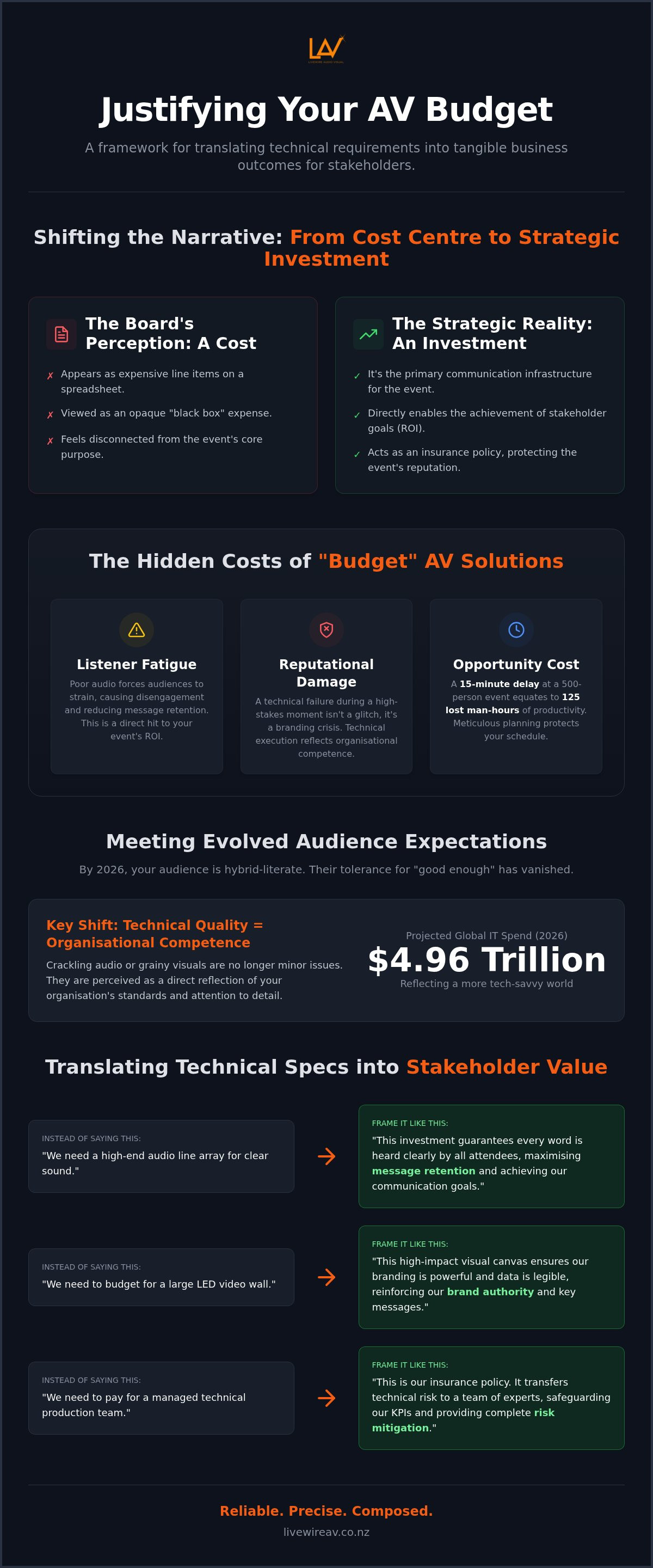
For many executive boards, AV appears as a series of expensive line items on a spreadsheet. They see hardware. They see cables. They see a "black box" expense that feels disconnected from the event's purpose. However, event planners recognise that these tools are actually the primary communication infrastructure. Without them, the message simply doesn't reach the audience. Reframing this perception is the first step in gaining approval for the resources you need.
To move the needle, you must speak the language of the boardroom. This starts with a clear understanding of Return on Investment (ROI). In a production context, AV ROI is the direct correlation between technical precision and the successful achievement of stakeholder goals. High-quality production isn't a luxury; it's the delivery vehicle for your strategic objectives. When the technology works perfectly, it amplifies your message. When it fails, it obscures it entirely.
By 2026, audience expectations have evolved alongside a projected global IT spend of $4.96 trillion. Your attendees are now hybrid-literate. They've spent years engaging with high-definition digital content, and their tolerance for "good enough" audio or grainy visuals has vanished. If the audio crackles or the vision lags, your brand authority suffers immediate, measurable damage. Modern audiences equate technical quality with organisational competence.
The Psychology of Stakeholder Approval
When justifying AV budget to stakeholders, you're often speaking to a CFO who prioritises risk mitigation and measurable rewards. They don't need to hear about lumen counts or kilohertz. Instead, focus on how technical stability protects the event's primary KPI, whether that's lead generation or internal cultural alignment. Frame the spend as an insurance policy against technical failure. Reliable production ensures the message is heard, understood, and acted upon, which directly influences the success of the entire project.
The "Invisible" Value of Seamless Production
The mark of a truly professional production is that the audience never notices the technology. It remains invisible. This seamlessness reinforces brand trust. When a keynote speaker transitions perfectly between slides while being heard clearly in every corner of the room, it reflects the organisation's own commitment to excellence. This is why many planners view premium event production New Zealand wide as a necessary safety net. A seasoned technical director doesn't just push buttons; they protect your reputation by managing every variable before it becomes a problem.
Quantifying Risk: The Hidden Cost of "Budget" AV Solutions
Choosing a lower-cost AV provider often seems like a pragmatic way to manage event overheads. However, this decision frequently introduces hidden "friction costs" that can undermine the entire project. When justifying AV budget to stakeholders, it's essential to discuss the psychological impact of technical quality. Poor audio doesn't just sound bad; it causes listener fatigue. When an audience must subconsciously strain to process a speaker's voice, they disengage. This loss of attention is a direct hit to your event's ROI, as the primary message fails to take root.
Reputational damage is another significant, though less visible, risk. Consider the implications of a failed CEO keynote on a national livestream. A technical drop-out or a vision switching error isn't merely a glitch. It's a branding crisis. In a high-stakes environment, the technical execution is a reflection of the organisation's own standards. Opting for "dry hire" equipment rentals might save money upfront, but it places the burden of technical success onto the organiser. A managed technical production fee, by contrast, transfers that risk to a team of experts whose sole focus is preventing failure.
Opportunity cost also plays a role in the budget discussion. Technical delays are expensive. If a 500-person event is delayed by just 15 minutes due to vision issues, the organisation has effectively lost 125 man-hours of productivity. Meticulous planning and reliable infrastructure ensure the schedule remains intact. If you are preparing for a critical presentation, it's often more cost-effective to partner with a team that provides full technical production rather than risking the schedule on unmanaged gear.
The Real Price of Technical Failure
Beyond the immediate event, poor technical quality impacts your post-event marketing assets. Grainy video recordings or distorted audio files are unusable for future promotional campaigns. There's also the very real risk of social media blowback. In 2026, attendees are quick to share technical blunders in real-time, which can tarnish a brand's digital presence for years. Furthermore, unmanaged lighting and rigging present physical safety and compliance risks that a professional production team is trained to mitigate through rigorous site inspections and load-bearing calculations.
Insurance via Expertise
Paying for a seasoned technician is the most effective way to insure your event against disaster. These professionals provide the "Zero-Failure" infrastructure required for high-stakes environments. They possess the venue-aware knowledge to anticipate power surges, signal interference, or acoustic challenges long before the first guest arrives. This is why high stakes event technical support is best viewed as an insurance policy. It provides the composure and control necessary to ensure your work takes centre stage without distraction.
Translating Technical Specs into Stakeholder Value
To bridge the gap between technical requirements and financial approval, you must translate hardware specifications into strategic benefits. Stakeholders often view a quote as a list of parts rather than a solution. By using a "Specs-to-Value" framework, you can demonstrate how each item contributes to the event's success. This level of precision is vital when justifying AV budget to stakeholders who prioritise message delivery over technical flair. Consider the following direct correlations:
LED Walls: High brightness and fine pixel pitch ensure content remains legible under stage lights, enhancing brand authority and social shareability.
Audio Line Arrays: Even sound distribution eliminates "dead spots" in the room, which directly supports information retention and attendee engagement.
Intelligent Lighting: Purposeful design moves beyond "atmosphere" to provide audience direction, ensuring the eye is always focused on the primary speaker or product.
The mark of a seasoned partner is the ability to show exactly why a specific piece of gear is necessary for the organiser's peace of mind. When you explain that a certain audio configuration prevents "listener fatigue," you're no longer talking about speakers; you're talking about the audience's ability to absorb the CEO's message. This pragmatic approach shifts the conversation from "what we're hiring" to "what we're achieving."
Visual Impact and Brand Perception
In the context of modern corporate summits, conference LED screen hire NZ has become a baseline requirement for maintaining professional standards. There's a profound difference between simply seeing the slides and truly experiencing the brand. High-resolution displays allow for complex data visualisation and cinematic video that commands attention. For hybrid attendees, vision switching creates a broadcast-quality experience that prevents the "second-class citizen" feeling often associated with remote participation. It ensures the digital audience feels as valued as those in the room.
Audio Clarity as an Accessibility Requirement
Precision audio is increasingly viewed through the lens of inclusivity. When planning audio visual for large conferences, line array systems are essential for ensuring every seat in the house receives the same acoustic value. This is a matter of accessibility. Attendees with hearing impairments or those for whom English is a second language rely on crystal-clear sound to follow the proceedings. In hybrid environments, the business case for zero-latency audio is equally strong. Any delay between the vision and the sound breaks the immersion, leading to immediate disengagement from your remote audience.
Building Your Business Case: A Framework for Approval
Securing approval requires a shift from technical requests to a structured business case. When justifying AV budget to stakeholders, you need a methodical approach that replaces ambiguity with evidence. This framework ensures your proposal is viewed as a strategic necessity rather than a negotiable expense. By following these four steps, you can present a case that speaks directly to the Board’s priorities.
Step 1: Alignment. Connect every AV line item to a specific event objective. If the goal is high-level networking, justify the audio line array as the tool that ensures every conversation is heard without strain.
Step 2: Benchmarking. Show how premium technicals compare to 2026 industry standards. With AV over IP now used in 77.1% of corporate projects, falling behind suggests a lack of innovation.
Step 3: Transparency. Use detailed proposals to demystify technical costs. Break down the "Labour vs. Gear" ratio so stakeholders understand they're paying for expertise, not just hardware.
Step 4: The "Plan B". Demonstrate the redundancy and contingency planning included in the fee. Industry standards recommend a 10-15% contingency for unexpected needs, providing a buffer that protects the event's integrity.
The Power of Visual Proposals
Abstract concepts often lead to budget cuts. 3D renders and detailed floor plans allow stakeholders to "see" the investment before the event begins. This visual clarity helps justify tiered options, such as an "Essential" package versus a "Signature" experience. It’s easier to approve a budget for an LED wall when the Board can see how it transforms the room’s brand authority. You aren’t just hiring gear; you’re investing in the people who operate it. High-quality production relies on technicians who possess the composure to handle complexity under pressure.
Addressing the "Venue-Provided AV" Objection
In-house systems often seem like a cost-effective choice, but they frequently lack the flexibility required for bespoke branding. External technical management provides unbiased quality control. A dedicated partner ensures the equipment is tailored to your specific goals rather than the venue's convenience. This is particularly critical for a hybrid conference AV setup NZ, where the complexity of vision switching and livestreaming requires a level of focus that standard venue packages rarely provide. For a truly seamless result, consider a comprehensive technical production partner who manages every detail from the first site visit to the final pack-out.
Partnering for Performance: Why LivewireAV is the Logical Choice
When the pressure of a live event arrives, the most valuable commodity is technical composure. We provide total technical control for organisations across New Zealand, ensuring your brand's message is delivered without interruption. By focusing on outcomes rather than just hardware lists, we simplify the process of justifying AV budget to stakeholders. This transparency helps you demonstrate that the technical spend is a direct investment in your event's success. You aren't merely renting equipment; you're securing a partnership that prioritises precision, reliability, and technical excellence.
Our approach is grounded in the reality of high-stakes environments. We act as the steady hand behind the scenes, possessing the deep technical knowledge required to handle complexity while remaining invisible enough to let your work take centre stage. This disciplined focus on execution is what earns the trust of event planners who cannot afford a single point of failure.
A Decade of High-Stakes Experience
With over 10 years of experience in high-pressure environments, we've developed a methodical approach to event execution. Our track record spans corporate conferences, sporting events, and complex outdoor productions where precision is non-negotiable. We understand that a successful event relies on the people behind the consoles. Our technicians are the core of our service. They possess the composure required to thrive under pressure and value clear, honest communication above all else. This expertise is the primary driver of our precise execution, ensuring that every audio line array and LED wall performs exactly as intended.
Seamless Integration from Site Visit to Showtime
Meticulous planning is the only way to prevent budget blowouts and technical surprises. Our process begins with venue-aware logistics and detailed technical site visits. These visits are essential for validating the final budget. They allow us to account for power requirements, rigging points, and acoustic challenges long before the first guest arrives. By managing the entire technical lifecycle, we reduce the "hidden costs" often associated with fragmented event planning. This end-to-end management provides a consistent level of quality across the entire country, ensuring regional variability never impacts your brand's reputation.
We don't just hire gear; we manage the technical success of your brand. Our national reach allows us to deliver seamless, stress-free solutions where every detail has been accounted for. To secure the technical success of your next project and gain confidence in justifying AV budget to stakeholders, contact LivewireAV for a tailored technical proposal that aligns with your strategic goals.
Securing Technical Excellence for Your 2026 Events
The transition from viewing AV as a cost to seeing it as a strategic asset is essential for modern event success. By focusing on the "invisible" value of seamless production, you protect your organisation's brand authority and ensure your message reaches every attendee without distraction. Successfully justifying AV budget to stakeholders requires a shift toward risk mitigation and measurable outcomes. You're not just requesting equipment; you're securing the composure and control necessary for high-stakes environments.
With over 10 years of technical excellence in high-pressure corporate settings, we provide the steady hand required to manage complex logistics across New Zealand. Precision. Composure. Reliability. Our national coverage ensures consistent, venue-aware execution regardless of your event's location. When you prioritise meticulous planning and professional expertise, you eliminate the friction of technical failure.
If you're ready to align your technical spend with your strategic goals, request a tailored technical proposal from LivewireAV. We'll help you build a compelling business case that ensures your next event is flawless, impactful, and entirely secure.
Frequently Asked Questions
How do I explain the difference between "AV hire" and "technical production"?
AV hire refers to the simple procurement of equipment, whereas technical production involves the comprehensive design, setup, and management of those systems. For high-stakes events, you aren't just paying for speakers; you're paying for a managed outcome. A production partner takes total technical control, ensuring that every cue is met and every speaker is heard. This distinction is vital when justifying AV budget to stakeholders who might assume gear alone is sufficient.
Can we save money by using the venue’s built-in sound system?
While using in-house systems can seem like a saving, these setups are often generic and lack the flexibility required for bespoke branding. Venue-provided audio is frequently designed for background music rather than crystal-clear keynote delivery. Bringing in a dedicated audio line array ensures even sound distribution across the entire room. This precision prevents listener fatigue and guarantees that your organisation's message isn't compromised by the limitations of a standard venue package.
What are the most common hidden costs in an AV budget?
The most common hidden costs include freight logistics, specialised power requirements, and venue rigging fees. Many organisers also overlook the cost of last-minute content changes or additional equipment needed after the initial site visit. Industry standards for 2026 suggest building a 10-15% contingency into your budget to account for these variables. This transparency allows for a more accurate financial forecast while protecting the integrity of the technical production.
How do I justify the cost of on-site technicians to my Board?
On-site technicians are the insurance policy that protects your event from technical failure. They provide the composure and expertise required to handle complex vision switching and audio mixing in real-time. In high-pressure environments, having a seasoned professional at the console ensures that any glitches are resolved before the audience notices. This peace of mind is a primary factor in justifying AV budget to stakeholders who prioritise a seamless brand experience.
What is the ROI of an LED wall compared to traditional projection?
LED walls offer superior brightness and contrast compared to traditional projection, particularly in rooms with significant ambient light. This visual clarity directly impacts brand authority and social shareability. While projection can wash out under stage lights, LED panels maintain their impact, ensuring your content looks professional in every photograph. The ROI is found in increased attendee engagement and the high-quality digital assets produced for post-event marketing campaigns.
How does hybrid event production affect the overall budget?
Hybrid production requires additional investment in camera packages, vision switching, and reliable livestream infrastructure. It shifts the event from a local presentation to a broadcast-quality production. While this increases the initial spend, it significantly expands your audience reach and provides a permanent archive of the event. Budgeting for zero-latency audio and high-definition vision ensures that remote attendees feel as valued and engaged as those present in the room.
What should I look for in a technical production proposal?
A professional proposal should offer total transparency regarding equipment specifications, labour ratios, and logistical fees. Look for a detailed breakdown that connects each technical item to a specific business outcome. The proposal must also outline redundancy plans and contingency measures. A clear, well-considered document reflects the provider's meticulousness and venue-aware knowledge, giving you the confidence to present the business case to your Board with total clarity.
How early should I involve an AV partner in the budgeting process?
You should involve an AV partner during the initial site selection or as soon as the event goals are defined. Early collaboration allows for a technical site visit that can identify potential budget blowouts before they occur. A seasoned partner provides the steady hand needed to align your technical requirements with the venue's capabilities. This proactive approach ensures that the final budget is grounded in reality and fully accounted for long before the first guest arrives.


Comments