Large Scale Event Sound Systems: The Expert Guide to High-Stakes Audio
A high-stakes keynote doesn't fail because the speakers aren't loud enough; it fails because the engineering lacked the precision to handle the room's physics. When you're managing thousands of attendees in a cavernous exhibition centre, the margin for error is non-existent. Clarity. Consistency. Control. You've likely felt that familiar knot of anxiety as a presenter walks on stage, wondering if the audio will drop out or if the back rows will only hear a muddy wash of echoes. Mastering large scale event sound systems requires more than just high-end hardware; it demands a disciplined, methodical approach to acoustic design and signal integrity.
We understand that your primary goal is total peace of mind. You need to know that every syllable is intelligible, whether a guest is sitting in the front row or the furthest corner of the gallery. This guide will show you how to navigate the technical complexities of professional sound engineering to ensure your message carries clearly across any venue. We will examine the importance of tailored acoustic modelling, the seamless integration of audio with LED walls, and the latest networking standards like Dante Controller 4.17 that keep modern productions stable and secure.
Table of Contents
The Science of Sound at Scale: Why Large Events Demand More Than Just Volume
Line Array Systems and SPL: The Backbone of Modern Event Audio
Navigating Acoustic Challenges: Indoor Halls vs. Outdoor Arenas
The Engineering Roadmap: From Site Visits to Zero-Failure Execution
Partnering for Precision: Ensuring Your Message Carries Across the Venue
The Science of Sound at Scale: Why Large Events Demand More Than Just Volume
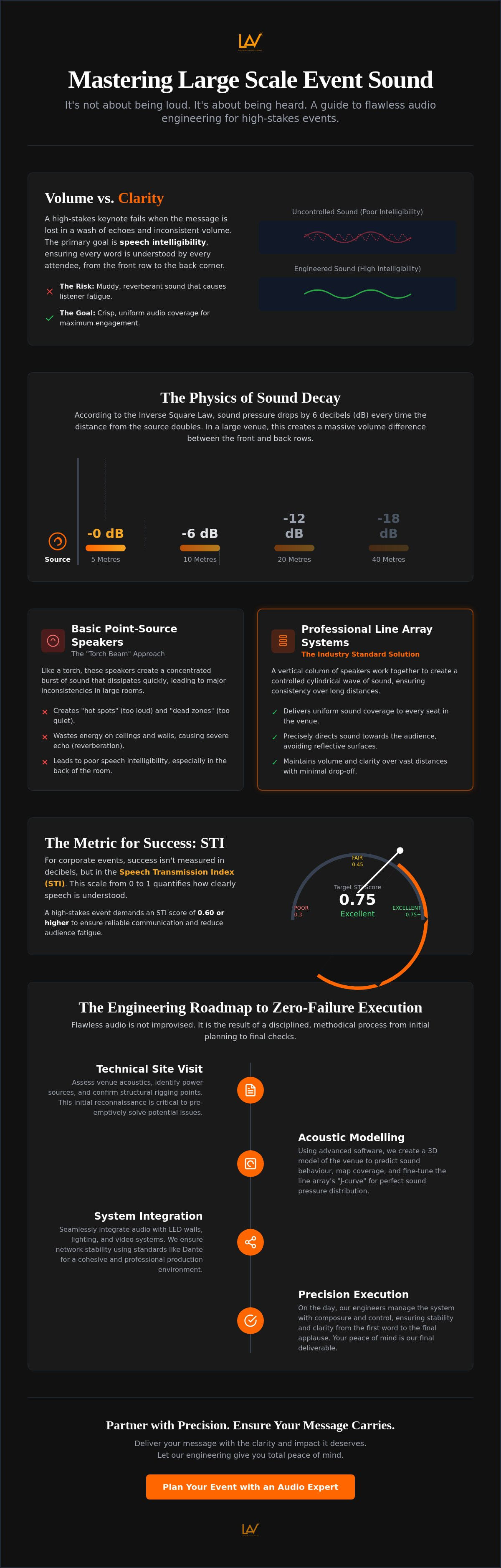
Large scale audio is an exercise in physics. It involves the precise management of acoustic energy across vast, complex spaces where standard equipment often falls short. A professional sound reinforcement system must do more than just amplify a voice; it must overcome the natural decay of sound waves. According to the inverse square law, sound pressure levels drop by 6 decibels for every doubling of distance from the source. In a 50-metre room, the difference between the front row and the back is immense. Without sophisticated engineering, you're left with a choice between deafening your front-row VIPs or losing your message entirely for those at the rear.
Success in large scale event sound systems rests on three pillars: coverage, clarity, and control. Coverage ensures the sound is uniform across every seat. Clarity ensures every syllable is distinct. Control allows engineers to direct energy away from reflective surfaces like glass walls or high ceilings, preventing the muddy wash that ruins professional presentations. Precision. Composure. Reliability. These are the standards required when the stakes are high.
The Problem with Basic PA Systems
Basic point-source speakers, often used in smaller settings, function like a torch beam. They provide a concentrated burst of sound that dissipates rapidly. In a large exhibition centre or outdoor arena, this creates hot spots near the stage where the volume is uncomfortable, while dead zones emerge in the corners. High-ceiling venues further complicate this through reverberation. When sound bounces off hard surfaces, it returns to the audience slightly delayed. This creates a chaotic environment where speech becomes unintelligible and the speaker's impact is lost.
Intelligibility: The Key Metric for Success
For a corporate keynote, loudness is secondary to intelligibility. Engineers measure this using the Speech Transmission Index (STI), a scale from 0 to 1 that quantifies how well speech is understood in a specific environment. A high-stakes event requires an STI score of at least 0.60 for reliable communication. Achieving this in a noisy venue requires a system that can cut through background hum and venue echoes without relying on sheer volume. Clear sound reduces listener fatigue. It keeps the audience engaged. It ensures your message is not just heard, but fully understood by every guest in the room.
Line Array Systems and SPL: The Backbone of Modern Event Audio
Reliability in a large venue depends on the predictable behaviour of sound. For large scale event sound systems, line array technology is the non-negotiable industry standard. Unlike traditional speakers that radiate sound in a spherical pattern, a line array consists of multiple identical loudspeaker units coupled in a vertical column. This configuration creates a cylindrical wave. Because energy is focused horizontally rather than wasted on ceilings or floors, the sound carries further with less drop-off in volume. It's a matter of efficiency. Precision. Stability.
A complete system requires a full frequency response to feel professional. While the main arrays handle the mid and high frequencies where speech lives, subwoofers provide the necessary weight for videos or walk-on music. High-quality Audio Line Array Systems are designed to deliver this power without distortion, ensuring that even at higher volumes, the audio remains clean and composed. This technical balance is what allows a message to feel authoritative rather than merely loud.
How Line Arrays Control Coverage
The physical arrangement of a line array is rarely straight. Technicians use a "J-curve" to physically angle the lower speakers toward the front rows while the top speakers fire straight to the back. This ensures that the sound pressure is balanced throughout the room. Before a single motor is turned, we use acoustic modelling software to map how the sound will disperse. This level of preparation is vital for identifying potential acoustical challenges for sound within the venue. By controlling the vertical spread, we can keep the audio off the stage, which prevents the dreaded feedback that can derail a presenter's momentum.
Managing Sound Pressure Levels (SPL)
Sound Pressure Level, or SPL, is the metric used to quantify the intensity of the audio. The target SPL varies significantly based on the event's purpose. A corporate conference might aim for a consistent 80 to 85 dBA to ensure clarity without discomfort. In contrast, a sporting event might push higher to build excitement. However, safety and regulation are always the priority. For instance, OSHA standards mandate a hearing conservation program if the 8-hour time-weighted average reaches 85 dBA. Our goal is to maintain a consistent impact while adhering to local noise regulations, ensuring every guest has a safe and premium experience.
Navigating Acoustic Challenges: Indoor Halls vs. Outdoor Arenas
Every venue possesses a unique acoustic signature that dictates how energy moves through the space. In New Zealand, event organisers often transition between modern, glass-heavy exhibition centres and expansive outdoor arenas. The technical requirements for large scale event sound systems shift dramatically between these environments. Indoor spaces are defined by reflection and reverberation. Outdoor settings are at the mercy of atmospheric variables. Precision. Composure. Control. Success depends on a venue-aware approach that prioritises signal integrity over raw power.
Managing these variables requires a combination of sophisticated modelling and on-site adjustments. Whether we are taming the harsh reflections of a concrete warehouse or compensating for a crosswind at a stadium, the goal remains the same. Every attendee deserves a consistent, clear experience. By utilising delay speakers and strategic acoustic treatments, we can create a uniform sound field that feels intimate, regardless of the venue's scale. It's about ensuring the person in the back row feels as engaged as the person in the front.
Indoor Dynamics: Taming the Echo
Large, rectangular corporate halls are notorious for "slap-back" echoes. This occurs when sound travels from the stage, hits a hard rear wall, and returns to the presenters with a noticeable delay. It's disorienting for speakers and muddy for the audience. We combat this by using directional audio arrays to keep energy focused on the seating zones rather than the walls or ceiling. It's also vital to account for the audience itself. A room full of people acts as a significant acoustic absorber, often "drying out" a room that sounded echoey during the morning soundcheck. Our engineers monitor these shifts in real-time to maintain a balanced mix as the room fills.
Outdoor Productions: Fighting the Elements
When moving a production outside, the air becomes an unpredictable variable. Wind. Temperature. Humidity. These elements all play a role in how your message is received. Wind is the primary enemy of high-frequency audio; a strong gust can physically deflect sound waves, causing the audio to "shimmer" or fade for guests downwind. For a successful Outdoor Event Production NZ, equipment must be robust and weather-proofed against the local climate. We also manage sound "carry" meticulously. Precision in our speaker aiming ensures we provide high-impact audio for your guests without disturbing neighbouring residential areas or businesses across the ditch.
The Engineering Roadmap: From Site Visits to Zero-Failure Execution
A flawless production isn't the result of luck; it's the outcome of a disciplined engineering roadmap. When deploying large scale event sound systems, the margin for error is eliminated through meticulous preparation and technical oversight. Our process begins long before the first speaker is rigged. We treat every high-stakes event as a mission-critical operation where precision and composure are the baseline requirements. From the initial venue assessment to the final live cue, every step is designed to project a sense of total technical control.
The live environment demands a steady hand behind the scenes. The Front of House (FOH) engineer serves as this anchor, managing the mix with a focus on consistency and clarity. By utilizing digital mixing consoles, we can program precise, repeatable audio cues that ensure the transition from a video package to a live speaker is seamless. This methodical approach allows the technology to remain invisible, letting your work take centre stage without the distraction of technical hiccups.
The Vital Technical Site Visit
The foundation of a successful event is the technical site visit. We don't rely on generic floor plans or outdated venue specs. Our team physically assesses rigging points and weight capacities to ensure heavy line arrays can be suspended safely. We also identify power requirements to avoid tripping circuits during peak loads, especially when sound is integrated with high-draw LED walls. Measuring the venue’s natural RT60, or reverberation time, allows us to create accurate acoustic models. This level of detail is a core component of technical site visits for events, ensuring the system is tailored to the room's specific physics.
Built-in Redundancy and Fail-safes
Reliability is built through layers of protection. We implement dual-redundant digital audio networks, often using Dante Controller 4.17 or later, to ensure that if one cable fails, the audio continues without a millisecond of interruption. Signal redundancy is the practice of running parallel audio paths to eliminate any single point of failure. This philosophy extends to the mixing position. We use Uninterruptible Power Supplies (UPS) for the digital mixing consoles, protecting the programme against sudden venue power drops. For presenters, we always employ a "hot-spare" microphone strategy, where a secondary, live mic is ready to be handed over instantly if needed.
Precision. Stability. Composure. These are the standards we bring to every venue. If you are planning a high-stakes production, you can enquire about our full technical production services to ensure every detail is accounted for long before the first guest arrives.
Partnering for Precision: Ensuring Your Message Carries Across the Venue
Selecting a partner for large scale event sound systems is a decision that moves beyond equipment lists and technical specifications. It is about securing a technical safety net. In high-stakes environments, you need a team that possesses the quiet confidence to handle complexity while remaining invisible enough to let your content take centre stage. LivewireAV positions itself as that steady hand. We understand that precision and composure are your most valuable commodities when the room is full and the lights go down. By choosing a full-service production partner, you eliminate the logistical friction that often occurs when multiple vendors attempt to coordinate across different departments.
Our philosophy is grounded in the belief that excellence is a standard requirement, not an occasional achievement. We don't just provide hardware; we provide a collaborative partnership that prioritises reliability over flashiness. This methodical approach ensures that every detail, from the rigging points to the signal redundancy, has been accounted for long before your first guest arrives. When the technology works seamlessly, your audience stays focused on the message, not the mechanics of the room. Stability. Focus. Results.
Seamless Integration of Audio and Visuals
Sound does not exist in a vacuum. For a truly professional impact, your audio cues must be perfectly coordinated with live event lighting design and high-impact video content. Whether it's a dramatic walk-on sequence or a synchronized reveal on massive LED walls, the timing must be frame-accurate. This is where the role of the Technical Director becomes vital. They act as the single point of oversight, ensuring that the audio engineers, lighting designers, and vision switchers operate as a single, cohesive unit. This level of integration prevents the disjointed feel that can undermine even the most expensive productions.
The LivewireAV Approach: Calm, Professional, Precise
We operate with a venue-aware mindset. Rather than forcing a generic setup into a space, we adapt our engineering to the specific acoustics and constraints of the environment. Our commitment to modern, well-maintained equipment is matched only by the expertise of our technicians who thrive under the pressure of live environments. We handle the technical heavy lifting so you can focus entirely on your guests and your delivery. It's a pragmatic, stress-free solution designed for those who cannot afford a technical failure. If you're ready to elevate your next project, you can contact us to discuss your next large-scale national production and experience a partnership built on consistent, high-quality execution.
Securing Your Message with Engineering Precision
Mastering large scale event sound systems is about more than just equipment; it's about the disciplined application of physics and planning. We have explored how line array technology and precise acoustic modelling ensure your message reaches every attendee with absolute clarity. From taming venue echoes to building redundant digital networks, the focus remains on total reliability. Precision. Composure. Control. These are the standards that transform a complex technical challenge into a seamless audience experience where every detail has been accounted for.
With over 10 years of technical event management experience across New Zealand, LivewireAV provides the steady hand required for high-stakes corporate environments. Our modern line array systems and digital mixing infrastructure are managed by expert technicians who understand that there are no second chances in live production. We handle the technical complexity so you can focus on your delivery with absolute confidence. We're here to ensure your message carries clearly across any venue, regardless of the scale or acoustic challenges.
Ready to ensure your next production is flawless? Discuss your large-scale event audio with our expert team today. We look forward to partnering with you to deliver an event where every word is heard.
Frequently Asked Questions
What is the difference between a point source and a line array sound system?
Point source speakers radiate sound from a single point in a spherical pattern, while line arrays use vertical columns to create a focused cylindrical wave. Line arrays are the industry standard for large scale event sound systems because they carry sound further with less volume loss over distance. This efficiency ensures consistent coverage. Clarity. Control. It allows us to provide uniform audio across deep venues without deafening the front rows.
How many speakers do I need for an event with 2,000 attendees?
The specific speaker count depends on the venue's dimensions and acoustic profile rather than just the attendee number. For a 2,000-person audience, a typical configuration involves two main line array hangs of 8 to 12 cabinets each, supplemented by front-fill speakers and potentially delay towers. We use acoustic modelling to determine the exact requirements. Precision. Stability. Reliability. This ensures every guest receives clear, intelligible audio regardless of their seat.
Can we use the venue’s built-in sound system for a large conference?
Venue systems are generally designed for background music or basic paging and rarely meet the standards required for high-stakes corporate keynotes. They often lack the directional control and frequency response needed for speech intelligibility at scale. For a professional result, we recommend a dedicated system tailored to your specific programme and audience layout. This approach avoids the muddiness and dead zones common in built-in ceiling speakers.
What is SPL and why does it matter for my event?
Sound Pressure Level (SPL) is the measurement of acoustic intensity or volume in a space. It matters because consistent SPL ensures the person in the back row hears as clearly as the person in the front. We monitor SPL to maintain a comfortable environment while adhering to safety regulations, such as the OSHA 85 dBA action level for hearing conservation. Our goal is impact without discomfort. Safety. Clarity. Impact.
How do you prevent audio feedback when presenters move around the stage?
We prevent feedback through precise speaker placement and directional audio management. By angling line arrays away from the stage and using sophisticated digital processing, we ensure the presenter's microphone doesn't pick up its own amplified signal. Our engineers monitor the frequencies in real-time, making subtle adjustments to attenuate problematic tones before they become audible. This allows your speakers to move freely with total technical confidence.
What kind of redundancy should I expect from a professional audio provider?
You should expect dual-redundant digital networks and secondary power solutions for all mission-critical components. This involves running parallel audio paths via protocols like Dante and using Uninterruptible Power Supplies (UPS) for mixing consoles. We also provide "hot-spare" microphones and backup hardware to eliminate any single point of failure. Redundancy is not an option; it is a standard requirement for high-stakes large scale event sound systems.
How does wind affect sound quality at outdoor sporting events?
Wind physically deflects high-frequency sound waves, which can cause the audio to fade or "shimmer" for guests located downwind. Temperature and humidity also play a role in how sound travels over long distances. We compensate for these atmospheric variables by using high-output arrays and real-time EQ adjustments to maintain clarity against the elements. Our technicians remain venue-aware, adjusting the mix as weather conditions shift throughout the day.
Do I need a separate sound system for a livestream or hybrid event?
While the physical speakers in the room remain the same, a separate "broadcast mix" is essential for a high-quality livestream. The audio requirements for a remote audience differ from those in the room, necessitating dedicated signal processing and independent level control. This ensures both your in-person guests and remote viewers receive a clear, professional feed. We manage these separate signal paths simultaneously to ensure a seamless experience for all audiences.


Comments