How to Budget for Event Audio Visual: 2026 Guide
Updated: Aug 28
If you think the most expensive part of your event is the LED wall, try calculating the cost of a total technical failure during the keynote. Precision. Composure. Reliability. These are the traits that define a successful production, yet they are often the hardest to quantify when you are learning how to budget for event audio visual. We understand that planning a high-stakes event is a balancing act of ambition and restraint. You want a modern, immersive experience, but the anxiety of hidden fees appearing after the final curtain is a constant pressure. It's difficult to justify a significant investment when you aren't certain what happens behind the vision switcher.
This 2026 guide provides a pragmatic, professional framework to master the complexities of technical production while maintaining control over your bottom line. We'll detail the essential cost components for audio line arrays and intelligent lighting, provide a system to compare production quotes fairly, and give you the confidence to present a robust budget to senior stakeholders. By the end of this article, you'll have a clear roadmap to ensure your event's technical side is managed with meticulous care, keeping your message at the centre of the room.
Table of Contents
The Core Components of a Professional Event AV Budget
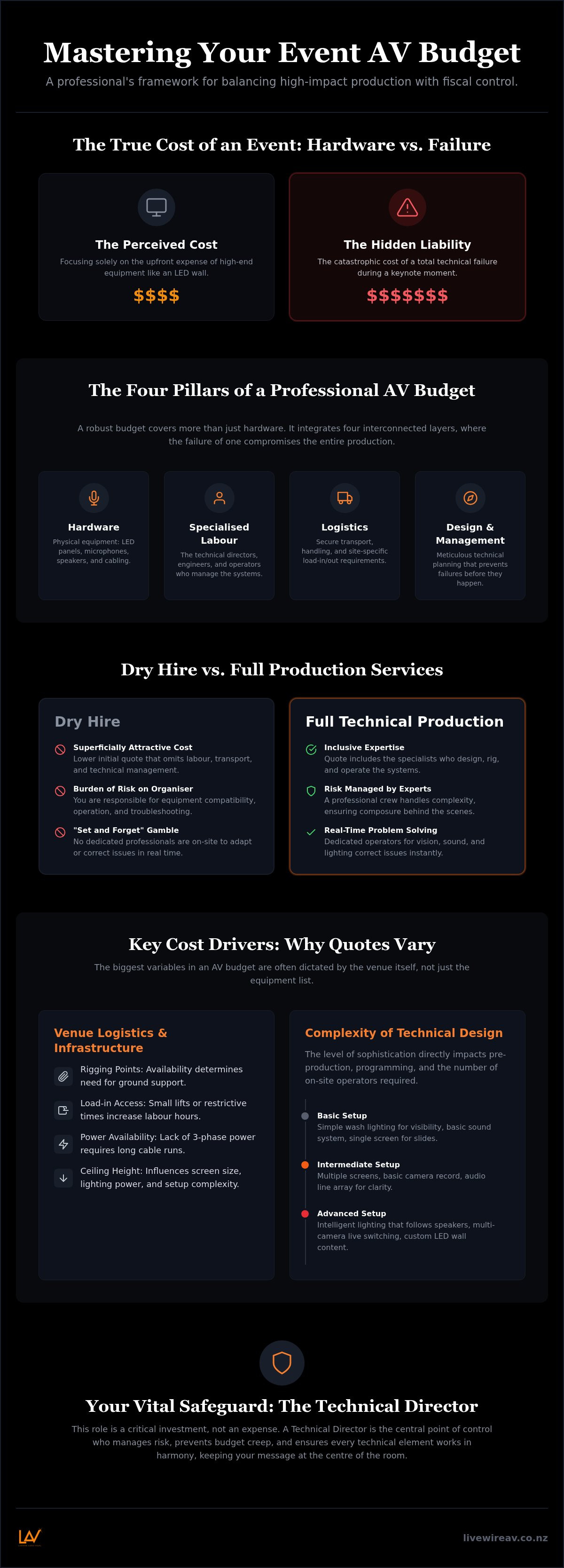
A professional budget accounts for more than just physical items on a pallet. It covers the Core Components of a Professional Event AV setup, which includes hardware, expert labour, and meticulous logistics. When you are determining how to budget for event audio visual, you must view these as interconnected layers. If one fails, the entire production is at risk. Hardware such as LED walls and audio line arrays provide the foundation, but technical management fees represent the "brain" that ensures these systems communicate seamlessly. Moving this specialised gear safely across New Zealand requires dedicated transport and handling, which is a logistical necessity often overlooked in early estimates.
Hardware vs. Professional Production Services
A dry hire quote might look attractive on paper, but it leaves the burden of risk on the organiser. Full technical production includes the specialists who design, rig, and operate the systems. Having dedicated operators for vision switching, sound, and lighting means that if a speaker’s lapel mic slips or a slide format is incorrect, there is a professional ready to correct it instantly. For high-stakes corporate environments, "set and forget" is a dangerous gamble. True value lies in the composure of a crew that handles complexity behind the scenes. Design. Rig. Operate. This disciplined approach ensures your presentation remains the focus of the room.
Defining Your Vision and Technical Scope
Precision starts with a storyboard. By mapping out the event flow early, you can identify which technical elements are essential and which are merely decorative. The venue itself dictates your baseline equipment requirements. High ceilings might necessitate more powerful lighting, while a room with poor acoustics requires a sophisticated audio line array to ensure clarity. Balancing "wow factor" visuals with essential clear audio is critical. A stunning LED wall loses its impact if the audience cannot hear the speaker. Understanding how to budget for event audio visual requires a clear-eyed look at these trade-offs. You want a budget that reflects a disciplined, results-oriented approach to event production rather than a collection of unnecessary gadgets.
Hardware Deployment: The physical LED panels, microphones, and cabling.
Specialised Labour: The technical directors and engineers who manage the environment.
Logistics: Secure transport and site-specific load-in requirements.
Design Fees: The technical planning that prevents failures before they happen.
Key Cost Drivers: Why Event Production Quotes Vary
Understanding how to budget for event audio visual requires looking beyond the itemised gear list. Often, the venue's physical architecture dictates the final price more than the equipment itself. A ballroom with no rigging points requires ground-supported trussing. This increases labour time and transport volume. Conversely, a modern plenary hall with pre-installed points might reduce setup hours but require specific venue-certified technicians. When organisers look at The Core Components of a Professional Event AV Budget, they often focus on what's visible on stage. However, the 'back of house' infrastructure is where quotes often diverge.
Venue Logistics and Infrastructure Requirements
Ceiling heights and rigging points directly influence your screen and lighting costs. In venues with low clearance, large LED walls may need to be split or ground-stacked. This changes the technical design and the crew required for the build. Access also plays a significant role. If a venue has a small goods lift or restrictive load-in times, the labour costs will reflect the extra hours needed to move gear. High-brightness LED walls also require significant power. Many older New Zealand venues don't have sufficient three-phase power in the room. This necessitates long cable runs or external distribution boards, adding logistical layers that aren't immediately obvious.
Complexity of the Technical Design
Technical complexity is a major driver of quote variation. A standard wash lighting setup provides basic visibility. An intelligent lighting design that follows a speaker across the stage requires pre-programming and a dedicated operator. The same logic applies to vision. Simple setups use one or two cameras. Complex vision switching for hybrid events requires managing a digital broadcast alongside the live room feed. This requires more specialised personnel and higher-spec equipment to maintain a zero-failure environment. Budgeting for redundancy, such as backup vision switchers or secondary audio consoles, ensures your event remains seamless even if a primary component fails.
Accurate planning prevents budget creep. A thorough technical site visit is the most effective way to identify these cost drivers before they become post-event surprises. This proactive approach allows you to understand how to budget for event audio visual with total technical control while ensuring your programme remains the centre of attention.
Strategic Allocation: LED Walls, Projection, and Sound Engineering
Allocation is a strategic exercise. It's about placing resources where they generate the highest return on audience engagement. When determining how to budget for event audio visual, the choice between different technologies should be driven by the venue's environment and the specific needs of your programme. High-definition LED walls and audio line arrays represent significant investments, but their impact on the clarity of your message is profound. A disciplined approach ensures you don't overspend on flashiness at the expense of technical stability. Precision. Composure. Reliability. These are the standards that should guide your spending.
Choosing Between LED Walls and Projection
LED walls offer superior brightness and contrast in rooms with high ambient light, whereas projection often requires complete blackout conditions to maintain image integrity. This makes LED the standard for modern plenary sessions where audience members need enough light to take notes or interact. Budgetary considerations for LED should focus on pixel pitch and resolution requirements. A tighter pitch ensures a crisp image for those in the front row. However, projection mapping remains a powerful tool for architectural impact, and using premium hardware from international specialists like SoundXcel ensures that the visual output remains sharp and professional. It can turn a venue's interior into a dynamic canvas, often providing a more cost-effective way to achieve a large-scale visual effect without the power requirements of large LED arrays.
Precision. Coverage. Clarity. These are the outcomes of professional sound engineering. Professional sound systems go far beyond simply being loud. They are about ensuring every attendee, regardless of their seat, receives the same high-quality experience. Line array systems are essential for large-scale clarity because they project sound in a controlled, directional manner that minimises echoes and dead spots. This level of engineering ensures that even the most nuanced keynote delivery is heard perfectly at the back of the room.
Effective sound design also requires budgeting for wireless frequency management. In busy event environments, managing the radio frequency (RF) spectrum is a critical safeguard against interference. This meticulous planning is part of The Human Element: Budgeting for Technicians and Management, ensuring that wireless microphones and in-ear monitors operate without interruption. By prioritising these technical foundations, you ensure that the visual impact of your event is supported by an invisible, zero-failure audio environment. This strategic allocation of funds protects the integrity of your event and provides the peace of mind that comes from total technical control.
The Human Element: Budgeting for Technicians and Management
Sophisticated equipment requires sophisticated operators. A common mistake when learning how to budget for event audio visual is underestimating the human expertise required to keep a production on track. Skilled labour is your best insurance policy. It protects you from technical failures and logistical oversights. Precision. Focus. Experience. These qualities are found in the crew, not the flight cases. Without a disciplined team, even the most modern hardware is just a collection of dormant tools. Investing in a professional crew ensures that your message remains the priority, while the technical complexity remains invisible.
The Value of Technical Management
A Technical Director acts as the safeguard for your event budget. They identify potential blowouts long before the first guest arrives. By coordinating multiple vendors, they ensure that the vision, audio, and lighting systems integrate without friction. They manage the technical run-sheet with surgical precision. This prevents costly overtime charges and ensures transitions are seamless. A Technical Director's involvement allows you to focus on your stakeholders while they maintain total technical control. They are the steady hand behind the scenes, thriving under pressure to keep your programme on schedule.
Labour Rates and On-Site Operation
Just as a Technical Director manages the budget and logistics for a corporate event, professional service providers in other sectors offer similar peace of mind. For those planning a destination wedding, Stevie Dee Wedding DJ provides expert resources on navigating local legal requirements and entertainment coordination.
Not all labour is equal. There is a distinct difference between setup crew who handle the heavy lifting and show operators who manage the live environment. Vision switchers, sound engineers, and lighting designers possess specialised knowledge that "cheap" labour simply cannot replicate. Errors in high-stakes environments are expensive. Accounting for travel and accommodation for these specialists is a pragmatic necessity for national event production across New Zealand. Local employment standards and shift requirements also dictate the rhythm of the technical crew. Clear communication regarding these costs ensures there are no surprises on the final invoice. A professional crew understands the logistical "why" behind their approach, ensuring every detail is accounted for long before the first guest arrives.
If you want to ensure your next event is supported by a disciplined, expert crew, explore our full technical production services for a zero-failure experience.
Maximising ROI: Partnering with an Expert Production Team
Return on investment in the technical space is measured by the absence of friction. When you are learning how to budget for event audio visual, the most valuable decision you can make is engaging a production partner early in the design phase. This collaboration transforms the relationship from a simple equipment hire into a strategic partnership. Early involvement allows for the refinement of technical designs, ensuring that every piece of hardware serves a specific purpose. It prevents the last-minute additions that often lead to budget creep. Precision. Composure. Strategic alignment. These are the markers of a well-managed production that respects your financial boundaries while delivering technical excellence.
Early Planning and Technical Site Visits
A technical site visit is the most cost-effective component of any AV budget. It's a pragmatic step that eliminates the "invisible" costs associated with venue constraints. By identifying power shortages or rigging limitations before the equipment arrives, you avoid the premium charges of emergency on-site solutions. This proactive approach ensures the technical team is venue-aware and prepared for any logistical challenge. Collaborating with experts during this phase allows you to leverage premium event production New Zealand to maintain consistency across your event calendar. It's about total control. Every detail is accounted for. Nothing is left to chance.
Risk Mitigation and Contingency
Budgeting for the unexpected is a hallmark of a disciplined professional. Allocating a small percentage of your budget for last-minute technical changes or script adjustments provides a vital safety net. This contingency isn't a sign of poor planning; it's a recognition of the dynamic nature of live events. For mission-critical sessions, the cost-benefit analysis of backup equipment is clear. Redundancy is the only way to guarantee a zero-failure environment. Managing audio visual for large conferences requires a different budget mindset, one that prioritises stability and risk mitigation over mere aesthetics. This structured approach ensures that when the lights go down and the first speaker takes the stage, your only focus is the message being delivered.
Secure Your Technical Production Strategy
Mastering technical excellence requires a disciplined approach to your finances. You've learned that understanding how to budget for event audio visual is as much about managing human expertise as it is about selecting the right hardware. By prioritising early site visits and engaging an experienced technical director, you eliminate the threat of hidden fees and ensure a zero-failure environment. Whether you are deploying modern LED walls or sophisticated line array systems, precision and composure remain your most valuable assets. This pragmatic framework allows you to justify every dollar spent to your senior stakeholders with absolute confidence.
If you are ready to secure a partner who values reliability over flashiness, request a bespoke technical production proposal from LivewireAV. Our modern equipment inventory and seasoned technical directors provide expert national event production across New Zealand. We specialise in high-stakes environments where precision is a standard requirement rather than an occasional achievement. Taking these steps now ensures your message stays at the centre of the room when the lights go down. Your next successful production starts with clear, honest communication and a well-considered plan.
Frequently Asked Questions
What is the most expensive part of an event AV budget?
High-definition vision systems and specialised labour are typically the largest components. An LED wall provides significant impact but requires a dedicated crew for rigging and operation. When you are learning how to budget for event audio visual, remember that hardware is only half the equation. The specialists who manage vision switching and sound engineering ensure these systems perform under pressure. This combination of modern inventory and expert management represents the primary investment in a professional production.
Can I save money by using the venue’s in-house audio visual equipment?
In-house equipment often carries hidden costs such as mandatory venue technician fees or restrictive "plug-in" charges. While it seems convenient, venue gear is frequently older and less reliable than modern production inventory. Bringing in an external production partner provides total technical control and equipment tailored specifically to your programme. This approach often prevents the post-event financial surprises common with venue-based contracts. It's about reliability, precision, and composure behind the scenes.
How much should I set aside for a technical contingency fund?
A pragmatic contingency fund should represent approximately ten to fifteen per cent of your total technical budget. This isn't for poor planning; it's a safeguard for last-minute script changes or unexpected venue requirements. Having these funds allocated early alleviates stress during the event week. It allows your technical director to manage minor adjustments without needing immediate financial approval. This disciplined approach ensures the production remains seamless despite any late-breaking changes or logistical hurdles.
Does a hybrid event double the AV budget compared to an in-person event?
Hybrid events don't necessarily double the budget, but they do require additional resources for vision switching and camera packages. You aren't just managing the live room; you are producing a digital broadcast. This involves extra bandwidth, streaming encoders, and specialised operators to manage the remote feed. While some audio components are shared, the vision requirements are more complex. Strategic planning ensures you invest only in the elements that impact both audiences equally.
Why do labour costs make up such a large portion of the AV quote?
Labour costs reflect the deep technical knowledge required to maintain a zero-failure environment. A professional crew includes vision switchers, sound engineers, and lighting designers who work across multiple days. This isn't just about the show hours; it includes the meticulous setup and pack-down phases. Skilled labour serves as your primary insurance policy. It ensures that every rigging point is secure and every signal path is redundant before the first guest arrives.
Is it cheaper to hire an LED wall or a high-end projector?
LED walls are often more cost-effective in bright venues because they don't require expensive blackout solutions. While high-end projectors are excellent for architectural mapping, they struggle with ambient light. An LED wall offers superior contrast and brightness, making it a high-value alternative for modern corporate sessions. The choice depends on your venue's light levels and the desired visual impact. Both require professional rigging, so the labour costs for either option often remain similar.
What technical questions should I ask before signing an AV proposal?
Ask about redundancy plans for mission-critical components such as vision switchers and audio consoles. You should also enquire about the power requirements for LED walls and whether the quote includes a technical site visit. Understanding the logic behind the crew numbers is also essential. A transparent proposal will detail the specific roles of each technician. These questions ensure you are comparing quotes fairly and that the technical side of your event is fully managed.
How far in advance should I involve a technical production company?
Involve your technical production team at least three to six months before the event date. Early engagement is critical for identifying venue constraints and refining the technical design. It allows for thorough site visits and prevents budget creep caused by last-minute equipment additions. For large-scale conferences across New Zealand, early planning ensures that the best inventory and most experienced technical directors are secured. This steady pace reinforces a stress-free solution where every detail is accounted for.


Comments