Solving Common Microphone Feedback Issues: A Complete Engineering Guide
Reaching for an equaliser the moment a sound system begins to howl is treating the symptom, not the cause. When a sudden, piercing squeal cuts across an executive address, rattling stakeholders and derailing room momentum, panicking behind the mixing desk only makes things worse. Solving common microphone feedback issues starts by stepping back from reactive notch filtering and looking at physical room geometry. Every engineer knows the stress of struggling for clean speech volume in reflective venues, or battling to keep a roving lapel microphone stable as a presenter walks across the stage.
Reliable sound demands discipline, precision, and preparation. By mastering the core principles of acoustic loop gain and transducer placement, you can maintain crystal-clear vocal audio across any corporate presentation or live gathering without compromising dynamic headroom. This guide breaks down the physical dynamics of feedback loops, methodical gain staging, and the practical boundary between smart loudspeaker deployment and corrective EQ to keep your live proceedings completely stable.
Table of Contents
What Causes Microphone Feedback in Live Audio Systems?
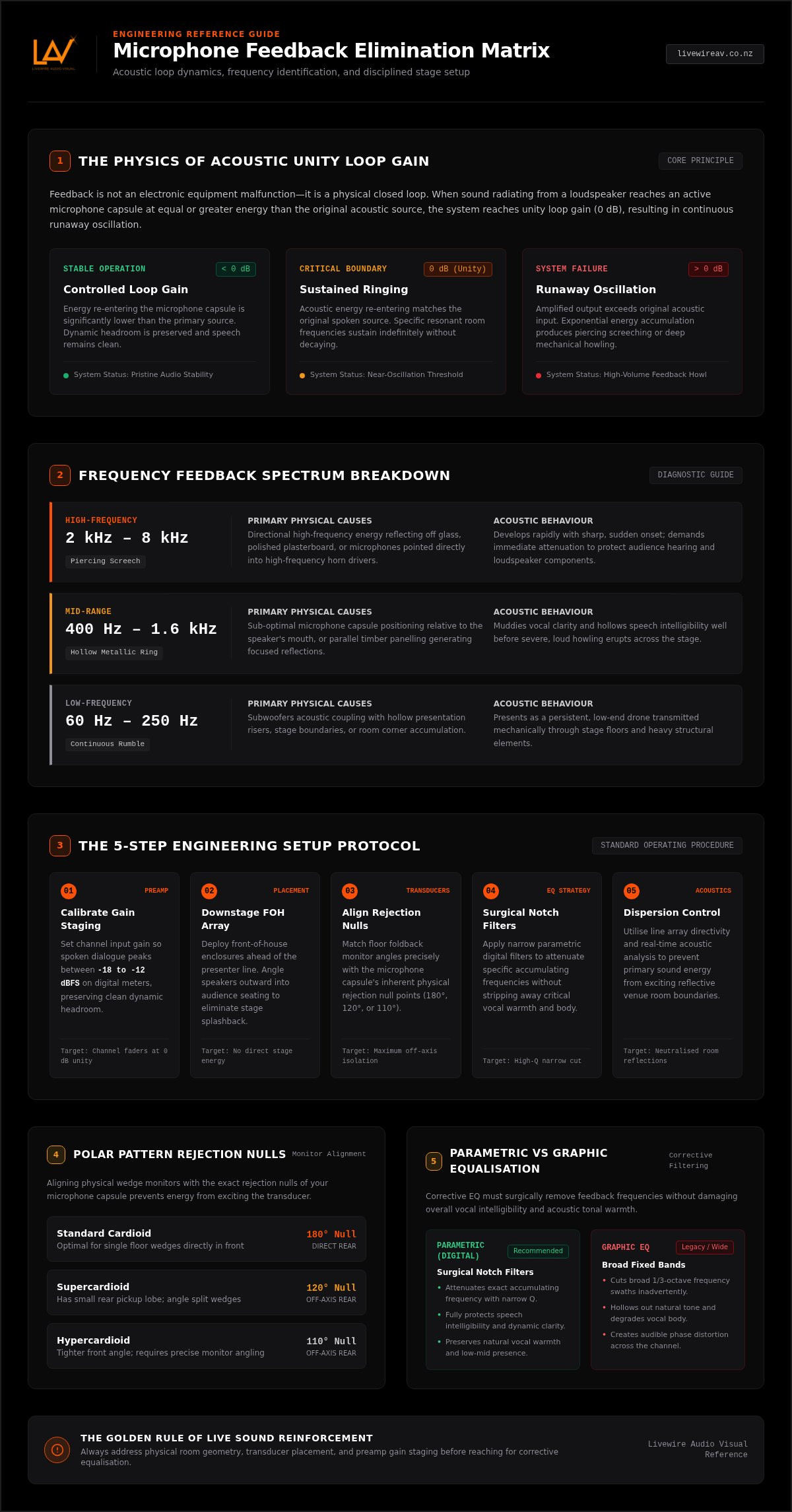
Acoustic feedback is not an electronic equipment malfunction. It is a closed loop of physical energy. The phenomenon occurs when amplified sound radiating from a loudspeaker travels through the air, re-enters an active microphone capsule, and gets sent through the mixing console to be re-amplified. When understanding what causes microphone feedback, engineers focus on loop gain. If the energy re-entering the microphone matches or exceeds the level of the original sound source, system loop gain reaches unity. At unity gain (0 dB), the audio signal sustains indefinitely. Any additional gain tips the system into runaway oscillation, producing an unbearable shriek or deep mechanical rumble.
Solving common microphone feedback issues requires recognising that this acoustic cycle is heavily frequency-dependent. Rather than all tones feeding back at once, the system destabilises at specific frequencies where acoustic energy accumulates fastest within the venue.
The Physics of the Acoustic Loop
Direct loudspeaker radiation is rarely the sole culprit in professional corporate setups. In typical conference halls, architectural boundaries dictate acoustic stability. Hard boundary surfaces such as floor-to-ceiling glass, polished plasterboard, and parallel timber panelling reflect acoustic energy back toward the presentation stage. When these reflections arrive at the capsule in phase with the primary sound source, they reinforce specific frequencies, causing loop gain to spike at those exact intervals. Proper gain staging keeps the loop gain safely below unity, preventing room reflections from triggering runaway oscillation.
Distinguishing High Squeals from Low Resonant Rumble
Feedback manifests differently across the frequency spectrum, each pointing to a distinct acoustic challenge:
High-Frequency Screeching (2 kHz to 8 kHz): Caused by directional energy bouncing off hard surfaces or microphones pointing too close to high-frequency horn drivers. It develops rapidly, demanding immediate attenuation to protect audience ears.
Mid-Range Ringing (400 Hz to 1.6 kHz): Presents as a hollow, metallic ring that muddies vocal intelligibility long before severe howling erupts. It often stems from poor capsule placement relative to the speaker's mouth.
Low-Frequency Rumble (60 Hz to 250 Hz): Generated by mechanical stage resonance or subwoofers coupling with hollow risers and corners, creating a continuous, low-end drone.
Mastering these mechanical distinctions enables systematic troubleshooting. Solving common microphone feedback issues becomes an exercise in controlled physical deployment rather than frantic, reactive knob-turning during high-stakes presentations.
How to Prevent Microphone Feedback: The 5-Step Engineering Setup
Eliminating acoustic feedback requires a strict order of operations. Predictable, methodical, and disciplined audio engineering stops system howling before presenters step onto the platform. When tackling live events, solving common microphone feedback issues is never about guessing; it is about establishing physical headroom through deliberate system calibration.
Step 1 & 2: Correct Gain Staging and Speaker Placement
Clean sound begins at the preamplifier. Set channel input gain so spoken dialogue peaks comfortably around -18 to -12 dBFS on digital meters, leaving clean dynamic headroom without driving preamps into saturation. Channel faders should sit close to unity gain (0 dB) for optimal signal-to-noise performance. Next, position all main front-of-house loudspeakers downstage, safely ahead of the presenter line. Angling speaker enclosures outward into audience seating keeps acoustic energy focused on patrons rather than splashing back onto stage surfaces.
Step 3: Aligning Microphones with Directional Rejection Nulls
Transducer geometry dictates stage stability. A standard cardioid microphone offers maximum rejection directly at its rear (180 degrees off-axis), making it ideal when floor wedges point straight up from the front. Supercardioid and hypercardioid capsules have a small rear pickup lobe, placing their true rejection nulls at 120 and 110 degrees respectively. Adapting The 5-Step Engineering Setup to align these physical null points with foldback wedges prevents stage monitors from exciting the capsule.
Steps 4 & 5: High-Pass Filtering and Resonant Frequency Notching
Engage a high-pass filter immediately on every vocal channel, rolling off frequencies below 80 Hz or 100 Hz. Spoken dialogue carries no useful information in this sub-audible register, but stage footfall, air handling units, and HVAC rumble will easily destabilise the low end. Once filtered, gently ring out the system during soundcheck by raising gain until a specific frequency starts to ring. Use a real-time analyser to isolate the resonant tone, then apply a narrow parametric cut with a tight bandwidth (Q of 8 to 12) to pull the peak below unity.
Methodical preparation guarantees stable vocal amplification without compromising tone. For complex national conferences where zero failure is tolerated, engaging a specialist partner for full technical production ensures every transducer, line array, and stage boundary is calibrated for seamless performance.
Parametric EQ vs Graphic EQ: Surgical Solutions for Stage Feedback
Equalisation is the final layer of protection, not the primary fix. Once gain structure and transducer angles are locked down, audio engineers rely on equalisation to suppress lingering room modes. Yet, choosing the wrong filter profile introduces new sonic compromises. Solving common microphone feedback issues requires understanding how filter curves interact with human speech, because excessive carving robs vocalists and corporate presenters of their natural presence.
The Limitations of 31-Band Graphic Equalisers
Traditional 31-band graphic equalisers divide the audio spectrum into fixed one-third octave bands. While familiar, a one-third octave slice is acoustically broad. Pulling down a 1 kHz fader by 6 dB does not merely suppress an isolated ringing tone. It scoops out a massive window between 891 Hz and 1120 Hz. When inexperienced operators yank down multiple adjacent faders to squash several squeals, the vocal body collapses. The presenter sounds thin, nasal, and distant. Analog graphic equalisers also introduce phase smearing across adjoining bands, degrading intelligibility when clarity is needed most.
Surgical Parametric Notching on Modern Digital Consoles
Digital consoles offer fully parametric filters that overcome these acoustic limitations through variable bandwidth (Q) control. While a standard graphic band operates at a fixed Q of roughly 4.3, a parametric notch filter can be tightened to a Q of 10, 14, or higher. This creates a razor-sharp cut that isolates a problem frequency precisely:
Targeted Attenuation: Applying a tight 2 dB to 4 dB cut directly on a room-excited harmonic stops oscillation cold without gutting neighbouring vocal frequencies.
Intelligibility Preservation: Retaining the natural consonant attack between 2.5 kHz and 4.5 kHz ensures speech cuts through large auditoriums effortlessly.
Phase Coherence: Narrower digital cuts cause far less phase distortion across the audible spectrum than sweeping banks of graphic faders.
Automated Feedback Destroyers: Strengths and Pitfalls
Hardware suppressors and digital console tracking plug-ins monitor incoming signals and drop narrow notch filters dynamically whenever they detect runaway resonance. While useful in uncrewed utility installations, relying entirely on automated processors during high-stakes presentations is risky. Auto-trackers act reactively, meaning a split second of audible squeal must occur before the software clamps down. More critically, dynamic algorithms often mistake sustained musical notes, video playback cues, or sharp vocal tones for feedback, dropping unneeded notches across your program mix. Solving common microphone feedback issues effectively demands thoughtful manual calibration during rehearsal, reserving automated suppression strictly as a silent safety net.
Solving Feedback on Common Microphone Types: Handheld, Lapel, and Headset
Capsule design and transducer placement govern physical isolation on a live stage. While front-of-house loudspeaker geometry establishes baseline headroom, real-world events involve roaming keynote speakers, panel discussions, and unpredictable presenter habits. Solving common microphone feedback issues requires matching the right capsule architecture to the presentation format, then enforcing strict physical placement standards before the event begins.
Overcoming Lavalier (Lapel) Microphone Instability
Lavalier capsules present the steepest gain-before-feedback challenge in live corporate production. Because lapels sit on the sternum roughly 15 to 20 centimetres below the speaker's vocal tract, the inverse-square law works against you. The capsule receives far less direct acoustic energy than a handheld microphone, forcing higher preamplifier gain to achieve equivalent speech loudness. In reflective venues, omnidirectional lavaliers pick up ambient room reverberation from every direction. Affix capsules along the central sternum line rather than off-centre lapels, and use smooth, optical-style digital leveling to suppress sudden vocal transients without pulling up ambient room noise during natural speech pauses.
Handheld Microphones and the Hazard of Capsule Cupping
Handheld dynamic microphones offer strong acoustic isolation, but only when handled correctly. A frequent hazard during corporate events occurs when an inexperienced speaker cups their fingers tightly around the metal grille. This innocent gesture blocks the rear acoustic ports engineered into directional cardioid capsules:
Loss of Directivity: Obstructing the rear ports transforms a directional cardioid pattern into an omnidirectional pickup, instantly destroying off-axis rejection.
High-Frequency Resonance: The user's enclosed hand forms an acoustic chamber that boosts resonant frequencies between 1 kHz and 3 kHz by up to 10 dB.
Immediate Oscillation: The combination of lost directional control and internal chamber resonance routinely tips the audio system into immediate howling.
Briefing talent to grip the lower chassis firmly maintains the capsule's designed polar response.
Why Headset and Earset Microphones Deliver Superior Gain-Before-Feedback
Head-worn miniature capsules eliminate the proximity problem inherent to chest-mounted lavaliers. Placing a directional micro-capsule just behind the corner of the presenter's smile line positions the transducer barely two centimetres from the sound source. This proximity delivers between 10 dB and 15 dB more acoustic input level into the console preamps compared to a lavalier. As a result, system operators require far less input gain, raising acoustic feedback margins dramatically while allowing mobile keynote speakers to walk stage boundaries with absolute composure.
Managing varied wireless hardware across multi-speaker conferences demands experienced supervision. To secure seamless vocal stability for your upcoming convention, book our audio line array systems and dedicated technical production team.
Acoustic Engineering and Professional Production: Ensuring Zero-Feedback Events
In complex architectural spaces, solving common microphone feedback issues transcends individual channel settings. Cavernous exhibition halls, glass-fronted pavilions, and high-ceiling auditoriums trap acoustic energy, bouncing reflections into active microphones regardless of capsule choice. True stability is achieved through system-level acoustic engineering, where loudspeaker dispersion control and spatial alignment contain the sound field before a single presenter takes the stage.
System Tuning and Real-Time Acoustic Calibration
Precision line array deployment isolates acoustic energy, directing audio onto seated delegates while steering it cleanly away from reflective rear walls and ceiling bulkheads. Rather than driving front-of-house arrays at excessive volumes to cover distant rows, seasoned engineers configure time-aligned delay zones down the length of the venue. This distributed topology maintains uniform speech clarity at moderate output levels, preventing front enclosures from overdriving the stage.
During soundcheck, engineers employ fast Fourier transform (FFT) measurement platforms such as SMAART alongside calibrated pink noise test signals. Analysing phase, transfer functions, and frequency response curves across the venue allows technicians to identify architectural resonances and calibrate DSP delays with precision. For event organisers coordinating enterprise gatherings, consulting our comprehensive resource on audio visual for large conferences reveals how pre-event acoustic mapping guarantees uniform listening clarity.
The Value of Dedicated Technical Management for High-Stakes Events
Even the most meticulously tuned system requires vigilant human oversight. Presenters turn off-script, step past speaker perimeters, or wander toward stage monitors. A dedicated front-of-house audio engineer actively rides vocal faders, tightening mute groups and anticipating speaker movements before loop gain approaches unity. Constant vigilance, rapid intervention, and steady composure keep the mix controlled.
Beyond acoustic monitoring, technical directors coordinate radio frequency (RF) spectrum across the floor. Congestion in modern venues frequently induces wireless dropouts and spurious noise bursts that destabilise automated console stages. Dedicated live sound engineers continuously track RF signal strength, antenna distribution, and intermodulation distortion across all wireless channels. When executive reputations are on the line, solving common microphone feedback issues relies on disciplined execution and seasoned live engineering. Review our detailed guide on premium event production New Zealand to understand how professional technical support protects your event delivery.
Achieving Total Acoustic Control on Stage
Acoustic stability is never an accident. It is the direct outcome of disciplined engineering, thoughtful transducer placement, and methodical gain staging. Solving common microphone feedback issues requires moving past reactive mixing adjustments to design a stage environment where loop gain remains safely below unity. By pairing directional capsule nulls with controlled loudspeaker dispersion and reserving narrow parametric notches for true room resonances, you preserve vocal warmth while protecting speech intelligibility.
High-stakes corporate gatherings leave no margin for sound errors. LivewireAV delivers comprehensive national technical production management across New Zealand, pairing modern networked line array audio systems with surgical DSP control. Our dedicated on-site sound engineers ensure zero-failure live sound, proactively managing wireless spectrum and vocal dynamics so your speakers perform with complete composure. Contact our technical team for flawless event production and step onto the stage with absolute confidence.
Frequently Asked Questions
Why does a microphone suddenly start ringing when a presenter begins speaking?
A microphone starts ringing because vocal energy and room reflections combine to push acoustic loop gain over unity. When an inexperienced speaker speaks softly, console operators often raise channel gain to compensate. This amplification boost pulls in ambient loudspeaker energy from floor monitors and hard boundaries. If that return signal reaches the capsule at equal strength, the system tips into immediate oscillation at the room's primary resonant frequency.
Is a lapel microphone more prone to feedback than a handheld microphone?
Yes, lapel microphones are significantly more feedback-prone due to physical distance from the vocal source. Sitting on the chest roughly twenty centimetres away, a lapel receives much lower acoustic sound pressure than a handheld held at the lips. Technicians must apply substantial preamp gain to achieve comparable volume, which shrinks the feedback margin. Solving common microphone feedback issues on lapels requires disciplined chest placement, high-pass filtering, and keeping speakers behind front-of-house arrays.
Can automatic feedback suppressors completely replace manual audio system tuning?
No, automated suppressors cannot replace skilled manual calibration and proper physical alignment. Digital suppressors act reactively, requiring a split second of audible howl before deploying dynamic notch filters. They frequently mistake sustained musical notes or expressive speech dynamics for feedback, unintentionally carving up the vocal mix. Automated tools serve best as emergency safety nets behind methodical gain staging, loudspeaker angling, and manual parametric notch filtering completed during pre-event rehearsal.
How does cupping the microphone head cause an instant feedback screech?
Cupping the grille covers the engineered acoustic rear ports, destroying the directional polar pattern of a cardioid capsule. This shifts the microphone into an omnidirectional pickup that captures room sound from all directions. Additionally, cupped hands create an acoustic resonance chamber that boosts upper-mid frequencies between 1 kHz and 3 kHz by up to 10 dB. That sudden boost routinely drives loop gain past unity, triggering instant howling.
What is gain-before-feedback and how do engineers improve it?
Gain-before-feedback is the maximum amplification level an audio system can produce before reaching unstable acoustic oscillation. Audio engineers improve this margin by reducing the physical distance between the sound source and the microphone, deploying directional loudspeaker arrays with controlled dispersion, and placing floor wedges inside microphone rejection nulls. Solving common microphone feedback issues relies on maximising this acoustic headroom mechanically before turning to channel equalisation.
Why do reflective surfaces like glass windows make microphone feedback worse?
Hard architectural boundaries like glass partitions, polished plaster, and concrete reflect acoustic energy rather than absorbing it. These reflections bounce secondary sound waves back across the stage out of phase with the direct speaker signal. When these reflected waves strike active microphone capsules, they reinforce narrow room modes and create standing waves. This energy buildup triggers runaway oscillation far earlier than in an acoustically damped room.
How does an on-site audio technician prevent feedback during a corporate event?
Dedicated on-site technicians maintain continuous control over vocal dynamics, fader levels, and mute groups throughout the proceedings. They anticipate presenter movement across the platform, immediately dipping channel gain if a speaker wanders near downstage loudspeaker perimeters. Technicians also monitor radio frequency stability in real time, preventing RF dropouts and anomalous signal surges from destabilising digital console stages during critical executive presentations.


Comments