Conference Stage Design and Lighting: The 2026 Guide to High-Impact Production
A single technical glitch can dismantle months of meticulous brand positioning in seconds. For event organisers across New Zealand, the pressure to deliver a high-impact environment often clashes with the fear of equipment failure or an over-specced budget. You want a stage that commands attention, yet the technical complexity of integrating LED walls with intelligent fixtures can feel overwhelming. It's a common challenge to balance visual ambition with the pragmatic need for stability.
This guide explores how to integrate sophisticated conference stage design and lighting to create a seamless, world-class experience. We'll show you how to align modern staging with visual technology to reinforce your brand authority. Reliable. Precise. Composed. You'll discover the essential components of a flawless technical execution, from venue-aware planning to real-time cue management. By the end of this 2026 guide, you'll have a clear framework for communicating with your technical team and ensuring your next event runs with zero downtime.
Table of Contents
Elevating Brand Authority Through Integrated Stage Architecture
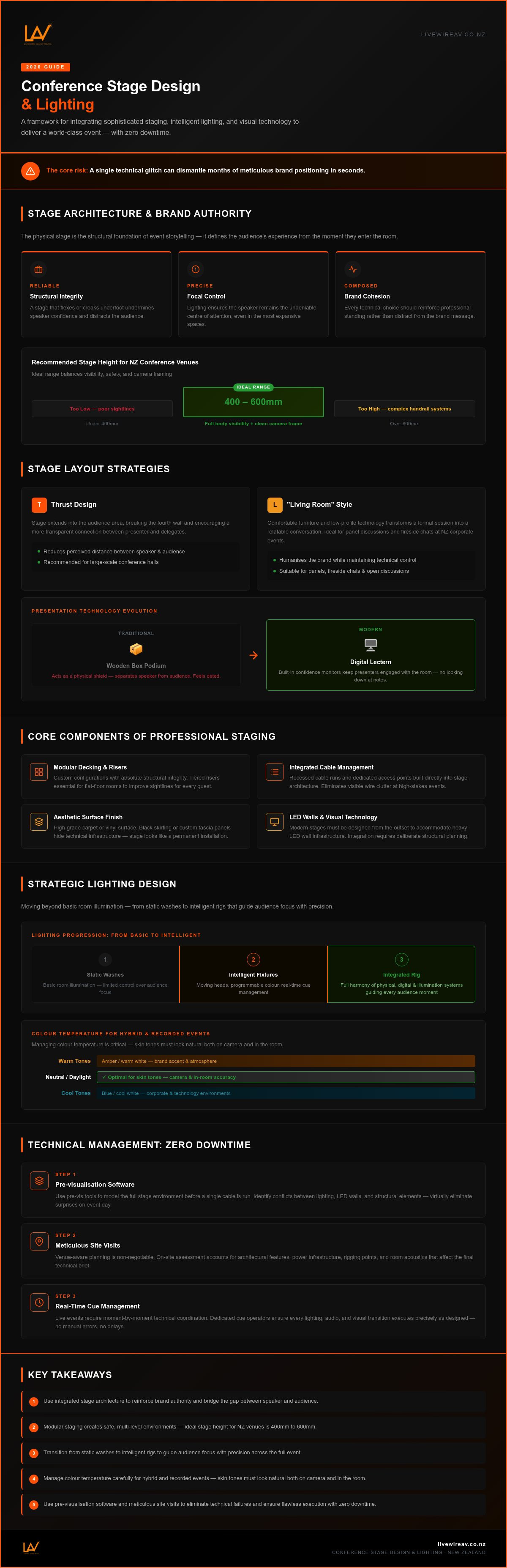
Stage architecture is the structural foundation of event storytelling. It is the physical framework that supports your message and defines the audience's experience from the moment they enter the room. Effective conference stage design and lighting requires a deliberate harmony between physical platforms, intelligent illumination, and digital visuals. When these elements work in unison, they reduce the perceived distance between the speaker and the audience. This creates an environment where your brand feels accessible yet authoritative, fostering a sense of direct engagement that traditional, fragmented setups often lack.
In a large-scale conference hall, the primary challenge is to manage the sheer scale of the environment. Without clear focal points, the audience's attention can easily drift toward the architectural features of the venue rather than your specific content. Applying fundamental stage lighting principles ensures that the speaker remains the undeniable centre of attention, even in the most expansive spaces. Precise. Purposeful. Coherent. This integrated approach ensures that every technical choice reinforces your professional standing rather than distracting from it. Meticulous planning at this stage prevents the "over-specced" feel that can occur when equipment is chosen without a clear architectural goal.
The Psychology of the Stage
The physical layout of your stage dictates the emotional tone of the entire session. Stage height is a primary tool for establishing authority, yet excessive elevation can create an unintended barrier between the leader and the team. We often recommend "thrust" designs that extend the stage into the audience area. This layout breaks the fourth wall and encourages a more transparent connection between the presenter and the delegates. Clean lines and uncluttered spaces are essential for maintaining focus on the message. By balancing bold brand colours with professional neutral tones, you create a sophisticated environment that feels modern and stable. This thoughtful approach to conference stage design and lighting ensures your message remains the priority throughout the day.
Moving Beyond the Traditional Lectern
The traditional "wooden box" podium often acts as a physical shield, separating the speaker from their audience in a way that feels dated. Modern alternatives provide a more dynamic presence. Digital lecterns equipped with built-in confidence monitors allow presenters to stay engaged with the room without constantly looking down at physical notes. For panel discussions or fireside chats, creating "living room" style sets is an effective strategy for New Zealand corporate events. These configurations use comfortable furniture and low-profile technology to transform a formal session into a relatable conversation. It's a pragmatic way to humanise your brand while maintaining total technical control over the presentation environment.
The Core Components of Professional Conference Staging
Professional staging is more than a raised platform. It is a technical necessity that must support the weight of heavy equipment while providing a safe, stable surface for presenters. High-quality conference stage design and lighting starts with this physical foundation. A stage that flexes or creaks underfoot undermines a speaker's confidence and distracts the audience. Safe. Level. Secure. We prioritise modular systems that allow for custom configurations while ensuring absolute structural integrity. Integrating cable management directly into the stage architecture is a requirement for a clean, professional look. By using recessed cable runs and dedicated access points, we eliminate the clutter of visible wires that often compromises the visual impact of high-stakes events.
Modular Decking and Risers
For most New Zealand conference venues, stage heights between 400mm and 600mm represent the ideal range for visibility and safety. This elevation provides enough height for the audience to see the speaker's full body without requiring complex handrail systems that can clutter the camera frame. In flat-floor rooms, tiered risers are essential for improving sightlines, ensuring your conference stage design and lighting remains effective for every guest in the room. The aesthetic finish is equally important. Using high-grade carpet or vinyl creates a professional surface, while black skirting or custom fascia panels hide the technical infrastructure beneath. This meticulous attention to detail ensures the stage looks like a permanent installation rather than a temporary setup.
Integrating LED Walls and Visual Tech
Modern stages must be designed to accommodate heavy visual technology. Ground-stacked LED walls exert significant point loads that require reinforced staging modules to prevent sagging or structural failure. Positioning these screens requires a balance between maximum visual impact and the presenter's physical space. If you are unsure about the technical requirements for your display, viewing our guide on conference LED screen hire NZ will help you understand pixel pitch and weight considerations. Managing the transition between the physical stage edge and the digital content is a key factor in professional production. When staging and vision are planned together, the result is a seamless environment where technology supports the message without dominating it.
Aesthetic finishes like LED-integrated flooring or high-gloss vinyl can further elevate the environment. These choices should always align with the overall lighting design to prevent unwanted glare on camera or for the live audience. We help you organise the technical logistics of these materials to ensure they meet safety standards for high-traffic areas. If you need assistance planning a stable and visually striking environment, our team at LivewireAV can provide a comprehensive technical assessment of your venue requirements.
Strategic Lighting Design: Moving Beyond Basic Room Illumination
A basic room wash is no longer sufficient for high-impact production. Modern conference stage design and lighting relies on intelligent, moving rigs that offer precision and flexibility. Unlike static fixtures, these systems allow us to adjust focus in real-time, directing the audience's gaze exactly where it needs to be. Precise. Dynamic. Controlled. This shift transforms the stage from a mere platform into a focal point of engagement that responds to the flow of your programme.
Synchronisation is vital for maintaining a professional atmosphere. By using DMX control, our technicians align lighting cues with walk-on music to create high-energy transitions that prepare the audience for each new segment. The technical requirements for these cues vary based on the event's objectives. A corporate gala might require dramatic, high-contrast scenes with saturated colours, whereas a technical seminar demands clean, high-visibility illumination that prioritises legibility. We manage these transitions with a steady hand, ensuring the lighting supports the mood without becoming a distraction.
Layering Light: Key, Fill, and Backlighting
Achieving a professional look on stage requires more than just front-facing light. We employ the "Three-Point Lighting" rule to ensure speakers pop against digital backgrounds or LED walls. This involves a primary key light for definition, a fill light to soften shadows, and a back or "hair light" to create separation from the backdrop. This depth prevents the presenter from looking "flat" or washed out on screen. It's a pragmatic approach that ensures your leadership looks as professional to the person in the back row as they do to the viewer watching a recording later. Avoiding flat lighting is a technical necessity in the age of high-definition recording.
Atmospheric and Intelligent Lighting
Texture is a powerful tool for transforming sterile conference halls into immersive environments. By using "gobos" (patterned filters), we project subtle textures onto venue walls or stage backdrops, adding visual interest without distracting from the content. Incorporating brand colours through subtle LED up-lighting provides a sophisticated way to reinforce identity across the room. This meticulous layering of light is a core part of modern live event lighting design. When executed correctly, these elements work invisibly to support your narrative, ensuring the technical production remains a steady, reassuring presence throughout the entire event.
Designing for the Lens: Optimising Stages for Hybrid and Recorded Content
Looking good in the room is a baseline, but it's not the standard for high-level production. Human eyes are forgiving; camera sensors are not. When planning conference stage design and lighting, we must account for how digital sensors interpret light and motion. Managing colour temperature, measured in Kelvin, is the first step in ensuring presenters look natural. If the stage lighting is too warm or too cool relative to the LED backdrop, skin tones will appear discoloured on the livestream. We typically aim for consistency across all light sources to prevent the camera from hunting for a white balance. Stable. Natural. Professional.
The relationship between LED wall refresh rates and camera shutter speeds is another critical factor. If these are not synchronised, the remote audience will see distracting scan lines or flickering. This is a technical failure that meticulous planning avoids. We ensure that sightlines remain clear for both the physical audience and the remote cameras, positioning equipment so that one never obstructs the other. This dual-focus approach ensures the experience is equitable for every delegate, regardless of their location.
Camera-Friendly Lighting Levels
Balancing the brightness of LED backdrops with front-of-house lighting is a delicate task. If the screen is too bright, the speaker becomes a silhouette; if the front light is too intense, the screen looks washed out. Strategic placement also reduces glare on glasses or reflective set pieces, which can be particularly distracting in high-definition recordings. Our Technical Directors monitor video levels in real-time to adjust for these variables as they happen. This proactive approach ensures the visual quality remains stable throughout the broadcast, providing a polished look that reinforces your brand's authority.
Hybrid Stage Logistics
A successful hybrid event requires a stage that feels intimate for virtual viewers while remaining functional for those on-site. We place confidence monitors strategically so speakers can address remote questions without breaking eye contact with the physical room. This creates a broadcast-style set that bridges the gap between two different audiences. For more detailed integration tips, see our guide on hybrid conference AV setup NZ. Planning for both audiences simultaneously is the only way to achieve a truly professional result. If you want to ensure your next event is broadcast-ready, you can contact our technical production team for a comprehensive venue assessment.
Technical Management: Turning a Design Concept into a Flawless Reality
Turning a conceptual design into a functional environment requires more than just high-end gear. It demands a disciplined approach to technical management. A comprehensive site visit is the first non-negotiable step in our process. We assess the venue's power distribution, rigging points, and load-in logistics long before the first truck arrives. This venue-aware preparation prevents the "on-the-day" surprises that lead to stress and delays. By using sophisticated pre-visualisation software, we allow you to see the exact configuration of your conference stage design and lighting before the bump-in begins. This provides a clear, shared vision between your team and our technicians, ensuring the final result matches your expectations perfectly.
Zero-failure production is a standard, not an aspiration. Achieving this requires meticulous planning and the implementation of redundant systems. We deploy backup power solutions and secondary signal paths for all critical visual and audio components. If a primary system encounters an issue, the secondary takes over invisibly. Stable. Redundant. Secure. This level of preparation provides the peace of mind necessary to focus on your presentation while we handle the technical complexity behind the scenes. It's the difference between hoping for a good result and ensuring one through disciplined engineering.
The Pre-Production Phase
Detailed floor plans and CAD drawings are the blueprints of a successful event. These documents ensure accurate equipment placement and help us coordinate with the venue's in-house team regarding specific power requirements and weight loading. For those managing massive scales, our resource on audio visual for large conferences offers further insights into the logistical demands of high-capacity environments. Every cable run and lighting fixture is mapped out in advance to ensure a clean, uncluttered finish that reflects your brand's professionalism. This level of detail is essential for a seamless transition from the loading dock to the stage.
On-Site Execution and Cue Management
The "Calm Professional" approach is most evident during the live event. High-pressure changes are managed with composure, ensuring the audience remains entirely unaware of any behind-the-scenes adjustments. We conduct full technical rehearsals to synchronise every lighting cue, vision switch, and audio transition. Dedicated operators for each discipline provide the precision required for a world-class execution. Our vision switchers and lighting designers work in tandem to ensure the stage looks as good on the recorded archive as it does to the front row. If you are ready to move from concept to reality, enquire with LivewireAV for a tailored technical proposal for your next event.
Building a Foundation for Technical Excellence
High-impact production is the result of disciplined planning and technical precision. By integrating modular staging with intelligent rigs, you create an environment that commands attention while reinforcing your brand authority. Successful conference stage design and lighting requires a dual focus on the physical audience and the digital lens, ensuring skin tones look natural and sightlines remain clear. This level of execution is only possible through meticulous site visits and a commitment to redundant systems. It's the difference between a simple presentation and a world-class experience.
LivewireAV provides the steady hand required for large-scale New Zealand events. Our expert technicians prioritise zero-failure performance, utilising a modern inventory of LED walls and intelligent lighting to deliver seamless results. We manage the technical complexity so you can focus on your message with total confidence. Partner with LivewireAV for your next high-stakes conference to ensure your vision is executed with composure and precision. Your next successful event starts with a reliable technical foundation.
Frequently Asked Questions
What is the most important element of conference stage design?
The most important element is the creation of a clear, unobstructed focal point that prioritises the speaker's visibility. Every component of conference stage design and lighting should serve this goal. Stable. Level. Purposeful. Without a defined centre, the audience's attention drifts toward the venue's architecture. We focus on reducing the perceived distance between the presenter and the delegates, ensuring the message remains the absolute priority throughout the entire event.
How does lighting affect the quality of a recorded conference?
Lighting dictates how digital sensors interpret skin tones and depth, directly impacting the quality of the recorded archive. Human eyes are forgiving, but cameras require consistent colour temperatures to prevent discolouration. Precise. Balanced. Professional. By using three-point lighting, we ensure presenters pop against digital backgrounds. This prevents the flat look common in poorly lit rooms, ensuring your recorded content maintains the same brand authority as the live session.
Do I need a custom stage if the venue already has a built-in platform?
Built-in platforms often lack the technical infrastructure required for modern production, such as integrated cable management or the weight capacity for heavy LED walls. A custom modular stage allows for thrust designs that improve audience connection and sightlines in flat-floor rooms. Stable. Secure. Clean. Custom staging also provides a professional finish with fascia and skirting that hides technical clutter, ensuring your brand remains the central focus of the environment.
What is the difference between static and intelligent lighting for events?
Static lighting provides a fixed wash of light, while intelligent lighting allows for real-time control over focus, colour, and movement. This flexibility is essential for guiding the audience's attention through different segments of a programme. Precise. Dynamic. Responsive. Intelligent rigs can be synchronised with walk-on music or brand cues via DMX control. This transforms the room from a static space into a reactive environment that supports the emotional flow of your conference.
How much time is required for the technical bump-in of a large stage?
Most large-scale conference stages require between four and eight hours for a complete technical bump-in and testing phase. This timeframe accounts for the physical assembly of modular decks, rigging of lighting fixtures, and the calibration of LED walls. Meticulous. Methodical. Thorough. We prioritise a venue-aware approach that includes full technical rehearsals. This ensures every cue is synchronised and every system is redundant before the first guest arrives, eliminating the risk of downtime.
Can you integrate my brand colours into the stage lighting design?
We integrate brand colours through a combination of subtle LED up-lighting and intelligent fixtures that maintain colour accuracy across the room. This is a core part of conference stage design and lighting that reinforces your identity without overwhelming the speaker. Controlled. Sophisticated. Coherent. By layering these colours with professional neutral tones, we ensure the environment feels modern and authoritative. This approach maintains a high-quality look on camera while providing an immersive experience.
What technical requirements are needed for an LED wall on stage?
LED walls require reinforced staging to support their significant point loads and a dedicated power distribution system to ensure stability. Technical synchronisation between the screen's refresh rate and the camera's shutter speed is also essential for flicker-free recording. Heavy. Technical. Precise. We conduct comprehensive site visits to assess rigging points and power availability. This venue-aware preparation ensures the visual technology integrates seamlessly with the physical stage architecture without compromising safety or performance.
Why should I hire a full-service production company instead of just renting equipment?
Full-service production provides the technical management and real-time cue management necessary for zero-failure execution. Renting equipment alone leaves you responsible for the complex integration of audio, lighting, and visuals. Reliable. Composed. Professional. Our team acts as the steady hand behind the scenes, handling high-pressure changes and technical failures invisibly. This end-to-end approach ensures every detail is accounted for, allowing you to focus on your presentation with total peace of mind.


Comments