Conference Technical Setup: The 2026 Guide to Flawless Event Production
Updated: Sep 29
Imagine the sudden, sharp silence that follows a burst of audio feedback just as your keynote speaker begins their opening remarks. It's the kind of technical glitch that can dismantle months of careful planning in seconds. For a high-stakes event in 2026, your conference technical setup is more than just a list of equipment. It's the invisible foundation of your brand's reputation. Precision. Composure. Control.
You know that even the most inspiring presenters cannot overcome a flickering LED wall or a lagging livestream. The pressure to deliver a seamless experience is higher than ever, particularly with the intricate requirements of modern hybrid audiences. This guide provides a clear roadmap to mastering these complexities. It ensures a zero-failure environment where the technology remains invisible so your message stays front and centre.
We'll examine the latest standards for audio uniformity, the shift toward fine-pitch LED displays, and the logistical precision required to coordinate multiple technical vendors into a single, disciplined team. By the end, you'll have a thorough understanding of the production timeline needed to guarantee a professional, stress-free event for every attendee.
Table of Contents
What Defines a Modern Conference Technical Setup?
A modern conference technical setup represents a sophisticated ecosystem where audio, visual, lighting, and data infrastructure operate as a single, unified organism. Modern event planning has shifted away from basic AV hire toward comprehensive technical production. This transition reflects a growing need for absolute reliability in high-stakes environments. Precision. Composure. Control. These are the standard requirements for any large-scale event where a single failure can disrupt months of preparation.
To achieve a zero-failure environment, redundancy must be engineered into every layer of the design. This involves secondary power sources, mirrored vision switchers, and backup microphones ready to engage instantly without the audience noticing a change. Modern conferences now demand a broadcast-mindset, treating the stage like a live studio. Whether you are managing local delegates or navigating complex hybrid event formats, the technical standard remains the same. The technology must remain invisible, allowing the speaker's message to take centre stage.
The Core Components of Technical Infrastructure
A stable foundation for any national event relies on three primary pillars of infrastructure. Each component must be calibrated to work in harmony with the venue's unique acoustics and layout.
Audio reinforcement: We use professional audio line array systems to provide uniform sound distribution. This ensures crystal clear speech intelligibility from the front row to the back of the gallery.
High-resolution visuals: Modern setups often favour fine-pitch LED walls over traditional projection because they offer superior brightness and clarity in high-ambient light environments.
Intelligent lighting: Professional lighting design serves a dual purpose. It creates a focused atmosphere for in-person attendees while ensuring the camera package captures a clear, professional image for the broadcast.
Why Technical Direction Matters More Than Gear
Sophisticated hardware is ineffective without disciplined management. The Technical Director (TD) acts as the steady hand behind the scenes, overseeing every cue, transition, and timing milestone. While individual operators manage their respective desks, the TD ensures the entire team moves in unison. This level of coordination prevents the awkward pauses or visual glitches that can dismantle a keynote's momentum. Technical direction is the bridge between creative vision and hardware execution. By focusing on meticulous planning and clear communication, we ensure a seamless experience where every detail has been accounted for long before the first guest arrives.
Essential Audio and Visual Standards for 2026
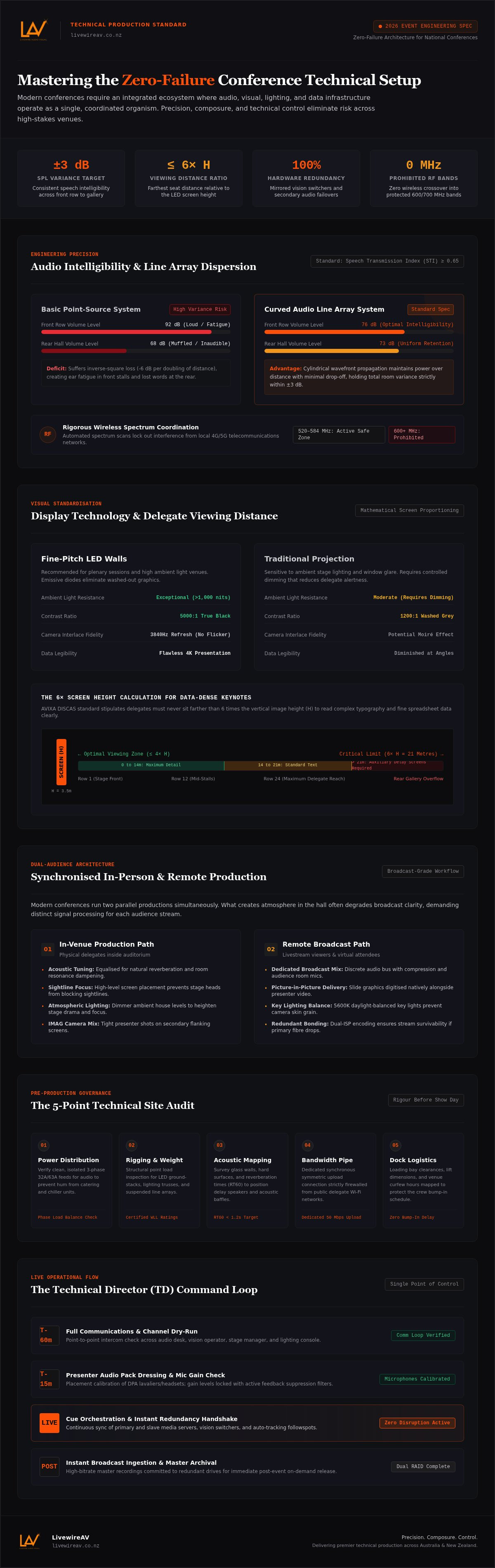
A flawless conference technical setup relies on precision engineering rather than just high-spec hardware. In large-scale venues, the goal is uniform coverage. Every attendee, whether seated in the front row or at the back of the hall, must experience the same clarity of sound and vision. We adhere to global audiovisual performance standards to ensure that technical delivery is measured and consistent. This involves calculating image heights so the farthest attendee is never more than six times the screen height away from the content. This mathematical approach to design eliminates the guesswork, ensuring that your data-dense slides remain readable for every delegate.
Achieving Crystal Clear Audio
Voice intelligibility is the most critical element of any presentation. We utilise professional audio line array systems to achieve a Sound Pressure Level variance of no more than ±3 dB across the audience area. This prevents listener fatigue and ensures every word is heard clearly. Managing multiple lapel and handheld microphones requires rigorous wireless frequency coordination. In 2026, we strictly avoid prohibited 600 MHz and 700 MHz bands to prevent interference from local telecommunications. Proper gain management and digital signal processing allow our technicians to eliminate feedback before it occurs. Precision. Stability. Reliability. These are the standards we maintain to ensure your speakers are heard without distraction.
High-Impact Visuals and LED Technology
The choice between LED walls and traditional projection depends on the venue's ambient light and the required level of detail. For high-stakes keynotes, we often recommend conference LED screen hire with a fine pixel pitch, typically between 1.2mm and 1.9mm. This provides the brightness and contrast necessary for technical charts to remain readable even in fully lit rooms. Seamless vision switching is the hallmark of professional production. It allows for smooth transitions between presentation decks and live camera feeds using Picture-in-Picture layouts. This multi-camera approach not only engages the live audience but also creates a high-quality archive for post-event distribution.
Professional camera packages serve as the eyes of your event. By deploying multiple angles, including a wide beauty shot and a tight follow-shot on the speaker, we capture the energy of the room. This vision is mixed live by a dedicated switcher, ensuring that the final recording is ready for distribution immediately after the final session. If you are planning a large-scale event, our team can help you organise a technical production plan that meets these rigorous standards and provides total peace of mind.
Hybrid Conference Setup: The New National Standard
A successful conference technical setup in 2026 must account for two distinct audiences with equal priority. The "two-audience" problem occurs when remote participants are treated as passive observers rather than active delegates. To solve this, we implement technical best practices for hybrid meetings that prioritise equitable participation. This involves integrating virtual Q&A and real-time polling directly into the live broadcast. It ensures that a question from a remote attendee carries the same weight as one from the front row of the plenary hall.
Achieving this level of synchronisation requires a robust hybrid conference AV setup built on a foundation of data redundancy. We recommend a baseline upload bandwidth of 15 to 25 Mbps of dedicated, unshared throughput per 1080p stream. Relying on shared venue Wi-Fi is a significant risk; instead, we deploy bonded cellular uplinks and satellite redundancy to maintain a zero-failure broadcast. This multi-path approach ensures the stream remains stable even if the venue's primary hardline experiences a local outage.
Broadcast-Quality Livestreaming
Bridging the Gap for Remote Speakers
Bringing a remote presenter onto a main stage LED wall requires more than just a stable video link. It involves sophisticated technical foldback, allowing the speaker to see the live audience and the presentation timer simultaneously. We utilise a dedicated virtual stage manager to brief remote speakers in a digital "green room" before they go live. This professional handles audio checks and lighting adjustments, preventing the technical friction that often occurs during remote transitions. The result is a seamless blend where the virtual speaker feels physically present in the room, maintaining the momentum of your event programme. Precision in these small details is what separates a standard meeting from a world-class broadcast.
Pre-Production: The Importance of Technical Site Visits
A successful conference technical setup is never left to chance. While digital floor plans provide a baseline, a physical site visit is the most critical phase of premium event production. This walk-through allows our team to identify physical constraints that a sales brochure simply cannot convey. We measure acoustic reverberation, aiming for an RT60 target between 0.4 and 0.6 seconds to ensure absolute speech clarity. We also conduct an RF scan to identify potential interference from local broadcast towers or neighbouring convention spaces. Precision. Preparation. Composure. These site visits transform a list of equipment into a bespoke engineered system.
Evaluating Venue Capacity and Power
Large-scale lighting and LED rigs require significant electrical infrastructure. We calculate three-phase power requirements early to ensure the venue can support the load using cam-lock or standard distribution drops. Safety is our primary concern. We verify rigging points against certified weight load limits to ensure all overhead equipment is secured correctly. This technical audit prevents power failures or structural issues on the day of the event.
Verify three-phase power availability and its proximity to the stage area.
Confirm ceiling rigging point certifications and motor access requirements.
Measure internal door widths and lift capacities for heavy equipment load-in.
Test cellular signal strength at the production desk for bonded backup connections.
The Technical Design Phase
Once the physical data is captured, we move into the CAD design phase to create accurate technical floor plans. This ensures that every seat in the house has clear sightlines to the main LED walls. We coordinate directly with the venue’s in-house IT department to secure dedicated network ports and configure VLAN segmentation. This protects our production data and livestream uplinks from public attendee traffic spikes. Locating the production desk is equally vital. It must be positioned to give the Technical Director a clear view of the stage while remaining inconspicuous to guests. This methodical approach ensures that every detail has been accounted for long before the first guest arrives. If you are ready to build a stable foundation for your next event, you can organise a technical site visit with our senior production team to assess your chosen venue.
Partnering for a Zero-Failure Conference
A successful conference technical setup is the result of a collaborative partnership rather than a simple vendor transaction. We position ourselves as a direct extension of your event planning team, absorbing the technical complexity so you can focus entirely on your delegates. This relationship begins during the initial design phase and continues through to the final pack-out. Precision. Composure. Reliability. These values ensure that the technology supports your message without ever becoming the story itself.
The true value of a professional technical partner lies in the peace of mind provided by on-site expertise. Having a dedicated team of technicians monitoring every audio level and vision feed allows you to navigate the high-pressure environment of a live event with total confidence. Our role is to maintain absolute control over the environment, ensuring that every transition is seamless and every speaker is supported by a stable, high-performance infrastructure. This steady hand behind the scenes allows the client's work to take centre stage.
Full Technical Management and Logistics
Managing the lifecycle of a national event requires meticulous logistical planning. We handle the transport, configuration, and testing of all hardware, including complex audio line arrays and modular LED walls. For organisations running national conference tours, we provide scalable solutions that maintain a consistent technical standard across every venue. Working alongside an experienced team like Fruitbowl Events Agency ensures that overarching event management and technical production operate in lockstep. Our technicians operate as "invisible experts," working behind the scenes to manage the intricate data and power networks required for modern production. This disciplined approach ensures that the equipment is ready long before the first guest arrives, regardless of the venue's location.
Why Experience and Composure Matter
In high-stakes environments, the ability to handle real-time troubleshooting is paramount. Experience allows a technical team to identify and resolve potential issues before they impact the audience. The LivewireAV approach is grounded and pragmatic; we rely on deep technical knowledge and a zero-failure mindset to manage the unexpected. This composure is what separates a standard AV hire from a professional production partnership. Once the event concludes, we provide comprehensive post-event reporting and high-quality media archiving, ensuring your content is preserved for future use. This methodical process provides a clear understanding of the production timeline and ensures every detail is documented for future planning.
If you are ready to secure a seamless experience for your next event, you can organise a technical consultation for your next conference with our specialist team.
Securing Your Event's Technical Future
A flawless conference technical setup is not achieved by chance; it is the result of disciplined planning and professional execution. By integrating high-resolution LED walls, precision audio line arrays, and robust hybrid infrastructure, you create an environment where your message remains the priority. The transition from simple AV hire to full technical production ensures that every detail, from power distribution to wireless frequency coordination, is managed with a zero-failure mindset.
With over 10 years of experience in high-stakes event management, LivewireAV provides full-service national production coverage. We specialise in meticulous technical management that allows you to focus on your attendees while we handle the complexity behind the scenes. Our team is ready to help you navigate the logistical requirements of your next major gathering. Precision. Composure. Reliability. These are the standards we bring to every partnership.
Discuss your conference technical requirements with our expert team to ensure your next event is seamless and professional. Let's work together to deliver an experience that your delegates will remember for all the right reasons.
Frequently Asked Questions
What is the most important part of a conference technical setup?
Meticulous pre-production planning is the most vital element of a successful conference technical setup. While high-quality hardware is essential, the logic behind the system integration ensures absolute reliability. A comprehensive site visit allows our technicians to audit power, acoustics, and rigging before any equipment arrives. This foundation creates a zero-failure environment where the technology remains invisible, letting the speaker's message take centre stage throughout the entire event.
How much lead time is required for a large-scale conference AV setup?
We recommend initiating the technical design phase at least three to six months before your event date. This lead time is necessary to secure specialised equipment like LED walls and to coordinate with venue IT departments. Large-scale productions require detailed CAD drawings and frequency coordination to ensure a seamless experience. Early engagement allows our team to manage logistics effectively and provides you with total peace of mind during the planning process.
Can we integrate our own laptops into a professional technical rig?
Yes, you can integrate external laptops, though we manage these through professional vision switching systems and DI boxes. This approach ensures that your presentation decks are scaled correctly and protected from resolution glitches or audio hum. Our technicians handle the transitions between your hardware and our primary playback systems. It is a standard requirement for maintaining a professional visual standard while allowing speakers to use familiar tools during their presentations.
What is the difference between an AV hire company and a technical production company?
An AV hire company typically focuses on supplying individual pieces of hardware for the client to manage. In contrast, a technical production company provides a comprehensive service that includes system design, logistical management, and on-site technical direction. We act as an extension of your planning team, taking full responsibility for the technical outcome. This partnership model prioritises reliability and composure, ensuring that every cue is executed with absolute precision.
Do I need a separate team for the livestreaming portion of my hybrid event?
You don't need a separate team if you partner with a full-service technical production provider. We manage both the in-room experience and the livestream broadcast as a unified system. This integrated approach prevents audio loops and ensures that remote participants see the same high-quality vision switching as the local audience. Centralising the technical management reduces coordination stress and guarantees a consistent experience for every attendee, regardless of their location.
What happens if there is a technical failure during a live presentation?
We engineer redundancy into every layer of the system to prevent visible failures. This includes mirrored vision switchers, backup microphones, and bonded cellular internet connections for livestreams. If a component fails, our technicians engage the secondary system instantly, often without the audience or the speaker noticing a change. Our zero-failure mindset relies on this deep preparation and the composure of our on-site operators to handle complexity invisibly.
How do you handle audio in a venue with poor acoustics or high ceilings?
We utilise professional audio line array systems and digital signal processing to overcome challenging venue acoustics. By precisely aiming the sound at the audience seating area and avoiding reflective surfaces like high ceilings, we maintain high speech intelligibility. Our technicians conduct an acoustic audit during the site visit to determine the optimal speaker placement. This methodical approach ensures that every word is heard clearly without the fatigue caused by poor sound distribution.
What technical information do I need to provide to get an accurate proposal?
To provide a tailored proposal, we require your venue details, expected attendee numbers, and a draft run-of-programme. It is also helpful to specify if you require hybrid capabilities, LED walls, or specific camera packages for archiving. This information allows us to calculate power requirements and logistical needs accurately. Clear communication at this stage ensures that every detail is accounted for in the initial design, leading to a stress-free production experience.


Comments