Common Event Production Mistakes to Avoid in 2026: The Technical Checklist
The most expensive technical failure isn't the one that stops the show. It's the one that was entirely preventable during the pre-production phase. Meticulous. Grounded. Deliberate. These are the qualities that separate a high-stakes success from a costly oversight. We understand that the pressure of managing hybrid feeds and complex vision switching can be overwhelming, especially when you're worried about audio-visual glitches interrupting a keynote. Identifying common event production mistakes to avoid is the first step toward reclaiming your peace of mind and ensuring every dollar of your budget is spent with purpose.
You shouldn't need a degree in engineering to feel in control of your event's technical backbone. By establishing a clear framework for vetting technical plans, you can bridge the gap between complex specifications and actual outcomes. This article provides a comprehensive checklist designed for the 2026 landscape. We'll examine how to organise your audio line array systems, streamline your livestream workflows, and manage the bump-in process with quiet confidence. You'll gain the vocabulary needed to lead your vendors and the foresight to deliver a seamless experience for every attendee, whether they're in the room or watching from across the globe.
Table of Contents
Underestimating the Technical Lead Time and Planning Phase
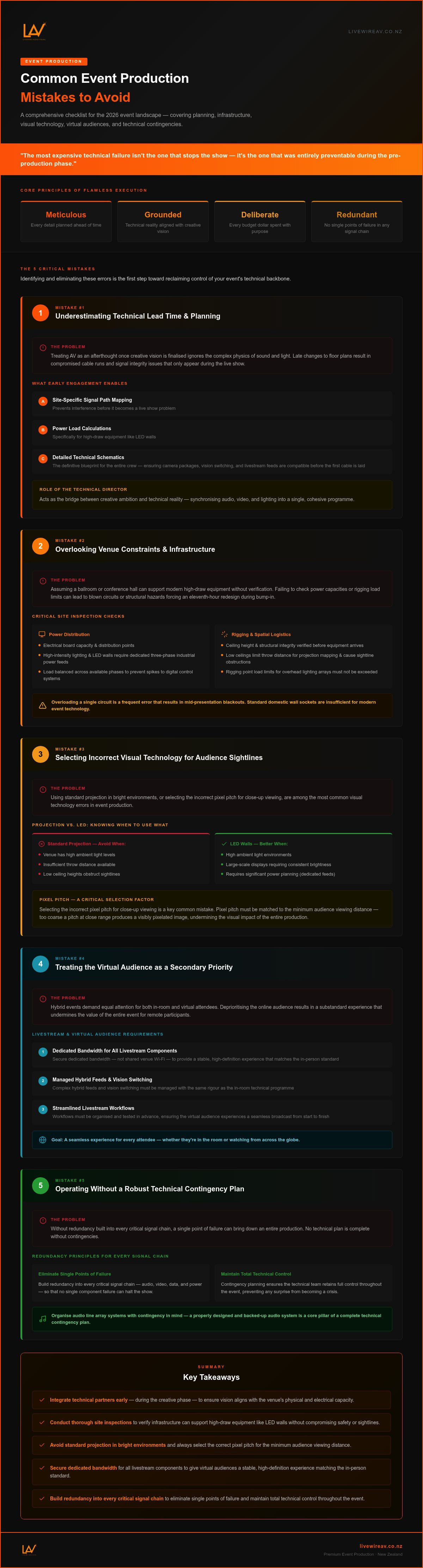
Technical production isn't a garnish; it's the foundation. Treating it as an afterthought is a recipe for disaster. One of the most common event production mistakes to avoid is the assumption that AV can be bolted on once the creative vision is finalised. This mindset ignores the complex physics of sound and light. Without early collaboration, you risk a beautiful stage design that is technically impossible to light or an audio system that creates unwanted echoes in a cavernous hall. Following established event management planning principles ensures that technical requirements are baked into the budget and timeline from the start. Precise. Cohesive. Reliable. These are the markers of a well-planned event.
The Cost of Rushed Technical Design
Speed kills precision. When technical plans are rushed, the details suffer. Late changes to floor plans often result in compromised cable runs or signal integrity issues that only appear during the stress of the live show. We define technical lead time as the essential buffer required for custom rigging, bespoke lighting design, and equipment procurement. To avoid these pitfalls, it's vital to secure a premium event production New Zealand partner during the initial concept phase. Early engagement allows for:
Site-specific signal path mapping to prevent interference.
Power load calculations for high-draw equipment like LED walls.
Detailed technical schematics that serve as the definitive blueprint for the entire crew.
Bridging the Communication Gap
Silos create friction. A creative team might design a stunning high-resolution presentation, but without technical oversight, it may fail to display correctly on the day. This is the common "it worked on my laptop" syndrome. A professional Technical Director acts as the bridge between creative ambition and technical reality. They synchronise audio, video, and lighting into a single, cohesive programme. Facilitating a pre-event technical meeting with all stakeholders ensures that everyone understands the "why" behind the gear. A comprehensive brief isn't just a list of equipment; it's a guarantee of compatibility. It ensures that your camera packages, vision switching, and livestream feeds all speak the same language before the first cable is even laid. This level of meticulousness reduces stress during the bump-in and ensures a seamless experience for every attendee.
Overlooking Venue Constraints and Infrastructure Requirements
A venue might look spectacular during a walkthrough, but its hidden limitations often dictate the success of your technical execution. One of the most common event production mistakes to avoid is assuming that a ballroom or conference hall possesses the infrastructure to support modern, high-draw equipment. Precision. Stability. Safety. These aren't negotiable. Failing to verify power capacities or rigging load limits can lead to blown circuits or, worse, structural hazards that force an eleventh-hour redesign during the bump-in.
Power Distribution and Load Balancing
Modern event technology requires more than a standard domestic wall socket. High-intensity intelligent lighting and large-scale LED walls demand significant current, often requiring dedicated three-phase industrial power feeds. Overloading a single circuit is a frequent error that results in mid-presentation blackouts. During a technical site visit, our team prioritises checking the venue’s electrical board capacity and distribution points. We ensure that the power load is balanced across the available phases, preventing the spikes that compromise digital control systems and vision switching hardware. This meticulous approach ensures that your technical infrastructure remains invisible and reliable.
Rigging and Spatial Logistics
Ceiling height and structural integrity are often overlooked until the equipment arrives on the dock. Low ceilings can severely limit the throw distance required for projection mapping or cause sightline obstructions for those at the back of the room. Conversely, ignoring rigging point load limits for overhead lighting arrays can jeopardise the entire floor plan. Identifying these constraints early allows for the design of ground-supported structures where overhead rigging isn't feasible.
Physical obstructions like pillars or low-hanging chandeliers create audio "dead zones" where clarity is lost. This is particularly critical when planning the audio visual for large conferences, where every attendee expects intelligible sound. The acoustic properties of the room, from glass walls to hard concrete floors, must be mapped to determine the correct placement of audio line array systems. A technical site visit is the only way to identify these variables before they become problems. By conducting a thorough venue assessment, we provide a bespoke proposal that respects the physical reality of the space. To ensure your next event is built on a solid technical foundation, consult with our production experts early in your planning process.
Selecting Incorrect Visual Technology for Audience Sightlines
Visual impact isn't just about the size of the screen; it's about the precision of the image. One of the common event production mistakes to avoid is selecting display technology based on aesthetics rather than the physical environment of the room. Clear. Sharp. Immersive. These outcomes are only possible when the hardware matches the lighting conditions and the audience’s proximity to the stage. If your attendees are squinting to see washed-out slides or are distracted by visible pixels, your message is lost before it's even delivered.
LED Walls vs. Projection: Making the Right Choice
Choosing projection in a room with high ambient light or large windows is a frequent technical oversight. Even the most powerful projectors struggle against natural daylight, resulting in a faded image that lacks contrast. In these environments, LED walls are the superior choice. They provide the necessary brightness to cut through glare while maintaining deep black levels and vibrant colours. However, the choice of LED requires a deeper technical understanding. Pixel pitch determines the minimum viewing distance by defining the density of the LED clusters on the surface of the screen. Using a large pixel pitch for an audience seated close to the stage results in a grainy, pixelated effect that compromises the professional feel of your event. Matching projector lumens to the screen size and environmental light is essential for those opting for traditional projection systems.
Content Synchronisation and Aspect Ratios
The technical excellence of your hardware is irrelevant if the content isn't formatted correctly. A visual disaster often occurs when standard 16:9 presentation slides are stretched or letterboxed to fit custom widescreen LED walls. This lack of alignment suggests a lack of preparation and diminishes the authority of the speaker. Ensuring your media server can handle the native resolution of the display is a critical step in the pre-production phase. It's not just about the static images; it's about how you move between them. Vision switching plays a vital role in managing multi-camera feeds and presentation decks. Professional vision switchers allow for seamless transitions, ensuring the audience sees exactly what they need to see at the right moment. This level of control prevents the jarring black-screen moments that occur when switching between different signal sources. By prioritising content synchronisation, you ensure that every visual element supports your message with quiet, technical authority.
Treating the Virtual Audience as a Secondary Priority
A hybrid event is not merely an in-person gathering with a camera placed at the back of the room. It is two distinct, concurrent experiences that require equal technical rigour. One of the common event production mistakes to avoid is allowing your remote attendees to feel like second-class citizens. When the livestream feed is grainy, the audio is thin, or the interactive elements are delayed, you lose the engagement of a significant portion of your audience. In 2026, technical parity is the standard. Meticulous. Purposeful. Inclusive. These are the values that should drive your hybrid strategy.
The Infrastructure of Professional Livestreaming
Reliability in broadcasting starts with the connection. Relying on shared venue Wi-Fi is a high-risk gamble that rarely pays off. For a high-definition, zero-failure broadcast, a dedicated, hard-wired internet line is essential. This ensures that your vision switching and multi-camera feeds reach the audience without the stuttering or buffering that compromises professional authority. Using a single static camera angle is another frequent oversight. It fails to capture the energy of the room. We employ comprehensive camera packages that allow for dynamic shots, ensuring the virtual audience sees the speaker’s expressions and the detail of the slides with the same clarity as those in the front row. Managing the "return feed" is equally critical; remote speakers must be able to see and hear the stage in real-time to facilitate natural, fluid contributions during panel discussions.
Audio Management for Hybrid Feeds
Audio failure is often the silent killer of hybrid events. A common error is sending the "house mix" directly to the livestream. The acoustics of a live room require different equalisation and compression than a digital broadcast. A dedicated broadcast mix ensures that the audio is levelled correctly for listeners on mobile devices or laptops, where built-in speakers have limited dynamic range. We also prioritise the elimination of echo and feedback loops, which frequently plague live Q&A sessions when audio from the room bleeds into the remote speakers’ microphones. By synchronising audio feeds with video latency, we ensure that the speaker’s voice and mouth movements are perfectly aligned, preventing the cognitive dissonance that leads to viewer fatigue. To ensure your remote and local audiences receive the same high-standard experience, partner with our livestreaming specialists for your next project.
Operating Without a Robust Technical Contingency Plan
Professionalism is defined by what happens when things go wrong. While meticulous planning reduces risk, total technical control requires a secondary layer of protection. One of the most critical common event production mistakes to avoid is operating with a single point of failure in your digital signal chain. If your entire show relies on one media server or a single network switch, you aren't planning for success; you're gambling on luck. Precision. Redundancy. Composure. These are the pillars of a resilient production.
Building Redundancy into the Signal Chain
For high-stakes presentations, we implement a 'Main and Backup' media server setup. This ensures that if the primary system hangs, the secondary unit is already in sync and ready to take over. We define fail-safe switching as the seamless transition to a redundant signal source that prevents any visible interruption to the audience experience. This logic extends to our audio line array systems, where redundant audio consoles and digital snakes provide a safety net for large-scale sound. Additionally, providing backup power through Uninterruptible Power Supplies (UPS) for critical control systems prevents a minor venue power dip from resetting your entire lighting and vision rig mid-show.
The Human Element: Crew Fatigue and Expertise
Technology is only as reliable as the people operating it. Understaffing a complex, multi-day programme is a frequent error that leads to crew fatigue and operational mistakes. A tired technician is more likely to miss a cue or overlook a warning light. It's essential to ensure your crew has the specific expertise required for the deployed technology, from intelligent lighting design to vision switching. A dedicated 'show caller' provides the final layer of security, managing cues and emergency protocols with a steady hand. Finally, never neglect the full technical rehearsal. This includes a 'blackout' test to verify exactly how the system recovers from a total power loss. This level of preparation ensures that your event remains seamless, regardless of the challenges that arise.
Securing Technical Excellence for Your 2026 Programme
Success in high-stakes environments is rarely the result of luck. It is the product of meticulous planning, redundant systems, and a deep understanding of venue infrastructure. By prioritising technical lead time and ensuring your visual technology matches the physical environment, you bypass the friction that often compromises large-scale events. Identifying common event production mistakes to avoid is the first step toward delivering a seamless experience that respects the needs of both in-person and virtual attendees. Precise. Reliable. Seamless. These standards should be the foundation of every technical brief.
With over 10 years of technical excellence, our team provides the composure and expertise required to handle complex productions. We manage the entire process through our national headquarters, ensuring total technical control from the first site visit to the final load-out. By utilising our state-of-the-art LED and audio inventory, we guarantee a high-standard execution for every project. We invite you to partner with LivewireAV for your next flawless event production and experience the peace of mind that comes from working with a disciplined specialist. We look forward to helping you deliver a show that takes centre stage without the stress of technical uncertainty.
Frequently Asked Questions
What are the most common technical failures at live corporate events?
Audio feedback, vision dropout, and power overloads are the most frequent issues. These often stem from inadequate planning or ignoring the physical constraints of the venue. One of the common event production mistakes to avoid is failing to build redundancy into the digital signal chain. When you rely on a single point of failure, any minor glitch becomes a show-stopper. We prevent these issues through rigorous pre-production and on-site technical management.
How early should I engage an event production company for a national conference?
Engagement should begin at least four to six months before the event date. Early collaboration allows your technical partner to conduct site visits and influence the venue selection based on infrastructure needs. This lead time is essential for designing custom lighting plots and organising complex audio line array systems. Waiting until the last minute often leads to compromised designs and increased costs due to rushed logistics and equipment procurement.
Why is a technical site visit necessary if the venue provides floor plans?
Physical reality often differs from architectural drawings. A site visit allows technicians to identify hidden obstructions like low-hanging chandeliers or pillars that ruin sightlines. We also verify the actual capacity of the venue's electrical board and locate specific rigging points. These details are rarely captured accurately on a standard floor plan. Seeing the space in person ensures our bespoke proposal is grounded in what is actually possible.
What happens if the internet fails during a hybrid event or livestream?
A robust contingency plan prevents the broadcast from going dark. We use dedicated, hard-wired internet lines rather than relying on shared venue Wi-Fi. If a primary connection drops, our systems can automatically switch to a secondary redundant feed, such as a bonded cellular network. This ensures the virtual audience remains connected while our technicians resolve the underlying infrastructure issue without the viewers noticing a significant interruption to the programme.
How do I avoid audio feedback and poor sound quality in large venues?
Proper microphone selection and speaker placement are the primary defences against feedback. Using audio line array systems allows us to direct sound precisely toward the audience while keeping it away from active microphones. We also use digital signal processing to 'ring out' the room during the soundcheck. This process identifies and attenuates the specific frequencies prone to feedback, ensuring crystal-clear audio for every attendee in the hall, regardless of the room's acoustics.
What is the difference between dry hire equipment and full technical production?
Dry hire involves simply renting gear, whereas full technical production provides end-to-end management. We don't offer dry hire because we believe reliability comes from our expert technicians managing the entire process. This includes design, transport, setup, and live operation of the equipment. Full production ensures that the technology works as a cohesive system, removing the technical burden from the client and guaranteeing a professional, stress-free outcome.
How much power does a large LED wall actually require?
Power requirements vary by size and brightness, but a standard large-scale LED wall often requires a dedicated three-phase industrial feed. A common event production mistake to avoid is assuming a domestic wall socket can handle the load. During our planning phase, we calculate the total draw of your vision and lighting rigs to ensure the venue's electrical infrastructure is sufficient. This prevents blown circuits and potential equipment damage during the show.
Can I use my own laptop for the main presentation, or should I use a show computer?
We always recommend using a dedicated show computer for the main presentation. Personal laptops often have background processes, notifications, or power-saving settings that can interrupt a live feed. Our show computers are optimised for high-performance graphics and are integrated directly into our vision switching hardware. This setup provides a stable environment for your slides and ensures that the transition between presenters is seamless, professional, and entirely predictable.


Comments