Conference LED Screen Hire NZ: The 2026 Technical Buying Guide
A high-impact LED wall is the fundamental infrastructure upon which your conference's professional credibility rests. In a high-stakes environment, your choice in conference LED screen hire NZ determines whether your message is delivered with total clarity or obscured by technical instability. Precision. Composure. Reliability. These are the standards your audience expects and your presenters require to feel supported on stage.
We understand that organising a large-scale event is complex, and technical jargon often clouds the decision-making process. You need vibrant colour reproduction, crystal-clear visuals, and the confidence that your displays will remain seamless from the opening keynote to the final closing remarks. This 2026 guide provides a comprehensive roadmap to mastering the technical specifications of modern LED displays. We'll break down the latest AS/NZS safety standards, explain how to choose the correct resolution for your venue, and reveal how to avoid the hidden costs that often arise during installation.
Table of Contents
Why LED Screens Are the New Standard for New Zealand Conferences
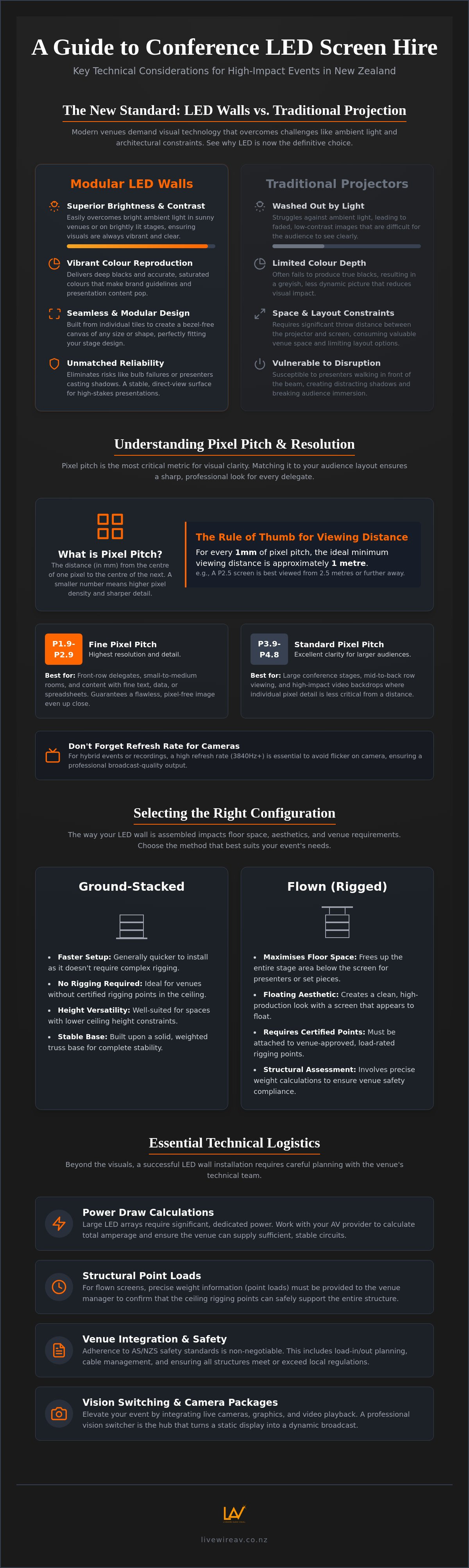
The technical landscape for corporate events in New Zealand has undergone a fundamental transformation. For years, projection was the default choice, but it often struggled against the architectural realities of modern venues. Sunlight. Glass. Open spaces. These elements, while aesthetically pleasing, are the natural enemies of traditional projectors. Choosing LED display technology allows organisers to reclaim control over their visual environment. It's no longer about merely showing a slide; it's about creating a stable, high-contrast focal point that commands attention.
Modern conference LED screen hire NZ services now prioritise modularity. Unlike fixed-ratio projection screens, LED walls are built from individual tiles that lock together to create a seamless, bezel-free canvas. This architecture allows us to tailor the screen size precisely to your stage design. We can build standard 16:9 formats or expansive panoramic backdrops that wrap around the presentation area. This flexibility ensures the technology fits the room, rather than forcing the room to accommodate the technology.
Reliability remains the cornerstone of any successful plenary session. Projectors are inherently vulnerable to bulb failures and "shadowing" when a speaker walks in front of the light source. LED walls eliminate these variables. They provide a stable, direct-view surface that remains unaffected by stage movement. As we move into 2026, the shift toward ultra-fine pixel pitches means that even in intimate keynote settings, the imagery remains sharp and pixel-free. Sharp. Stable. Seamless. This is the standard required for high-stakes communication.
LED vs. Traditional Projection
The primary differentiator is brightness, measured in nits. A typical LED wall provides significantly higher luminance than a projector, which is essential for daytime sessions or brightly lit venue environments. Colour accuracy is equally critical. LED technology delivers deep blacks and vibrant saturations that make corporate brand colours truly pop. These walls are also remarkably space-efficient. They don't require the long throw distances or bulky rigging structures associated with large-format projection, allowing you to use every square metre of your venue effectively.
The Impact on Audience Engagement
Visual clarity directly correlates with attendee focus. When every delegate has a front-row view, your message lands with greater impact. LED walls also serve as dynamic digital sets. They can transition from a static presentation slide to a cinematic backdrop in an instant, creating a sense of theatre that keeps the audience engaged. These displays also ensure your event is social-media ready. Content captured on smartphones by attendees looks professional and clear, preventing the "washed-out" look that often plagues photos of projected screens.
Understanding Pixel Pitch and Resolution for Corporate Visuals
Pixel pitch represents the distance between the centre of one pixel and the centre of the next. In the context of conference LED screen hire NZ, this measurement dictates the clarity of your content relative to where your audience sits. A smaller number indicates a higher pixel density. More pixels. Greater detail. Sharper text. For corporate presentations involving spreadsheets or fine typography, this density is the single most important technical metric.
Industry guidelines for selecting pixel pitch often rely on the 1-to-1 rule. This framework suggests that for every 1mm of pixel pitch, the minimum viewing distance should be approximately one metre. For example, a P2.5 screen is best viewed from 2.5 metres or further. If your front-row delegates are closer than this, they may begin to see the individual diodes. This distracts from the message. Consistent. Professional. Reliable. These are the qualities you maintain by matching pitch to seating.
As we move through 2026, refresh rates have become a critical consideration for hybrid events. While older screens might look fine to the naked eye, they often flicker when captured by professional cameras. High-performance LED panels now feature refresh rates of 3840Hz or higher. This ensures a stable, flicker-free image for both your in-room audience and your remote participants. Resolution is not just about physical size; it's about the quality of the signal being delivered to every viewer.
Choosing the Correct Pixel Pitch
Selecting the right pitch is a balance of venue size and content detail. P2.5 has emerged as the versatile sweet spot for most New Zealand plenary rooms. It offers sufficient resolution for standard PowerPoint decks while remaining cost-effective for large-scale walls. If your session involves high-detail data visualisations or CAD drawings, investing in an ultra-fine pitch under P1.9 is advisable. This ensures that even the smallest text remains legible for every attendee, regardless of their position in the room.
Broadcast-Ready Visuals for Hybrid Events
The rise of hybrid conferences requires a screen that performs well on camera. One common issue is the moiré effect, a distracting wavy pattern that appears when a camera's sensor conflicts with the LED's pixel grid. We mitigate this by using high-density panels and precise camera positioning. Modern LED walls also support High Dynamic Range (HDR). This technology provides richer colours and deeper contrast, which translates beautifully to the final event recording. To ensure your vision is captured correctly, it's worth reviewing our guide on how to organise a multi-camera event production.
If you aren't sure which resolution fits your specific floor plan, consulting with a technical partner early in the planning phase can prevent costly mid-event adjustments.
Selecting the Right Configuration: Ground-Stacked vs. Flown LED Walls
The physical integration of an LED wall into your venue is a critical decision that balances aesthetics with structural reality. When choosing conference LED screen hire NZ, you must decide between suspending the display from the ceiling or building it from the floor up. Each method requires a different technical approach. Precision. Stability. Safety. These are the non-negotiable standards we apply to every installation, regardless of the chosen configuration. The way your screen sits in the room defines the scale of the event and the professional tone of your brand.
Flown LED: The Professional Standard
Flown configurations are the benchmark for large-scale plenary sessions. By suspending the screen from a truss, we create a clean, floating appearance that maximises valuable stage floor space. This is particularly effective in modern New Zealand convention centres where high ceilings allow for elevated sightlines. Raising the screen ensures that even delegates at the back of the room have an unobstructed view. However, this requires meticulous pre-planning. We must verify venue point loads and truss capacities weeks before the event to ensure the building's infrastructure can support the weight. Clean. Elevated. Unobstructed. This configuration removes visual clutter and allows your presenters to take centre stage.
Ground-Stacking: When and Why
Ground-stacking remains the most practical solution for venues with restricted ceiling heights or strict rigging limitations. This method involves building the screen on a dedicated base frame directly on the stage or floor. It's often faster to deploy, making it an ideal choice for events with tight pack-in windows. In many of New Zealand’s historic ballrooms, floor-loading limits are a more significant concern than ceiling points. Ground-stacking allows for even weight distribution across a larger surface area, protecting the venue’s integrity while still providing a high-impact visual backdrop. It's a pragmatic, reliable solution that works within the physical constraints of older architecture.
Beyond the standard 16:9 rectangle, modern modular systems allow for curved and creative layouts. We can design displays that wrap around a corner or follow the natural contour of a stage, breaking the traditional "screen" mould. Regardless of the shape, we strictly adhere to power, rigging, and safety protocols to protect your attendees and staff. Using certified rigging hardware and appropriate ballast for ground-stacked walls ensures the installation remains secure under all conditions. Composed execution on-site begins with this disciplined approach to structural safety.
Technical Logistics: Power, Weight, and Venue Integration
Behind the vibrant visuals of a successful conference lies a complex web of logistical requirements. Managing conference LED screen hire NZ involves more than just assembling panels. It requires a deep understanding of the venue's electrical and structural limitations. Precision. Meticulousness. Foresight. These are the qualities that prevent technical setbacks on show day. Every watt of power and every kilogram of weight must be accounted for long before the first guest arrives.
Power Requirements for NZ Venues
Large-scale LED arrays are power-intensive. While a single 60-inch display might run on a standard wall outlet, a 6-metre plenary wall requires a robust power distribution plan. We typically specify 3-phase power to ensure the screen has a dedicated, stable supply. This avoids interference with sensitive audio equipment or lighting rigs. Heat dissipation is also a pragmatic concern. In smaller breakout spaces, the cumulative heat from thousands of diodes can affect room temperature. We manage this through strategic placement and coordination with the venue's HVAC team to ensure both the hardware and your presenters remain at an optimal temperature.
Site Visits and Venue Liaison
A technical site visit is a mandatory step in our planning process. We verify physical access points, measure door widths, and check the weight capacity of service lifts. These details determine whether the flight cases can actually reach the ballroom or if we need to adjust the pack-in schedule. This collaborative approach extends to other vendors as well. We coordinate with lighting designers to manage glare and with camera crews to ensure optimal positioning for the screen's refresh rate. This level of preparation is explored further in our guide to premium event production New Zealand.
Floor loading and point loads are data points your venue manager will insist on seeing. A ground-stacked wall can weigh several hundred kilograms, concentrated over a small footprint. We provide detailed technical drawings that outline these loads to ensure compliance with the New Zealand Building Code. Signal flow is the final piece of the logistical puzzle. We employ redundant signal loops for every installation. If a primary data cable fails mid-presentation, the backup processor takes over in milliseconds. The audience never sees a glitch. This "zero-failure" mindset is what separates a standard rental from a professional technical partnership.
If you're planning an event in a challenging space or a historic venue, consult our technical team early to ensure a seamless integration with your chosen location.
Partnering with LivewireAV for Seamless Visual Execution
A high-performance LED wall is only as effective as the technical direction behind it. Many providers treat conference LED screen hire NZ as a simple equipment rental, but we view it as a critical component of a broader broadcast environment. Our role is to act as the steady hand behind the scenes, ensuring that the technology remains invisible so your message can take centre stage. Precision. Composure. Reliability. These are the standards we maintain from the initial site visit to the final pack-out.
Integrated Technical Management
Successful visual execution requires more than just a screen; it requires integrated vision switching and professional technical direction. Our operators manage the complex transitions between presenter slides, high-resolution videos, and live camera feeds with total precision. This ensures a seamless flow that keeps your audience focused on the content rather than the transitions. Having a dedicated technician on-site provides the peace of mind that any technical variables are handled immediately and quietly. For a deeper look at how these elements work together, see our resource on audio visual for large conferences.
The LivewireAV Difference
We don't believe in one-size-fits-all solutions. Every venue in New Zealand has its own architectural quirks, and every conference has its own specific goals. Our approach is built on meticulous planning and venue-aware execution. We maintain our equipment to the highest standards, ensuring that the hardware we bring to your event is modern, reliable, and safe. Whether you're hosting a small executive keynote or a large-scale national convention, our team acts as a disciplined extension of your own planning staff.
We provide national coverage, delivering consistent technical excellence across New Zealand. From Auckland to Queenstown, we understand the logistical nuances of local venues and the regulatory requirements of the New Zealand Building Code. Our proposals are personalised, reflecting the specific pixel pitch, configuration, and power requirements your event demands. By focusing on the outcomes of the technology rather than just the specifications, we help you achieve total technical control.
Getting your visual production sorted starts with a clear, honest conversation. We invite you to contact our team for a tailored proposal that aligns with your venue and your vision. Let us handle the complexity while you focus on delivering a high-impact experience for your delegates.
Securing Technical Control for Your Next Plenary
Effective visual communication is built on technical precision. By matching your pixel pitch to delegate distances and accounting for venue-specific power and structural limits, you eliminate the variables that lead to presentation failure. Modern conference LED screen hire NZ is no longer just about the hardware. It's about the integrated management that ensures every transition is seamless and every visual is flicker-free for your hybrid audience.
With 10+ years of technical event production experience and a modern, high-resolution LED inventory, we provide the steady hand required for high-stakes corporate environments. Our team offers national NZ-wide support for large-scale events, delivering consistent results from the first site visit to the final keynote. We take the time to understand your venue's unique constraints so you can focus on your delegates with total confidence. Planning. Execution. Success.
We invite you to Get a Tailored Technical Proposal for Your Next NZ Conference. We look forward to supporting your next event and ensuring your vision is delivered with absolute clarity.
Frequently Asked Questions
How much does it cost to hire an LED wall for a conference in NZ?
Pricing for LED installations is determined by screen dimensions, pixel density, and rigging complexity. For an indicative Auckland-based hire, a 2m x 4m ground-stacked screen typically starts from NZ$1200 + GST. Flown configurations or larger arrays involving dedicated technicians and rigging infrastructure require a specific assessment. We recommend a site-specific proposal to ensure all logistical variables and venue requirements are accurately accounted for in your budget.
What is the difference between indoor and outdoor LED screens for events?
The primary distinctions involve brightness levels and environmental protection. Outdoor screens are engineered with significantly higher nit levels to remain visible under direct sunlight and carry IP ratings for weather resistance. Indoor panels prioritise finer pixel pitches and superior colour depth for close-range viewing. Precise. Robust. Modern. Selecting the correct hardware prevents the washed-out imagery often seen when under-powered screens are used in high-ambient-light environments.
How long does it take to set up a large LED video wall?
A standard plenary screen usually requires four to six hours for physical assembly, signal patching, and colour calibration. Larger flown arrays or complex modular designs often necessitate a full day to ensure all rigging points are verified and the system is fully redundant. We build these windows into our production schedules to guarantee the technology is stable and tested long before your first delegate enters the room.
Can I use an LED wall for a hybrid conference with livestreaming?
Yes, modern LED technology is essential for achieving a professional broadcast look in hybrid settings. Using panels with high refresh rates prevents the flickering and moiré patterns that often disrupt camera feeds. Our conference LED screen hire NZ services integrate vision switching to manage the signal flow between the physical room and the digital stream. This ensures a consistent, high-quality experience for both in-person attendees and remote participants.
Do I need special power for an LED wall at my venue?
Large LED arrays generally require 3-phase power to ensure a stable and safe electrical supply. While a single small display might run on a standard 10-amp wall socket, a full-scale conference wall draws significant current that can easily overload standard circuits. We conduct technical site visits to evaluate your venue's existing infrastructure and coordinate with site managers to organise the necessary power distribution for a zero-failure environment.
What happens if a single panel in the LED wall fails during my event?
We mitigate this risk by using redundant signal loops and maintaining a stock of spare modules on-site. If a data path is interrupted, the backup processor takes over instantly to keep the screen active. Our technicians are trained to swap individual modules quietly during session breaks if a hardware fault occurs. Meticulous. Prepared. Composed. This disciplined approach ensures your presentation continues without the audience ever noticing a technical hiccup.
How do I choose between a P2.5 and a P3.9 pixel pitch?
The decision rests on the minimum viewing distance of your front-row delegates. A P2.5 pitch is the professional standard for indoor plenary sessions where the audience sits within three to five metres of the stage. P3.9 is a practical, cost-effective solution for larger venues or outdoor environments where the audience is positioned further back. Matching the pitch to your floor plan ensures that text remains sharp and images appear seamless to every attendee.
Can LivewireAV provide the cameras and sound system to go with the LED screen?
LivewireAV provides full technical production, including professional camera packages, audio line array systems, and intelligent lighting. We manage the entire signal chain to ensure that your visual, audio, and broadcast elements are perfectly synchronised. This integrated approach removes the complexity of coordinating multiple vendors and ensures that every piece of hardware is calibrated to work in harmony. Seamless. Integrated. Reliable.


Comments