Best Microphones for Panel Discussions: Technical Guide
The most expensive microphone on stage is often the wrong tool for a live panel. Finding the best microphone type for panel discussions is rarely about chasing high-end specifications; it's about matching hardware to panellist behaviour, wardrobe realities, and room acoustics. Precision, placement, composure. When these three elements align, your audio stays clean and your stage remains completely controlled.
Every event organiser understands the immediate anxiety of an unexpected feedback squeal when several channels open at once, or the thin sound of a speaker turning away from a fixed lectern. You want your speakers to feel confident and your dialogue to cut through cleanly across both the room and the broadcast mix. This technical guide evaluates each primary microphone format across real-world staging environments, showing you how to resolve wardrobe hurdles, eliminate feedback risks, and protect your signal chain from RF interference. Below, we examine the practical strengths and trade-offs of goosenecks, lavaliers, headsets, and handhelds so you can engineer an immaculate panel setup.
Table of Contents
Acoustic Challenges in Live Panel Discussions: Why Microphone Selection Matters
Comparing the Primary Microphone Types for Panel Discussions
Evaluation Framework: How to Choose the Right Microphone Setup
Mitigating Live Audio Risks: Feedback, Crosstalk, and Frequency Clutter
Delivering Flawless Panel Audio with LivewireAV Technical Production
Acoustic Challenges in Live Panel Discussions: Why Microphone Selection Matters
Single-presenter keynotes offer controlled acoustic environments. A dedicated speaker faces forward, projects consistently, and addresses a single pickup pattern. Panel discussions dismantle this predictability entirely. When four, six, or eight speakers share a stage, selecting the best microphone type for panel discussions becomes a mathematical exercise in room physics rather than a simple aesthetic preference.
The core difficulty stems from acoustic summing. When multiple capsules remain live simultaneously, sound waves from the room enter different inputs at slightly offset intervals. This interaction triggers comb filtering, phase cancellation, and elevated ambient noise, which hollows out vocal warmth and muddies speech intelligibility.
The Multi-Microphone Feedback Loop
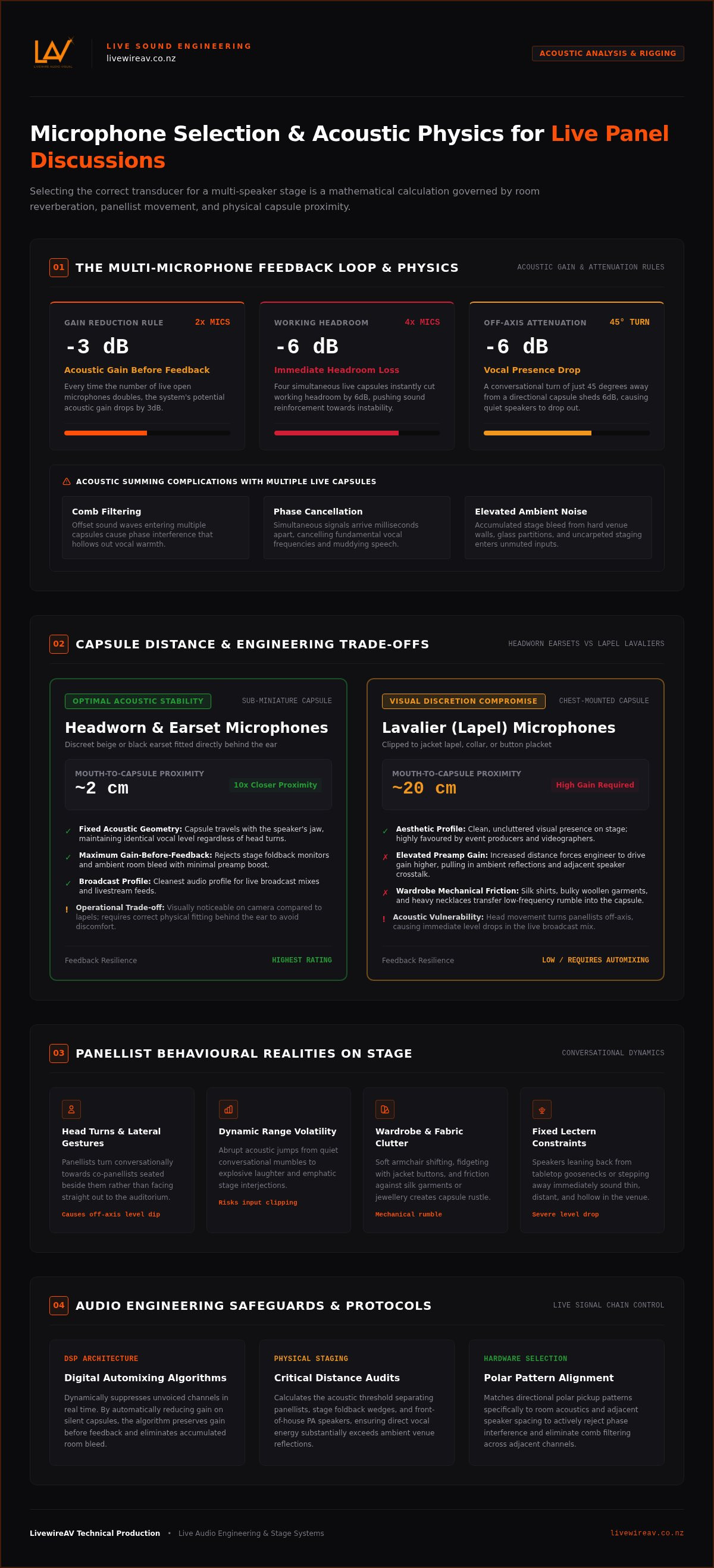
Stage feedback is an ever-present risk during multi-speaker events. Under standard acoustic principles, every time you double the number of open microphones, your potential acoustic gain before feedback drops by 3dB. Four open microphones instantly reduce your working headroom by 6dB, forcing the sound system closer to instability.
Reverberant venue surfaces compound the problem. Hard conference walls, glass partitions, and uncarpeted staging reflect amplified speech straight back into live capsules. Without deliberate physical positioning and polar pattern control, these reflections create a closed loop that results in piercing squeals. To maintain stability, engineers must calculate the critical distance between speakers, capsules, and stage foldback monitors, ensuring the direct sound significantly exceeds ambient reflections.
Vocal Dynamics and Physical Panellist Movement
Panellists behave conversationally, not theatrically. They turn their heads to address colleagues seated beside them, laugh abruptly, or drop their vocal projection when delivering nuanced points. These natural habits create severe operational hurdles across common microphone types if the pickup pattern does not align with their physical behaviour.
Off-axis attenuation: Turning just 45 degrees away from a directional capsule can cause a 6dB drop in vocal presence, causing quiet panellists to disappear from the mix.
Mechanical friction: Nervous fidgeting, shifting posture in soft armchairs, and jacket adjustments easily transfer low-frequency rumble into poorly isolated chest capsules.
Dynamic range swings: Mixing desks must handle abrupt shifts from muted mumbling to emphatic interjections without overloading the front-of-house system.
Understanding these acoustic and behavioural vulnerabilities allows technical teams to establish real acoustic control. Factoring in room reverberation and stage movement from the start ensures you deploy the best microphone type for panel discussions before the first rehearsal begins.
Comparing the Primary Microphone Types for Panel Discussions
Selecting the best microphone type for panel discussions requires balancing acoustic stability, visual subtlety, and speaker familiarity. No single transducer solves every stage scenario. Four distinct form factors dominate professional stages: headworn earsets, lapel lavaliers, wireless handhelds, and tabletop goosenecks. Each carries clear engineering trade-offs.
Headworn and Earset Microphones: Maximum Gain-Before-Feedback
Headworn microphones place a sub-miniature capsule just two centimetres from the corner of the mouth. Because the capsule travels with the speaker's jaw, mouth-to-capsule distance remains completely fixed. This consistent proximity guarantees maximum gain-before-feedback and rejects stage monitors with ease. While visually noticeable compared to lapels, discreet beige or black earsets provide the cleanest audio profile for livestream feeds. Experienced technicians must fit them properly behind the ear to prevent panellist discomfort.
Lavalier (Lapel) Microphones: Visual Discretion with Acoustic Trade-Offs
Lavalier microphones deliver a clean, uncluttered visual aesthetic that event producers appreciate on camera. However, they introduce significant acoustic compromises. Positioned roughly twenty centimetres below the mouth on a jacket or collar, they require substantially more preamp gain. This elevated gain pulls in room reverberation and adjacent speaker crosstalk. Silk shirts, bulky wool, and heavy necklaces frequently cause distracting mechanical friction noise directly against the capsule.
Wireless Handhelds and Tabletop Goosenecks: Simplicity and Control
Handheld dynamic microphones offer high dynamic range, bulletproof feedback resistance, and intuitive handling. They work brilliantly when passed between guest speakers, but panellist arm fatigue often leads to drifting holding positions that drop vocal levels. Conversely, tabletop goosenecks securely anchor seated participants at a panel desk, hiding all cabling out of sight. They sound pristine when speakers remain seated upright, though performance falters if someone leans back away from the desk.
Mastering these trade-offs is essential for flawless staging. Applying verified principles from Shure's guide on Microphone Techniques for Live Sound helps your crew maintain clean signal isolation across every active channel. For complex stages where dynamic conversations demand zero technical distraction, partnering with LivewireAV for full technical production ensures your wireless hardware and acoustic processing are engineered perfectly for the venue.
Evaluation Framework: How to Choose the Right Microphone Setup
Selecting audio hardware based on room aesthetics alone guarantees compromise. Determining the best microphone type for panel discussions requires a methodical, step-by-step engineering audit. Four sequential evaluations clarify the setup:
Venue acoustics: Measure boundary reflections, stage depth, and front-of-house PA alignment.
Speaker ergonomics: Review panellist wardrobe variety, media familiarity, and physical movement styles.
Distribution feeds: Balance the acoustic demands of the in-room audience against digital broadcast and recording mixes.
Contingency planning: Implement dedicated backup frequencies, redundant handheld channels, and clear Q&A paths.
Venue Acoustics, PA Positioning, and Stage Layout
Acoustic performance starts with loudspeaker placement. In large convention spaces, placing main line arrays ahead of the stage boundary prevents high-output spill into live capsules. Highly reverberant halls with polished concrete or expansive glass demand tight directional control. Deploying cardioid or supercardioid patterns rejects unwanted reflections, whereas omnidirectional capsules will quickly destabilise the room. Integrating specialised audio visual for large conferences ensures that speaker coverage, stage angles, and transducer selections are engineered together from the outset.
Panellist Experience, Wardrobe, and Ergonomics
Guest speakers rarely possess broadcast vocal discipline. Untrained contributors often lean back, talk with animated hand gestures, or drop their voice when formulating thoughts. For these speakers, headworn microphones provide consistent vocal pick-up regardless of head turns, eliminating the volume drops common with handhelds or table mics.
Wardrobe choices introduce practical staging limitations. Traditional lapels require structured collars, sturdy lapels, or buttoned plackets to sit upright. Delicate fabrics, silk blouses, or collarless necklines struggle under the weight of a standard clip, causing capsules to droop or brush against material. Similarly, securing wireless beltpacks demands sensible mounting points. Tailored dresses without waistbands require discreet fabric pouches, specialized neoprene waist straps, or magnetic clip mounts.
Stage furniture shapes this dynamic just as decisively. Casual armchairs encourage panellists to sink back, changing mouth angles away from fixed microphones. Low lounge settings heavily favour headworn units. Conversely, formal executive desks and boardroom panels naturally accommodate low-profile goosenecks or weighted boundary units, concealing wiring and letting guests sit without wearing hardware.
Hybrid requirements add the final layer of technical planning. An audio balance that cuts cleanly through room reflections can sound harsh on digital streams. Applying disciplined microphone techniques for streaming allows engineers to isolate source dialogue cleanly, feeding both the in-room line arrays and the broadcast feed without sonic degradation. Choosing the best microphone type for panel discussions is fundamentally about systematically resolving these staging friction points before the audience sits down.
Mitigating Live Audio Risks: Feedback, Crosstalk, and Frequency Clutter
Deploying the right transducers accounts for only half the battle. Even when you select the best microphone type for panel discussions, live stages introduce unpredictable acoustic variables. Real-time feedback, mechanical crosstalk, and dense radio frequency (RF) traffic can undermine an otherwise well-planned session. Containing these variables demands digital signal processing and active RF coordination.
Automated Mixing and Digital Signal Processing
Managing six or eight open microphones manually during an unscripted debate is challenging. Digital speech automixers, such as the industry-standard Dugan speech algorithm, balance these dynamics automatically. Rather than acting as a harsh noise gate, an automixer distributes gain mathematically across all active channels. As one panellist speaks, their channel opens smoothly while unvoiced channels attenuate instantly. This process locks overall system gain to that of a single microphone, preserving maximum headroom and eliminating room hum.
Targeted DSP filtering secures clarity across the mix:
High-pass filtering: Steep low-cut filters set between 80Hz and 120Hz instantly strip out table thumps, foot tapping, and stage HVAC rumble before hitting the PA.
Dynamic EQ and notch filtering: Precision parametric cuts tame harsh resonant frequencies without compromising natural vocal warmth.
Subtle compression: Gentle multiband compression controls unexpected vocal spikes when an energetic speaker laughs or projects forcefully.
Wireless Spectrum Management and Redundancy
Modern conference venues are RF minefields. Crowded exhibition halls, mobile devices, venue Wi-Fi networks, and local broadcast transmitters congest the wireless spectrum. Operating multiple wireless transmitters reliably requires pre-event spectrum scanning and coordination rather than relying on automatic receiver sync.
Directional distributed antenna systems mounted with direct stage line-of-sight eliminate dead spots caused by stage scenery or architectural pillars. Professional workflows also require matched redundancy. Pre-configured spare bodypacks and handheld transmitters tuned to isolated backup frequencies must stand by at the audio control desk, ready for instant deployment without interruption.
A flawless discussion ultimately rests on calm human execution. To safeguard your stage against unexpected dropouts, screeching feedback, and RF clutter, you can book complete technical production with LivewireAV to manage live automixing, RF coordination, and line array distribution with complete precision.
Delivering Flawless Panel Audio with LivewireAV Technical Production
High-stakes panel sessions leave no room for trial and error. Even after identifying the best microphone type for panel discussions, hardware alone cannot guarantee clear dialogue. Flawless execution requires modern audio line array systems, clean RF spectrum deployment, and real-time mixing by seasoned operators who understand conversational pacing under live event pressure.
LivewireAV provides full technical production across New Zealand for corporate assemblies, association conferences, and leadership summits. We treat live sound as a complete ecosystem where microphone selection, venue acoustics, and loudspeaker coverage work together to deliver absolute vocal clarity.
Comprehensive Audio Infrastructure and Engineering
Panel discussions present rapid conversational shifts. Our dedicated on-site sound engineers actively manage each channel, using digital automixing and surgical EQ to eliminate feedback loops before they develop. We ensure consistent vocal intelligibility across both the physical auditorium and off-site broadcast feeds.
Every event relies on tailored system architecture:
Precision line arrays: Modern speaker arrays deliver uniform acoustic energy across the entire audience while keeping direct sound off the stage.
Digital multichannel wireless: Fully managed multi-transceiver racks operate on coordinated, intermodulation-free frequencies to prevent dropouts.
Dual-feed distribution: Custom bus routing delivers a robust public address mix alongside a dedicated broadcast mix for your hybrid conference AV setup NZ.
End-to-End Technical Partnership for Corporate Events
The speaker experience dictates the success of a live stage. Panellists are rarely broadcast professionals; unexpected hardware issues can unsettle their confidence before they utter a single word. Our crew manages the backstage process with quiet composure, fitting bodypacks comfortably, securing subtle headworn units, and briefing speakers on natural microphone techniques.
We eliminate friction by integrating every technical layer under a single, accountable production team. Along with specialized audio systems, LivewireAV coordinates intelligent lighting design, LED walls, projection, and multi-camera vision switching. This unified approach ensures that audio cues, stage lighting transitions, and screen feeds operate in total synchronisation.
Engineering pristine panel audio is about giving your speakers a clear voice and giving your event team complete peace of mind. By combining top-tier wireless ecosystems with calm technical execution, we ensure the best microphone type for panel discussions translates into a polished, feedback-free experience for every attendee in the room.
Engineer Absolute Certainty for Your Next Live Panel
Achieving pristine sound across a multi-speaker stage requires far more than unboxing high-end hardware. Selecting the best microphone type for panel discussions comes down to respecting venue acoustics, anticipating speaker movement, and controlling multi-channel feedback through active digital automixing. When transducer choice, acoustic treatment, and proper placement align, your panellists speak naturally and your audience remains completely engaged.
Precision, composure, flawless delivery. At LivewireAV, we back every event with specialised audio line array systems, multi-channel digital wireless inventory, and experienced on-site sound engineers dedicated to active real-time mixing. Our full national production delivery ensures your staging operates with zero-failure technicals from opening remarks to final Q&A. Ensure crystal-clear audio for your next panel discussion with LivewireAV and give your speakers the effortless platform they deserve.
Frequently Asked Questions
What is the best microphone type for an inexperienced panel discussion speaker?
A miniature headworn earset microphone is generally the best microphone type for panel discussions involving untrained speakers. Because the tiny capsule rests at the corner of the mouth, the pick-up distance remains entirely uniform regardless of how often the panellist turns their head. This eliminates the sudden volume drops and off-axis hollow tones that frequently happen when nervous speakers use handheld or static tabletop microphones.
Why do lavalier lapel microphones frequently cause audio feedback on live stages?
Lavalier microphones sit roughly twenty centimetres away from the speaker's vocal cords, requiring sound technicians to dial in significant preamp gain. In live rooms with hard surfaces and active stage monitors, this extra gain readily picks up ambient reflections and speaker bleed. That acoustic bleed re-enters the microphone capsule at high volume, creating the closed loop that triggers sharp feedback squeals.
How many open microphones can be used simultaneously on a conference panel?
While four to eight active panellists are common on corporate stages, unmanaged open channels severely degrade sound quality. Every time the number of open capsules doubles, overall gain before feedback drops by 3dB. Without digital signal processing or active multi-channel automixing to attenuate inactive lines dynamically, having more than three open microphones simultaneously introduces noticeable phase comb filtering and elevated room rumble.
What is the difference between cardioid and omnidirectional microphones for panel sessions?
Cardioid microphones pick up sound primarily from the front while rejecting energy from the rear, providing vital feedback rejection on noisy corporate stages with stage monitors. Omnidirectional capsules capture sound evenly from all angles. While omnidirectional designs sound more natural and resist wind or breath pops, their wide coverage pattern easily introduces room reverberation and feedback on reflective event stages.
How does an automated microphone mixer improve sound quality during panel debates?
An automated microphone mixer calculates the total acoustic energy across all connected lines and adjusts channel gains in real time. When a panellist speaks, the automixer raises that channel seamlessly while attenuating silent microphones by several decibels. This keeps total system gain identical to a single active microphone, removing ambient stage hum and keeping spoken dialogue crisp and legible throughout fast-paced discussions.
Can we pass a single handheld microphone between panellists to cut costs?
Passing a single handheld microphone disrupts conversational momentum and introduces severe mechanical handling thumps across the sound system. Panellists frequently forget to hold the capsule close to their mouth, resulting in missed opening sentences and strained audience listening. Providing each speaker with a dedicated, properly calibrated channel ensures natural dialogue flow and consistent audio clarity across both the room and broadcast feeds.
What microphone setup works best when streaming a live panel discussion online?
Headworn microphones paired with a dedicated broadcast matrix offer the cleanest results for remote viewers. Live streams lack the natural acoustic masking of a physical room, meaning broadcast listeners notice mechanical clothing rustle and background reverb instantly. Headworn capsules capture high direct vocal presence and isolate dialogue cleanly, allowing the mixing engineer to feed crisp, direct speech straight to the streaming encoder.


Comments