The Ultimate Checklist for Technical Site Visits for Events in 2026
- Jul 8
- 11 min read
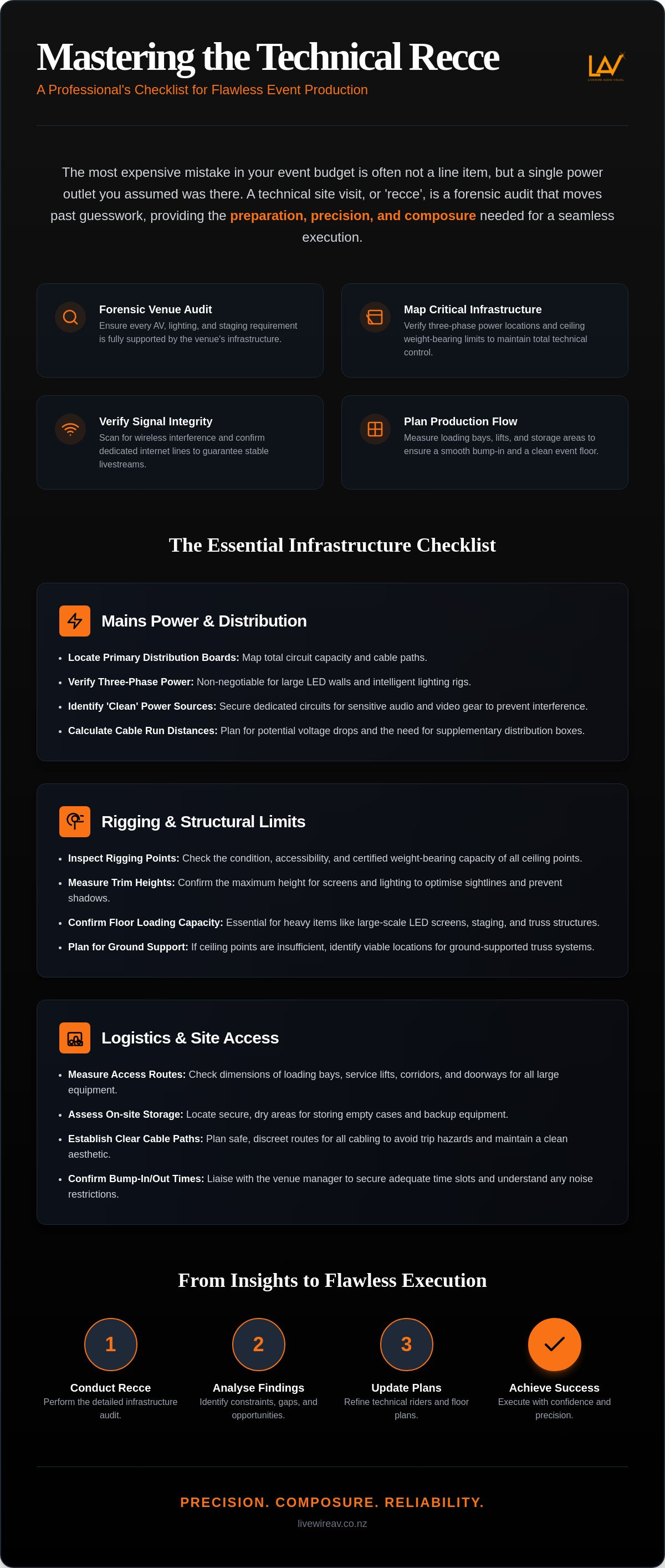
What if the most expensive mistake in your 2026 event budget isn't a line item, but a single power outlet you simply assumed was there? It's a common scenario. You walk into a stunning ballroom or a sleek industrial space, only to find the infrastructure doesn't match the vision. Conducting thorough technical site visits for events is the only way to move past the guesswork. It's about preparation, precision, and composure.
We understand the pressure of high-stakes environments. You shouldn't have to worry about equipment incompatibility or hidden venue fees that appear long after the contract is signed. You want a foolproof plan. This article provides a professional checklist designed to help you master the technical recce, eliminating surprises and ensuring your production team has total control over the environment. We'll cover power, rigging, and connectivity to give you the confidence required to organise a seamless execution.
Table of Contents
What is a Technical Site Visit and Why is it Non-Negotiable?
The Infrastructure Checklist: Power, Rigging, and Structural Limits
Signal Integrity and Wireless Coordination: The Invisible Environment
Logistics and Bump-in: Planning the Physical Production Flow
The Outcome: Turning Site Insights into a Flawless Production Plan
What is a Technical Site Visit and Why is it Non-Negotiable?
A technical site visit is more than a casual stroll through a ballroom or a quick look at a floor plan. It's a forensic audit of a venue's capacity to support specific AV, lighting, and staging designs. Within the broader field of event management, this process is known as a technical recce. While a standard walkthrough focuses on catering flow and guest registration, technical site visits for events prioritise the underlying infrastructure. We look for what's hidden behind the walls. We measure the actual height of rigging points. We verify the real-world capacity of the electrical switchboard.
There's a significant financial benefit to this level of detail. A thorough recce ensures your initial quote remains accurate. It eliminates those stressful, hidden equipment additions that often surface when a production team arrives on-site and realises the venue lacks the necessary power or structural support. By identifying these gaps early, we protect your budget and your peace of mind.
The Core Objectives of a Technical Recce
The primary goal is to validate the feasibility of the creative vision against the physical constraints of the room. Executing thorough technical site visits for events allows us to achieve several critical outcomes:
Identifying "show-stopper" issues such as insufficient power or obstructed sightlines before they become emergencies.
Establishing a direct, professional relationship with the venue’s house technicians to understand local protocols and access.
Refining the equipment list based on real-world measurements rather than generic venue brochures.
Who Should Attend the Site Visit?
A successful visit requires the right expertise in the room. The Technical Director acts as the steady hand, overseeing the entire production architecture. Department heads for lighting, audio, and vision assess their specific requirements, such as acoustic reflections or cable paths. Finally, the event planner ensures that the technical solutions don't compromise the guest experience or the aesthetic flow of the event. This collaborative approach ensures every detail is accounted for during the planning stage.
The Infrastructure Checklist: Power, Rigging, and Structural Limits
Infrastructure defines what's possible. During technical site visits for events, we move beyond the aesthetic to evaluate the hard limits of the building. This phase of the audit focuses on three pillars: power, weight, and space. Without a verified understanding of these elements, even the most creative lighting or vision design risks failure at the point of execution. Precision. Stability. Safety. These are the standards we apply to every venue assessment.
Mains Power and Distribution
Power is the lifeblood of the rig. We locate the primary distribution boards to map out total circuit capacity and identify dedicated "clean" power for sensitive audio gear. Three-phase power is the standard requirement for large-scale LED walls and intelligent lighting rigs. Assessing the distance from the power source to the stage is equally vital. Long cable runs can lead to voltage drops, so we calculate the exact requirements for looms and distribution boxes during the recce. Knowing the venue's electrical limitations allows our team to organise technical production that remains stable under full load.
Rigging and Ceiling Heights
Weight-bearing capacity is a non-negotiable safety factor. We inspect the condition and accessibility of existing rigging points to support audio visual for large conferences. Measuring trim heights ensures that projection and lighting angles are optimised, preventing unwanted shadows on stage. If ceiling points are insufficient or poorly positioned, we confirm the need for ground-support structures early in the planning phase. This foresight prevents last-minute delays and ensures the rig complies with all relevant safety standards.
Structural Integrity and Cable Pathing
Floor loading is a critical consideration for modern events. Large-scale LED screen setups and heavy staging require a surface that can handle significant point loads without risk of damage. We verify these limits with venue engineers when necessary to ensure the site can support the physical weight of the production. Finally, we map out discrete cable paths. Identifying routes for looms that avoid high-traffic guest areas is essential for maintaining both safety and a professional aesthetic. This meticulous approach to technical site visits for events ensures that every physical component of the production is integrated seamlessly into the venue's architecture.
Signal Integrity and Wireless Coordination: The Invisible Environment
The most critical risks are often the ones you can't see. While we verify the physical limits of power and rigging during technical site visits for events, we also audit the invisible environment. This includes the Radio Frequency (RF) landscape and the digital stability of the venue's network. In a high-stakes environment, a wireless microphone dropout or a stuttering livestream is just as damaging as a power failure. Precision in these areas is what separates a standard production from a flawless execution. Composure. Control. Reliability.
Network Stability for Hybrid and Livestreaming
Digital infrastructure is non-negotiable for modern events. We test the ping and jitter of the venue’s network to ensure a stable hybrid conference AV setup NZ. A simple speed test isn't enough. We need to know how the network behaves under sustained upload loads. During the recce, we negotiate firewall bypasses with venue IT departments for broadcast encoders and remote presenter feeds. This proactive step prevents technical blocks on the day. If the venue infrastructure proves unreliable, we establish a secondary failover network using 5G or Starlink to maintain total technical control.
Audio Acoustics and RF Management
Sound behaves differently in every room. We analyse the natural reverb of the space and identify "dead zones" where audio clarity might suffer. This allows us to plan for additional delay speakers or specific line array positioning to ensure every guest hears the same high-quality audio. We also test comms signal strength across the entire site. Ensuring the technical crew can communicate seamlessly from the loading dock to the control booth is essential for maintaining composure under pressure.
Managing the RF environment is equally complex. We scan for competing wireless signals from nearby businesses, internal security teams, and local broadcasters. These external signals can easily interfere with wireless microphones and crew communications. Precise frequency coordination is the most critical factor for zero-failure wireless audio. By mapping out the available spectrum during technical site visits for events, we assign dedicated bands to each device. This meticulous planning ensures the technical crew communicates seamlessly and the keynote presentations remain clear and uninterrupted.
Logistics and Bump-in: Planning the Physical Production Flow
Logistics represent the physical reality of your event design. While power and signal integrity are vital, they mean little if the hardware cannot reach the ballroom. We use technical site visits for events to map the entire journey of our equipment, from the tail-lift of the truck to the final rigging point. This level of planning prevents logistical gridlock, where multiple departments compete for the same service lift or loading bay space. Precision. Order. Composure.
Access Routes and Lift Dimensions
We measure dock heights and door widths with meticulous care. It's essential to verify that the service lift can handle the weight and dimensions of outdoor LED screen rental NZ components or large line array towers. Tight corners or narrow hallways can quickly derail a schedule if they aren't identified during the recce. We also clarify out of hours access requirements. Knowing exactly when we can start a multi-day build or a late-night strike allows us to coordinate seamless technical logistics that respect the venue's operational limits.
The sequence of the bump-in is just as important as the access route. We coordinate the arrival of lighting, audio, and staging in a logical flow. Typically, this means the heavy staging and overhead rigging arrive first, followed by lighting and audio, and finally the sensitive vision equipment. This methodical approach ensures that one team isn't waiting for another to finish, keeping the production on schedule and the environment calm. It turns a potentially chaotic morning into a disciplined, steady progression.
Staging and Crew Management
During the visit, we allocate a dedicated space for the front of house (FOH) control position. This area requires clear sightlines to the stage and sufficient room for the technical crew to operate without obstructing guest movement. We also identify dead case storage areas. Keeping empty flight cases out of sight is a simple but effective way to maintain a clean, professional aesthetic for the client. Crew welfare is another priority. We plan for catering and rest areas to ensure our specialists remain focused during long production days. Finally, we ensure the staging design complies with local health and safety standards, verifying that all structures are secure and fit for the specific venue layout.
The Outcome: Turning Site Insights into a Flawless Production Plan
The data gathered during technical site visits for events isn't just for the technical crew. It's the foundation of the entire event strategy. Once the recce is complete, we move from the assessment phase into the refinement phase. We take the measurements, the RF scans, and the power maps to update our technical riders and floor plans. Every detail is adjusted to reflect the physical reality of the room. This process ensures that when the final "Run of Show" is produced, every technical cue is physically possible. Precision. Accuracy. Composure.
We also use these insights to refine the live event lighting design. Many venues have unique architectural features or large windows that introduce natural light. By identifying these factors during the site visit, we can adjust our rig to complement the environment rather than fighting against it. This meticulous level of detail ensures the visual atmosphere is perfectly controlled, regardless of the time of day or the venue's existing fixtures.
Refining the Technical Proposal
We translate site measurements into 3D renders or CAD drawings for your approval. This provides a clear, visual representation of how the stage, LED walls, and audio systems will integrate into the space. We also adjust the equipment manifest to match the venue's specific power and signal requirements. A documented site visit report serves as the source of truth for the entire production team, ensuring everyone is working from the same verified information. This disciplined approach eliminates the guesswork that often leads to event-day friction.
A successful recce is also the most effective tool for budget control. It eliminates the need for expensive, last-minute equipment rentals on event day. By identifying the need for extra cable ramps, specialised rigging motors, or additional signal boosters early, we ensure your initial quote remains accurate. You won't find hidden costs appearing after the contract is signed. We believe that transparency is built on thorough preparation, and our goal is to provide a quote that reflects the true requirements of the site.
The LivewireAV Commitment to Preparation
Our "Calm Professional" ethos is built on the foundation of meticulous site visits. We understand that in high-stakes environments, precision and composure are the most valuable commodities. We reduce your stress by managing all venue technical liaison on your behalf, acting as the steady hand behind the scenes. This allows you to focus on your guests and the content of your event, confident that the technical environment is under total control. Excellence is our standard requirement, and it begins long before the first guest arrives.
Ready to plan your next high-stakes event? Speak with the LivewireAV team today.
Mastering the Technical Landscape
Mastering technical site visits for events is the definitive way to move from assumption to certainty. By auditing physical infrastructure, managing the invisible RF environment, and planning precise logistical flows, you eliminate the variables that cause event-day stress. This level of preparation ensures that every vision is achievable and every budget remains accurate. Precision. Composure. Control. These are the standards that transform a simple venue into a high-performance production environment.
With over 10 years of technical event management expertise, we specialise in high-stakes corporate and hybrid productions. Our methodical, zero-failure approach to technical planning is designed to let your work take centre stage while we handle the complexity behind the scenes. We invite you to partner with LivewireAV for your next high-stakes event production. Let's ensure your 2026 event is executed with total technical confidence and flawless AV execution. Your vision deserves the steady hand of a seasoned partner.
Frequently Asked Questions
Is a technical site visit necessary if I have used the venue before?
Yes. Venues frequently update their internal infrastructure, change staff, or modify house equipment without updating their marketing brochures. A fresh visit ensures that any recent maintenance to power boards or changes in rigging protocols are accounted for before your design is finalised. It provides the quiet confidence that your current production plan remains compatible with the venue's current state.
How long does a typical technical recce take?
A standard technical recce usually takes between 90 minutes and three hours. The duration depends on the complexity of your staging and the total number of rooms being used. We take the time to test power circuits, scan for wireless interference, and measure physical access routes to ensure every detail is documented with total precision.
Who is responsible for organising the technical site visit?
The event organiser typically coordinates the date and time with the venue manager, while the technical production team leads the actual inspection. We work closely with your venue contact to ensure house technicians and IT specialists are available to answer specific questions. This collaborative approach ensures that all parties are aligned on the logistical requirements long before the bump-in begins.
What happens if the venue does not have enough power for my LED wall?
We identify these limitations early and provide a pragmatic solution. This might involve hiring a silent external generator or negotiating access to additional distribution boards in adjacent rooms. Identifying these gaps during technical site visits for events prevents last-minute failures and ensures your high-draw equipment has the stable current it requires for a flawless performance.
Can a technical site visit be done virtually?
A virtual tour provides a helpful overview, but it cannot replace a physical inspection. Virtual walkthroughs cannot measure the ping of a network, scan for radio frequency interference, or verify the weight-bearing capacity of rigging points. Physical presence is the only way to ensure total technical control and eliminate the risk of event-day surprises.
What are the most common technical issues found during a site visit?
Insufficient power, wireless signal interference, and obstructed sightlines are the most frequent discoveries. We also often find that service lift dimensions or loading dock heights differ from the venue's official specifications. Identifying these "show-stopper" issues during the planning phase allows us to adjust the equipment manifest and maintain total composure during the live event.
Does the production company charge extra for a site visit?
Most professional production partners include the primary site visit as an essential part of their service. It is a standard requirement for ensuring a reliable and safe execution. We view the recce as a necessary investment in the project's stability. It protects your budget by eliminating the need for emergency equipment rentals on the day of the event.
What documents should I bring to a technical site visit?
You should have the latest floor plans, the draft run of show, and a detailed equipment manifest ready for review. Having these documents on hand allows the technical team to cross-reference theoretical designs with the physical space. It ensures every cable run, camera position, and lighting angle is validated against the real-world constraints of the venue.


Comments