How to Choose an Event Production Company in NZ: The 2026 Technical Buying Guide
- 3 hours ago
- 12 min read
What if the success of your national keynote didn't depend on the pixel pitch of the LED wall, but on the composure of the technician sitting behind the desk? Precise. Composed. Reliable. These are the traits that matter most when the house lights go down. When you're standing in the wings, the last thing you need is to worry about a flickering screen or a muffled microphone. Understanding how to choose an event production company NZ is about moving beyond basic equipment hire; it's about finding a partner who values technical discipline as a standard requirement rather than an occasional achievement.
We know the pressure of managing multiple vendors while trying to decipher complex AV quotes. It's exhausting and leaves too much room for error. You deserve a seamless, zero-failure execution where one team takes full responsibility for every signal and sequence. This 2026 guide provides the technical criteria and vetting strategies required to select a production partner that ensures your event is flawless and stress-free. We'll explore the shift toward immersive environments, the necessity of rigorous site visits, and how to identify the steady hand of a true technical expert.
Table of Contents
Defining the Technical Scope: Event Production vs. Event Management
Assessing Technical Infrastructure: Audio, Visual, and Lighting Standards
The Selection Framework: Comparing Quotes and Production Portfolios
Operational Excellence: Site Visits and Zero-Failure Planning
Securing a National Partner: The LivewireAV Standard of Execution
Defining the Technical Scope: Event Production vs. Event Management
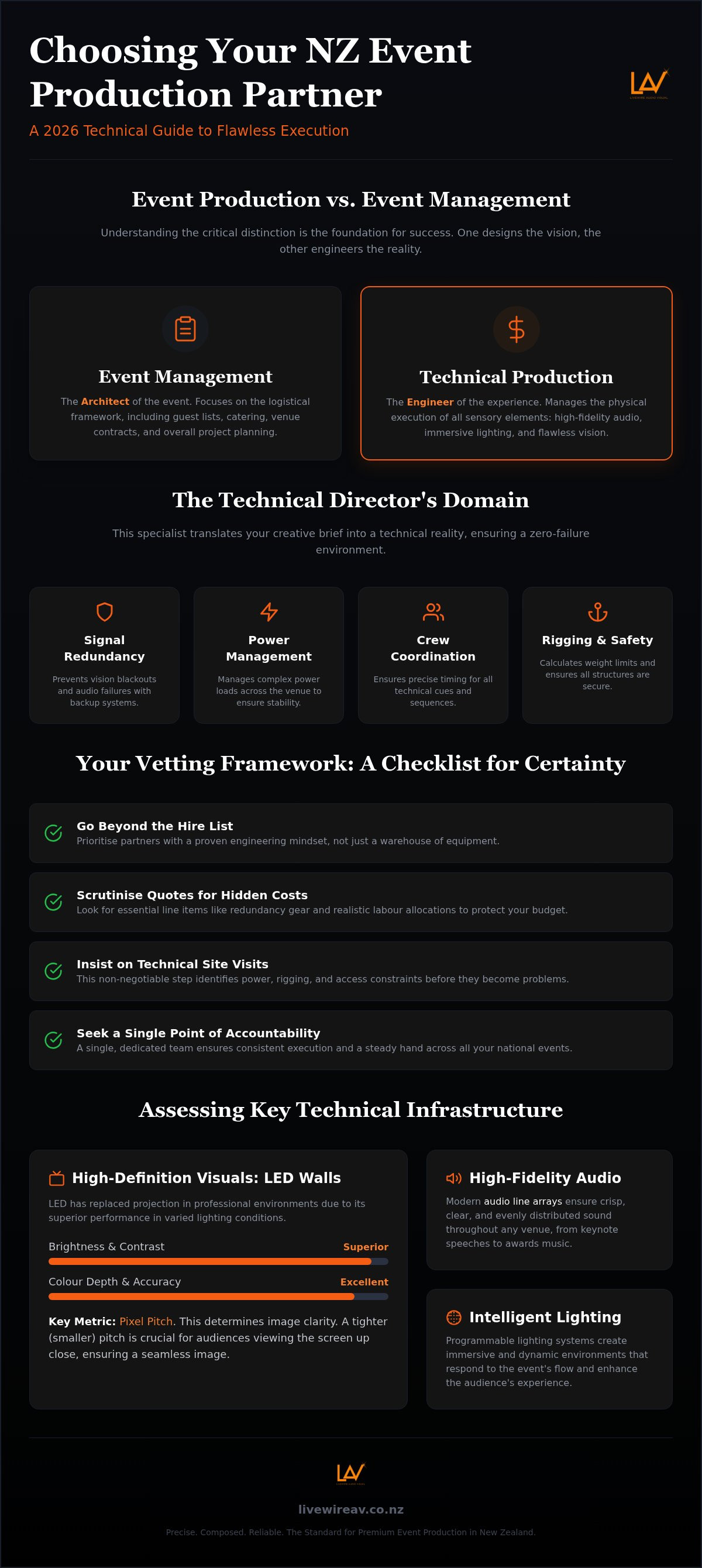
Choosing the right partner for your national event begins with a clear understanding of the roles involved. While the terms are often used interchangeably, event production and event management represent two distinct disciplines. Event management focuses on the logistical architecture; it covers the guest lists, catering, and venue contracts. In contrast, technical production is the engineering and physical execution of the experience. It's the steady hand that ensures the sound is crisp, the vision is sharp, and the lights respond exactly when they should. Precise. Composed. Reliable.
The Architect vs. The Engineer
Think of the relationship between an architect and a structural engineer. The event planner designs the vision, but the production team ensures the structure can actually stand. Technical production is the seamless integration of hardware and expert labour. It manages the sensory experience. High-fidelity audio. Immersive lighting. Flawless vision. When you're evaluating how to choose an event production company NZ, look for a team that prioritises this engineering mindset over simple equipment hire. This approach reduces technical friction, ensuring that the creative vision doesn't collide with the reality of signal paths or power loads.
Central to this process is the Technical Director. This specialist acts as the bridge between your creative goals and the technical reality. They translate a conceptual brief into a technical reality. The Technical Director focuses on:
Signal path redundancy to prevent vision blackouts.
Power load management across the venue.
Crew coordination and precise timing for cues.
Site-specific rigging safety and weight limits.
When to Engage a Production Specialist
Waiting until the venue is booked to contact a technician is a common mistake. Early engagement prevents costly workarounds later. A production specialist understands venue-specific constraints that a planner might overlook. Power distribution. Ceiling heights. Rigging points. Floor loading. These details dictate what's possible on stage. If the venue's power supply can't handle a large LED wall, you'll need to know that before you sign the contract.
Engaging a partner for premium event production New Zealand at the site selection stage allows for a technical audit of the space. This ensures you don't commit to a venue that lacks the infrastructure to support your vision. It's about total technical control. By involving the production team early, you secure a partner who can manage the "why" behind the technology, rather than just the "what". This is how you ensure a flawless, stress-free delivery from the first site visit to the final pack-down.
Assessing Technical Infrastructure: Audio, Visual, and Lighting Standards
To understand how to choose an event production company NZ, you must look beyond the equipment list and into the engineering standards of the fleet. Modern. Scalable. Precise. A professional production house doesn't just supply gear; it provides a curated ecosystem of technology designed for reliability. In 2026, the gap between basic hire shops and specialist partners is defined by the quality of their primary infrastructure: audio line arrays, high-pitch LED walls, and intelligent lighting systems. These tools are the building blocks of a zero-failure environment.
High-Definition Visuals and LED Technology
LED wall technology has largely replaced traditional projection for high-impact corporate environments. Unlike projection, which can appear washed out in well-lit conference centres, LED panels offer superior colour depth and consistent brightness. The critical factor in your selection should be pixel pitch. This measurement determines the clarity of your content based on how close the audience is to the screen. A tighter pitch ensures that even those in the front row see sharp, seamless imagery rather than individual diodes. For a deep dive into these specifications, see our guide on conference LED screen hire NZ. Choosing the right pitch ensures your brand visuals remain professional, regardless of the venue's ambient light conditions.
Audio Engineering for Large Venues
Audio engineering for large venues requires more than just high volume. It requires speech intelligibility. Professional audio line array systems are the standard for 2026 because they provide even coverage across massive rooms without the "hot spots" or "dead zones" common with older point-source speakers. This precision is vital for both in-person attendees and remote viewers. With 86% of B2B organisations reporting a positive ROI from hybrid events (Reaction Audio Visual, January 2026), your audio signal must be pristine for the livestream feed as well as the room. Sound design is about control, not just power. A disciplined technician will map the room's acoustics to ensure every word of a keynote is heard clearly in the back row and on the digital recording.
Intelligent lighting design bridges the gap between a standard stage and a broadcast-quality environment. These systems allow for layered lighting and kinetic displays that respond in real-time to the event's rhythm, creating a sense of total technical control. When these elements are integrated correctly, they let your work take centre stage without the distraction of technical instability. If you're planning a national tour, consulting with a technical specialist early ensures your infrastructure is fit for purpose across every city on your itinerary.
The Selection Framework: Comparing Quotes and Production Portfolios
Comparing two vastly different price points for the same event brief can be a source of significant stress. In the high-stakes environment of live production, the lowest quote often carries the highest risk of technical failure. This is because budget-driven quotes frequently omit the "invisible" safety nets that ensure a flawless delivery. Redundancy gear. Backup signal paths. Sufficient labour hours. When evaluating how to choose an event production company NZ, your goal is to look past the bottom line and identify the steady hand of a partner who prioritises reliability over a low-cost, high-risk approach.
Decoding the Technical Quote
A professional production quote should clearly differentiate between "Dry Hire" (simply renting gear) and "Full Production" (a fully managed service). If a quote looks surprisingly low, it may be because it lacks the expert labour required to operate the equipment under pressure. Look for specific line items such as vision switching and camera packages. These are not optional extras for a national conference; they are the tools that allow for a dynamic, professional visual experience. Labour costs are a direct reflection of expertise. They represent the technicians who manage high-pressure cues with composure and precision, ensuring that every transition is seamless and every signal is secure.
Redundancy Gear: Backup mixers, spare microphones, and redundant vision processors.
Labour Allocations: Realistic hours for setup, rehearsal, and pack-down.
Transport and Logistics: Clear costs for moving heavy infrastructure across New Zealand.
Technical Direction: A dedicated lead to oversee the entire signal chain.
Assessing Experience in High-Stakes Environments
A portfolio should demonstrate more than just "pretty lights." It must show a track record of success in environments similar to your own. Ask for case studies involving live broadcasts or complex hybrid integrations where there was no room for error. You need a partner who is venue-aware, someone who understands the specific rigging points, power grids, and access constraints of major New Zealand convention centres. This familiarity allows the team to work with a quiet confidence that keeps the "bunker"—the technical control area—calm and focused.
When vetting potential partners, use this audio visual for large conferences resource to cross-reference their proposed solutions against industry standards. Look for a team that communicates with pragmatic, matter-of-fact delivery. This composed professionalism is exactly what you want behind the desk when your keynote speaker takes the stage. It is the hallmark of an expert who understands that in event production, precision is the only standard that matters.
Operational Excellence: Site Visits and Zero-Failure Planning
Operational excellence is the invisible engine of a successful event. It's the difference between hoping for the best and knowing exactly how every signal will behave. When researching how to choose an event production company NZ, you must look for a partner who treats risk mitigation as a non-negotiable standard. This process starts long before the first flight case is loaded onto the truck. It begins with a disciplined approach to site visits and a technical plan built on the principle of redundancy. Prepared. Meticulous. Resilient.
The Necessity of Technical Site Visits
A professional production team must see the venue in person before finalising any design. Photos and floor plans are useful, but they don't reveal the whole story. A physical walkthrough identifies sightline obstructions, acoustic reflections, and hidden power constraints that could compromise your delivery. We check for rigging point weight limits and ensure the proposed technical design aligns with the Health and Safety at Work Act 2015. This legislation requires robust risk management for all staff, contractors, and attendees. Identifying these variables early prevents expensive last-minute workarounds. It ensures that the pack-in and pack-out logistics are compliant, efficient, and respectful of the venue's operational rules.
Redundancy and Risk Management
Zero-failure planning means assuming that every piece of hardware has the potential to fail. We mitigate this through dual-redundant systems for all critical paths. This includes backup audio consoles, spare microphones, and "fail-to-black" visual paths that ensure your brand remains protected even in an equipment crisis. For those managing a hybrid conference AV setup NZ, specific fail-safes for internet connectivity and stream encoders are essential. Redundancy is not an optional extra; it is a baseline requirement for high-stakes environments.
The real value of an expert partner isn't just the backup gear; it's the composure of the team. When an unexpected issue arises, you need technicians who remain calm and invisible. They possess the deep technical knowledge required to switch to a secondary signal path without the audience ever noticing a flicker. This steady hand is what allows you to focus on your presentation with total peace of mind. Every detail is accounted for long before the first guest arrives.
Ready to secure a steady hand for your next national event? Contact our technical production team to discuss your upcoming requirements.
Securing a National Partner: The LivewireAV Standard of Execution
Selecting a partner for a high-stakes event is about more than just equipment lists. It's about accountability. When considering how to choose an event production company NZ, the final decision often rests on who will provide the steadiest hand during the live show. LivewireAV positions itself as that disciplined specialist. We offer more than just fragmented hire; we provide full-service technical management that lets your work take centre stage. Precise. Composed. Reliable.
End-to-End Technical Management
True technical management means taking total ownership of the signal chain. From the first audio input to the final pixel on an LED wall, we manage every detail. This integrated approach removes the friction of managing multiple technical vendors. It ensures that the lighting design complements the camera packages and that the audio line arrays are tuned perfectly for the room's acoustics. Our team thrives in high-pressure environments, maintaining a quiet confidence that translates into a stress-free experience for you. This expertise extends to complex logistics, such as outdoor event production NZ, where environmental variables require a meticulous approach to power and rigging.
National Coverage and Logistical Reliability
Many providers focus solely on a single city, often leaving clients to navigate different standards as they move between venues. LivewireAV offers national service capability from our Auckland base, providing a consistent standard of execution across New Zealand. Whether you're running a multi-city roadshow or a national conference, you benefit from a single point of accountability. This centralised project management ensures that technical specifications and creative requirements aren't lost in translation between venues. We understand the specific nuances of major New Zealand convention centres, allowing us to maintain total technical control regardless of the location.
Choosing a production partner is a commitment to a collaborative relationship. We value clear, honest communication and professional discipline above all else. Our goal is to remain the steady hand behind the scenes, ensuring that every transition is seamless and every detail is accounted for long before the first guest arrives. If you're ready to move beyond basic AV hire and secure a partner who prioritises technical mastery, organise a tailored proposal for your next event with LivewireAV. We'll provide the composure and precision your national event requires.
Securing Technical Composure for Your National Event
Selecting a partner for a large-scale project is a strategic decision that directly impacts your brand's reputation. You now possess the technical framework for how to choose an event production company NZ by prioritising engineering discipline over basic equipment hire. A successful execution relies on the seamless integration of modern hardware, such as LED walls and audio line arrays, with the steady hand of an experienced technician. Redundancy is a baseline requirement. Composure is a non-negotiable standard.
LivewireAV brings 10+ years of technical excellence to every stage we manage. We specialise in full technical production, providing seamless national project management that ensures your message is delivered with absolute clarity across any New Zealand venue. Our focus remains on precision and reliability, allowing you to engage with your audience while we handle the complexity behind the scenes. We thrive under pressure so you don't have to.
Partner with LivewireAV for your next high-stakes New Zealand event and experience the peace of mind that comes from total technical control. We're ready to ensure your next national tour or conference is delivered with the quiet confidence of an expert.
Frequently Asked Questions
What is the difference between an AV hire company and an event production company?
An AV hire company focuses on the rental of hardware, whereas an event production company provides the engineering and expert labour required to manage a high-stakes environment. Production partners take total ownership of the technical design, signal paths, and live execution. This managed service ensures that the gear is fit for purpose and operated by specialists who remain calm under pressure. It's about securing a steady hand behind the scenes rather than just a list of equipment.
How early should I involve a production company in my event planning process?
You should involve a technical partner as early as the venue selection stage to prevent costly logistical workarounds. Learning how to choose an event production company NZ involves finding a partner who can audit a venue's power, rigging, and access constraints before you sign a contract. Early engagement allows for a more integrated technical design, ensuring the infrastructure supports your vision without compromise. It's the most effective way to maintain total technical control.
Do I need to hire an external production team if the venue has in-house AV?
Hiring an external production team provides a single point of accountability and a consistent technical standard, especially for national tours. While in-house AV is convenient, an external specialist brings a deeper understanding of your specific brand requirements and often higher-quality equipment, such as specialised LED walls or audio line arrays. This partnership ensures that your technical execution remains seamless regardless of the venue, providing a steady hand that works exclusively in your interest.
What are the most common technical mistakes made during corporate events?
The most frequent technical errors include inadequate audio coverage in large rooms and a lack of signal redundancy. Many organisers underestimate the power requirements for high-impact lighting or fail to plan for "fail-to-black" visual paths. These mistakes often stem from choosing the lowest quote without verifying the technical safety nets. A professional production partner mitigates these risks through meticulous planning and the use of dual-redundant systems for all critical event elements.
How do production companies handle hybrid events and livestreaming in NZ?
Production companies manage hybrid events by integrating dedicated stream encoders and dual-redundant internet connections to ensure broadcast stability. In 2026, this involves vision switching that caters to both the in-room LED wall and the remote digital audience simultaneously. This approach ensures that organisations can achieve the positive ROI typically associated with hybrid formats. It requires a disciplined technician who understands how to balance live acoustics with a clean digital feed without compromise.
What technical information should I have ready before asking for a quote?
To receive an accurate quote, you should provide the venue name, expected audience size, and a draft run sheet or schedule. It's also helpful to specify if you require high-resolution LED walls, camera packages for vision switching, or specialised audio for a large-scale room. Having this data ready allows the production team to calculate realistic labour hours and transport logistics. Clear communication at this stage ensures there are no hidden costs in your final proposal.
How do I know if a production company is capable of handling a large-scale outdoor event?
Capability for outdoor events is defined by a company's approach to weatherproofing, temporary power distribution, and high-output audio engineering. You should ask for case studies that demonstrate success in managing large-scale logistics and complex health and safety requirements. Look for a partner who prioritises technical site visits to identify environmental risks. A seasoned team will have the composure and specialised gear required to deliver a flawless performance in unpredictable outdoor conditions across New Zealand.
Why are technical site visits considered essential for event success?
Technical site visits are essential because they identify physical constraints that aren't visible on a floor plan. We check for rigging point weight limits, acoustic reflections, and cable path obstructions that could compromise the show. This walkthrough ensures the technical plan is venue-aware and compliant with the Health and Safety at Work Act 2015. It's a non-negotiable step in our process that allows us to account for every detail long before the first guest arrives.


Comments