Technical Production for Hybrid Conferences NZ: 2026 Guide
- 5 days ago
- 11 min read
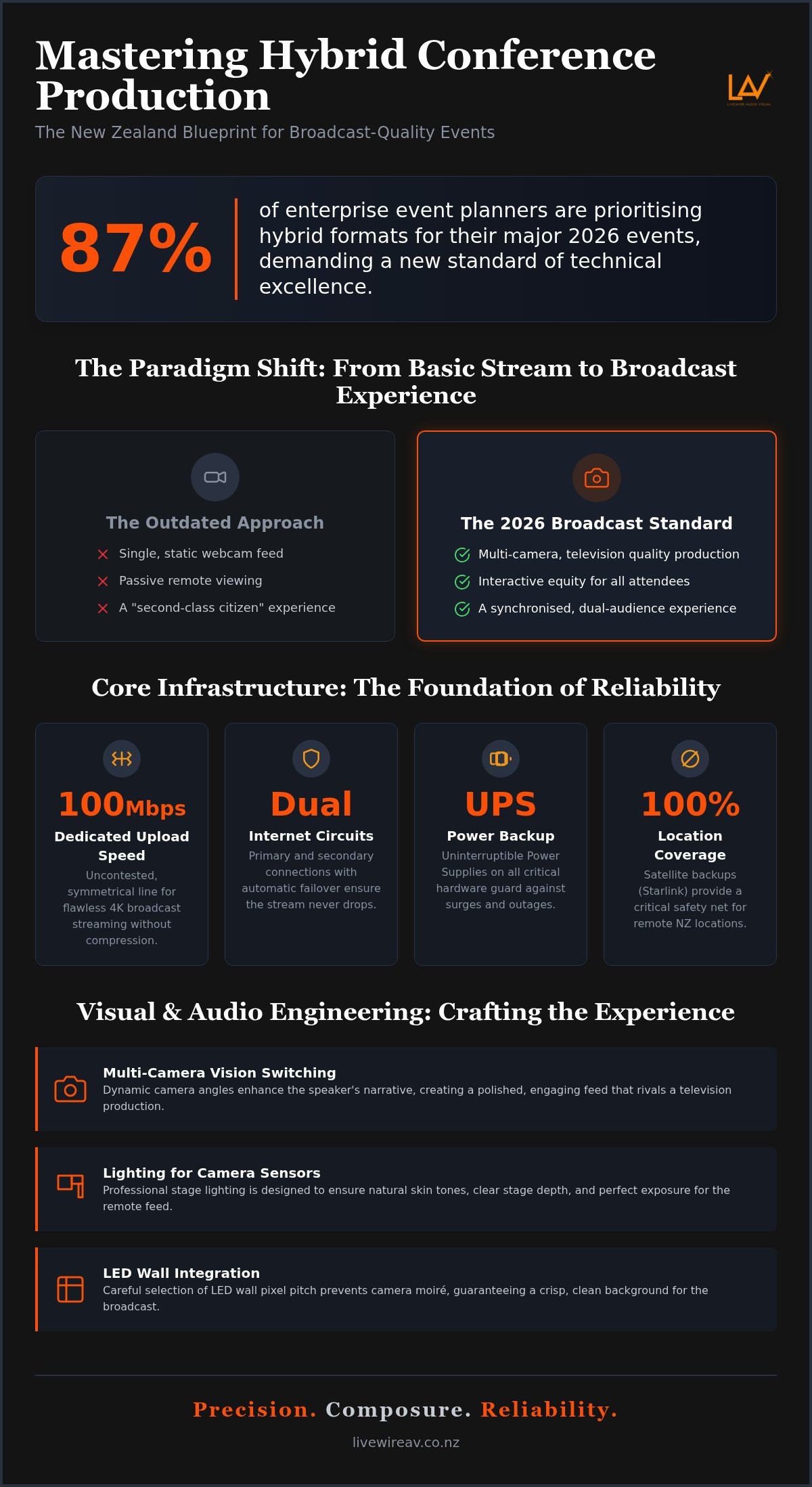
With 87% of enterprise event planners now prioritising hybrid formats for their major 2026 events, the margin for technical error has vanished. A hybrid conference is no longer just a meeting with a webcam at the back of the room. It is a sophisticated, dual-audience broadcast that demands absolute precision. Navigating the technical production for hybrid conferences NZ requires more than just high-end gear. It requires a singular management layer that treats your virtual feed with the same prestige as the physical stage. Precision. Composure. Reliability.
You likely understand the stress of fragmented vendors who fail to communicate or the dread of a stream dropping out during a critical keynote. It's a common pain that leaves remote attendees feeling like second-class citizens. This guide provides the expert roadmap you need to master these complexities and deliver broadcast-quality results across New Zealand. We'll show you how to achieve zero-failure execution, drive high engagement metrics, and maintain total peace of mind. From navigating the 2026 medical conference law changes to integrating low-latency streaming, this is your blueprint for a seamless live show. Meticulous. Modern. Methodical.
Table of Contents
The Evolution of Technical Production for Hybrid Conferences NZ
Core Infrastructure: Connectivity, Redundancy, and Low-Latency
Visual Engineering: Integrating LED Walls and Multi-Camera Packages
The Technical Production Roadmap: From Site Visit to Show Day
Why National Organisations Partner with LivewireAV for Hybrid Success
The Evolution of Technical Production for Hybrid Conferences NZ
The definition of a successful event has fundamentally shifted. In 2026, hybrid production is defined as the synchronised delivery of content to two distinct, equal audiences. It is no longer enough to simply "add a stream" to a physical gathering. Mastering the technical production for hybrid conferences NZ means ensuring that the delegate in the room and the attendee on the screen receive the same calibre of experience. High-fidelity audio. Low-latency vision. Resilient connectivity. These are the non-negotiable pillars of modern event execution.
For those establishing their strategy, understanding What is a Hybrid Event? involves looking past the screen to the underlying infrastructure. A professional hybrid execution ensures that remote participants are not treated as second-class citizens. They require interactive equity, where their questions, polls, and presence carry the same weight as those physically present. This level of synchronisation demands a disciplined approach to signal flow and timing.
Why National Organisations are Moving to Hybrid Models
Recent data indicates that 87% of enterprise event planners now prioritise hybrid options for their major 2026 conferences. This shift is driven by a focus on environmental sustainability and the practicalities of national logistics. By reducing the necessity for every delegate to travel across the country, organisations can lower their carbon footprint while expanding their reach. The "digital twin" concept has become the standard. This approach creates a virtual environment that mirrors the physical venue's energy and branding, allowing the conference to exist beyond the constraints of four walls. This is particularly relevant following the 2025 reform of Section 20 of the Medicines Act 1981, which has already attracted major international medical conferences to New Zealand shores for 2026.
The 2026 Standard: Broadcast-Quality vs. Basic Streaming
The days of a single webcam positioned at the back of a plenary room are over. New Zealand corporate standards now demand broadcast-quality visuals that rival television productions. This requires sophisticated multi-camera vision switching, where every angle is chosen to enhance the narrative of the speaker. Lighting also plays a critical role. Professional stage lighting must be designed specifically for camera sensors to ensure skin tones are natural and the stage depth is clear for the remote feed. Achieving this level of polish requires expert technical event management to oversee the intersection of live sound, vision, and streaming. Precision is the baseline. Composure is the requirement. Excellence is the result.
Core Infrastructure: Connectivity, Redundancy, and Low-Latency
The backbone of any successful event is its data infrastructure. For high-stakes technical production for hybrid conferences NZ, bandwidth is the first consideration. To maintain a 4K broadcast stream without compression artifacts, a dedicated upload speed of at least 100 Mbps is the industry standard. This must be a clean, uncontested line, separate from the delegate Wi-Fi or venue operations. High speed alone is not enough; the connection must be symmetrical and stable to handle the constant data load of a multi-day programme.
Stability requires more than just speed. It requires redundancy. We implement primary and secondary internet circuits as a standard requirement. If the venue's fibre line fails, the system must automatically switch to a secondary provider. In remote New Zealand locations where terrestrial fibre may be inconsistent, satellite backup through Starlink Business provides a critical safety net. This ensures that whether your event is in a central Auckland hotel or a remote lodge in the Southern Alps, the stream remains unbroken. Reliability. Precision. Composure.
Redundancy Planning and Failover Protocols
Reliability is built into the signal flow. Every broadcast rack should be supported by Uninterruptible Power Supplies (UPS) to guard against local power surges or outages. Hardware encoders are configured for automatic failover, meaning the secondary stream is always active and ready to take over. This is not a manual switch; it's a seamless transition that happens in the background, invisible to the viewer. This meticulous preparation ensures the virtual audience never sees a "loading" spinner. Adhering to strict technical A/V requirements is how we maintain total technical control during the live show.
Low-Latency Interaction for Live Q&A
Real-time engagement depends on the speed of the return feed. Latency is the delay between a physical action and its remote appearance, measured in milliseconds. To keep conversations natural, we use low-latency protocols that facilitate fluid two-way audio between virtual speakers and the live room. This prevents the awkward pauses that often plague poorly managed hybrid events. Ensuring the virtual speaker can hear the room and the room can hear the speaker without echo requires sophisticated mix-minus audio routing. If you are planning a complex programme, choosing a partner who understands professional hybrid solutions is the best way to ensure your guests remain connected. Focus. Stability. Results.
Visual Engineering: Integrating LED Walls and Multi-Camera Packages
Visuals anchor the stage and define the remote viewer's experience. In 2026, conference LED screen hire NZ has become the foundation of modern hybrid environments because it offers the brightness and contrast required for high-definition cameras. However, selecting an LED wall involves more than just size. You must choose the correct pixel pitch to prevent moiré patterns, those distracting wavy lines that appear when a camera sensor and an LED grid don't align. Meticulous planning ensures that the backdrop looks as crisp on a 65-inch home office monitor as it does in a physical ballroom. Precision. Focus. Clarity.
Effective technical production for hybrid conferences NZ requires synchronised graphics management. Your in-room slides may need to be formatted differently from the virtual overlay to account for lower resolutions or smaller screen sizes. It's often helpful to consult a guide to a successful hybrid event to understand how the technology stack should support these dual-audience requirements. A dedicated vision engineer ensures that branding remains consistent across all feeds, managing lower-thirds, name straps, and transition graphics in real time. Stable. Modern. Professional.
Multi-Camera Production for Engagement
A single camera angle is a static experience that leads to viewer fatigue. We typically deploy a standard three-camera setup: a wide shot of the stage, a tight shot on the speaker, and a roaming camera for audience questions. Vision switching creates a "TV show" feel that keeps remote attendees engaged. It's also vital to manage the "Return Feed." This allows on-stage speakers to see the virtual audience, facilitating a natural dialogue rather than a one-way lecture. This two-way visual connection is what separates a broadcast from a simple recording.
Lighting Design for Camera and Room
Lighting is the bridge between the physical space and the digital sensor. We use live event lighting design to balance colour temperatures, typically measured in Kelvin, so that speakers look natural on screen without feeling washed out in the room. Strategic three-point lighting separates the subject from the background, adding depth to the camera feed. We avoid harsh shadows that look exaggerated on a digital stream, ensuring the presenter remains the focus. This methodical approach to illumination provides a polished, professional finish that reassures both organisers and attendees. Composed. Pragmatic. Reliable.
The Technical Production Roadmap: From Site Visit to Show Day
High-stakes event execution is a science of preparation. Delivering technical production for hybrid conferences NZ requires a methodical timeline that eliminates guesswork long before the plenary doors open. It isn't about flashy gear; it's about a disciplined roadmap that transitions from the initial venue audit to the live show. We operate with a quiet confidence that comes from knowing every cable, signal path, and redundancy route has been tested. Planning. Preparation. Performance.
Technical Site Visit: Audit venue power and data infrastructure to ensure it meets broadcast standards.
Bespoke Design: Architect the AV signal flow specifically for dual-audience delivery.
Speaker Briefings: Conduct rehearsals for both physical and virtual presenters to ensure comfort with the technology.
Rig Day: Deploy the full system and stress-test all failover paths and backup circuits.
Live Execution: Manage the event under the oversight of a dedicated Technical Director.
The Vital Role of the Technical Site Visit
Assuming that a venue’s marketing brochure accurately reflects its technical capability is a risk you don't need to take. A site visit allows us to audit the actual power distribution and verify that the dedicated upload speeds meet the 100 Mbps standard required for 4K stability. We also identify line-of-sight issues for camera placement and map out safe cable paths to maintain a clean, professional floor. This venue-aware approach ensures that there are no surprises on rig day. Composed. Pragmatic. Reliable.
Managing the "Run of Show" for Two Audiences
A hybrid event is essentially two simultaneous productions. The "Run of Show" must be timed so that neither audience is left waiting in the dark. This involves synchronising cues for the physical room with the digital overlays for the stream. In many older venues, a specialised hybrid conference AV setup NZ is required to overcome acoustic or structural limitations. We often integrate a "Virtual MC" into the signal chain to provide dedicated commentary and instructions for the remote guests, ensuring they feel like active participants rather than observers.
The final layer of security is the Technical Director. This individual serves as the steady hand behind the scenes, coordinating the vision switchers, audio engineers, and stream technicians. They ensure that every transition is seamless and every cue is hit with precision. If you are ready to begin planning your next high-stakes event, you can contact our team to discuss your technical roadmap. Meticulous. Modern. Methodical.
Why National Organisations Partner with LivewireAV for Hybrid Success
Choosing a partner for technical production for hybrid conferences NZ is a decision based on trust. In high-stakes corporate environments, the most valuable commodity isn't the equipment; it's the composure of the team operating it. We position ourselves as the steady hand behind the scenes. Our "Calm Professional" approach is designed to alleviate the organiser's stress through total technical control. Precision. Composure. Reliability.
National organisations require a partner who can provide consistent technical quality across any New Zealand venue. Whether your event is held in a metropolitan Auckland centre or a regional Queenstown retreat, the standard of execution must remain identical. We maintain a modern inventory of line array audio systems and high-resolution LED walls to ensure your brand is presented with absolute clarity. This infrastructure, combined with our zero-failure philosophy, provides the peace of mind necessary to focus on your delegates rather than the data feed. Seamless. Stable. Certain.
Experience in High-Stakes Corporate Environments
With over a decade of experience managing complex technical logistics, we understand the unique pressures of the corporate sector. We don't just provide gear; we integrate seamlessly with your internal event teams and Professional Conference Organisers (PCOs). Our role is to be the disciplined specialist who thrives under pressure, ensuring that every transition is accounted for. Clear, honest communication is our baseline. We provide regular updates and transparent technical audits so that there are no ambiguities as the live show approaches. Methodical. Direct. Professional.
Tailored Proposals for Bespoke Event Requirements
We don't believe in "one-size-fits-all" AV packages. Every organisation has specific brand goals, and the technical solution should be built around them. Our process begins with a thorough understanding of your programme requirements, followed by the design of a bespoke signal flow that supports your vision. This ensures that your technical production for hybrid conferences NZ is efficient, effective, and perfectly aligned with your objectives. We take the time to plan every detail, from the audio mix-minus routing to the pixel pitch of the stage screens. This steady pace reinforces our commitment to quality execution. Ready to elevate your next hybrid event? Contact LivewireAV for a tailored proposal.
Securing Your 2026 Hybrid Event Success
The standard for corporate events has shifted toward a broadcast-first mentality. Success now depends on your ability to synchronise the physical and virtual worlds without friction. Mastering the technical production for hybrid conferences NZ involves a commitment to redundant data paths, professional multi-camera vision, and a methodical roadmap that begins long before the first guest arrives. By treating both audiences with equal prestige, you protect your brand's reputation and drive meaningful engagement. Precision. Composure. Reliability.
LivewireAV brings over 10 years of high-stakes technical management to every project. We provide specialised hybrid broadcast technicians and comprehensive national service coverage across New Zealand, ensuring a consistent calibre of execution from Auckland to Queenstown. We act as the steady hand behind the scenes, allowing your work to take centre stage while we maintain total technical control. Meticulous. Modern. Methodical.
Partner with the Calm Professionals for your next hybrid conference to ensure a seamless, zero-failure delivery. We look forward to helping you execute your vision with absolute confidence and peace of mind.
Frequently Asked Questions
What is the minimum internet speed required for a hybrid conference in NZ?
A dedicated upload speed of at least 100 Mbps is the industry standard for maintaining a stable 4K broadcast stream. This must be a clean, uncontested line that remains separate from the delegate Wi-Fi or general venue operations. While lower speeds can support 1080p, the higher bandwidth provides a necessary buffer against fluctuations and ensures the broadcast-quality visuals expected for high-stakes corporate environments in 2026.
Do I need a separate AV team for the virtual audience?
You don't need entirely separate teams, but you do require dedicated roles within a single, unified management layer. A synchronised approach ensures that the vision switcher, audio engineer, and stream technician are all working from the same "Run of Show." This prevents communication gaps between the physical room and the virtual feed, which is a critical component of professional technical production for hybrid conferences NZ.
How do I prevent audio feedback when virtual speakers are talking?
We prevent audio feedback by implementing sophisticated "mix-minus" audio routing through our digital consoles. This technical configuration ensures the virtual speaker receives a feed of the entire room except for their own voice. Without this specific setup, the remote speaker's audio would loop back through the venue microphones and speakers, creating the distracting echoes or squeals that can compromise the professionalism of your event.
Can any New Zealand venue host a professional hybrid conference?
Most venues can host a hybrid event, but their suitability depends on their existing power and data infrastructure. Older or more remote New Zealand venues often require additional support, such as portable data circuits or satellite backup, to meet modern broadcast standards. This is why we prioritise a technical site visit to audit the venue's actual capabilities rather than relying on advertised specifications or marketing brochures.
What happens if the internet goes down during the livestream?
Our zero-failure philosophy relies on primary and secondary internet circuits with automatic failover protocols. If the venue's main fibre line fails, the system instantly switches to a secondary provider or a satellite backup like Starlink Business. This transition happens seamlessly in the background, ensuring the virtual audience remains connected without experiencing a stream dropout or seeing a loading spinner during a critical keynote session.
How far in advance should I book technical production for a hybrid event?
We recommend booking your technical production at least six to twelve months in advance for large-scale national conferences. This lead time is necessary to secure high-demand equipment, such as LED walls and line array systems, and to allow for a thorough technical roadmap. For smaller corporate gatherings, a minimum of three to four months ensures every logistical detail is meticulously accounted for before the first guest arrives.
What is the difference between a livestream and a hybrid production?
A livestream is typically a one-way broadcast where a remote audience simply observes a video feed. In contrast, technical production for hybrid conferences NZ focuses on interactive equity and two-way engagement. A true hybrid model ensures that virtual attendees can participate in real-time Q&A, join live polls, and interact with on-stage speakers as if they were physically present in the room, creating a single, unified experience.
Is it possible to have real-time Q&A with both audiences?
Real-time Q&A is entirely achievable when using low-latency streaming protocols and a dedicated return feed for the on-stage presenters. This setup allows the speaker to see and hear the virtual audience's questions with minimal delay, facilitating a natural and fluid dialogue. By managing the audio and vision signal flow with precision, we ensure that the interaction feels seamless for both the delegates in the room and those watching remotely.


Comments