High Quality Event Video Production: The Definitive Guide to Technical Excellence
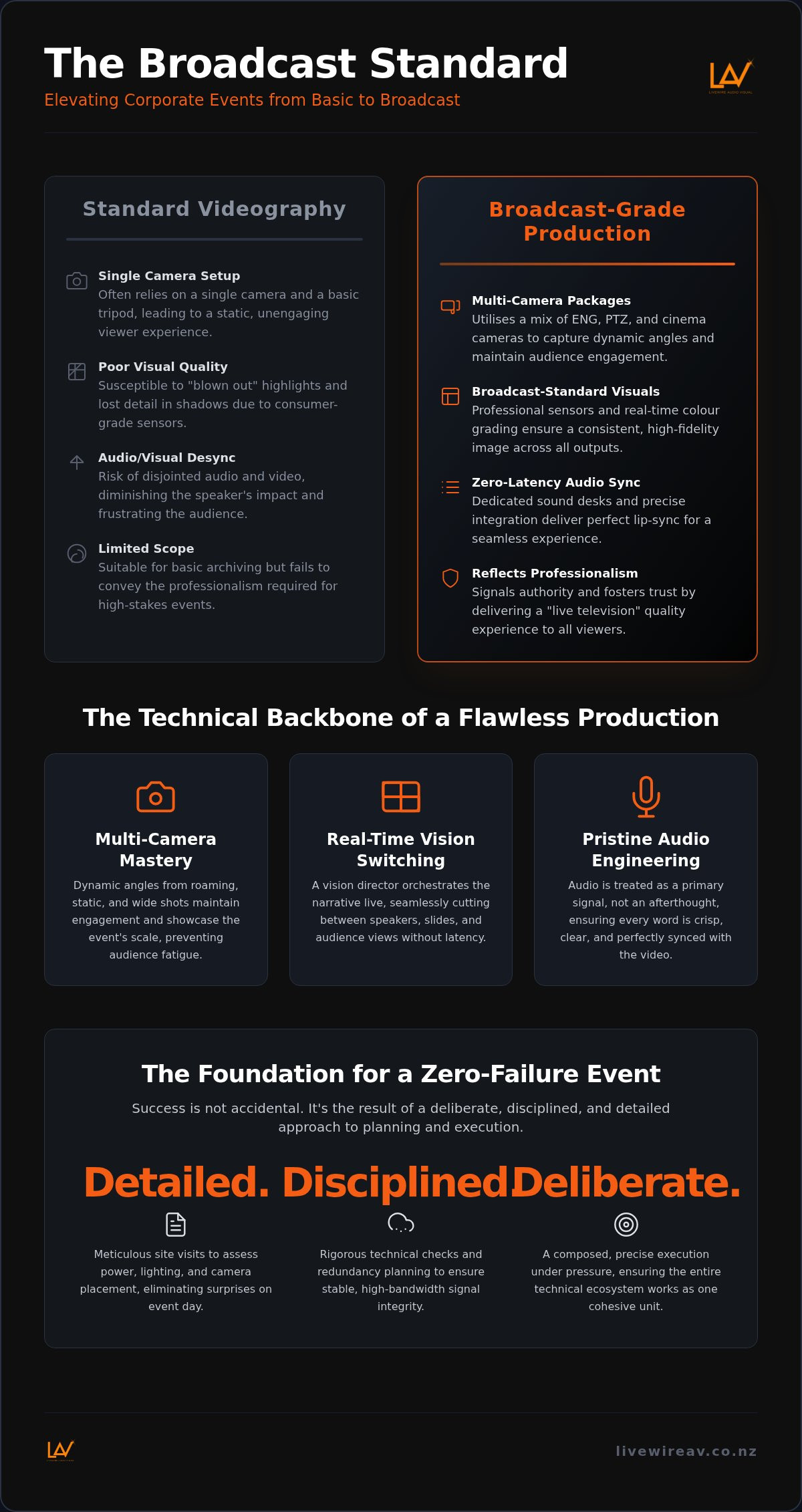
A shaky livestream or a desynced audio feed isn't just a technical hiccup; it's a direct reflection of your brand's professionalism in front of a global audience. For high-stakes corporate events, the gap between basic videography and high quality event video production is measured in reliability, precision, and composure. You aren't just filming a presentation. You're managing a complex technical ecosystem where every frame must meet broadcast standards. Detailed. Disciplined. Deliberate. This is the standard required when there's no room for error.
We understand the pressure that comes with the "live" button. It's natural to worry about laggy feeds or remote attendees losing focus due to poor audio-visual sync. This guide provides the technical roadmap you need to eliminate that stress and maintain total control. We'll explore the essential infrastructure, from camera packages to vision switching, that ensures your delivery is seamless and stable. You'll learn how to organise a broadcast-grade environment that captivates every viewer, whether they're in the front row or on the other side of the world.
Table of Contents
Defining High Quality Event Video Production in 2026
High quality event video production is no longer defined by the mere act of recording a presentation. It has evolved into a sophisticated technical ecosystem where vision, sound, and lighting must be perfectly integrated to maintain professional credibility. For corporate brands, the standard has shifted from simple event archiving to a live broadcast standard that rivals national television. Detailed. Disciplined. Deliberate. This approach ensures that every technical element serves the message without distraction.
While many focus on resolution, true technical excellence relies on bitrates and frame rates. A 4K image means very little if the bitrate is too low to handle movement or if the frame rate causes jitter during a high-stakes keynote. High quality event video production requires a stable, high-bandwidth signal that preserves the texture and clarity of the vision, even in low-light venue conditions. When these technical foundations are solid, the psychological impact on the audience is immediate. High-quality visuals signal authority, foster trust, and ensure remote attendees remain engaged rather than frustrated by technical mediocrity.
Broadcast Quality vs. Standard Videography
The distinction between standard videography and broadcast production lies in the infrastructure. Standard videography often relies on a single camera and a basic tripod, which is suitable for internal records but fails to capture the energy of a live environment. Broadcast-grade production employs multi-camera configurations, vision switching, and professional sensors designed to handle high-contrast stage lighting. These sensors maintain detail in the shadows and highlights, preventing the "blown out" look common in amateur setups. Furthermore, professional colour grading is applied in real-time to ensure every camera feed is consistent, creating a cohesive visual experience across all screens.
The Importance of Synchronised Audio
Video quality is effectively halved if the audio engineering is neglected. In a professional production, audio is not an afterthought; it's a primary signal that must be integrated with the vision feed through dedicated sound desks and line array systems. This integration prevents the hollow, echoing sound often heard in basic recordings. Our focus remains on zero-latency delivery, ensuring that what the audience sees matches exactly what they hear. Lip-sync is the precise temporal alignment of audio and video signals that ensures a speaker’s voice matches their mouth movements without any perceptible delay. If this alignment is off by even a few milliseconds, the production feels disjointed and the speaker's impact is diminished.
The Technical Backbone: Camera Packages and Vision Switching
The foundation of high quality event video production is a robust, well-engineered hardware stack. It isn't enough to simply have cameras in the room; you need a specific mix of tools to capture every nuance of a high-stakes corporate environment. Professional camera packages typically include a combination of ENG cameras for rock-solid stability, PTZ units for discreet placement in tight corners, and cinema cameras to provide the high-end aesthetic that modern audiences expect. Precise. Composed. Reliable. This combination ensures that every angle is covered without the equipment becoming a distraction.
Vision switching is where the narrative is built in real-time. The vision director acts as the conductor, managing multiple feeds to ensure the audience is always looking at the most relevant content. Whether it's a tight shot of a keynote speaker or a wide view of the plenary, the transition must be invisible. This level of control requires a vision switcher capable of handling multiple 4K inputs without latency, ensuring the signal remains pristine as it travels across massive LED walls and out to remote streaming platforms. Maintaining signal integrity across long cable runs is a technical challenge that requires high-quality distribution amplifiers and a deep understanding of signal flow.
Multi-Camera Mastery for Dynamic Events
A single camera angle is a recipe for audience fatigue. To maintain engagement during long corporate sessions, we utilise varied angles that offer a fresh perspective every few seconds. Roaming cameras are particularly effective for audience interaction, allowing the vision director to cut to a participant during Q&A sessions without missing a beat. We also integrate wide-angle venue shots to showcase the scale of your production, reminding remote viewers of the event's physical presence and prestige. These tactical choices are a standard part of our full technical production services.
Integrating LED Walls and Visual Tech
Modern events frequently use high-resolution LED walls as dynamic backdrops, but these present unique challenges for video production. The primary concern is the moiré pattern, a visual interference that occurs when the camera's sensor pixels don't align with the LED pixels. Managing this requires specific camera choices and meticulous focus adjustments to ensure the background looks as sharp on screen as it does in the room. For a deeper look at the hardware involved, you can explore our conference LED screen hire NZ guide. Choosing a partner who understands these interactions is the difference between a professional broadcast and a technical failure.
Ensuring Seamless Hybrid and Livestream Integration
High quality event video production in a hybrid context requires a total shift in perspective. You are no longer just managing a room; you are producing a live television programme for a global audience. Remote participants shouldn't feel like they're peering through a keyhole. They deserve the same level of engagement, visual clarity, and audio precision as those sitting in the front row. This requires a dedicated vision mixing strategy that prioritises the remote feed as a primary output rather than a secondary mirror of the stage. By treating the livestream as a broadcast production, you ensure that every remote attendee feels personally addressed and professionally valued.
Zero-failure execution is the only acceptable metric for national broadcasts. This level of reliability is built on redundant infrastructure. We never rely on a single internet source. A professional setup includes a primary fibre connection backed by a secondary, independent path such as a high-bandwidth satellite or cellular bond. If one fails, the other takes over instantly. Stable. Secure. Seamless. This redundancy ensures the stream remains uninterrupted, protecting your brand's reputation from the frustration of a "buffering" screen. Real-time interaction between in-person and virtual speakers is only possible when this connectivity is rock-solid, allowing for natural dialogue without the awkward pauses caused by signal lag.
Professional Livestreaming Infrastructure
The choice between hardware and software encoding is a matter of reliability. While software solutions are flexible, hardware encoders offer dedicated processing power that won't lag under the pressure of a high-bitrate stream. These devices are the workhorses of the industry, ensuring your vision reaches the CDN without frame drops. Equally important is the management of "return feeds." These allow remote speakers to see the audience and hear the room with minimal latency, facilitating natural interaction between in-person and virtual participants. For a deeper look at these technical requirements, our guide on hybrid conference AV setup NZ covers the essential signal routing needed for flawless integration.
Post-Event Content: Extending the Life of the Production
A high-quality production continues to provide value long after the live stream ends. Capturing "vox pops" and high-energy highlight reels provides the raw material for future marketing and internal training. We manage these secondary captures without disrupting the main event flow, using dedicated roaming crews to gather insights from attendees and speakers. By organising a fast-turnaround edit, you can release a social media hype film while the event is still fresh in the minds of your audience. This approach maximises the return on your technical investment and keeps the conversation going well beyond the final keynote. For those seeking a partner who understands this level of detail, our team provides full technical production tailored to high-stakes environments.
Meticulous Planning: The Role of Technical Site Visits
Technical excellence in high quality event video production is never a happy accident. It is the direct result of exhaustive, pre-emptive preparation. A technical site visit is the foundation of our zero-failure approach, allowing us to identify potential risks before they become active problems. We don't simply look at the room; we map the infrastructure. This includes a rigorous assessment of venue power requirements to support high-draw lighting and complex video racks. Many venues lack the dedicated power circuits needed for modern, high-resolution LED walls, and identifying these requirements early prevents a catastrophic power trip during your keynote.
Collaboration with the venue manager is the quiet engine of a successful corporate event. We work as a disciplined partner to ensure our technical footprint respects the venue's operational constraints while meeting your creative goals. Mapping camera positions is a surgical process during these visits. We identify clear lines of sight that remain unobstructed even when the room is at full capacity. Every cable path is planned to ensure safety and aesthetics. Orderly. Discreet. Secure. This level of detail keeps the technical machinery invisible, allowing the audience to focus entirely on your presentation.
The Site Visit Checklist
Our site visits follow a methodical checklist designed to de-risk every technical layer of the event. We conduct live tests for signal interference and verify internet stability in the main room to ensure the livestream feed is resilient. Identifying suitable rigging points for lighting and camera jibs is equally critical for maintaining a clean stage floor. Executing pre-event cable runs during the set-up phase saves hours of critical stress on show day by ensuring every signal path is tested and verified before the first guest arrives. These logistical steps are essential for maintaining the standard of high quality event video production your brand deserves.
Technical Management and Design
The role of the technical director is to translate a creative vision into a precise wiring diagram. This transition from concept to technical reality requires a deep understanding of signal flow and hardware compatibility. We advocate for a dedicated rehearsal day for high-stakes corporate functions, allowing speakers to familiarise themselves with the stage and the production team to fine-tune the vision switching. For a more detailed look at our planning frameworks, you can explore our guide on premium event production New Zealand. If you are ready to secure a partner who prioritises precision over flashiness, you can contact our technical team to discuss your upcoming event requirements.
Selecting the Right Partner for National Event Production
Choosing a partner for high quality event video production is a decision rooted in risk management. When the "live" light is on, the most valuable commodity is not the resolution of the cameras, but the reliability of the team behind them. You need a partner who views technical excellence as a baseline requirement rather than an occasional achievement. This means evaluating a provider based on more than just their equipment list; you must assess their technician expertise and their ability to maintain composure when the stakes are highest. Composed. Pragmatic. Precise. A team with over 10 years of experience in high-pressure environments brings a quiet confidence that alleviates client stress and ensures every detail is accounted for.
One of the most significant advantages of a professional partnership is end-to-end management. Dealing with separate vendors for audio, video, and lighting creates unnecessary friction and increases the risk of technical desync. By utilising a single point of contact for full technical production, you ensure that every department is working in total alignment. The vision team knows exactly what the lighting designers are doing, and the audio engineers have perfectly integrated their feeds with the broadcast vision. This holistic approach results in a seamless, broadcast-quality experience that looks as good as it sounds. It removes the burden of coordination from your shoulders, allowing you to focus on the content while we handle the complexity.
The "Calm Professional" Approach
A team that thrives under live pressure is the invisible backbone of any successful event. We prioritise a "Calm Professional" approach, maintaining a steady, matter-of-fact delivery that suggests total technical control at all times. This mindset starts long before the event begins, with transparent communication from the initial proposal to the final pack-out. We also understand that specialised event lighting is a critical component of video clarity. Without intelligent lighting design, even the most expensive camera packages will struggle to deliver a sharp, professional image. Our technicians ensure the stage is lit specifically for the camera's sensor, preventing the grain and shadow issues that plague basic videography.
National Reach and Capability
Managing the logistics of large-scale events across the country requires a partner who is venue-aware and understands national infrastructure. Whether you are hosting a plenary in Auckland or a multi-room conference in Wellington, the technical requirements remain the same: zero-failure execution and meticulous planning. Our team manages the entire logistical chain, ensuring that modern equipment like line arrays and high-resolution LED walls are deployed and tested well before your guests arrive. This national capability ensures consistency for your brand, regardless of where your event takes place. If you are ready for a partner who prioritises precision over flashiness, contact the LivewireAV team for a tailored technical proposal.
Securing Technical Excellence for Your Next Broadcast
Delivering high quality event video production is a commitment to precision. It requires an integrated ecosystem where vision switching, sound engineering, and intelligent lighting work in total alignment. By focusing on meticulous pre-event planning and redundant infrastructure, you ensure that every technical risk is mitigated long before the first guest arrives. This disciplined approach transforms a standard recording into a broadcast-grade experience that commands authority and maintains engagement for both in-person and remote audiences. Stable. Secure. Seamless.
LivewireAV brings over 10 years of technical event expertise to every project. We provide the specialised equipment needed for national success, from high-resolution LED walls to precision line array systems. Our team offers the composed, expert presence required to manage complexity in high-pressure environments. We handle the technical machinery with a quiet confidence that lets your work take centre stage. Request a bespoke technical proposal for your next event to secure a partner who prioritises reliability above all else. Your next successful broadcast starts with a steady hand and a clear technical roadmap.
Frequently Asked Questions
What is the difference between event videography and event production?
Event videography typically involves a single operator capturing footage for archive or later editing, whereas high quality event video production is an integrated technical service. Production involves a dedicated crew managing vision switching, professional lighting, and synchronised audio in real-time. It treats your event as a live broadcast rather than a simple recording, ensuring every element is managed with broadcast-standard precision. Detailed. Disciplined. Deliberate.
Do I need a multi-camera setup for a corporate conference?
A multi-camera configuration is essential for maintaining audience engagement during long keynote sessions or panel discussions. Using varied angles allows the vision director to cut between the speaker, the presentation slides, and audience reactions, which prevents the visual fatigue caused by a single static shot. This approach creates a dynamic, professional experience that is particularly important for keeping remote attendees focused throughout the day.
How much internet bandwidth is required for a broadcast-quality livestream?
We recommend a dedicated upload speed of at least 10Mbps for a stable 1080p stream, though 20Mbps or higher is preferable for high-bitrate 4K delivery. It is critical that this bandwidth is not shared with guests or venue staff to avoid signal drops. For high-stakes corporate broadcasts, we always implement a secondary, redundant internet path such as a cellular bond to ensure the stream remains uninterrupted if the primary connection fails.
Can you integrate remote speakers into a live venue screen?
Yes, we can seamlessly integrate remote speakers into your live venue screens using professional vision switching and low-latency return feeds. This technical setup allows the virtual speaker to see the room and hear the audience in real-time, facilitating natural two-way dialogue. By managing the signal flow through our production desks, we ensure the remote participant appears as a high-resolution, full-screen element that feels like a natural part of the stage programme.
What are the benefits of using an LED wall for event video?
LED walls provide high-contrast, high-resolution backdrops that remain vibrant even under bright stage lighting that would wash out traditional projection. They act as a dynamic visual anchor for your production, providing a crisp background that looks exceptional on camera. When managed correctly by a technical partner who understands moiré patterns and sensor alignment, an LED wall significantly elevates the aesthetic quality of your video feed.
How long does the setup and pack-out take for a professional video production?
Setup times depend on the scale of the infrastructure, but most professional productions require between four and eight hours of installation. For larger national events involving extensive LED walls and complex camera packages, we often require a full day for setup followed by a dedicated rehearsal period. Pack-out is generally more efficient, typically taking half the time of the initial installation once the final session concludes.
Do you provide post-event editing and highlight reels?
We provide a comprehensive range of post-event services, including fast-turnaround highlight reels and the delivery of high-quality raw footage. These assets are organised and edited to suit your specific requirements, whether for social media hype films or internal training archives. Capturing these elements during the main event ensures you have a library of professional content to extend the life of your production long after the final keynote.
Is a technical site visit always necessary?
A technical site visit is the foundation of a zero-failure event and is considered essential for high-stakes corporate functions. It allows our team to assess venue power requirements, map camera lines of sight, and identify potential signal interference before show day. This proactive approach ensures that every logistical detail is accounted for, removing the stress of technical unknowns and ensuring a seamless execution from the moment the first guest arrives.


Comments