Professional Event Filming NZ: The 2026 Technical Production Guide
Your event’s legacy isn't defined by the room's energy, but by the quality of the recording that survives it. In high-stakes corporate environments, there's no room for technical ambiguity or amateurish production. You've likely felt the stress of managing multiple vendors while worrying about inconsistent audio or a glitchy live stream. It's a common pressure. Selecting professional event filming NZ services should simplify your workflow, not complicate it. At LivewireAV, we believe technical excellence is a standard, not a luxury. Precision. Composure. Reliability. These are the foundations of a successful broadcast.
We understand that high-quality output requires more than just a lens. It demands meticulous planning, synchronised hardware, and a steady hand behind the scenes to protect your brand prestige. This 2026 guide shows you how to elevate your next project with multi-camera switching and seamless technical integration across the country. You'll learn about the transition to 4K/60fps standards, the impact of New Zealand's shifting media regulations, and the specific infrastructure needed to ensure a zero-failure delivery for every attendee.
Table of Contents
Professional Event Filming NZ: Defining Broadcast Standards for 2026
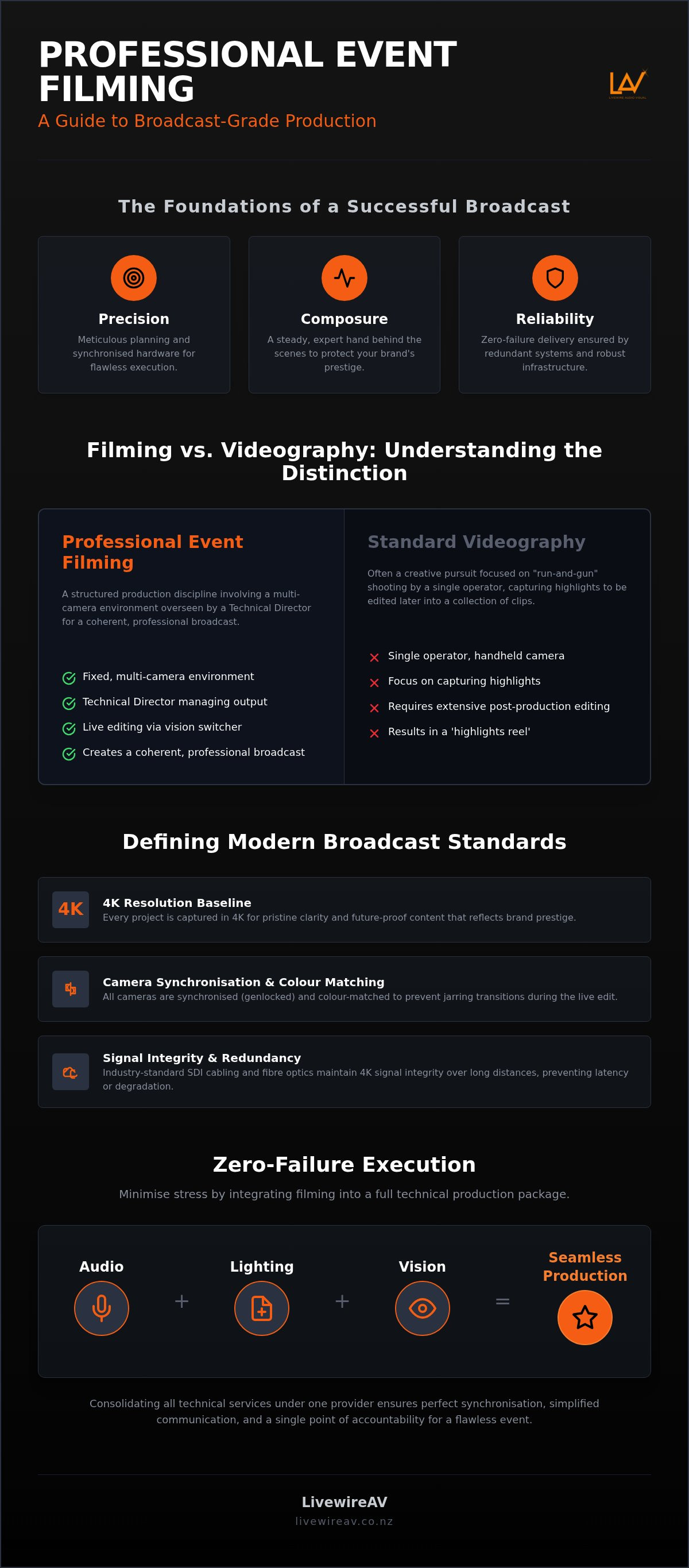
Professional event filming NZ has evolved into a high-stakes engineering discipline. In 2026, a single camera positioned at the back of the room is no longer an acceptable standard for corporate engagement. Professionalism now requires the integration of broadcast-grade hardware and meticulous technical management. Modern audiences expect the same visual polish they see on streaming services or television. This shift moves the focus from passive recording to active, high-pressure production. It's about creating a visual record that matches the prestige of your brand.
To achieve this, a professional rig must prioritise frame rates, colour consistency, and signal reliability. We operate with 4K resolution as the baseline for every project. We ensure every camera is synchronised and colour-matched to prevent jarring transitions during the live edit. We rely on industry-standard SDI cabling and genlock to maintain signal integrity over long distances. This rigorous approach aligns with global technical production standards, where zero-failure execution is the only acceptable outcome for New Zealand corporate brands. Precision. Composure. Reliability. These are the markers of a professional broadcast.
Filming vs. Videography: Understanding the Distinction
Professional event filming is a production discipline, while videography is often a creative pursuit. Videographers typically focus on run-and-gun shooting, capturing highlights with a single operator and a handheld gimbal. In contrast, structured event filming involves a fixed multi-camera environment. A Technical Director oversees the entire output, managing the vision switcher and monitoring every signal path in real time. This director ensures every shot transition is purposeful and every angle is secure. It's the difference between a collection of clips and a coherent, professional broadcast.
The Importance of Broadcast Quality for Brand Integrity
High-resolution video directly influences how stakeholders perceive your organisation. Professionally switched video creates evergreen content that remains valuable for years. You can repurpose these high-quality recordings for marketing campaigns, internal training, or social media long after the final guest leaves the venue. This longevity justifies the investment in superior hardware. Broadcast-grade video is defined as a combination of 4K resolution, professional colour grading, and redundant signal paths. This level of technical polish ensures your digital presence is as professional as your physical event. It protects your brand integrity by delivering a flawless visual experience to every viewer.
The Technical Infrastructure: Multi-Camera Packages and Vision Switching
A single camera angle provides a record, but a multi-camera rig provides an experience. For dynamic environments like gala dinners or award ceremonies, the technical infrastructure must account for multiple concurrent points of interest. Professional event filming NZ relies on these sophisticated setups to capture the presenter, the audience reactions, and the stage content simultaneously. This multi-perspective approach ensures the final output reflects the true energy of the room. Stability. Synchronisation. Scope. These are the requirements for a high-tier production.
Managing these feeds across large venues requires a robust signal distribution network. We utilise high-bandwidth SDI cabling and fibre-optic converters to maintain 4K signal integrity over long distances. This prevents the latency or signal degradation often found in consumer-grade wireless solutions. Every camera position is strategically mapped during the planning phase to account for the venue's specific lighting and layout. This level of preparation ensures that the technical team remains invisible while maintaining total control over the visual output.
Vision Switching: The Art of the Live Edit
Vision switching is the mechanical heart of a professional broadcast. It involves a technical director managing multiple live feeds and selecting the most relevant shot in real time. While software-based switching is common for small webinars, high-stakes corporate events demand hardware-based broadcast switchers. These dedicated units offer the zero-latency performance and redundancy required for live environments. This technology allows event vision switching services to be seamless, creating a "live edit" that keeps the audience engaged from start to finish.
Choosing the Right Camera Package for Your Venue
The choice of hardware depends entirely on the venue's physical constraints and the event's creative goals. PTZ (Pan-Tilt-Zoom) units offer a discreet footprint, making them ideal for tight spaces where a manned camera would obstruct the audience's view. Conversely, manned roaming cameras provide the fluid movement needed to capture the nuances of a keynote speaker or a panel discussion. Large-format sensors are non-negotiable for low-light corporate environments, as they ensure the image remains clean and professional without excessive digital noise. These camera packages are designed to integrate directly with on-site conference LED screen hire NZ, ensuring the live audience and the recorded output share the same broadcast quality. If you're planning a complex multi-camera production, it's worth discussing your venue's layout with a technical production specialist early in the planning phase.
Livestreaming vs. Post-Production: Selecting Your Workflow
Choosing a workflow is a strategic decision that dictates your entire technical infrastructure. For a national conference, you must decide between the immediate reach of a live broadcast and the curated polish of a post-event edit. With over 123 million hybrid events taking place globally in 2025, the industry has shifted toward a model that serves both audiences simultaneously. We often recommend a hybrid approach. This involves switching a live feed for the in-person audience while capturing high-bitrate recordings for future use. It's a pragmatic way to satisfy two distinct groups without doubling the workload. Efficiency. Strategy. Results.
The technical demands of a live broadcast are unforgiving. Success depends on bitrate stability, low latency, and redundant internet connections. In New Zealand venues, relying on standard guest Wi-Fi is a significant risk that often leads to signal drops. We deploy dedicated hardware encoders and bonded cellular connections to ensure the stream remains active regardless of local network fluctuations. This level of redundancy is a standard requirement for professional event filming NZ. It provides the peace of mind that comes from knowing every signal path has a backup.
The Requirements for Flawless Livestreaming
A successful live broadcast requires a fail-safe approach to every signal path. This is especially critical for a hybrid conference AV setup NZ, where the virtual audience must feel as valued as those in the room. We avoid simple laptop-based streaming; instead, we use dedicated rack-mounted encoders that handle the heavy lifting of video compression. This setup allows us to integrate remote guest speakers seamlessly. We manage their video and audio feeds as independent inputs. This ensures they appear on the stage screens and the live stream with broadcast-grade clarity, maintaining the professional rhythm of the event.
Maximising Value with Post-Event Recap Videos
If your primary goal is marketing or long-term training, the focus shifts to post-production quality. This requires capturing iso recordings from every camera in the rig. By recording the raw feed from each lens at a high bitrate, we provide the maximum flexibility for the final edit. This process allows us to create hype films and social media snippets that look significantly better than a simple recording of the live switch. Audio is equally critical. We capture a direct feed from the main sound desk to ensure every interview and keynote is crystal clear. This meticulous approach to data management ensures your event remains a valuable asset long after the final guest leaves the venue.
Logistical Excellence: Technical Site Visits and Venue Strategy
A technical site visit is a non-negotiable requirement for professional event filming NZ. It transforms a conceptual plan into a precise logistical reality. We don't rely on floor plans alone; we physically assess the environment to identify potential obstacles before they become show-stoppers. Power distribution and cable management are frequent hurdles in diverse New Zealand venues. Older buildings often lack the circuit capacity for heavy-duty filming rigs and LED walls. We map these requirements early to ensure a tidy, safe, and reliable installation. This meticulous groundwork prevents the technical glitches that often plague poorly planned productions.
This preparation allows our team to maintain a calm, professional presence on the day. When the unexpected happens, we've already accounted for the variables. We coordinate closely with the broader team providing audio visual for large conferences to ensure signal paths are clear and shared resources are managed efficiently. This integration is vital. It ensures that the lighting design doesn't wash out the camera sensors and that the audio feed remains isolated from interference. Composure. Precision. Control. These are the standards we bring to every venue.
The Technical Site Visit Checklist
We use a rigorous diagnostic process during every site visit. First, we check ambient lighting levels to optimise camera sensor settings. This ensures consistent exposure across all angles. Second, we identify camera positions that offer the best perspective without obstructing the guest experience. We look for elevated positions or discreet corners that allow for a clean line of sight to the stage. Finally, we verify dedicated internet upload speeds. For high-stakes streaming, we require a hardwired connection with a minimum 10Mbps upload buffer to guarantee signal stability. This is a baseline requirement for zero-failure delivery.
Managing National Logistics for High-Stakes Events
Executing high-stakes events across the country requires more than just local coverage; it requires centralised technical management. This approach ensures that your brand prestige remains consistent across multiple dates and locations. Our venue-aware technicians understand the nuances of local infrastructure, from loading dock access to ceiling rig points. We manage the transport and setup of specialised hardware, including line array systems and vision switching racks, using a methodical logistics chain. This eliminates the variability of using separate local vendors. By keeping the technical core consistent, we protect the integrity of your recorded output. If you are planning a multi-city tour or a complex national summit, contact our technical production team to arrange a comprehensive site assessment.
Zero-Failure Execution: Filming as Part of Full Technical Production
Filming should never be a standalone service. It is a core component of the technical architecture. When treated as an isolated task, you risk technical silos where the camera team and the AV team work at cross-purposes. In the context of professional event filming NZ, this means your video output is never at the mercy of poor venue lighting or isolated audio glitches. An integrated design ensures that every pixel captured is intentional. It requires a holistic view of the room's electronics. Precision. Integration. Control.
The benefits of a single point of contact for audio, lighting, and vision are practical and immediate. It eliminates the friction of managing multiple vendors who may not share the same technical standards. By consolidating these services, you ensure that the recorded output reflects the true quality of the live experience. This unified approach allows for a zero-failure delivery. It provides the quiet confidence that every technical variable has been accounted for by a single, accountable team.
The Synergy of Lighting and Vision
High-quality video capture depends entirely on strategic live event lighting design. We prioritise "constant lighting" to avoid the exposure shifts that occur with theatrical pulsing. It's about balance. We synchronise the colour temperatures of our stage fixtures with our camera sensors to prevent the unnatural tinting that ruins many corporate recordings. Additionally, we use high-refresh-rate lighting to eliminate the "banding" and flicker often seen when filming against large-scale LED walls. This technical alignment is what separates a broadcast-grade production from a standard recording.
Unified Technical Management
A single point of management simplifies the entire operation. Having a shared Technical Director means every cue for audio, lighting, and vision is synchronised from a central desk. This reduces the risk of missed cues or technical lag. Integrated signal paths allow us to share data between systems, which significantly reduces the physical footprint of equipment in your venue. It's a cleaner, more efficient way to work. Fewer cables. Fewer points of failure. More composure.
The LivewireAV approach is built on three pillars. Meticulous planning. Modern equipment. Composed presence. We don't just capture what happens; we engineer the environment to ensure the capture is flawless. This is the standard required for professional event filming NZ in a high-stakes corporate world. We act as the steady hand behind the scenes, letting your work take centre stage. To see how we can streamline your technical requirements, organise a tailored proposal for your next event.
Securing Your Event’s Visual Legacy
The standard for professional event filming NZ has moved beyond simple documentation. It's now a technical engineering feat that requires broadcast-grade infrastructure and a unified production design. By integrating your filming requirements with your broader AV strategy, you eliminate technical silos and protect your brand prestige. Success depends on the transition from reactive videography to proactive technical management. Planning. Execution. Composure. These are the elements that ensure your message reaches your audience without interference.
With 10+ years of experience in the New Zealand event industry, we understand the complexities of high-pressure environments. We provide modern broadcast-grade camera packages and full technical management to guarantee a zero-failure delivery for every client. Our team acts as the steady hand behind the scenes, allowing you to focus on your content while we handle the technical complexity. Partner with LivewireAV for your next high-stakes production and experience the peace of mind that comes with total technical control. We look forward to helping you elevate your next project.
Frequently Asked Questions
What is the difference between event videography and professional event filming?
Professional event filming NZ is a production discipline focused on technical precision, whereas videography is often a creative, single-operator pursuit. High-stakes filming involves multi-camera rigs, vision switching, and a Technical Director overseeing the live output. We prioritise broadcast-grade hardware like 4K sensors and SDI signal paths to ensure a zero-failure delivery. This structured approach provides a consistent visual record that reflects your brand prestige, moving beyond simple highlight clips to a coherent, professional broadcast.
How many cameras do I need for a professional event production?
Most professional productions require a minimum of three cameras to ensure dynamic engagement. This typically includes a wide "master" shot of the stage, a tight "hero" shot of the presenter, and a roaming camera for audience reactions or panel discussions. For larger gala dinners or award ceremonies, we may add PTZ units to capture multiple angles without obstructing guest views. This variety allows the technical director to create a "live edit" that maintains a professional rhythm throughout.
Can you provide livestreaming services for events across New Zealand?
Yes, we provide comprehensive hybrid and livestreaming services for events throughout the entire country. We don't rely on standard venue Wi-Fi; instead, we deploy dedicated hardware encoders and bonded cellular connections to ensure signal stability. This national coverage allows for a consistent technical standard across multiple locations. We manage the entire signal path from the camera lens to the end-user's screen, providing a reliable experience for both in-person and remote attendees.
What technical requirements does a venue need for broadcast-quality filming?
A venue requires specific infrastructure to support professional event filming NZ, starting with a dedicated internet connection. We require a hardwired upload speed of at least 10Mbps for stable streaming. Additionally, the venue must have sufficient power distribution for heavy-duty lighting and LED walls. During our technical site visit, we also assess rigging points for cameras and cable paths to ensure a tidy installation. These requirements are essential for maintaining total technical control over the environment.
How do you ensure the audio in the video is clear and professional?
We ensure crystal-clear audio by capturing isolated digital feeds directly from the main sound desk. This prevents the "echo" or background noise often found in amateur recordings. Every presenter is equipped with high-quality lapel or headset microphones, and we monitor the levels in real-time at the vision switching station. By integrating audio management into our full technical production, we guarantee that the spoken word is as polished as the high-definition visual output.
Do you provide vision switching for live audiences and recordings simultaneously?
Yes, our hardware-based vision switchers allow us to manage multiple feeds for different purposes simultaneously. We can provide a specific "IMAG" (Image Magnification) feed for on-site LED walls while sending a separate, edited broadcast feed to the recording or live stream. This ensures that the live audience sees what's most relevant to them, while the filmed output remains a coherent, stand-alone production. It's a seamless way to maximise the value of your technical investment.
What is the lead time required for planning a large-scale filmed event?
For large-scale national events, we recommend a planning lead time of at least three to six months. This timeframe allows us to conduct thorough technical site visits and design a bespoke production plan. Early engagement ensures that we can secure the necessary equipment and coordinate logistics for heavy-duty rigs or LED walls. However, our experienced team can often accommodate tighter schedules for smaller corporate gatherings, provided the technical requirements are clearly defined from the outset.
Can filming be integrated with on-site LED walls and projection mapping?
Filming is most effective when it's part of an integrated technical design that includes LED walls and projection mapping. We synchronise our camera refresh rates with the LED processors to avoid visual "banding" or flicker in the recording. By managing both the vision capture and the stage displays, we ensure a unified aesthetic. This technical synergy allows the filming team and the AV operators to work from a shared set of cues, resulting in a flawless execution.


Comments