Multi-Camera Event Streaming: The Professional Guide to Broadcast-Quality Production
- 5 days ago
- 11 min read
A single static camera angle isn't a professional broadcast. It is a security feed. In a high-stakes environment, your audience expects more than just a window into the room; they expect a dynamic, immersive experience that reflects the prestige of your brand. Mastering multi-camera event streaming is the definitive step between a basic video call and a polished production that commands absolute attention. We understand the specific pressures of the live environment. The fear of a sudden stream dropout, the confusion over vision switching, and the persistent stress of managing audio-visual sync across multiple feeds are significant hurdles that can undermine your professional reputation.
This guide provides the technical roadmap you need to move beyond simple setups and achieve zero-failure delivery. Preparation. Precision. Composure. These are the pillars of a successful broadcast. You will learn how to coordinate complex visual inputs, manage high-quality audio, and maintain total control over your digital output. We will outline the meticulous planning and technical choreography required to organise a broadcast that is delivered with seamless, broadcast-grade precision. By the end of this article, you will have the clarity needed to turn technical complexity into a stable, high-quality production that resonates with your viewers.
Table of Contents
What is Multi-Camera Event Streaming and Why Does It Matter?
Professional multi-camera event streaming is the synchronised capture and live broadcast of an event using multiple professional camera angles. It is not simply a matter of placing more lenses in a room. It is a technical choreography. This process involves a vision switcher, multiple operators, and a dedicated director to ensure every transition serves a purpose. Precision. Composure. Reliability. These are the markers of a broadcast that moves beyond a basic video call and into the territory of high-end production.
The standard for digital content has shifted. Modern audiences are accustomed to high-definition television and polished digital media. A grainy, static shot from the back of the room no longer meets the expectations of a corporate environment. When a stream looks professional, the message it carries gains immediate authority. Television-quality transitions and varied perspectives are now the benchmark for any organisation looking to maintain its prestige during a live broadcast.
Viewer retention is directly linked to visual variety. Single-camera feeds often lead to visual fatigue, where the lack of perspective change causes the audience to lose focus. Multi-camera event streaming solves this by allowing for wide shots of the stage, tight crops on the speaker, and reaction shots from the audience. This variety keeps the viewer engaged. The vision switcher acts as the heart of this operation, allowing a director to cut between these feeds in real-time to create a cohesive narrative for remote attendees.
Beyond the Basics: The Corporate Advantage
Production value is brand value. High-quality visuals suggest a brand that is meticulous, modern, and disciplined. For large national conferences or exhibitions, capturing the scale of the venue is essential to convey the importance of the event. It allows you to facilitate dynamic Q&A sessions and panel discussions effectively. By cutting between the moderator, the panellist, and the audience member, you ensure the remote viewer feels like an active participant rather than a distant observer.
The Hybrid Imperative in 2026
Organising a hybrid conference AV setup NZ requires more than a single wide-angle shot. In 2026, the hybrid model is the standard for major events, not the exception. You are managing two distinct audiences with different needs. The virtual attendees require the same level of visual context as those sitting in the front row. Multi-camera streaming bridges this gap. It provides the technical control needed to manage both feeds simultaneously, ensuring a seamless experience that reflects your brand’s commitment to excellence.
The Professional Technical Stack: Gear That Guarantees Results
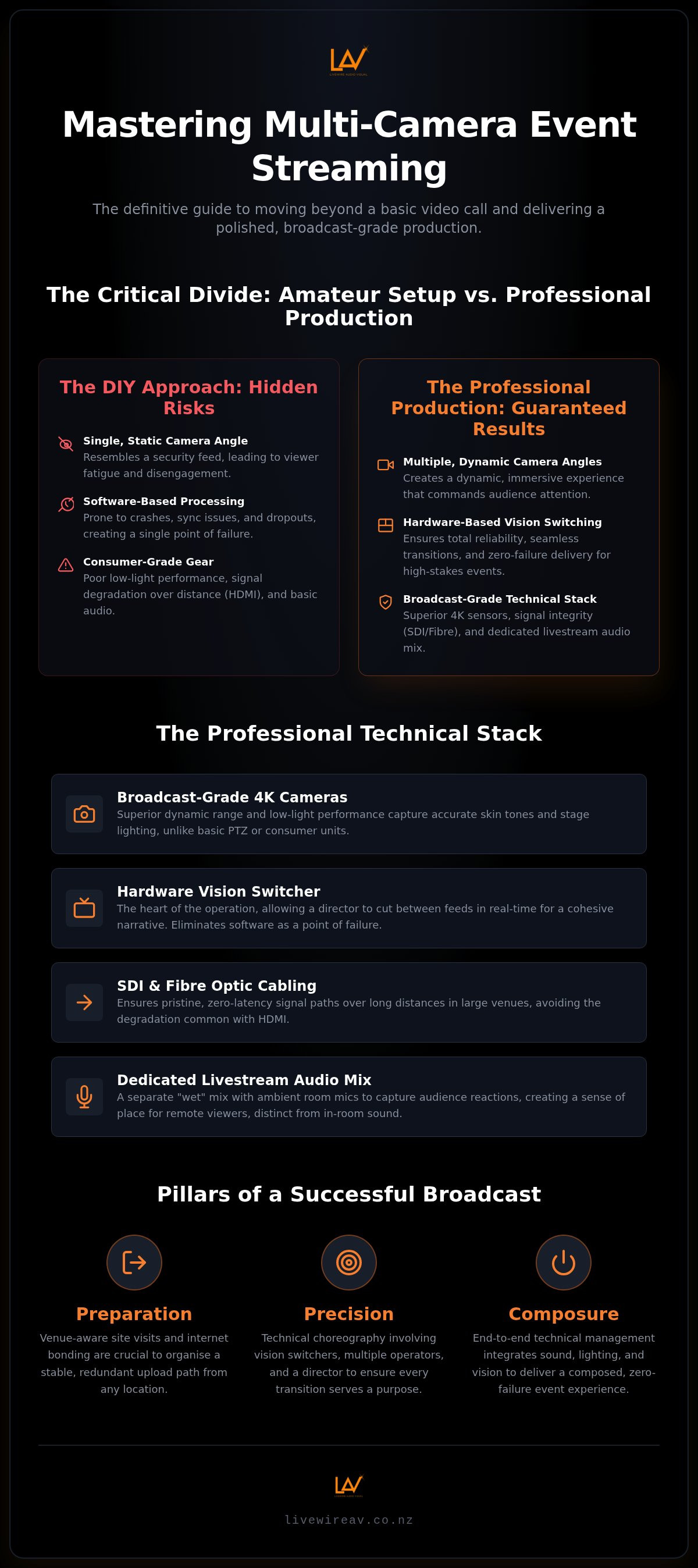
Reliability is the foundation of professional production. While consumer-grade gear has become more accessible, it lacks the stability and precision required for high-stakes multi-camera event streaming. A professional technical stack is designed to eliminate variables. It prioritises hardware-based processing over software solutions. This approach ensures that your broadcast remains fluid, sharp, and, most importantly, uninterrupted. Precision. Stability. Control. These are the standards we maintain to protect your brand's reputation.
The difference begins with the sensors. Broadcast-grade 4K cameras offer superior dynamic range and low-light performance compared to standard PTZ or consumer units. This ensures that skin tones look natural and stage lighting is captured accurately. Signal path integrity is equally vital. In large venues, we utilise SDI and fibre optic cabling rather than HDMI or Wi-DI. These professional standards allow for long cable runs without signal degradation or latency issues, ensuring the vision switching centre receives a pristine feed every time.
Audio integration is often where DIY setups falter. Broadcast sound is a distinct discipline from in-room sound. While the venue speakers are tuned for the physical space, the livestream feed requires a dedicated "wet" mix that includes ambient room microphones to capture audience reactions and applause. This creates a sense of place for the remote viewer. Engaging a partner with the right Camera Packages & Vision Switching ensures your audio and video are perfectly synchronised before they ever reach the encoder.
Camera Selection for Diverse Event Needs
Every venue presents unique challenges. For a keynote presentation, a mix of static and manually operated cameras is essential. A dedicated operator can follow a speaker’s movement with a level of fluidity that automated systems cannot match. Large-scale outdoor productions often require long-lens configurations to capture clear shots from a distance. For more dynamic visuals, incorporating roving cameras or jib arms adds a cinematic quality that keeps the audience engaged throughout the duration of the event.
Vision Switching and Signal Management
The vision switcher is the command centre of your production. Utilising professional event vision switching services allows for the simultaneous management of multiple outputs. This includes the primary livestream feed, the on-site LED walls, and a clean ISO recording for post-event editing. Redundancy is built into every layer. We employ hardware backups for mission-critical components, ensuring that if one path encounters an issue, a secondary system is ready to take over instantly without the viewer ever noticing a flicker.
Professional Production vs. DIY: The Hidden Risks of Going Solo
DIY solutions often look appealing on paper. However, the reality of live production is unforgiving. Software-based streaming via platforms like OBS or vMix relies heavily on computer hardware that wasn't designed for the rigours of a high-stakes environment. Thermal throttling, background operating system updates, or simple software crashes can terminate a stream instantly. This is the "Single Point of Failure" trap. In a professional multi-camera event streaming environment, we use dedicated hardware encoders. These devices serve one purpose. They do it with absolute reliability. They don't crash because of a background task or a full hard drive.
Latency and sync issues are common in complex AV setups. When video signals travel through switchers and audio passes through digital mixers, they often arrive at the encoder at slightly different times. This creates the "lip-sync" problem, where the audio and video are visibly out of alignment. Solving this requires precise delay management at the technical desk. It isn't just about the gear; it's about the expertise to calculate and correct these offsets in real-time. A dedicated technical team provides this level of oversight, ensuring the output is perfectly synchronised for the viewer.
Resource management is the final hurdle for solo operators. Attempting to switch cameras, monitor audio levels, and manage a stream simultaneously is a recipe for error. Professional production is a team discipline. Each member has a specific focus. One manages the vision switching, another monitors the audio mix, and a third ensures the stream health remains stable. This division of labour allows for a level of precision that a single operator simply cannot achieve.
The Cost of Technical Failure
Reputational damage is the highest cost of technical failure. A buffering wheel during a keynote address doesn't just frustrate viewers; it reflects poorly on your brand's professionalism. Audience engagement is fragile. Once a dropout occurs, viewer numbers plummet and rarely recover. This is why premium event production New Zealand prioritises zero-failure technical support. We provide the composure and preparation needed to ensure your message is delivered without interruption.
Scalability and Capability
Consumer internet connections are the Achilles heel of DIY streaming. They lack the stability and upload speed required for a high-bitrate broadcast. Professional teams use internet bonding and dedicated redundancy to ensure a stable path to the viewer. Handling complex cues—such as integrating slides, pre-recorded videos, and remote presenters—requires a level of technical choreography that goes beyond basic streaming. Specialised technicians thrive under this pressure. They manage the technical complexity so you can focus entirely on your presentation.
Planning for Success: Logistics and Connectivity
A successful broadcast is won in the weeks leading up to the event. While high-end gear is essential, it is the logistical preparation that ensures multi-camera event streaming remains stable under pressure. Meticulous planning is the difference between a broadcast that feels effortless and one that feels precarious. We approach every project with the quiet confidence of an expert who has already solved the problems before they arise. Precision. Planning. Composure. These are the standards that define our preparation process.
Technical logistics extend beyond the equipment list. Power management is a critical consideration, particularly in heritage buildings or non-traditional venues where electrical circuits may not be rated for modern AV loads. We assess these constraints early to avoid circuit overloads that could jeopardise the entire production. Similarly, we develop comprehensive shot lists and run sheets. This director’s guide acts as a technical script, ensuring every camera operator and vision switcher knows exactly when to move and when to cut, creating a choreographed experience for the viewer.
Connectivity is the backbone of any livestream. Without a stable upload path, even the most sophisticated production will fail to reach its audience. We prioritise dedicated Ethernet connections over shared venue Wi-Fi, which is notoriously unreliable in high-density environments. To ensure zero-failure delivery, we implement internet bonding. This technology combines multiple data sources into a single, robust connection, providing a fail-safe path for your broadcast nationwide. If you are planning a high-stakes broadcast, our professional technical production services provide the reliability your brand requires.
The Vital Role of Technical Site Visits
A technical site visit is the first step in risk mitigation. It allows us to identify potential signal interference and calculate exact cable run limitations before the day of the event. We also check lighting levels to ensure camera sensors perform optimally, as poor stage lighting can lead to visual noise in the final feed. These technical site visits for events are essential for mapping out the physical environment and ensuring every piece of equipment is placed for maximum impact and safety.
Connectivity Strategies for Remote Broadcasting
Remote broadcasting requires a disciplined approach to bandwidth. We use 4G and 5G bonding to create a redundant internet connection, ensuring your stream remains live even if a primary provider fails. This is non-negotiable for events held in locations with limited infrastructure. We also balance bitrate and resolution with the available bandwidth. By prioritising a stable, consistent stream over an overly ambitious resolution that might cause buffering, we maintain a smooth experience that keeps your audience engaged from start to finish.
Partnering with LivewireAV for Meticulous Multi-Camera Execution
Execution is where technical theory meets the reality of live production. At LivewireAV, we provide the steady hand behind the scenes, allowing you to focus on your presentation while we manage the technical choreography. Our approach to multi-camera event streaming is built on a foundation of reliability and quiet confidence. We understand that in high-stakes environments, precision is the most valuable commodity. By taking total technical control, we alleviate the stress often associated with live broadcasts, ensuring a seamless experience for both the organiser and the audience.
Successful technical production requires more than just high-end gear; it requires a team that understands how to integrate sound, lighting, and video into a single, cohesive programme. We provide audio visual for large conferences nationwide, bringing a consistent standard of excellence to venues across the country. Every proposal we create is customised to your specific goals. We don't believe in one-size-fits-all solutions. Instead, we tailor our camera packages and vision switching setups to the unique requirements of your event space and your audience.
Our Technical Philosophy
Reliability. Composure. Precision. These are the pillars of our technical philosophy. We maintain a fleet of modern equipment to the highest industry standards, ensuring every component in the signal chain is fit for purpose. Our team is venue-aware and detail-oriented. We understand the nuances of diverse national event spaces, from modern convention centres to heritage buildings with complex power constraints. This deep technical knowledge allows us to maintain composure in high-pressure environments, providing a stable platform for your brand’s message.
From Concept to Credits
We act as your collaborative partner from the initial planning stages through to the final credits. Our technical directors work with you to realise your creative vision, ensuring every camera angle and transition serves the narrative of your event. On the day, our on-site technicians remain invisible but essential, providing the technical choreography required for a flawless broadcast. Once the stream concludes, we provide high-quality ISO recordings of every camera feed. This gives you a library of professional content for future marketing, highlight reels, and internal communications.
Securing Your Broadcast Legacy
Achieving a broadcast-grade production requires a shift from simple software solutions to hardware-based precision. Professional multi-camera event streaming isn't just about having more lenses in the room; it is about the technical choreography that ensures every transition is seamless and every signal path is redundant. By prioritising meticulous venue-aware planning and robust internet bonding, you eliminate the single points of failure that threaten high-stakes events. Excellence is a standard requirement, not an occasional achievement.
With over 10 years of professional AV experience, we provide full-service technical production for national events. We specialise in zero-failure hybrid and livestream solutions, acting as the steady hand behind the scenes. We manage the technical complexity so your brand can take centre stage with total composure. Discuss your multi-camera streaming requirements with our expert team to ensure your next production is delivered with absolute precision. Your next event deserves the stability of a seasoned partner who values clear, honest communication and disciplined execution.
Frequently Asked Questions
How many cameras do I actually need for a professional event stream?
Three cameras are generally considered the standard baseline for a professional broadcast. This configuration allows for a wide safety shot of the stage, a medium shot focused on the speaker, and a tight lens for capturing audience reactions or detailed stage elements. For more complex panels or large-scale national conferences, five or more angles may be required to maintain high audience engagement and provide a truly dynamic visual experience.
Can we stream from a venue with poor internet connectivity?
Streaming from venues with limited infrastructure is entirely possible through the use of 4G and 5G internet bonding. We combine multiple cellular data paths into a single, stable upload stream that bypasses the limitations of shared venue Wi-Fi. This provides a reliable fail-safe for multi-camera event streaming in remote locations or heritage buildings where a dedicated fixed-line Ethernet connection is unavailable.
What is the difference between a vision switcher and a simple video mixer?
A professional vision switcher is a hardware-based command centre designed for low-latency, frame-accurate transitions. Unlike basic video mixers that may introduce delay or software instability, a switcher manages multiple independent outputs simultaneously. It handles the primary livestream feed, on-site LED walls, and high-quality ISO recordings with the absolute precision and stability required for high-stakes environments.
Do we need a separate audio feed for the livestream audience?
A dedicated audio mix is essential for the livestream audience to ensure a professional result. While in-room audio is tuned for the physical acoustics of the venue, the virtual feed requires a balanced mix that includes direct microphone inputs and ambient room sound. This "wet" mix ensures remote viewers hear audience applause and reactions, creating a sense of place that a standard "dry" board feed cannot provide.
How much space does a multi-camera production team require on-site?
Most production teams require a technical "control centre" area of approximately 3 metres by 3 metres. This footprint accommodates the vision switching desk, audio consoles, and hardware streaming encoders. We coordinate with you during the technical site visit to identify a location that provides the necessary infrastructure and line of sight without obstructing the guest experience or the venue's aesthetics.
What happens if the primary internet connection fails during the broadcast?
Redundancy protocols ensure your broadcast continues without interruption if the primary connection fails. We employ dual-path encoders that automatically switch to a secondary bonded cellular connection the moment a dropout is detected. This transition is handled instantly by the hardware, meaning the viewer never notices a flicker or a change in stream quality. Reliability. Composure. Precision.
Can you integrate remote guest speakers into a multi-camera live stream?
Integrating remote presenters is a standard feature of modern multi-camera event streaming. We utilise low-latency return feeds to bring remote speakers onto the stage screens and into the broadcast mix. This allows for real-time, fluid interaction between on-site panellists and virtual guests. Our technicians manage the technical choreography required to ensure the remote audio and video remain perfectly in sync with the live environment.
Is multi-camera streaming suitable for outdoor events?
Outdoor environments are well-suited for multi-camera production provided the equipment is appropriately weatherproofed and power is managed. Long-lens configurations are particularly effective for outdoor festivals or large-scale exhibitions, allowing cameras to capture clear, stable shots from a distance. We assess sun position, wind factors, and signal paths during our planning to ensure the output remains consistent despite the variable conditions.


Comments