Audio Mixing for NZ Live Events: Professional Guide
Updated: Aug 28
What if the most important part of your event's audio is the sound you never actually hear? Professional audio mixing is not about volume; it is about the meticulous management of clarity, stability, and risk. When a microphone screeches with feedback or a speaker’s voice disappears into the back of a large venue, the message is lost. You have likely felt that specific tension in the room when technical glitches occur. It is a distraction no organiser should have to manage during a high-stakes gathering.
Professional audio mixing for live events NZ transforms these technical vulnerabilities into a seamless, high-impact foundation. With the New Zealand business events industry projected to generate NZ$170 million in 2026, the standard for execution is higher than ever. This guide explains how expert engineering ensures crystal-clear speech and a stress-free technical experience. We will examine the essential equipment, real-time cue management, and the local noise regulations required to maintain total composure behind the scenes.
Table of Contents
What is Professional Audio Mixing for Live Events in NZ?
Professional audio mixing is the active, real-time management of every sound source within a venue. It involves the careful balancing, equalisation, and processing of microphones, multimedia feeds, and musical elements to create a cohesive whole. While many view it as simply making things louder, true live sound mixing is a technical discipline that prioritises clarity over sheer volume. In high-stakes corporate environments, audio mixing for live events NZ serves as the invisible glue that holds a presentation together. It's the difference between a message that resonates and one that's lost in the noise.
Audio is often the most critical element of the attendee experience. A guest can tolerate a flickering screen or a slightly dim room, but they'll quickly disengage if they can't understand the keynote speaker. Professional mixing ensures that the message remains the focus. It protects your brand reputation by projecting an image of total technical control. Precision. Composure. Reliability. These are the standards required when your organisation is on display. When the sound is handled correctly, the audience doesn't notice the technology; they only notice the speaker's impact.
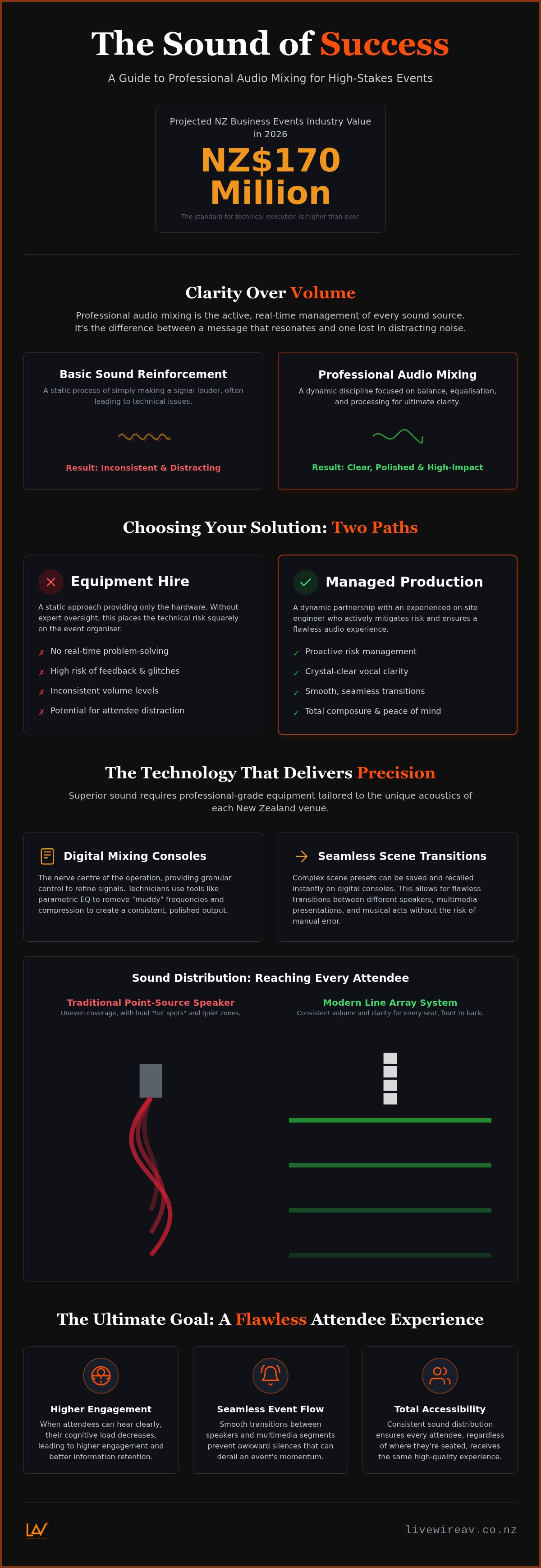
There's a distinct difference between basic sound reinforcement and professional live mixing. Reinforcement is a static process; it's the act of amplifying a signal so it reaches the back of the room. Mixing is dynamic. It requires an engineer to respond instantly to the changing acoustics of a crowded room, the varying projection of different speakers, and the transition between media types. This level of oversight ensures that technical risks are mitigated long before they become visible to your guests.
The Core Components of a Live Audio Mix
A successful mix balances vocal clarity against background elements without compromise. Our technicians focus on managing the dynamic range of each source. This ensures that a quiet, intimate moment during a presentation is just as audible and comfortable as a high-energy video intro. We work to eliminate technical distractions before they occur. Feedback, ground hum, and inconsistent volume levels are managed through meticulous gain staging and signal processing. The result is a clean, polished soundscape that feels natural to the ear.
Why National Event Organisers Prioritise Audio
The psychological impact of clear sound is profound. When attendees can hear clearly, their cognitive load decreases, leading to higher engagement and better information retention. Professional audio mixing for live events NZ also facilitates a seamless flow for complex programmes. This is especially true for dynamic staged productions, such as the holiday programmes hosted by Pform.nz, where multiple performers and musical cues must be balanced with precision. Professional mixing allows for smooth transitions between different speakers and multimedia segments, preventing the awkward silences that can derail an event's momentum. Finally, consistent sound distribution ensures accessibility. Every attendee, regardless of where they're seated in a large New Zealand venue, receives the same high-quality experience.
The Technical Foundations of Superior Sound Reinforcement
Achieving professional results requires more than high-end hardware; it demands a deep understanding of the relationship between technology and the physical environment. Large-scale New Zealand venues, from modern convention centres to historic town halls, present unique acoustic challenges like excessive reverberation and uneven frequency response. Effective audio mixing for live events NZ begins with a bespoke sound design that accounts for these variables. Accuracy. Stability. Focus. This is particularly vital when managing audio visual for large conferences, where the technical layout must ensure every attendee receives a direct signal without the interference of room echoes.
Modern digital mixing consoles provide the granular control needed to refine these signals during audio mixing for live events NZ. Technicians use professional signal processing tools like parametric EQ to remove "muddy" frequencies and compression to level out a speaker's volume for a consistent listening experience. These fundamentals of live sound are applied with a composed, pragmatic hand to create a polished output. By using digital consoles, we can also save complex scene presets, allowing for instant, seamless transitions between different speakers or musical acts without the risk of manual error.
Audio Line Array Systems vs. Traditional Speakers
Traditional point-source speakers often struggle with volume drop-off and sound spill in large, acoustically difficult rooms. In contrast, line array systems are engineered to provide consistent coverage from the front row to the back. By controlling vertical and horizontal dispersion, we can direct sound specifically at the audience and away from reflective surfaces like glass walls or high ceilings. This level of control ensures that speech intelligibility remains high regardless of where a guest is seated. It is the technical reason why line arrays remain the standard for premium event production New Zealand.
Wireless Frequency Management and Reliability
Reliability in a live environment depends heavily on wireless frequency management. The RF landscape in New Zealand is increasingly crowded, making it essential to use high-quality digital wireless systems that can navigate available spectrum without interference. We prioritise zero-dropout performance through active monitoring and meticulous redundancy planning. This includes having "hot" backup microphones on standby, ready for immediate use if a primary unit encounters a physical issue. If you're planning a complex programme, partnering with a specialist who understands these nuances ensures these risks are managed long before the first guest arrives.
Comparing Audio Mixing Solutions: Equipment Hire vs. Managed Production
Choosing between simple equipment hire and a managed production service is a decision about risk management. The "dry hire" trap assumes that having professional-grade hardware is enough to ensure success. However, hardware is only as effective as the person operating it. Audio mixing for live events NZ requires a specialist who can navigate the complexities of a live environment in real-time. By opting for managed production, event organisers shift the technical burden to a dedicated team. This allows them to focus on the programme rather than the signal chain. The total cost of ownership for managed services is often lower when weighed against the reputational cost of a technical failure.
Managed production provides a layer of insurance that equipment alone cannot offer. It involves end-to-end technical oversight, from the initial site visit to the final pack-out. This approach reduces the logistical burden on the organiser, ensuring that every piece of the audio puzzle is accounted for before the first guest arrives. When you invest in a managed service, you're not just paying for speakers and consoles. You're securing a commitment to zero-failure execution.
The Human Element: The Role of the Mix Engineer
A dedicated engineer provides real-time problem solving that a static setup cannot replicate. They are responsible for handling unexpected noises, such as a speaker accidentally bumping a lapel microphone, or adjusting levels for an unpractised presenter with a quiet voice. Understanding the fundamentals of live sound engineering allows the technician to manage multiple outputs simultaneously. They must mix for the physical room while also providing a separate, balanced feed for recordings or livestreams. This "steady hand" approach ensures that even when cues change instantly, the audio remains composed and professional.
Tailoring the Audio to the Event Format
Every event format demands a specific audio strategy. A gala dinner requires a subtle mix that allows for comfortable conversation while still delivering punchy, clear walk-up music and speeches. In contrast, a technical conference focuses almost entirely on speech intelligibility and multimedia clarity. To create a truly cohesive experience, we integrate these audio solutions with live event lighting design. This ensures that the technical elements work in unison rather than competing for the audience's attention. Whether it's a bespoke solution for a corporate outdoor event or a high-stakes sporting presentation, the mixing must be tailored to the environment and the audience's expectations.
Planning and Logistics for Flawless National Event Audio
Successful technical execution starts weeks before the faders move. Technical site visits are non-negotiable for large-scale New Zealand events. They allow us to map the acoustic profile of the venue, identify potential RF interference, and plan cable runs that remain invisible to your guests. Whether you are hosting in a major city centre hotel or a regional centre, coordinating audio mixing for live events NZ requires a methodical approach to logistics. We manage the timeline from initial system design through to the final "faders down," ensuring every technical milestone is met with precision. This disciplined preparation is the standard for high-stakes environments.
Effective communication with your technical partner is vital for a seamless experience. When briefing your audio team, focus on the desired outcomes rather than just the equipment list. Tell us about the speakers' presentation styles, the anticipated audience reaction, and the specific energy you want to convey. This allows the engineer to tailor the signal processing to support your goals. A clear brief enables us to act as the steady hand behind the scenes, ensuring your message remains the central focus of the production.
Managing the Hybrid Challenge
Mixing for a hybrid audience requires a dual-mindset approach. The engineer must create a rich, immersive sound for those in the room while simultaneously providing a separate, broadcast-quality feed for the livestream. A common pitfall in hybrid conference AV setup NZ is neglecting the audio return for remote presenters. We prioritise crystal-clear two-way communication, ensuring that remote speakers feel integrated into the live environment without the distraction of echoes or latency. This ensures a professional experience for both physical and digital attendees.
Outdoor and Sporting Event Considerations
Outdoor environments introduce unique variables, primarily the unpredictable New Zealand climate. Weatherproofing is essential for protecting sensitive electronics and ensuring continuity. Additionally, we must manage sound spill to comply with local noise regulations. Under the Resource Management Act 1991, and following the August 2025 amendment, companies can face infringement fees of up to NZ$2,000 for excessive noise. For large-scale outdoor event production NZ, we employ delay systems. These secondary speaker clusters are time-aligned to the main stage, providing clear audio across vast spaces without exceeding local volume limits. If you are ready to secure a steady hand for your next national production, contact LivewireAV to discuss your technical requirements.
Why LivewireAV is the Reliable Choice for Your Next NZ Production
LivewireAV operates with the quiet confidence of a seasoned partner. We understand that in high-stakes environments, precision and composure are the most valuable commodities. With over a decade of technical management experience, we have developed a grounded approach to audio mixing for live events NZ. This isn't about flashiness or trend-following. It is about reliability. Stability. Consistency. Our team provides end-to-end technical management, allowing you to focus on your attendees while we manage the complexities of signal flow and venue acoustics. We act as the steady hand behind the scenes, ensuring every detail is accounted for long before the first guest arrives.
Our national service model ensures consistent quality regardless of your location. We coordinate complex logistics to deliver full technical production across the country, from major city centres to regional venues. Every project benefits from our inventory of modern, meticulously maintained audio line array systems. These systems are specifically chosen for their ability to deliver crystal-clear speech intelligibility in even the most difficult acoustic environments. By prioritising meticulous preparation over on-site improvisation, we ensure that technical excellence is a standard requirement for every production we manage.
Our Approach to Technical Excellence
Our "Steady Hand" philosophy defines how we interact with your production. It means maintaining total technical control regardless of the pressure. Experience. Precision. Composure. We conduct thorough site visits and develop venue-aware sound designs that account for every architectural variable. This level of planning ensures that technical distractions like feedback or inconsistent volume levels are eliminated before they occur. Our comprehensive support lets your speakers take centre stage, providing a seamless experience that feels effortless to the audience and stress-free for the organiser.
Secure Your Event Sound Today
Starting the consultation process is straightforward and methodical. We work closely with you to customise a technical production package that fits your specific goals, audience size, and venue requirements. Whether you need specialised audio mixing for live events NZ or a full-scale technical production including lighting and vision, we provide the expertise required for zero-failure execution. We take the time to understand your logistical needs, creating a cadence that feels thorough and well-considered. Enquire about professional audio mixing for your next event to discuss your technical requirements with a specialist who values clear, honest communication above all else.
Secure a Flawless Soundscape for Your Next Event
Professional audio mixing for live events NZ is the silent engine that drives successful communication. It is not a luxury; it's a standard requirement for any organiser who values clarity and brand reputation. By prioritising managed production over simple equipment hire, you ensure that technical risks are mitigated through meticulous planning and real-time engineering. Excellence. Precision. Composure. These are the qualities that transform a standard gathering into a high-impact experience where every word is understood by every attendee.
LivewireAV brings 10+ years of technical event experience to every project. We provide full-service national production across NZ, specialising in high-stakes corporate environments where reliability is the most valuable commodity. Our team acts as the steady hand behind the scenes, allowing you to lead your event with total confidence. If you're ready to move beyond basic sound reinforcement and invest in a zero-failure technical strategy, we're here to help. Contact LivewireAV for a tailored technical production proposal. We look forward to ensuring your message is heard exactly as intended.
Frequently Asked Questions
What is the difference between a sound technician and a mix engineer?
A sound technician focuses on the physical installation and maintenance of hardware, while a mix engineer manages the active, real-time balance of audio sources. The engineer uses signal processing to ensure clarity and professional tone throughout the event. This distinction is vital for high-stakes environments where technical composure is required to handle changing cues. While the technician ensures the system works, the engineer ensures the message is heard perfectly.
Do I really need a professional audio mix for a corporate conference?
Speech intelligibility is the most critical factor in corporate engagement. Professional audio mixing for live events NZ ensures that every speaker, regardless of their natural vocal projection, is heard clearly without technical distractions. It prevents common issues like microphone feedback or inconsistent volume levels between different presenters. A managed mix protects your brand reputation by projecting an image of total technical control and professionalism to your attendees.
Can you provide audio mixing for events across all of New Zealand?
We provide technical management and audio mixing for live events NZ across the entire country. While we are based in Auckland, our national service model allows us to manage complex logistics in any regional centre or major city. This ensures that you receive the same standard of technical excellence and meticulous planning regardless of your venue's location. Our team is experienced in coordinating regional deliveries for large-scale national event programmes.
How do you prevent microphone feedback during a live event?
We prevent feedback through a combination of precise speaker placement and a process called "ringing out" the room. This involves identifying and attenuating the specific frequencies that cause resonance in a particular acoustic space. Our engineers use digital equalisation and careful gain staging to ensure the system remains stable at higher volumes. This proactive approach manages technical risk long before the first guest arrives, providing a stress-free experience for the organiser.
What equipment is included in a professional audio production package?
A professional production package typically includes high-fidelity audio line array systems, digital mixing consoles, and professional-grade wireless microphones. We also provide signal processors, stage monitors, and all necessary cabling for a clean, invisible installation. Each package is customised based on the venue's acoustic profile and the specific requirements of your programme. Our inventory consists of modern, well-maintained equipment designed for the rigours of high-pressure corporate and sporting environments.
How do you handle audio for hybrid events with remote speakers?
For hybrid events, we create separate audio feeds for the physical room and the digital livestream. We use "mix-minus" techniques to ensure remote presenters can hear the live environment without hearing a delayed echo of their own voice. This requires dedicated return paths and precise signal routing. By managing these feeds independently, we maintain crystal-clear two-way communication, ensuring that remote participants feel fully integrated into the live presentation.
Is a site visit necessary for every event location?
Technical site visits are essential for large-scale or acoustically complex events. They allow our team to map the venue's acoustic properties and identify potential wireless interference in the local RF landscape. We also use these visits to plan cable routes and speaker positions that minimise sound spill. For smaller, standardised venues, we may rely on existing technical data, but we always prioritise a thorough assessment to ensure zero-failure execution.
What happens if a piece of audio equipment fails during the show?
We manage technical risk through a strategy of total redundancy and real-time oversight. Every critical component, such as a keynote microphone, has a "hot" backup ready for immediate use. Our experienced on-site technicians monitor the signal chain constantly to identify and resolve issues before they become apparent to the audience. This disciplined approach ensures that even if a physical component fails, the flow of your event remains seamless and undisturbed.


Comments