Multi-Camera Corporate Events NZ: 2026 Technical Guide
A broadcast-quality result isn't defined by the number of lenses in the room, but by the invisible discipline of the signal path behind them. You understand that the stakes for a national conference or high-level gala are unforgiving. One dropped signal or a poorly timed switch can instantly break the professional veneer you've worked months to build. Managing a multi-camera production for corporate events NZ requires more than just high-end gear; it demands a technical roadmap that accounts for every variable from SDI latency to operator synchronisation across a large venue.
We agree that technical uncertainty is the greatest source of stress for any event organiser. This guide provides the clarity you need to master the technical requirements of a modern production, ensuring your stakeholders are impressed by a seamless execution. We'll examine the 2026 standards for hardware, the logistics of coordinating multiple operators, and the methods for securing versatile footage for your post-event marketing. By the end, you'll have the confidence that comes from total technical control, allowing you to focus on your guests while the experts handle the vision.
Table of Contents
Understanding Multi-Camera Production for NZ Corporate Events
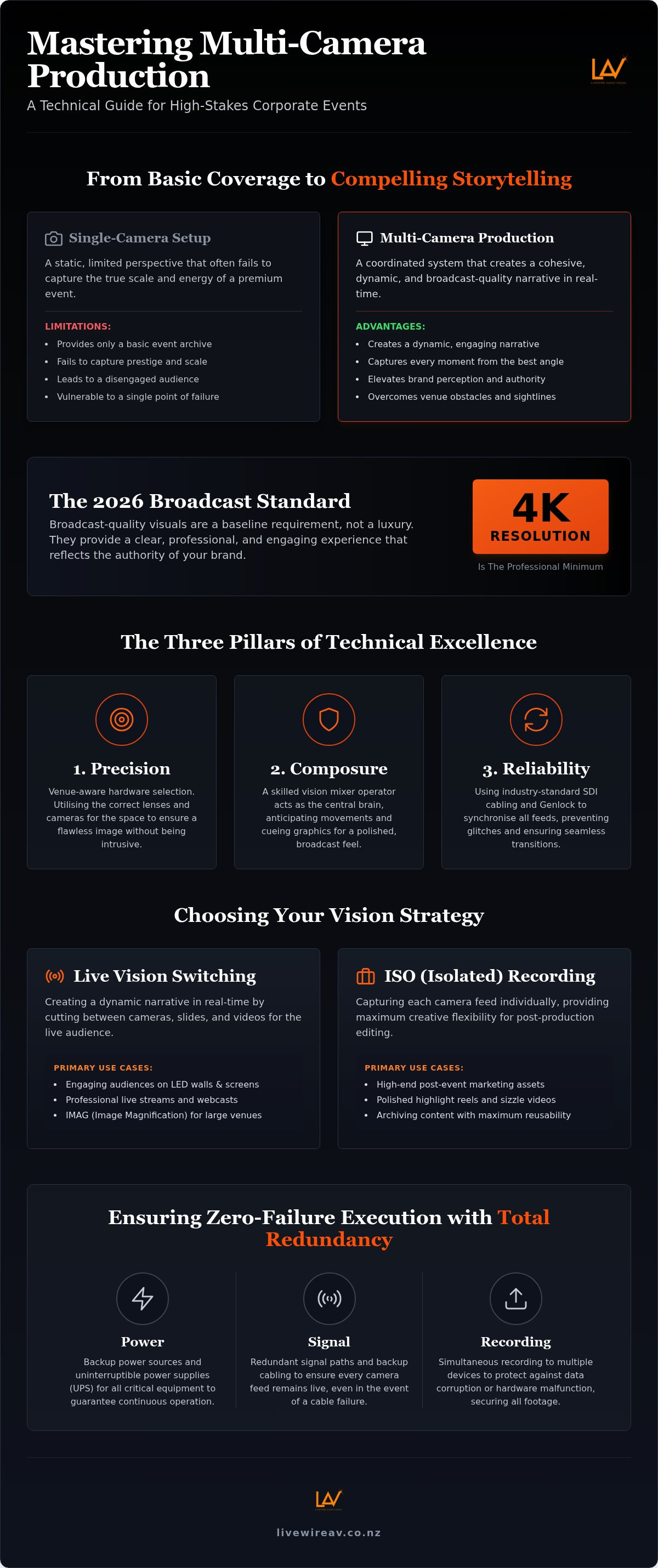
Multi-camera production for corporate events NZ is a highly coordinated system of vision switching and strategic camera angles designed to create a cohesive, dynamic narrative in real-time. It moves beyond the limitations of simple record-keeping. While a single-camera setup provides a basic archive of an event, it often fails to capture the scale, energy, and prestige of a premium corporate function. A multi-camera approach ensures that every key moment is captured from the optimal perspective, reflecting the true value of the content being shared.
The standard for corporate video has evolved. In 2026, stakeholders and attendees view broadcast-quality visuals as a baseline requirement rather than a luxury. With 4K resolution now established as the professional standard, your audience expects a level of clarity and production value that mirrors high-end television. This broadcast standard isn't about being flashy. It's about providing a clear, professional, and engaging experience that respects the audience's time and attention. By prioritising this level of production, you ensure your brand is perceived with the weight and authority it deserves.
The Shift from Coverage to Storytelling
Modern production is about more than just seeing the speaker; it's about controlling the pacing and focus of the event. Multiple camera angles allow a director to switch between a wide hero shot of the stage, tight profiles of the presenters, and the digital assets being displayed. This variety is essential for maintaining audience engagement during longer sessions. Short, purposeful cut-aways to audience reactions or panel members help to contextualise the speaker's points and keep the visual energy high. It's a methodical process that transforms a standard presentation into a structured visual story.
Solving Common Event Challenges
Every venue presents unique logistical hurdles. Strategic camera placement is the most effective way to overcome physical obstacles like pillars, low ceilings, or unconventional seating arrangements that might block an attendee's line of sight. By distributing cameras across the room, we can provide a best seat in the house view to every screen and remote viewer. This setup also allows for the discreet capture of audience participation and Q&A sessions without disrupting the flow of the evening. Multi-camera production is a sophisticated tool for professional brand elevation that ensures your message is delivered with total clarity and impact.
The Essential Components of a Professional Multi-Camera Setup
Precision. Composure. Reliability. These three pillars form the foundation of any high-stakes camera package. While modern hardware is more accessible than ever, the difference between a basic recording and a broadcast-quality production lies in how these components are integrated. A successful multi-camera production for corporate events NZ relies on an ecosystem where every piece of gear serves a specific, calculated purpose within the wider technical roadmap.
Selecting the right camera bodies and lenses is a venue-aware process. A large-scale conference in a high-ceilinged ballroom requires long-range lenses with high light sensitivity to maintain image quality without requiring intrusive stage lighting. Conversely, a panel discussion in a more intimate space might benefit from compact units that remain unobtrusive. In 2026, 4K resolution is the baseline expectation, but the glass in front of the sensor determines whether that resolution translates into a professional image or a digital distraction.
The invisible infrastructure is what ensures a zero-failure event. High-quality SDI cabling remains the industry standard for its reliability over long distances, far surpassing consumer-grade HDMI. Professional setups also utilise genlock to synchronise the frame rates of every camera. This prevents the glitching or flickering that can occur when switching between unsynced feeds, ensuring the transition from one angle to another is imperceptible to the audience.
The Role of the Vision Mixer and Operator
The vision mixer is the central brain of the operation. It allows the technical team to transition seamlessly between camera angles, presentation slides, and pre-recorded video content. A skilled operator does more than just push buttons; they understand the rhythm of a corporate show. They anticipate speaker movements and cue lower-third graphics, such as speaker names and titles, in real-time to provide a polished, broadcast feel. This level of professional vision switching ensures the final programme feed is ready for both the room's LED walls and a global livestream.
Communication Systems: The Silent Backbone
Coordination across a large venue is impossible without a dedicated talkback, or comms, system. This allows the technical director to lead the team with quiet authority, providing instructions to operators without being heard by the audience. Tally lights are another vital component. These small red lights on the cameras signal to both the operator and the speaker which camera is currently live. This simple visual cue prevents dead air and ensures the presenter always knows which lens to address, maintaining a direct connection with the viewers.
Live Switching vs. ISO Recording: Choosing Your Vision Strategy
Determining the right vision strategy is a pivotal step in planning a multi-camera production for corporate events NZ. There are two primary methods for capturing and distributing your content. Live switching involves a director or vision mixer operator selecting the best camera angles in real-time to create a finished programme feed. This feed is what the audience sees on the big screens or via a livestream. It provides an immediate, polished result that captures the energy of the room as it happens.
ISO recording, or isolated recording, takes a different approach by capturing the raw output of every individual camera simultaneously. While live switching provides the "now," ISO recording provides the "later." Having every angle recorded separately allows for a high-end post-event edit where mistakes can be corrected, different angles can be chosen, and the pacing can be tightened. For most premium events, a hybrid approach is the standard. This involves live switching for the immediate audience while ISO recording every feed to ensure maximum flexibility for future marketing assets.
Maximising ROI on Your Footage
The value of your event shouldn't end when the final guest leaves the venue. By utilising ISO feeds, you can create a suite of high-impact marketing materials that extend the life of your content. These individual recordings are essential for producing social media hype reels, speaker highlight videos, or educational webinar series. This methodical approach to content capture ensures you get the best possible return on your production investment. For more details on how this fits into a broader technical plan, see our Hybrid Conference AV Setup NZ: The 2026 Guide to Flawless Event Production.
Integrating with LED Walls and Projection
In large venues, live camera feeds are often used for IMAG, or Image Magnification. This ensures that attendees at the back of the room have a front-row experience by seeing a clear, tight shot of the speaker on large displays. A critical technical challenge here is managing latency. The visual on the screen must match the live audio perfectly to avoid a distracting "lip-sync" delay. Expert technical management ensures that the signal path is optimised for speed and clarity. To understand the hardware required for these displays, refer to our Conference LED Screen Hire NZ: The 2026 Technical Buying Guide. This integration is a standard requirement for any sophisticated multi-camera production for corporate events NZ.
Organising Your Production: From Site Visits to Show-Day
Meticulous planning is the only way to ensure a stress-free show day. A high-stakes multi-camera production for corporate events NZ requires a methodical approach that begins weeks before the first lens is uncapped. We don't rely on chance or "fixing it in the mix." Instead, we follow a rigorous technical roadmap that accounts for every variable, from signal latency to operator positioning. This level of preparation is what allows our team to maintain total composure when the lights go down and the show begins.
A technical site visit is the single most important insurance policy for your event. During this visit, we assess the venue's power capacity, identify clear sightlines for camera platforms, and map out cable runs that avoid guest traffic areas. This venue-aware planning ensures that when the gear is loaded in, there are no surprises. We work closely with venue staff to organise technical footprints that provide our operators with the optimal views while remaining invisible to your guests. Preparation. Protocol. Precision. These are the standards that define our pre-production phase.
The Importance of Venue-Aware Planning
Identifying the best camera positions involves more than just finding a spot for a tripod. We look for clean backgrounds and unobstructed views that won't be compromised when the room is full of attendees. Coordinating with venue management on load-in schedules and power distribution is a standard part of our process. This meticulous groundwork allows us to integrate our camera packages and vision switching systems into the space with surgical precision. It's about creating a technical environment where excellence is a standard requirement rather than an occasional achievement.
Managing the Human Element
Technical excellence is only half the equation; the human element requires just as much coordination. A detailed "Run of Show" document serves as the master script, aligning camera cues with lighting changes and audio transitions. We always recommend a "tech run" or rehearsal. This session is essential for the crew to learn the rhythm of the speakers and for the presenters to feel comfortable with the camera placement. It's during these rehearsals that we brief operators on the specific visual style required for the brand.
Our Technical Director maintains a clear line of sight to both the stage and the vision mixer, leading the team with quiet authority. This approach is vital for handling last-minute schedule changes or technical adjustments without projecting stress to the client. If you're looking for a steady hand to manage your next project, explore our full technical production services to see how we handle the complexity for you.
Ensuring Zero-Failure Execution with Expert Technical Management
Precision. Composure. Reliability. In high-stakes environments, these are the most valuable commodities. A flawless multi-camera production for corporate events NZ is built on the principle of redundancy. We don't just plan for the primary signal path; we account for the unexpected. This means having independent back-up systems for power, signal distribution, and digital recording. If a primary recorder fails, a secondary unit is already capturing the feed. If a cable is compromised, a redundant line is ready to take the load. This methodical approach to risk management ensures that the output remains uninterrupted, regardless of technical variables.
Expert technical management is about more than just owning the latest gear. It is about maintaining total control over a complex environment. A disciplined specialist understands that the success of the show depends on the invisible work done during the setup and the steady hand during the live switch. This consistent execution earns the trust of stakeholders who cannot afford a technical glitch. By prioritising stability over flashiness, we provide a foundation where your message can take centre stage without distraction.
The Peace of Mind of Professional Partnership
Partnering with a dedicated technical team allows you to step away from the monitors and focus on your guests. A professional "stealth" production team stays invisible, operating from the back of the room or a separate control booth to deliver excellence without intruding on the event's atmosphere. This partnership alleviates the organiser's stress by ensuring that every technical detail is handled with quiet precision. To understand how this fits into a wider strategy, read our guide on Premium Event Production New Zealand: The Guide to Flawless Technical Execution.
Ready to Elevate Your Next Event?
We invite you to discuss tailored camera packages for your upcoming national events. Whether you are planning a multi-day conference or a high-profile gala, our team provides the deep technical knowledge required to handle the most demanding environments. Our planning process begins with a no-nonsense technical consultation to assess your venue and objectives. When you are ready to secure a broadcast-quality result, contact LivewireAV for your next multi-camera production. We'll handle the signals, so you can handle the stage.
Securing Your Broadcast-Quality Result
A successful multi-camera production for corporate events NZ is the result of disciplined planning and technical composure. We have explored how venue-aware site visits and redundant signal paths create a zero-failure environment, allowing your brand to take centre stage. By choosing a vision strategy that balances live engagement with high-end post-event assets, you maximise the return on your production investment while ensuring a seamless experience for every attendee.
Frequently Asked Questions
How many cameras do I actually need for a corporate conference?
Most professional conferences require a minimum of two cameras. One provides a wide master shot of the stage while the second captures tight shots of the presenter. Adding a third camera allows for audience reaction shots and cut-aways, which are essential for maintaining engagement during long sessions. For large-scale galas or panel discussions, four or more units may be necessary to cover all participants and angles effectively.
What is the difference between ISO recording and a programme feed?
A programme feed is the finished visual output created by the vision mixer in real-time. It's what the audience sees on screen. In contrast, ISO recording captures the raw feed from every individual camera simultaneously. While the programme feed is ready for immediate use, ISO files provide the flexibility needed for high-end post-production. This allows you to choose different angles or fix transitions long after the live event has concluded.
Do I need extra lighting for a multi-camera production to look good?
Professional cameras require consistent, high-quality light to produce a broadcast-standard image. While house lighting might be sufficient for attendees, it often creates harsh shadows or colour imbalances on screen. We typically recommend an intelligent lighting design that includes front-wash and back-lighting. This ensures presenters are clearly defined from the background, which is a critical requirement for any high-stakes multi-camera production for corporate events NZ.
Can multi-camera feeds be integrated into a hybrid event livestream?
Multi-camera feeds are the foundation of a professional hybrid event. The live-switched programme feed is sent directly to an encoder, which then broadcasts the vision to your remote audience. This approach ensures that online viewers receive the same dynamic, high-quality experience as those in the room. By using multiple angles, you can keep remote participants engaged and prevent the visual fatigue often associated with static, single-camera livestreams.
How much space does a camera crew and vision mixing station require in the venue?
The physical footprint depends on the complexity of the setup. A standard vision mixing station typically requires a space of approximately three by two metres for the director and hardware. Camera positions vary; a tripod usually occupies a one-metre square area, while a raised platform or riser for better sightlines might require more room. We assess these requirements during a technical site visit to ensure the crew remains unobtrusive.
What happens if a camera fails during the live event?
Our systems are designed with built-in redundancy to handle hardware failures without disrupting the show. If a camera signal is lost, the vision mixer operator immediately switches to an alternative angle or a generic wide shot. Because we use multiple cameras, the audience rarely notices a single unit dropping out. Our technicians are trained to troubleshoot in the background, maintaining total composure while they resolve the issue without affecting the live feed.
Can you provide multi-camera production for outdoor events in NZ?
We provide full technical production for outdoor environments across New Zealand. These setups require specialised considerations for weather protection, power stability, and screen brightness. Using high-output LED walls and weather-sealed cable runs, we ensure the multi-camera production for corporate events NZ remains professional regardless of the conditions. Our team handles the unique logistical challenges of outdoor sites, from temporary structures for camera operators to robust signal paths that withstand the elements.
How long does it take to receive the final edited footage after the event?
The delivery timeline depends on the level of post-production required. A basic copy of the live-switched programme feed is often available immediately after the event. For more complex projects involving ISO feeds, colour grading, and professional editing, the turnaround is typically between five and ten business days. This methodical approach ensures that the final marketing assets meet the same broadcast-quality standards as the live production itself.


Comments