Live Event Technical Direction NZ: The Strategic Guide to Flawless Production
In a high-stakes live environment, the difference between a standing ovation and a technical catastrophe isn't the quality of the gear. It's the invisible architecture of the production. You've likely felt that tightening in your chest as a keynote speaker walks toward the lectern, hoping the audio holds and the vision switching remains flawless. It's an exhausting way to run a show. When you're managing complex live event technical direction NZ, coordinating multiple vendors while trying to decipher venue requirements can leave even the most seasoned organiser feeling exposed.
We understand that for your brand, failure isn't an option. This guide demonstrates how expert technical oversight transforms that nervous energy into total composure. By consolidating every technical discipline under a single, accountable partner, you gain the freedom to focus on your guests rather than the signal chain. We'll explore the strategic pillars of flawless execution: meticulous planning, venue-aware design, and precise technical control. Discover how a grounded, professional approach to production creates a seamless experience where every detail is accounted for, allowing your message to take centre stage with absolute clarity.
Table of Contents
What is Live Event Technical Direction in the New Zealand Context?
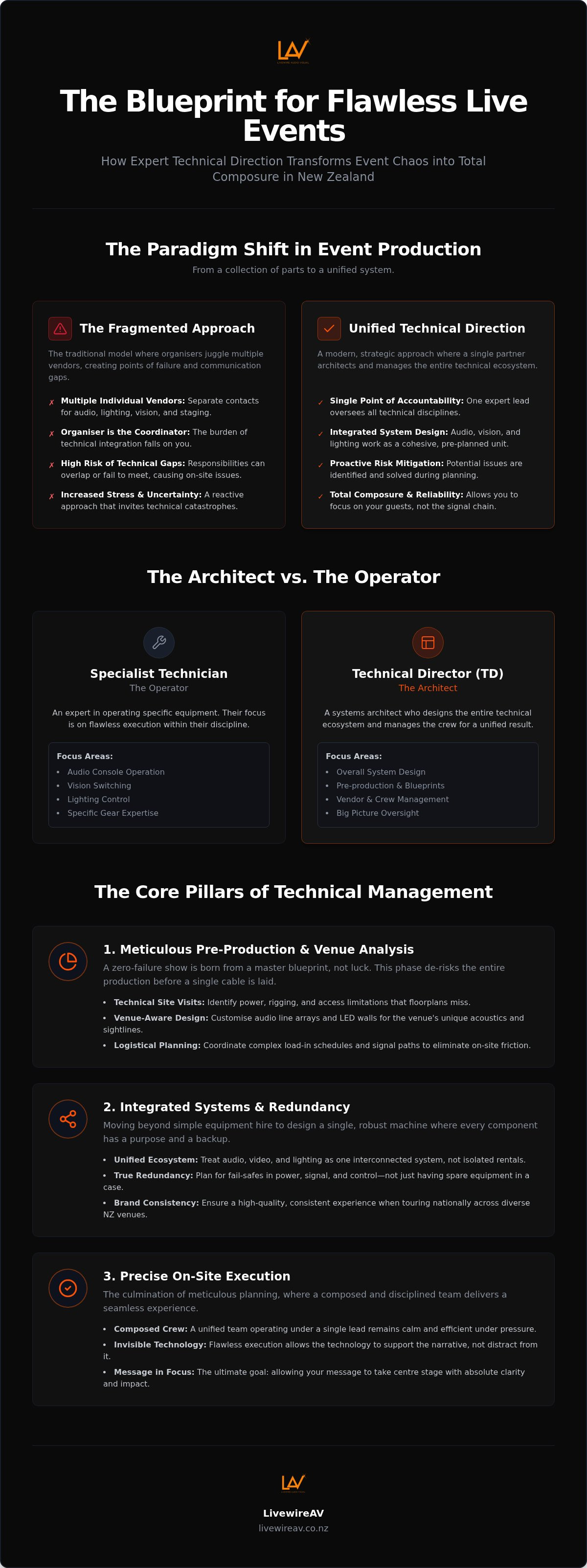
Live event technical direction NZ is the senior oversight that bridges the gap between a creative concept and its logistical reality. It isn't just about providing equipment; it's about the strategic integration of every technical component to ensure a flawless delivery. In the past, many organisers relied on a simple equipment hire model, where they managed multiple individual vendors for audio, lighting, and vision. Today, high-stakes productions require a comprehensive technical management approach. This shift places a technical director at the helm as the single point of accountability, ensuring that separate technical disciplines work as a unified system rather than a collection of parts.
Precision. Composure. Reliability. These are the markers of professional technical direction. By moving away from a fragmented vendor list, you eliminate the risk of technical gaps where responsibilities overlap or, worse, where they don't meet at all. A dedicated lead provides the steady hand required to navigate complex signal paths and tight load-in schedules, giving you the peace of mind that the technical foundation of your event is secure.
The Role of a Technical Director vs. a Standard Technician
It's vital to distinguish between a specialist technician and a technical director. A technician is an expert operator of specific gear, such as an audio console or a vision switcher. In contrast, a technical director is a systems architect who designs the entire technical ecosystem and manages the crew. While a technician focuses on their specific discipline, the TD looks at the big picture, coordinating vendor timelines and pre-production blueprints. For a broader definition of this professional role, you can research What is a Technical Director. Ultimately, the TD is the architect of the event's technical soul, translating your brand's vision into a robust, fail-safe reality.
Why New Zealand Events Demand Senior Oversight
New Zealand's venue landscape is uniquely diverse, ranging from heritage halls with limited power to state-of-the-art convention centres. This variety requires a venue-aware lead who understands the specific constraints of local infrastructure. Senior oversight is essential for managing the 'invisible' elements that often cause failure: power distribution, rigging point loads, and complex signal flow across large distances. When you're touring a show nationally, a technical director ensures brand consistency remains high, regardless of the venue's footprint or local equipment availability. This level of meticulous planning ensures that the technical execution is invisible, allowing your message to remain the focus of the audience's attention.
The Core Pillars of Technical Event Management
A zero-failure show isn't the result of good luck on the day. It's the product of a methodical pre-production phase that serves as the master blueprint. Effective live event technical direction NZ ensures that audio, video, lighting, and staging aren't treated as isolated rentals, but as a single, integrated machine. This requires a deep understanding of how technical systems interact within a physical space. For instance, an audio line array system isn't just hung; it's acoustically modelled to ensure consistent coverage for every seat in the house. Similarly, LED walls are positioned not just for impact, but for optimal sightlines that account for the venue's specific architectural quirks.
Planned. Tested. Executed. These three stages define our approach to production. By focusing on the logistical 'why' behind every piece of equipment, we eliminate the guesswork that leads to technical friction. This level of technical oversight creates a seamless environment where the technology supports the narrative rather than distracting from it.
Technical Site Visits and Venue Analysis
A physical walkthrough is the most critical step in de-risking a production. Relying on outdated venue floorplans is a common pitfall that leads to on-site compromises. By conducting technical site visits for events, a technical director identifies potential show-stoppers long before the trucks are loaded. We look for restricted access points, inadequate power distribution, and rigging limitations that could impact the rig's safety or scale. This level of scrutiny aligns with global standards for event operations and safety, ensuring that every logistical hurdle is cleared during the planning phase rather than the load-in.
CAD Design and Pre-Visualisation
Precision requires visual confirmation. We use Computer-Aided Design (CAD) to create a digital twin of your event space. This allows us to verify that the lighting rig won't obstruct the projection or that the stage height provides clear sightlines for the back row. Pre-visualisation isn't just about the aesthetics; it's a pragmatic tool for decision-making. By mapping out detailed signal flow diagrams and cable paths in advance, we prevent the "troubleshooting on the fly" that often plagues less-prepared shows. This meticulous approach turns complex technical requirements into a predictable, manageable process.
This collaborative partnership supports the event producer by providing a steady hand through every phase of the project. When the technical foundation is this robust, the producer can focus on the programme, confident that the delivery is in total control. If you're planning a high-stakes production, our team at LivewireAV provides the technical expertise required to make your vision a reality.
Mitigating Risk in High-Stakes Live Environments
High-stakes New Zealand productions leave no room for technical error. Effective live event technical direction NZ is defined by its ability to anticipate and neutralise risks before they manifest on stage. While many providers offer a "backup" plan, true redundancy is a comprehensive system design where a failure in one component is instantly and invisibly mitigated by another. This isn't just about having a spare cable; it's about architecting a signal path that remains unbroken under pressure. For national corporate functions, where your brand's reputation is on the line, "good enough" is a liability that we simply do not accept.
Precision. Redundancy. Composure. These are the standards of a professional production. By focusing on fail-safe architecture, we ensure that the technical execution remains invisible, providing a stable platform for your speakers and performers. This methodical approach to risk management is what separates a standard equipment hire from a professional technical partnership.
Zero-Failure Audio and Visual Redundancy
Redundancy must be built into every critical path of the show. For presentations and video content, this involves using primary and secondary playback systems that run in perfect synchronisation. If a primary system encounters a fault, the secondary takes over the output instantly. We apply this same rigor to audio by using redundant microphone channels and secondary mixers that can maintain the house mix without a perceptible drop in quality. When deploying large-scale visual displays, such as LED wall rental for events NZ, we utilise redundant processing and data loops. This ensures that even if a processor fails or a data cable is damaged, the screen remains active and the show continues uninterrupted.
The 'Calm Professional' Mindset
The "human factor" is often the most overlooked variable in live production. A Technical Director acts as the grounding force for the entire crew, maintaining order during rapid transitions or unexpected programme changes. Composure is a technical requirement, not just a personality trait. By establishing strict communication protocols between the TD, stage manager, and operators, we ensure that every cue is delivered with precision. This disciplined approach prevents the frantic energy that often leads to mistakes. Real-time problem solving is about having the foresight to know which lever to pull before the audience even notices a flicker. This steady, matter-of-fact delivery of technical control is what allows our clients to remain relaxed, knowing that every detail is being managed by a seasoned expert.
How to Choose a Technical Partner for National Delivery
Choosing a technical partner for national delivery is a decision that impacts every facet of your production. It moves beyond simply hiring gear. You need a partner who understands the logistical weight of moving high-end systems between Auckland, Wellington, and Christchurch without compromising on quality. When evaluating live event technical direction NZ, look for a firm that prioritises planning over reaction. A partner who asks about loading dock dimensions and three-phase power requirements in the first meeting is one who understands the reality of the New Zealand venue landscape.
Inventory depth is another critical factor. A partner must possess the national logistics capability to deploy complex systems, such as audio line arrays and large-scale LED walls, regardless of the location. This ensures that the technical standards of your show remain consistent as you move from venue to venue. A history of successful high-stakes execution provides the evidence you need to trust their composure under pressure. Reliability is earned through years of consistent delivery in diverse environments.
Key Questions for Your Potential Technical Director
Before signing a contract, you must probe their operational depth. Ask how they handle last-minute changes to the run-of-show. A professional TD should have a documented process for updating cue sheets and informing operators instantly. Inquire about their process for venue liaison. A technical lead should act as the primary point of contact for the venue's house technicians, managing power distribution and rigging safety on your behalf. Finally, ask for specific examples of how they've managed outdoor event production NZ logistics. Managing environmental variables like wind loading and weather protection requires a level of specialised knowledge that standard indoor providers may lack.
The Value of a Single-Vendor Solution
Coordinating multiple AV, lighting, and staging companies is a common source of friction. By choosing a single-vendor solution, you consolidate accountability. This streamlined approach ensures that the lighting design doesn't interfere with the vision switching and that the audio coverage is optimised for the specific stage layout. A unified technical plan creates a cohesive look and feel, reflecting well on your brand's professionalism. When you have a single point of contact, communication is direct, clear, and efficient. This reduces the administrative burden on your team, allowing you to focus on the event's strategic goals. For a partner that provides this level of integrated technical oversight, contact LivewireAV to discuss your next production.
LivewireAV: Professional Technical Direction for NZ Events
LivewireAV operates on a simple premise: the best technical direction is felt, not seen. Our philosophy is grounded, professional, and deeply reassuring. We understand that for a high-stakes New Zealand production, the technology must be an invisible servant to the message. By providing comprehensive live event technical direction NZ, we move beyond the role of a traditional vendor to become a strategic partner. Our focus is on end-to-end technical management that is tailored specifically to your event goals, ensuring that every piece of hardware and every crew member is aligned with your vision.
Stability. Focus. Precision. These are the anchors of our service. We don't just supply equipment; we provide a single point of accountability that eliminates the stress of managing multiple technical streams. This commitment to meticulous planning and zero-failure execution allows you to lead your event with total confidence, knowing that the technical foundation is unshakeable.
A Steady Hand Behind the Scenes
Our team consists of seasoned professionals who thrive in high-pressure environments. We prioritise your peace of mind over flashy specifications because we know that reliability is the most valuable commodity in a live show. Whether we are managing complex signal paths or coordinating rapid-fire cues, our approach remains composed and pragmatic. We specialise in integrating modern technology, such as audio visual for large conferences, into a seamless workflow that feels effortless to the audience. By focusing on the outcome rather than just the gear, we ensure that your brand is reflected in the best possible light, with a polished and professional show that leaves nothing to chance.
National Reach, Local Expertise
With over 10 years of experience in high-stakes environments, we have developed a deep understanding of New Zealand's diverse venue landscape. From our Auckland-based headquarters, we manage national logistics with a level of precision that ensures consistent delivery across the country. We are venue-aware and detail-oriented, possessing the local knowledge required to navigate the specific power and rigging constraints of New Zealand's premier event spaces. This national deployment capability means your touring production maintains the same high standard in every city. If you are ready to elevate your next production with a partner who values reliability above all else, organise a consultation with our technical team today.
Leading Your Next Production with Absolute Technical Certainty
The success of a high-stakes production isn't determined by the brightness of the screens or the volume of the speakers. It's defined by the invisible architecture of your planning. By prioritising live event technical direction NZ, you move from managing technical anxiety to leading with total composure. Meticulous site visits and CAD pre-visualisation eliminate the guesswork that often leads to on-site failure. True redundancy and a single point of accountability ensure that your brand's message remains the focus, regardless of the venue's complexity.
Excellence. Reliability. Precision. These are the standards we bring to every show. With over 10 years of experience in high-stakes environments, our team provides full end-to-end technical management with national New Zealand coverage. We're the steady hand behind the scenes, allowing you to focus on your guests while we handle the logistical complexity. Secure a technical director for your next New Zealand event and experience the peace of mind that comes from professional technical oversight. We look forward to making your vision a reality.
Frequently Asked Questions
What is the difference between a technical director and an AV technician?
A technician is a specialist who operates specific equipment, such as an audio console or a vision switcher. In contrast, a technical director acts as the systems architect. The TD designs the overall technical ecosystem and manages the entire crew. They bridge the gap between your creative vision and the physical execution, ensuring that all individual disciplines work together as a single, cohesive unit.
Why should I hire a technical director instead of using the venue's in-house team?
An independent technical director provides a single point of accountability and works exclusively for your interests. While in-house teams know their specific venue, a TD brings comprehensive live event technical direction NZ across multiple locations. They ensure brand consistency and technical standards are maintained, regardless of the venue's internal limitations or the age of their equipment.
At what stage of event planning should I involve a technical director?
It's best to involve a technical director during the initial concept phase or as soon as a venue is shortlisted. Early involvement allows the TD to conduct technical site visits and identify potential logistical hurdles like power constraints or rigging limits. This proactive approach prevents costly last-minute changes and ensures the technical design is integrated into the event's foundation from the start.
Does technical direction include help with hybrid or livestreamed events?
Yes, technical direction is essential for managing the added complexity of hybrid and livestreamed environments. A TD coordinates the vision switching, camera packages, and broadcast audio to ensure a high-quality experience for both in-person and remote audiences. They manage the critical signal paths required to keep the stream stable and perfectly synchronised with the activity in the live room.
How does a technical director manage multiple AV and lighting vendors?
The technical director acts as the central hub for communication and logistics between all technical vendors. They consolidate separate gear lists into a master technical rider and create unified signal flow diagrams. This senior oversight prevents overlaps in responsibility and ensures that lighting, audio, and video teams are working toward the same cue sheet with total precision and composure.
What kind of pre-production documents should I expect from a technical director?
You can expect a suite of detailed planning documents including CAD floorplans, rigging plots, and signal flow diagrams. A professional TD also provides a comprehensive technical run-sheet and a master equipment schedule. These documents serve as the blueprint for the entire production, ensuring every member of the crew understands their specific role and timing long before the first truck arrives.
Can a technical director help with outdoor event logistics in New Zealand?
Technical directors are vital for outdoor productions where environmental variables like wind and rain require specialised planning. They manage weather protection for sensitive electronics and ensure that structures like LED walls meet strict New Zealand safety standards for wind loading. Their expertise ensures that the technical execution remains robust, regardless of the unpredictable local weather conditions often found across the country.
How do you ensure zero-failure technicals for high-stakes corporate keynotes?
We achieve zero-failure results through rigorous redundancy planning and a disciplined operational mindset. This involves setting up primary and secondary playback systems that run in sync, along with redundant microphone channels and backup mixers. By maintaining total control over the signal chain and following a strict cue management process, we eliminate the risks typically associated with high-pressure live environments.


Comments