Full-Service Event Production vs Dry Hire: The 2026 Strategy Guide
A stack of high-end speakers and a crate of cables don't guarantee a successful keynote. In the high-stakes environment of New Zealand corporate events, the gap between having the gear and having a flawless execution is often measured in technical hitches and avoidable stress. When weighing up full-service event production vs dry hire, the real question isn't just about the equipment; it's about the outcome. Precision. Composure. Reliability. These are the qualities that transform a simple rental into a professional experience.
You've likely felt that familiar tension as the house lights dim, wondering if the microphone will cut out or if the vision switching will lag at the critical moment. It's a common pressure point for organisers who find themselves caught between the perceived savings of renting equipment and the necessity of a professional result. This guide will help you settle the debate by looking at the strategic impact of each choice on your 2026 event schedule. We'll break down the true costs of logistics, the value of technical reliability, and how to choose a model that protects your brand's reputation.
Table of Contents
Defining the Models: Full-Service Event Production vs Dry Hire
The distinction between full-service event production vs dry hire is often misunderstood as a simple matter of budget. In reality, it represents two entirely different approaches to risk and responsibility. One is a transaction for hardware; the other is a commitment to a guaranteed technical outcome. Understanding where your event sits on this spectrum is the first step toward a successful delivery.
What Exactly is Dry Hire?
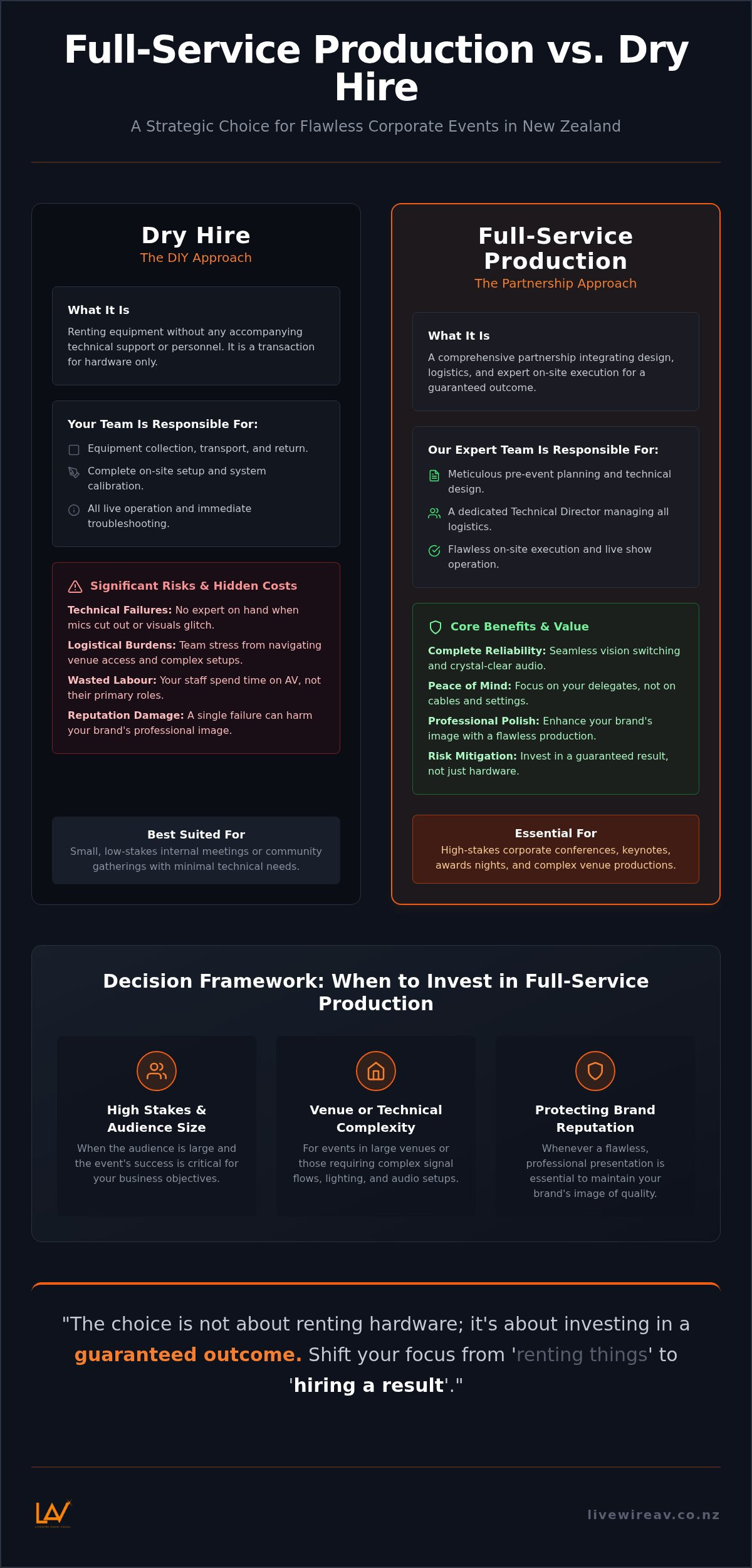
Dry hire is the process of renting equipment without any accompanying technical support or personnel. The organiser is responsible for collecting the gear, transporting it to the venue, and performing the setup. If a signal chain fails or a wireless frequency experiences interference, the burden of troubleshooting falls squarely on your team. This model is often chosen for small gatherings, such as a local community meeting or a low-stakes internal presentation, where the technical requirements are minimal and the consequences of a failure are low. It's a pragmatic choice for basic needs, but it offers no safety net for complex environments.
The Scope of Full-Service Technical Production
Full-service production is a comprehensive partnership that integrates design, logistics, and on-site execution. It begins well before the event date with meticulous planning, venue site visits, and technical drafting. This model is essential for audio visual for large conferences, where the complexity of the signal flow requires expert oversight. A dedicated Technical Director manages the entire production schedule, ensuring that every transition is seamless and every cue is met with precision. This approach shifts the focus from "renting things" to "hiring a result," providing a level of professional polish that hardware alone cannot achieve.
Choosing a full-service partner means you are investing in composure. While dry hire leaves you managing the technical minutiae, a production partnership allows you to focus on your delegates. It ensures that the atmosphere is controlled, the audio is intelligible, and the visual impact is consistent with your brand's standards. In the high-stakes environment of corporate event management, this reliability is the most valuable commodity an organiser can possess. Reliability is not a luxury; it is a baseline requirement for any professional engagement.
The Hidden Risks and Costs of the Dry Hire Approach
The appeal of dry hire often lies in the initial quote. On paper, it appears to be a straightforward way to reduce overheads. However, this perspective frequently overlooks the "DIY trap." Many organisers assume that internal staff can manage professional-grade AV equipment because they are comfortable with consumer electronics. This is a risky assumption. Professional systems require a level of technical literacy that goes beyond connecting a laptop to a projector. When you attempt to Master Your Event Budget, it is vital to account for the time your team spends troubleshooting instead of focusing on their primary roles. The labour cost of an exhausted marketing manager trying to fix a flickering LED wall is a significant, if invisible, expense.
Logistical burdens also accumulate quickly. Beyond the rental fee, you must factor in the cost of transport hire, insurance for high-value gear, and the physical toll of the "bump-in." New Zealand venues often have strict load-in windows and complex access requirements. Navigating these without a dedicated crew leads to delays and unnecessary stress. If a critical component fails mid-keynote, a dry hire agreement leaves you with no immediate recourse. There is no backup equipment on-site and no technician to swap out a faulty microphone. The cost of a failed presentation, measured in lost reputation and delegate dissatisfaction, far outweighs any marginal saving on equipment hire.
Technical Compatibility and Setup Errors
Modern event technology is rarely "plug and play." Integrating an audio line array with a complex vision switching system requires precise calibration. Common setup mistakes made by non-experts often result in persistent feedback loops or visual glitches that distract your audience. Without a Technical Director to oversee the signal flow, you risk using equipment that is technically compatible but poorly optimised for the venue's acoustics or lighting conditions. These errors are difficult to rectify once the event is underway, often leading to a compromised experience that feels unpolished and amateur.
The Burden of On-Site Troubleshooting
Managing an event requires total focus on the attendees and the programme. If you are also the person responsible for managing technical cues, your attention is divided. Dry hire packages rarely include redundancy; they provide exactly what is on the manifest and nothing more. If a cable is damaged during setup, the show simply stops. Furthermore, the "bump-out" at the end of a long day is often the most taxing part of the process. Managing the pack-down, checking the inventory, and ensuring the gear is safely returned adds hours of labour to an already demanding schedule. For those seeking a more reliable outcome, partnering with a professional production team ensures these logistical and technical risks are managed by experts, allowing you to remain focused on your guests.
Why Technical Management is the Secret to Flawless Execution
The core differentiator in the debate of full-service event production vs dry hire is the presence of a Technical Director. This individual serves as the central nervous system of your entire production. While hardware is static, a live event is dynamic. A Technical Director anticipates potential issues before they manifest, maintaining composure when variables change. They oversee the entire production schedule, ensuring that transitions between speakers are tight and that every piece of media plays correctly. This level of oversight is what protects your corporate message from being undermined by technical distractions. It ensures that your brand's reputation remains intact throughout the engagement.
The Role of the On-Site Crew
A full-service partnership provides access to specialists who understand the nuances of their craft. Audio engineers focus on delivering crystal clear sound for every attendee, regardless of where they are seated in the venue. Vision technicians manage conference LED screen hire NZ and complex projection mapping, ensuring that visuals are sharp and colour-accurate. Lighting designers work to create the right mood and focus, directing the audience's attention exactly where it needs to be. These professionals work in unison, guided by a single production plan, to create a cohesive experience that dry hire simply cannot replicate. Each member of the crew is a specialist in managing complexity under pressure.
From Design to Delivery
Meticulous preparation is the foundation of a zero-failure technical philosophy. This process includes detailed site visits and the creation of precise floor plans that account for power distribution, rigging points, and sightlines. For modern events, this often includes integrating a hybrid conference AV setup NZ to ensure remote audiences receive the same high-quality experience as those in the room. This end-to-end management elevates the overall "look and feel" of your brand. It transforms a standard presentation into a polished production. By choosing full-service event production vs dry hire, you are securing the peace of mind that comes from knowing every detail has been accounted for by experts who thrive in high-stakes environments.
The transition from a gear list to a managed solution is where true event success is found. It's about moving away from the stress of coordinating multiple vendors and toward a single, reliable point of contact. This approach ensures that the technical infrastructure remains invisible, allowing your content and your speakers to take centre stage. Excellence in event production is not about the flashiest gear; it is about the quiet confidence of a team that has everything under control.
Decision Framework: When to Invest in Professional Production
Choosing between full-service event production vs dry hire is a calculation of risk. Scale. Complexity. Impact. These three metrics determine whether a DIY approach is a viable strategy or a significant liability. For a small internal briefing, the stakes are contained. For a national conference, those same stakes are magnified. Every technical cue becomes a reflection of your organisation's professionalism. When you view production as an investment in ROI rather than a line-item expense, the choice becomes clearer. You aren't just paying for speakers and lights; you're paying for the certainty that your message will be heard without interruption.
The complexity of your programme is the second major factor. If your event involves multiple speakers, integrated video content, live music, or vision switching between several sources, the margin for error shrinks. Managing these elements requires a level of coordination that goes beyond basic technical ability. It requires the presence of a team that understands the rhythm of a live show. In high-stakes environments, the ability to maintain composure when a schedule shifts is what separates a professional delivery from a stressful one.
Criteria for Choosing Full-Service
Professional technical management is essential for any event with more than 100 attendees or a complex visual programme. Awards ceremonies, product launches, and televised events require a level of precision that rental gear alone cannot provide. This is particularly true for outdoor event production NZ, where environmental variables like wind, moisture, and power stability necessitate specialised knowledge and robust equipment. In these scenarios, the presence of an on-site crew isn't a luxury; it's a fundamental requirement for safety and reliability.
When Dry Hire Might Suffice
There are instances where renting equipment is perfectly appropriate. Small internal meetings with basic audio needs often don't require an on-site engineer. Similarly, low-stakes social gatherings where technical perfection isn't the primary goal can be managed by organisers. If your organisation employs a dedicated, technically trained in-house AV team, dry hire provides the tools they need to execute their work. In these specific scenarios, the risk is manageable and the logistical burden is balanced by the internal expertise available to you.
If your next project requires a guaranteed outcome and the peace of mind that comes from expert management, it's time to move beyond simple rentals. Discuss your technical requirements with our team to ensure your event is delivered with total composure and professional polish.
Partnering with LivewireAV for Stress-Free Event Success
LivewireAV positions itself as the steady hand behind your event. We recognise that in high-stakes corporate environments, technical precision is not optional; it is a standard requirement. Our national service coverage ensures we can deliver premium event production New Zealand wide, providing a consistent standard of excellence regardless of the venue. We maintain a modern inventory of audio line array systems and high-resolution LED walls, but our true value lies in how we manage this technology. Choosing full-service event production vs dry hire with us means you are investing in a partnership that prioritises your peace of mind through meticulous preparation and total technical control. We understand that in these environments, precision and composure are the most valuable commodities an organiser can possess.
A Collaborative Approach to Technical Design
Our process begins with understanding your creative vision. We don't just supply a gear list; we work alongside your team to design a technical solution that supports your objectives. This involves clear communication, honest advice, and thorough site visits. We account for every detail, from power distribution to sightlines, long before the first guest arrives. This collaborative method ensures that our technical design is perfectly integrated with your programme. It allows us to anticipate challenges and implement redundancies that a simple rental agreement cannot offer. We believe that a successful event is the direct result of disciplined preparation and a shared commitment to quality. Our process is collaborative, meticulous, and venue-aware.
Why NZ Brands Trust LivewireAV
New Zealand brands trust us because we prioritise reliability over flashiness. We have spent tens of years operating in high-pressure environments, developing a reputation for staying calm when the stakes are at their highest. Our focus remains on the outcome of the technology rather than just the specifications of the equipment. We act as the guardians of your brand's reputation, ensuring that your message is delivered without distraction. This disciplined approach has made us a preferred partner for organisations that value clear, honest communication and consistent, high-quality execution. We are the disciplined specialist who earns trust through every successful keynote. If you are ready to move beyond the risks of DIY setups, contact LivewireAV for a tailored production proposal and experience the confidence of a professional technical partnership.
Securing a Flawless Technical Legacy
The strategic choice between full-service event production vs dry hire ultimately determines the resilience of your event. It represents a fundamental shift from managing hardware to managing outcomes. While renting gear might satisfy a budget on paper, a comprehensive production partnership protects your brand's reputation through meticulous planning and technical redundancy. The peace of mind gained from a zero-failure philosophy is the most valuable asset any organiser can possess.
With national New Zealand coverage and 10+ years of high-stakes event experience, LivewireAV provides the steady hand required to navigate complexity. Our experienced on-site technical crew handles the intricate signal flows and vision switching, allowing your team to focus on the attendees. We ensure your technical infrastructure remains invisible so your message stays at the centre of the room. Request a bespoke technical proposal from LivewireAV to secure a professional, stress-free delivery for your next project. We look forward to helping you achieve a flawless result.
Frequently Asked Questions
What is the main difference between dry hire and full-service production?
The primary distinction lies in the level of responsibility and technical support provided. Dry hire is a transaction for hardware alone, whereas full-service production is a comprehensive technical partnership. This model includes meticulous planning, on-site technicians, and a dedicated Technical Director. When comparing full-service event production vs dry hire, the former focuses on delivering a guaranteed outcome. Precision. Composure. Reliability. These are the standards we maintain.
Is full-service event production significantly more expensive than dry hire?
While the initial quote for full-service production is higher, it often proves more cost-effective by eliminating hidden expenses. Dry hire requires you to manage transport, insurance, and the labour costs of your own staff performing setup. Full-service production protects your brand by mitigating the risk of technical failure. This investment ensures a professional delivery that justifies the budget through reliability and superior attendee engagement across New Zealand.
Can I dry hire equipment from LivewireAV?
No, LivewireAV does not offer dry hire services. We position ourselves as a premium production partner, focusing on end-to-end technical management to ensure the highest standards of reliability. By providing both modern equipment and experienced personnel, we maintain total control over the technical environment. This approach allows us to guarantee the professional polish and composure that high-stakes corporate and large-scale events require.
What kind of events require a full technical production team?
Any event where the technical requirements exceed basic "plug and play" setups benefits from a full production team. This includes national conferences, awards ceremonies, and product launches. When weighing up full-service event production vs dry hire for these scenarios, the managed model is essential. If your programme involves multiple speakers, high-resolution LED walls, or integrated media, professional oversight ensures a seamless experience for your delegates.
Does full-service production include the setup and pack-down of gear?
Yes, full-service production covers the entire logistical lifecycle of the event equipment. Our team manages the meticulous "bump-in" and "bump-out" processes, including transport, rigging, and system calibration. This allows your team to remain focused on hosting guests and managing the programme. We ensure that every piece of technology is correctly configured and tested well before the first attendee arrives, providing a stress-free environment for organisers.
How do I know if my event needs a Technical Director?
A Technical Director is necessary whenever the complexity of technical cues or the stakes of the event are high. If you are managing multiple vision sources, live performers, or a tight run-of-show, you need a steady hand to coordinate these elements. They serve as the central point of contact, ensuring that every transition is seamless and that your brand's reputation is protected throughout the entire engagement.
What happens if equipment fails during a full-service event?
Full-service production includes built-in redundancy and the immediate presence of expert technicians to resolve issues. Unlike dry hire, where a failure might stop the show, our team monitors signal paths in real-time. We carry backup equipment for critical components and can swap out faulty hardware or reroute signals instantly. This proactive approach ensures that your presentation continues without distraction, maintaining a professional atmosphere even when technical variables change.
Do you provide technical support for hybrid or livestreamed events?
We provide comprehensive technical management for hybrid and livestreamed events across New Zealand. Our services include broadcast-grade camera packages, vision switching, and robust audio systems tailored for both in-room and remote audiences. We focus on creating a seamless experience that bridges the gap between physical and digital attendees. This ensures your content is delivered with crystal clear clarity, regardless of how your audience chooses to participate.


Comments