Event AV Planning and Design: The How-To Guide for Outdoor NZ Productions
- Jul 11
- 12 min read
An outdoor event is an engineering project disguised as a celebration. When you move technical production into the open air, you aren't just renting gear; you are managing variables that change by the hour. Precision, composure, and foresight. These are the core requirements for managing outdoor event production NZ where the stakes are always high. One sudden gust of wind or an unexpected power surge can silence a stage in seconds, making technical control your most valuable commodity.
We understand the anxiety that comes with technical planning under the New Zealand sky. You want your audience to remember the message, not the microphone feedback or the screen glare. This guide provides a clear technical roadmap to ensure your production remains stable and impactful. We will walk through the essential steps of site engineering, power management, and weather-proofing. Our aim is to help you achieve a result that is seamless, professional, and reliable from the first sound check to the final pack-down.
Table of Contents
Mastering the Fundamentals of Event AV Planning and Design
Successful outdoor event production NZ is far more than a logistical exercise. It is a specialised engineering feat. While an indoor venue provides a controlled shell, the outdoors offers no such protection. Every piece of equipment must be calculated against the physical environment. We don't just set up gear; we engineer a solution that accounts for acoustics, structural integrity, and electrical safety. Precision, composure, and foresight. These are the standards we apply to every project to ensure the environment remains a backdrop rather than a disruption.
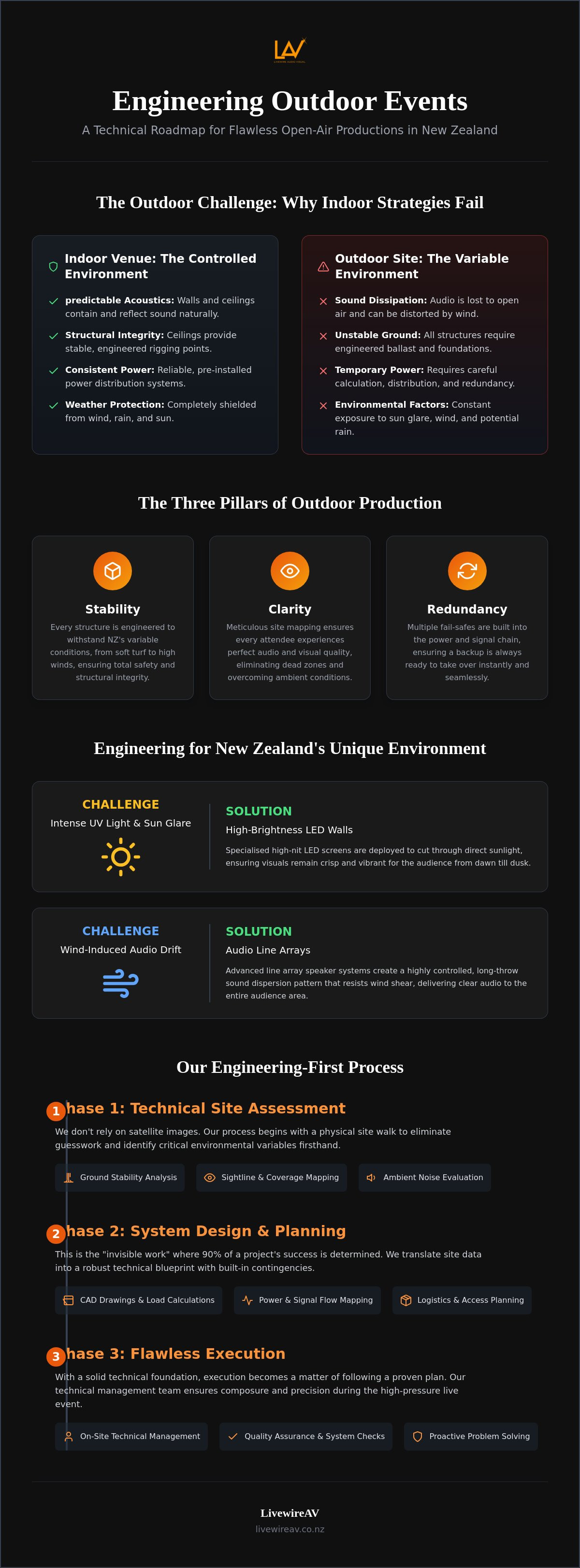
Indoor AV strategies often fail when applied to open-air environments because they rely on fixed architecture. In a ballroom, walls reflect sound and ceilings provide convenient rigging points. Outside, sound dissipates into the sky and there is no ceiling to hide behind. This is why 90% of a project's success happens long before the first truck arrives. This "invisible work" involves CAD drawings, wind load calculations, and signal flow mapping. When the technical foundation is solid, the execution becomes a matter of following a proven plan.
Moving away from a "hire" mindset is crucial for high-stakes productions. Simply booking a list of equipment doesn't guarantee a show. A technical management partnership ensures that the team designing the system is the same team responsible for its performance. It creates a direct link between technical preparation and your peace of mind. By focusing on outcomes rather than just gear lists, we eliminate the gaps where failures often occur.
The Core Pillars of Outdoor Design
Clarity: We ensure every attendee, regardless of their position in the crowd, experiences perfect audio and visual quality. This requires meticulous mapping of the site to eliminate dead zones.
Stability: Every structure is engineered to withstand New Zealand's variable conditions. We account for everything from soft turf stability to the ballast required for high-wind safety.
Redundancy: We build multiple fail-safes into the signal chain. If a primary connection is compromised, a backup is already live and ready to take the load without the audience noticing a change.
Why NZ Conditions Demand Specialised Planning
New Zealand's environment presents unique challenges for sensitive electronics. The intensity of our UV light and ambient glare requires high-nit LED walls that remain visible even in direct afternoon sun. Similarly, wind can physically shift the "throw" of sound waves, causing the audio to "drift" for those at the back. To counter this, we use Audio Line Arrays to maintain a tight, controlled dispersion of sound that stays on target. For 2026, site-aware technical design is defined as the proactive integration of local environmental data into the engineering of audio and visual systems to ensure total operational reliability. It's about being prepared for the environment rather than fighting against it.
Step 1: Conducting a Comprehensive Technical Site Assessment
A successful production starts on the ground. We don't rely on satellite imagery or outdated floor plans. We walk the site. This physical assessment is the only way to identify the variables that determine the success of outdoor event production NZ. We map the "Field of Play," ensuring every attendee has an unobstructed view of the LED walls and a clear path for audio waves. Every topographical detail matters. Assessment, engineering, and execution. This is how we eliminate the guesswork.
Weight loadings are a critical consideration. A large LED wall or a covered stage structure exerts massive downward pressure. We evaluate whether the ground is soft turf, reinforced gravel, or concrete. This determines the type of ballast or distribution plates required to prevent sinking or shifting. Stability, safety, and scale. These are the non-negotiables for any outdoor build. If the ground isn't stable, the show isn't safe.
We also identify existing infrastructure versus what we must bring in. This includes a thorough check of available power and its proximity to the stage. Ambient noise is another factor. If the site is near a busy road or under a flight path, the audio design must compensate to maintain clarity. Local council restrictions also play a role. Whether it's Auckland's bespoke permit requirements or Christchurch's specific fee structures for public spaces, we ensure the technical plan remains compliant with noise limits and operating hours.
Logistics and access points are mapped with precision. Large-scale equipment transport requires specific turning circles and load-bearing paths. If a truck can't reach the stage site, the "bump-in" timeline is compromised. Planning for these logistical realities prevents stress on the day and ensures the crew can work efficiently.
The Site Map: Your Technical Blueprint
The site map is a living document. We place the Front of House (FOH) position where the technicians can accurately hear and see what the audience experiences. Cable runs are organised to avoid public thoroughfares, using cable ramps to maintain safety and signal integrity. By identifying potential "dead zones" early, we can adjust the full technical production plan to include delay speakers or secondary screens, ensuring total coverage.
Stakeholder Collaboration in Planning
Technical success is a collaborative effort. We work closely with venue managers to confirm weight limits and power draws. Coordination with health and safety officers is essential, particularly regarding wind-load limits for temporary structures. This constant communication ensures the technical design perfectly supports the creative vision while staying within the boundaries of physical safety and regulatory compliance.
Designing for Sight and Sound: Audio Line Arrays and LED Visuals
Precision in delivery is the hallmark of professional outdoor event production NZ. Unlike an indoor venue where sound bounces off walls, an open-air site acts like an acoustic vacuum. This is why Audio Line Array Systems are non-negotiable. These systems allow our technicians to control the vertical dispersion of sound, ensuring the audio travels directly to the audience rather than dissipating into the sky. It is the difference between a muffled echo and crystal-clear speech that reaches the very back row.
Visual impact requires a similar level of engineering. Ambient New Zealand sunlight can easily wash out standard screens. For effective daylight visibility, we utilise LED walls with high-nit brightness ratings, typically exceeding 5,000 nits. This ensures your content remains vivid even in direct afternoon sun. When combined with professional vision switching and multi-camera packages, the technical production transforms from a static display into a dynamic broadcast that keeps thousands of attendees engaged.
Ensuring total coverage is about more than just volume. It is about the science of acoustic pressure. We use predictive software to model how sound will behave across your specific site, accounting for atmospheric absorption and wind speed. This meticulousness ensures that a guest standing 100 metres away hears the same tonal balance as someone in the front row. Reliability, clarity, and consistency. These are the results of a site-first design philosophy.
Audio Engineering for Open Spaces
Calculating the "throw" of a system is a mathematical requirement. For larger sites, we deploy delay towers to maintain audio synchronisation over long distances. This prevents the "echo" effect caused by the time sound takes to travel from the main stage. These principles of scale and precision are similar to those used in audio visual for large conferences, where clarity is the absolute priority. By aligning the signal timing, we ensure the audience perceives the sound as coming directly from the stage, regardless of their distance.
Visual Tech: Beyond the Big Screen
Choosing the right screen involves balancing pixel pitch with viewing distance. For large outdoor crowds, a slightly wider pixel pitch often provides superior brightness and contrast when viewed from afar. We only use IP65-rated gear for our outdoor builds. This weather-proofed equipment ensures that a sudden rain shower won't compromise the signal chain or damage sensitive electronics. Vision switching allows our team to cut between speakers, presentations, and crowd shots. It provides a seamless experience for both the live audience and any linked livestream, ensuring the production feels professional and polished.
Managing Environmental Logistics: Power, Weather, and Contingency
Logistics is the quiet engine of any successful show. In the context of outdoor event production NZ, logistics is synonymous with risk management. We don't just hope for the best; we engineer for the worst. This involves a meticulous calculation of every electrical load, structural wind rating, and logistical movement. Precision, stability, and control. These are the factors that ensure your event continues without interruption, regardless of the environmental challenges.
Calculating power distribution is a primary engineering task. We aggregate the total draw of lighting rigs, audio line arrays, and LED walls to determine the exact requirements for a site. This isn't just about total wattage. It's about phase balancing and ensuring the signal remains stable under peak loads. Our "Plan B" protocol is a predefined set of actions triggered by environmental thresholds. If wind speeds reach a specific limit, or if rain intensity threatens the signal chain, the technical team has a clear, rehearsed response. This composure under pressure is what defines a professional production partnership.
Managing the "bump-in" and "bump-out" schedules is equally critical. Outdoor sites often have restricted access windows or difficult terrain that slows down the movement of heavy gear. We build realistic timelines that account for these physical constraints, ensuring the technical setup is complete well before the first guest arrives. For a partner who prioritises this level of detail, contact us for full technical production.
Reliable Power Systems
Domestic power is rarely sufficient for professional events. We rely on event-grade generators that provide "Clean Power." This is essential for sensitive digital AV equipment, which can be damaged by the voltage fluctuations common in standard outlets. We also implement redundant power supplies for mission-critical elements like the main mixing console and vision switchers. If one source fails, the backup takes over instantly, keeping the show live and the audience engaged.
New Zealand Weather Contingency
New Zealand's weather is famously unpredictable. We monitor real-time weather data throughout the production, watching for shifts in wind direction or precipitation. Our structures are built based on site-specific wind-load calculations, ensuring that LED walls and lighting trusses remain stable even in significant gusts. We use specialised enclosures and waterproof covers to protect any equipment that isn't inherently weather-rated. For more on managing these variables, refer to our guide on Outdoor Event Production NZ for site-aware management.
Executing a Flawless Show: The Role of Technical Management
The moment the first guest arrives, the focus shifts from engineering to execution. In the high-stakes environment of outdoor event production NZ, the Technical Director acts as the anchor. They are the "Calm Professional" at the centre of the show, monitoring weather feeds, power levels, and crowd dynamics simultaneously. Precision, composure, and control. This steady hand ensures that the complex technical layer remains invisible, allowing the audience to focus entirely on the event itself.
Communication across large outdoor sites is a specialised discipline. We use high-grade intercom systems to keep the crew in sync, from the camera operators at the back of the field to the vision switchers at Front of House. Clear, honest communication is the baseline. When every team member is aligned, cues are hit with frame-perfect accuracy. It's about maintaining a methodical rhythm that mirrors the logical flow of the event programme.
The live environment is fluid and unpredictable. A speaker might move off-script, or a sudden cloud break might require a real-time adjustment to the LED wall's brightness. Our team is trained to adapt without hesitation. We don't just follow a static plan; we manage the reality of the moment. This ability to stay composed under the pressure of a live crowd is what separates a managed production from a simple equipment hire.
After the final pack-down, we conduct a thorough post-event analysis. This involves reviewing data logs, such as power consumption and decibel levels, to improve future productions. We believe that excellence is a standard requirement rather than an occasional achievement. Every show provides technical insights that we use to further refine our site-aware design philosophy.
The Human Element: Expert Technicians
Skilled operators are more important than the gear itself. Even the most advanced audio line array requires a seasoned ear to tune it to the specific atmospheric conditions of the day. Our technicians possess the deep technical knowledge required to handle complexity while remaining invisible behind the scenes. They are "site-aware" professionals who understand the terrain and thrive under the unique pressures of New Zealand's outdoor venues. Reliability is built on experience, not just equipment.
Partnering for Technical Certainty
Full-service production is designed to reduce organiser stress. By consolidating the technical management under one steady hand, you eliminate the gaps where failures often occur. We provide a bespoke proposal tailored to your specific site, ensuring that every detail has been accounted for long before the first truck arrives. This collaborative partnership is built on trust and consistent, high-quality execution. To ensure your next show is handled with total technical control, contact the LivewireAV team for an expert site visit.
Engineering Your Vision Under the New Zealand Sky
Achieving technical excellence in an open-air environment requires more than just high-performance gear. It demands a site-first design philosophy that treats every venue as a unique engineering challenge. By conducting thorough site assessments and prioritising environmental stability, you ensure your message isn't lost to the wind or the glare of the sun. This methodical approach to outdoor event production NZ turns potential risks into managed variables, providing the reliability your audience expects.
With over 10 years of technical excellence and a modern inventory of line arrays and LED technology, we provide the steady hand behind the scenes for events nationwide. Our team is ready to help you translate your creative vision into a stable, high-impact reality. Whether you're planning a sporting event or a corporate gala, precision and composure remain our standard requirements. Discuss your upcoming outdoor event with the LivewireAV experts today and ensure your production is handled with total technical control.
Frequently Asked Questions
How far in advance should I start event AV planning and design?
You should ideally begin the technical planning process three to six months before your event date. This lead time is necessary to conduct thorough site assessments, secure council permits, and engineer a system that accounts for the specific terrain. Early engagement ensures that every logistical detail is accounted for well before the first truck arrives on-site.
Can I use standard indoor LED screens for an outdoor event in NZ?
No, standard indoor screens are not suitable for open-air environments. Indoor panels lack the brightness required to remain visible in New Zealand sunlight and do not possess the IP65 weather-proofing needed to protect against moisture. Outdoor-rated screens are a requirement for daylight visibility, structural safety, and operational reliability.
What happens if it rains during my outdoor event production?
We activate a predefined "Plan B" protocol that is built into the initial technical design. This involves using weather-proofed signal chains, specialised equipment enclosures, and waterproof covers for any non-rated gear. Our technical directors monitor real-time weather data to make informed, composed decisions regarding the safety and continuity of the show.
How do you manage power requirements in a remote outdoor location?
We deploy event-grade generators and sophisticated distribution systems to provide "Clean Power" in remote areas. Our engineers calculate the exact electrical draw for all lighting, sound, and screens to ensure the system remains balanced and stable. This prevents the voltage fluctuations that can often compromise sensitive digital AV equipment in off-grid settings.
What is the difference between a dry hire and full technical production?
Dry hire is the simple rental of equipment, whereas full technical production is a managed technical partnership. With full production, we handle the site engineering, on-site technical operation, and overall show management. It provides a direct cause-and-effect relationship between our meticulous preparation and your total peace of mind.
Do I need a technical site visit if the venue has hosted events before?
Yes, a technical site visit is essential for every unique project. Ground conditions, access paths, and ambient noise levels can change significantly between seasons. We must verify the current state of the site to ensure our outdoor event production NZ design is accurate, safe, and perfectly suited to the current environment.
How do you ensure the sound doesn’t disturb the surrounding neighbourhood?
We use directional audio line arrays and acoustic modelling software to keep the sound energy focused strictly on the audience. This precision allows us to deliver high-impact audio while minimising spill into the surrounding area. We also work within local council noise restrictions to ensure the event remains compliant and professional.
What is the most common mistake in outdoor event planning?
The most common mistake is treating an outdoor site as if it were a controlled indoor venue. Organisers often underestimate the impact of ambient light on screens, the effect of wind on audio throw, or the complexity of power distribution. Successful execution requires a site-aware mindset where every environmental variable is engineered and managed. Precision, composure, and control. These are the standards that prevent common failures.


Comments