Avoiding Hidden Costs in Event Production: The 2026 Technical Guide
Imagine the house lights have just come up after a flawless keynote, only for you to find a "miscellaneous" invoice for extra cabling and late-night labour waiting in your inbox. It's a common frustration that can quickly erode your event's margin and your professional composure. Truly avoiding hidden costs in event production requires more than just a 15 percent contingency fund; it demands a shift from reactive accounting to proactive technical foresight. You've worked hard to build a budget that balances ambition with reality, so seeing it stretched by unforeseen venue surcharges or power fees feels like a breach of trust.
We agree that surprise expenses are the greatest threat to a successful delivery. You deserve a transparent, fixed-price production budget that remains stable from the first site visit to the final pack-down. This guide provides a meticulous roadmap for identifying those quiet expenses before they become loud problems. We'll examine how expert oversight, detailed technical audits, and venue-aware planning ensure your 2026 events stay seamless, professional, and financially on track.
Table of Contents
Understanding the True Cost of Technical Production
Event production is often misunderstood as a simple transaction of equipment. Many planners view it as a list of hardware line items, but true production is a service-led technical discipline. It requires precision, composure, and control. When you focus solely on the gear, you overlook the intellectual property and management hours required to make that gear function. This oversight is the primary driver of budget creep. It's the difference between having a pile of components and having a working system.
The Event management process involves balancing dozens of moving parts, and the technical layer is arguably the most volatile. High-stakes environments leave no room for ambiguity. Without a detailed technical brief, providers are forced to offer placeholder pricing based on assumptions. These assumptions usually dissolve once the reality of the venue or the schedule is revealed, leading to the surprise invoices that every planner dreads. Avoiding hidden costs in event production starts with Technical Foresight, the ability to anticipate logistical friction before it manifests as a line item.
The Difference Between Equipment Hire and Production
A dry hire quote is exactly what it sounds like: a box of gear delivered to a dock. It looks attractive on paper because it lacks the service fees associated with a full-scale partner. However, this model often hides the true cost of labour, logistics, and troubleshooting. If a cable is missing or a signal path fails, you're the one responsible for the solution. The hidden hours spent managing these failures aren't free.
Full technical production provides the design and management that a DIY approach lacks. It's about coordination. A technical partner manages the relationship between audio, video, and lighting to ensure they work as a single unit. Technical production is the integration of hardware, design, and expert operation.
Why Initial Quotes Often Change
Quotes fluctuate when the initial brief lacks technical depth. If a provider doesn't know the exact ceiling height or the power capacity of a room, they can't accurately spec the rigging or the distribution. These vague requirements result in quotes that are under-specced by design. They look affordable early on but grow as the details emerge.
Labour is another major factor. Changing schedules often push crew hours into overtime or require additional travel and accommodation that wasn't in the first draft. Finally, venue-specific requirements, such as mandatory patch fees or specific rigging points, are frequently missed during the early stages. Meticulous planning is the only way to lock these variables down and ensure your budget remains fixed. This disciplined approach to planning is a standard practice for top event management companies Sydney, ensuring that every variable is accounted for before the project begins.
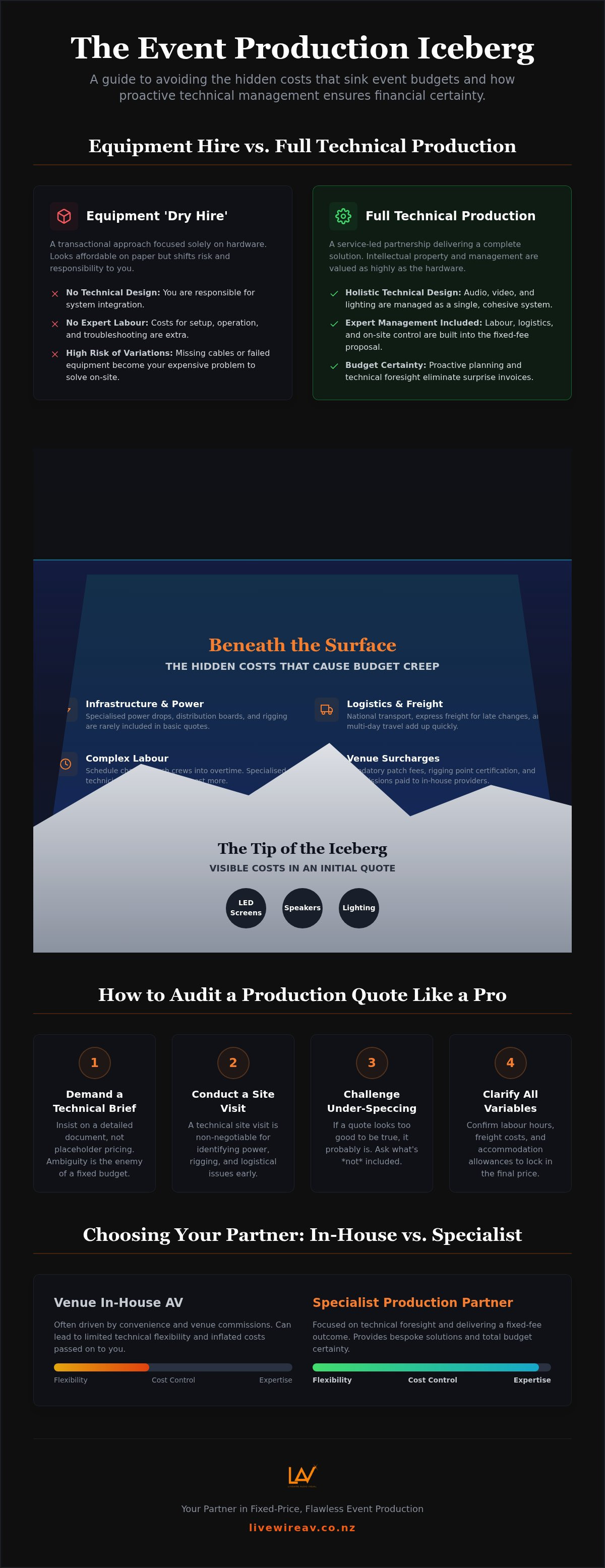
The first page of a quote often displays the "hero" gear, the high-definition screens and line array speakers that define the event's aesthetic. However, the true complexity of a production budget lies beneath the surface. Budgeting for high-stakes corporate environments requires a deep understanding of what we call the "technical iceberg." These are the costs that planners often miss because they aren't immediately obvious in a broad proposal. Avoiding hidden costs in event production requires a shift from looking at hardware to looking at the total infrastructure required to support it.
Infrastructure and Power Requirements
Modern high-output LED walls and intelligent lighting rigs demand significant, specialised power. Many venues charge additional fees for "power drops" or the use of dedicated distribution boards to handle these loads safely. If you assume house electricity is sufficient, you might face an unexpected surcharge on the day of the event. Rigging is another silent cost. Hanging equipment from the ceiling involves certified hardware, motors, and specialised labour. These elements must be identified during a technical site visit to ensure the venue can support the design without last-minute structural reinforcements.
Logistics, Freight, and National Touring
Moving audio line array systems and large-scale vision packages across New Zealand presents unique logistical challenges. Freight is a primary budget killer, especially when late changes to the floor plan force express transport for extra components. For events outside a provider's primary hub, you must also account for crew travel and accommodation. Meticulous planning allows for consolidated freight schedules, which is the most effective way to keep these costs fixed. A partner with national coverage can often mitigate these expenses by leveraging local resources while maintaining a consistent technical standard.
Labour and Technical Expertise
Hardware is only as reliable as the person operating it. A "zero-failure" event relies on the expertise of vision switchers, sound engineers, and lighting designers who understand how to handle complexity under pressure. Labour surcharges for long days or public holidays in 2026 are a reality that must be reflected in the initial quote to avoid surprises. Professional technicians are an insurance policy for your brand reputation. By carefully managing the bump-in and bump-out schedule, you can avoid costly overtime rates. Engaging a steady production hand ensures these variables are accounted for long before the first guest arrives, providing the peace of mind that comes from total technical control.
Evaluating Service Models: In-House vs. Specialist Partners
Choosing between a venue's in-house team and an external specialist is a pivotal decision. It's often framed as a choice of convenience, but the commercial reality is more complex. Many venues operate on a commission-based structure with their preferred AV suppliers. This means a portion of what you pay for technical services is redirected back to the venue as a facility fee. This hidden markup doesn't improve the quality of your audio or vision; it simply increases the baseline cost without adding technical value.
Choosing the right service model is a critical step in avoiding hidden costs in event production. While the house system might seem like the path of least resistance, it often lacks the bespoke flexibility required for high-stakes corporate environments. An external partner prioritises your specific outcomes, not the venue's bottom line. They bring a fresh perspective, modern equipment, and a level of dedication that is difficult to replicate with a generic, one-size-fits-all approach.
The Pros and Cons of In-House AV
In-house systems are generally built for broad, everyday use. They're sufficient for basic meetings, but they often struggle with the demands of complex hybrid events or large-scale projection. The primary risk here is "venue-blindness." Technicians who work in the same room every day can become complacent about the venue's technical limitations or infrastructure decay. You might also find that the gear is older, as venues don't always prioritise the same aggressive maintenance and upgrade cycles as a dedicated production house.
The Advantage of a Dedicated Production Partner
A dedicated partner provides technical consistency. This is vital for national tours across New Zealand where the environment changes, but the brand standards must remain identical. Your technical event management team understands your specific requirements, from the exact colour grade on your LED wall to the precise EQ of your CEO's microphone. They act as a single point of contact, managing the technical layer so you don't have to.
A specialist partner also acts as your advocate. When a venue attempts to charge an "external supplier fee" or an "AV patch fee," an experienced partner knows the industry standards and can negotiate these infrastructure gaps on your behalf. They provide the steady hand required to navigate venue contracts, ensuring you only pay for what you actually use. This level of oversight is the most effective way to maintain budget certainty while delivering a professional, zero-failure result.
How to Audit an Event Production Quote Like a Pro
Auditing a technical proposal is about more than checking the bottom line. It's about verifying that the scope of work matches the technical reality of the room. Under-specced quotes are a common tactic used to win tenders; they look attractive initially but inevitably lead to variations once the project commences. Avoiding hidden costs in event production requires a meticulous review of every line item to ensure nothing essential has been omitted. A professional proposal should be transparent, detailed, and realistic.
A comprehensive quote should reflect a deep understanding of the venue and the schedule. If a quote seems significantly lower than others, it's often because the provider has cut corners on the "invisible" elements of production. These omissions usually manifest as last-minute charges for extra cabling, distribution boards, or additional crew hours. Reliability, precision, and composure are the hallmarks of a well-planned budget.
The Essential Quote Checklist
When reviewing competing proposals, use this checklist to ensure you are comparing like-for-like services:
Labour and Logistics: Does the quote include all bump-in and bump-out labour, including specialised technicians and travel expenses?
Ancillary Equipment: Are all necessary cables, signal processors, and power distribution units itemised?
Project Management: Is there a dedicated Technical Director or Project Manager assigned to the event to handle on-site coordination?
Contingency: Does the quote include backup systems for critical components like vision switchers or primary microphones?
Comparing Equipment Quality and Specifications
Equipment specifications can vary wildly between providers. A "cheap" projector might save money on the quote but cost you more in setup time and poor visibility for your audience. For example, when hiring LED walls, the pixel pitch determines the clarity of your content at specific viewing distances. An under-specced screen will result in a pixelated image that reflects poorly on your brand. Audio systems should also be specced for the specific acoustics of the room, not just for raw loudness.
The complexity of hybrid event production often introduces several hidden costs. You must verify that the quote covers dedicated internet lines, hardware encoders, and redundant backup streams. Without these, the risk of technical failure increases significantly. Ensuring these technical bases are covered during the audit phase is the only way to achieve total peace of mind. To ensure your next event is backed by a fixed-fee guarantee, request a transparent technical proposal from a partner who values meticulous preparation.
Ensuring Budget Certainty with LivewireAV’s Technical Management
At LivewireAV, we believe that budget certainty is the natural byproduct of technical foresight. Our "Calm Professional" approach is built on the understanding that surprise expenses are usually the result of insufficient planning or vague initial requirements. By prioritising accuracy over speed during the quoting stage, we provide the fixed-fee reliability that protects your bottom line and your professional reputation. Avoiding hidden costs in event production is not a matter of luck; it is a discipline. We provide the steady hand required to manage technical complexity without the flashiness that often masks logistical gaps.
Our Approach to Transparent Proposals
We start every project with a deep discovery phase. We don't just look at a floor plan; we conduct technical site visits to assess power distribution, rigging points, and signal paths. This venue-aware mindset allows us to identify potential roadblocks before they manifest as invoices on the day of the event. This process eliminates the "extra cable" or "late-night labour" surprises that typically erode an event's margin. Our commitment to modern hardware means we only deploy equipment maintained for high-pressure environments. These systems are tested, prepared, and ready. By addressing variables like cable lengths, signal interference, and power distribution during the design phase, we ensure our proposals are comprehensive, honest, and final.
Seamless Execution from Planning to Bump-Out
Execution is where planning meets reality. Every major project is overseen by a dedicated Technical Director whose sole focus is zero-failure delivery. This individual provides the precision, composure, and control necessary for high-stakes corporate environments. They act as your technical advocate, managing the invisible details so you can focus on your attendees. As a national partner, we handle the intricacies of logistics across New Zealand with methodical precision. Whether we are freighting audio line array systems or managing the setup of large-scale LED walls, we coordinate every movement to maximise efficiency and eliminate the risk of last-minute freight charges. This seamless approach ensures your event stays on track financially and professionally. From the first cable laid to the final bump-out, we remain the steady hand behind the scenes. Contact LivewireAV for a transparent, bespoke production proposal.
Securing Your Next Event's Financial Success
Budget certainty in high-stakes environments isn't a matter of luck. It's the result of meticulous preparation and the quiet confidence that comes from total technical control. Precision. Composure. Control. These are the standards that ensure your vision is realised without compromise. By shifting your focus from simple equipment hire to full technical production, you move beyond the surface-level quotes that often hide infrastructure gaps. We've explored how technical site visits, detailed quote audits, and the right service model are the primary tools for avoiding hidden costs in event production.
With over 10 years of technical excellence and nationwide New Zealand service, LivewireAV provides the steady hand required to handle complexity. Our expert technicians ensure your brand reputation remains protected through zero-failure execution and transparent planning. You deserve the peace of mind that comes from a partner who values precision as much as you do. Request a meticulous, fixed-fee production proposal from LivewireAV and ensure your 2026 calendar remains seamless, professional, and financially on track.
Frequently Asked Questions
What is the biggest mistake when planning an event production budget?
The biggest mistake is failing to account for the service-led nature of the industry. Many planners treat production as a hardware rental rather than a technical discipline. This leads to under-budgeting for the expert labour required to manage complex systems like LED walls or audio line arrays. Without a detailed technical brief, you're essentially guessing the final cost. Avoiding hidden costs in event production requires you to prioritise technical management over simple equipment hire.
How much should I budget for event production contingency?
You should typically set aside a contingency buffer of 10 to 20 per cent of your total production budget. For new events with many unknown variables, a 20 per cent margin is recommended to cover unforeseen venue requirements. For repeat events where the technical landscape is well-understood, a 10 to 15 per cent buffer is often sufficient. This fund protects you from rising labour costs or last-minute freight requirements that weren't in the initial proposal.
Why do venues charge an "external supplier fee" for AV?
Venues charge an external supplier fee to recover the commission they would have earned from their preferred in-house provider. These fees, sometimes called "patch fees" or "infrastructure levies," cover the use of house points, power, or rigging. It's a commercial reality of the venue industry. A specialist production partner can often negotiate these surcharges on your behalf by ensuring the venue's technical requirements are met without unnecessary double-handling or infrastructure overlap.
What is included in a "full technical production" service?
Full technical production is an end-to-end service that integrates design, hardware, and expert operation. Unlike dry hire, it includes a dedicated Technical Director to oversee the entire event lifecycle. You'll receive a bespoke solution featuring intelligent lighting, vision switching, and high-performance audio systems. The service covers everything from initial technical site visits and 3D floor plans to the final pack-down, ensuring a seamless experience that lets your content take centre stage.
Can I save money by providing my own technical equipment?
Providing your own equipment rarely results in genuine savings. Technical production relies on an ecosystem of hardware that must be perfectly compatible to ensure a zero-failure event. When you introduce outside gear, technicians must spend extra time on troubleshooting and signal testing, which often increases labour costs. Furthermore, we can't guarantee the reliability of equipment that hasn't been maintained to our specific standards, which increases the risk of technical failure under pressure.
What happens if my event runs over the scheduled time?
If an event runs over the scheduled time, you'll likely incur additional labour surcharges and venue overtime fees. Most technical crew are booked on specific day or half-day rates, and exceeding these windows triggers overtime payments. It's important to build a realistic schedule that includes enough time for testing and rehearsals. Clear communication with your technical team about potential delays helps manage these expectations and allows for more accurate pricing in your initial budget.
How do technical site visits help avoid hidden costs?
Technical site visits are the most effective way to identify infrastructure gaps before they become expensive problems. During a visit, our team assesses power distribution, ceiling heights for rigging, and logistical access for heavy equipment. We check for signal interference and verify that the room's acoustics suit your chosen audio line array. This proactive approach ensures that every venue-specific requirement is itemised in your quote, preventing the "on-the-day" surprises that cause budget creep.
Are labour costs higher for events on weekends or public holidays in NZ?
Yes, labour costs in New Zealand are higher on weekends and public holidays due to statutory requirements. Under current NZ labour laws, staff working on public holidays must be paid time-and-a-half and are often entitled to an alternative day off. These costs are reflected in our technical proposals to ensure full compliance and budget transparency. We recommend checking the 2026 public holiday calendar early in your planning phase to account for these predictable surcharges.


Comments