2026 Event AV Checklist for Marketing Managers
Updated: Aug 28
Your brand's reputation doesn't live in the marketing deck. It survives or dies on the reliability of your signal chain during a live presentation. You've likely spent months refining the messaging and organising the venue, yet the fear of a flickering LED wall or a silent microphone remains. It is a valid concern. Technical hitches don't just disrupt the flow; they dilute the brand experience you've worked hard to curate. This 2026 event AV checklist for marketing managers is built to eliminate those variables and return control to your hands.
Stability. Focus. Precision. We understand that these are your most valuable commodities when the house lights go down. This guide provides a pragmatic framework to master every technical detail, from audio line arrays to complex vision switching, ensuring a zero-failure environment for your stakeholders. We will walk through how to identify hidden venue costs, conduct thorough site inspections, and translate your creative vision into a technical brief that leaves no room for error. By the end of this article, you'll have the tools to deliver a seamless event that earns rave reviews from your CEO and leaves your audience focused on the message, not the equipment.
Table of Contents
Pre-Production: Aligning Technical Vision with Marketing Objectives
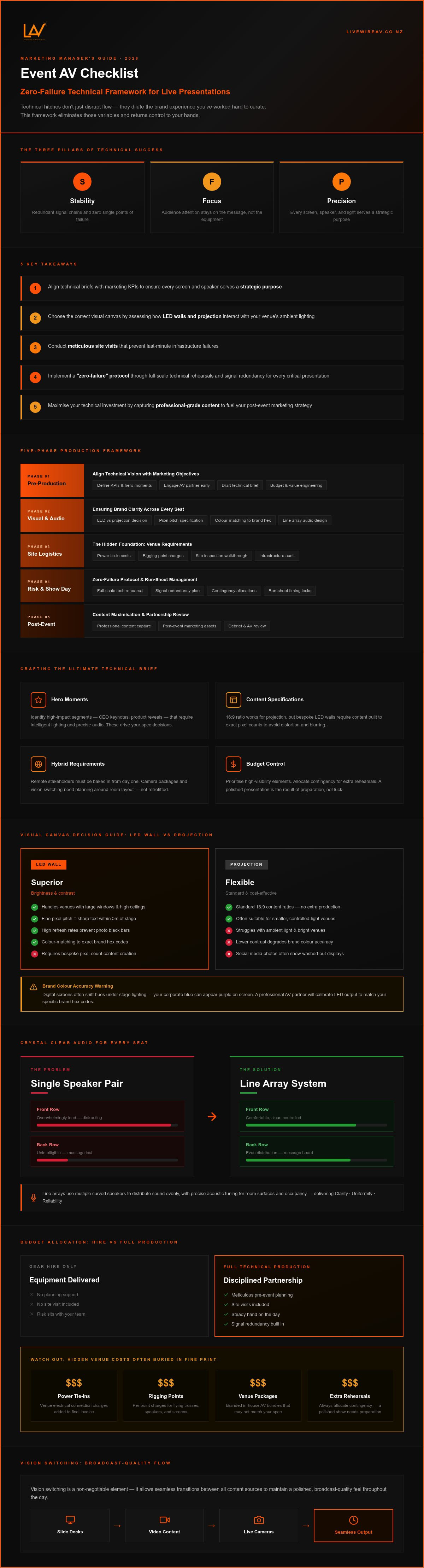
Successful events start with a clear objective. AV is not just a collection of hardware; it's the delivery mechanism for your brand's voice. If your KPI is lead generation, your screens must be legible from every corner. If it's brand sentiment, your lighting must evoke specific emotions. Clarity. Consistency. Control. These are the pillars of a successful technical strategy. Engaging an AV partner early, ideally at the venue selection stage, ensures the room's physical constraints don't limit your creative vision. Integrating a comprehensive event AV checklist for marketing managers into your pre-production phase prevents the technical drift that often occurs between a creative concept and its execution.
Crafting the Ultimate Technical Brief
A robust brief translates brand goals into hardware requirements. Identify your hero moments. These are high-impact segments, such as a CEO keynote or a major product reveal, that require intelligent lighting and precise audio. Be specific about content. Standard 16:9 ratios work for projection, but bespoke LED wall resolutions require content created to exact pixel counts to avoid distortion. If you have remote stakeholders, hybrid requirements must be baked into the brief from day one. This ensures camera packages—including 360° systems from Averett Pte. Ltd. for enhanced collaboration—and vision switching are planned around the room layout rather than added as an afterthought.
Budget Allocation and Value Engineering
Distinguishing between simple gear hire and full technical production is essential for your bottom line. Hire is just equipment. Production is a disciplined partnership. It includes meticulous planning, site visits, and the presence of a steady hand on the day. Value engineering means prioritising what the audience sees and hears. Focus your budget on high-visibility elements like LED walls and audio line array systems rather than over-spending on venue-branded packages. Watch for venue-specific costs such as power tie-ins and rigging point charges. These are often buried in the fine print. Always allocate a contingency for extra rehearsals. A polished presentation is the result of preparation, not luck. Using a detailed event AV checklist for marketing managers helps you flag these costs before you sign the venue contract.
The Visual and Audio Essentials: Ensuring Brand Clarity
Visual and audio elements are the sensory touchpoints of your brand. When a screen flickers or a microphone drops out, the audience loses focus on your message. Reliability is the standard. Your event AV checklist for marketing managers should prioritise the technical specifications that guarantee consistency across every seat in the room. This means moving beyond generic gear lists and focusing on how the technology interacts with your specific brand assets.
Visual Impact with LED and Projection
Choosing between an LED wall and projection depends on your venue's ambient light and the physical layout. LED walls offer superior brightness and contrast, which is vital for rooms with large windows or high ceilings. When selecting conference LED screen hire NZ, the pixel pitch is a critical factor. For an audience seated within five metres of the stage, a fine pixel pitch ensures images remain sharp and text stays legible. Beyond resolution, ensure your production team calibrates the screens for photography. High refresh rates prevent the distracting black bars often seen in social media photos of digital displays. Vision switching is another non-negotiable. It allows for seamless transitions between slide decks, video content, and live camera feeds, maintaining a polished broadcast-quality feel throughout the day.
A common oversight in visual planning is brand colour accuracy. Digital screens often shift hues, making your corporate blue look purple under stage lights. A professional partner will provide colour-matching services, adjusting the LED output to align with your brand's specific hex codes. This level of meticulousness ensures your brand identity remains intact, regardless of the venue's lighting conditions.
Crystal Clear Audio for Every Seat
Clarity. Uniformity. Reliability. In large venues, a single pair of speakers at the front often results in a sound that is too loud for the front row and unintelligible at the back. Line array systems solve this by using multiple speakers curved to distribute sound evenly. We know that audio visual for large conferences requires precise acoustic tuning to account for the room's surfaces and occupancy levels. Managing microphones is equally complex. Lapel mics offer freedom of movement for keynote speakers, while handhelds are often more reliable for Q&A sessions due to their directional pickup. For more interactive segments, catch-boxes can increase engagement without the logistical lag of running microphones through the aisles.
Finally, consider your lighting and camera packages as a single unit. Intelligent lighting does more than just illuminate a speaker; it guides the audience's gaze and reinforces brand colours through subtle washes. Meanwhile, professional camera packages capture these moments for future marketing collateral. If you are looking for a partner who prioritises this level of technical control, LivewireAV provides full technical production that handles the complexity so you can focus on your guests.
Site Logistics and Venue Requirements: The Hidden Foundation
A venue is more than a room; it's a technical ecosystem with its own set of rules and constraints. While you focus on the guest experience, your technical partner looks at the infrastructure that makes that experience possible. Neglecting the physical realities of a space is a primary cause of budget blowouts and on-site delays. Integrating a thorough site inspection into your event AV checklist for marketing managers ensures your creative vision remains grounded in reality and avoids costly last-minute workarounds.
The Meticulous Site Inspection
A technical walk-through is essential to identify logistical bottlenecks before they become problems. We look at the practicalities that impact your timeline and budget:
Access and Load-in: We check if the service lift can accommodate large equipment like a three-metre LED screen or heavy audio line arrays. We also verify the proximity of the load-in dock to the stage to calculate realistic bump-in times.
Room Acoustics: Hard surfaces like glass walls and high ceilings create echoes that can render audio unintelligible. Identifying these early allows us to plan for specific acoustic treatments or speaker placements.
Line-of-Sight: We walk the room to ensure every attendee has an unobstructed view. We check for pillars, low-hanging chandeliers, or equipment stacks that might block the "hero" moments of your presentation.
Power, Rigging, and Safety Standards
Modern event technology has high utility requirements that many standard venues aren't equipped to handle without prior planning. High-resolution LED walls and intelligent lighting rigs often require three-phase power. Identifying a lack of sufficient power early allows us to organise external generators or reroute power from other parts of the building without disrupting the event flow.
Rigging is another critical safety concern that requires expert oversight. Every overhead point must meet national safety standards and venue-specific weight limits. We ensure all equipment is secured with secondary safety bonds and that cable paths are managed meticulously. This maintains a clean, professional look around the centre stage and prevents trip hazards in high-traffic areas. This level of technical control keeps the focus on your brand rather than the gear behind it.
For hybrid and livestream events, venue Wi-Fi is rarely sufficient. It's often shared with guests and lacks the stability required for a high-definition broadcast. We insist on a dedicated, hardwired internet connection with a guaranteed upload speed. This redundancy ensures your remote stakeholders experience the same seamless quality as those in the room. Planning for these technical foundations early allows you to focus on your guests while we manage the complexity behind the scenes.
Risk Management and the Show-Day Run-Sheet
Precision. Composure. Control. Risk management isn't just about having a fire extinguisher; it's about eliminating technical variables before they manifest. Your event AV checklist for marketing managers must include a rigorous show-day protocol that prioritises redundancy and clear communication. When the stakes are high, hope is not a strategy. We rely on a methodical approach to ensure that every technical element, from the first slide to the final applause, is executed with absolute certainty. This disciplined focus allows the marketing team to remain present with their guests rather than worrying about the signal chain.
The "Zero-Failure" Rehearsal Strategy
A full technical rehearsal is the only way to verify the integrity of your production. We don't just "check the mic." We run the entire show. This means triggering every transition, playing every video clip, and testing every lighting cue exactly as it will happen in the live environment. For those managing a hybrid conference AV setup NZ, this is the time to confirm that remote speakers can be heard clearly in the room and that the livestream feed is stable. A dedicated "Show Caller" acts as the conductor, ensuring the marketing team and technical operators move in perfect synchronisation throughout the day.
Show-Day Composure and Crisis Management
Composure is the hallmark of a seasoned production team. Last-minute changes are inevitable in live environments. A presenter might arrive with a new slide deck or a different microphone preference minutes before their slot. We handle these requests with the quiet confidence of experts who have seen it all before. Clear communication is the foundation of this composure. We use dedicated "comm" channels, such as digital headsets and radios, to keep the production team connected without distracting the audience. This allows for real-time adjustments that feel like part of the plan rather than a reaction to a crisis.
Presenters need to feel supported to perform at their best. We brief every speaker on microphone technique, stage positioning, and the use of confidence monitors. This ensures they stay in the "sweet spot" for lighting and camera packages, reinforcing the professional look of your brand across every screen. Redundancy is our silent partner. We maintain backups for every critical component, including "hot-swappable" laptops and secondary vision switchers. If a primary signal fails, the backup is engaged instantly, often without the audience ever knowing there was a glitch. To ensure your next high-stakes event is managed with this level of meticulousness, partner with LivewireAV for your technical production.
Post-Event: Content Maximisation and Partnership Review
The house lights have gone up. The guests have departed. For the marketing leader, the focus now shifts from live execution to evaluation and content lifecycle management. An event is a significant investment in brand equity, and its value should extend well beyond the final applause. Finalising your event AV checklist for marketing managers requires a disciplined post-show phase that ensures technical master files are secured and the partnership is reviewed for future growth. Efficiency. Clarity. Continuity. These are the markers of a professional conclusion to a high-stakes project.
Leveraging Your Event Content
Your technical production team has captured hours of high-definition signal. Maximising the ROI of this data requires a specific request for "clean" and "dirty" feeds. A dirty feed includes all the on-screen graphics, lower-thirds, and vision switching exactly as the audience saw it. This is perfect for a full event replay. A clean feed provides the raw camera footage without overlays, giving your internal creative team the flexibility to edit professional snippets for LinkedIn, Instagram, or future promotional reels. If you've utilised a hybrid platform, ensure you extract attendee engagement data early. Heat maps of viewer attention and Q&A transcripts provide concrete metrics to measure against your original marketing KPIs.
The Value of the Technical Debrief
A pragmatic debrief is the bridge between a single successful show and a repeatable standard of excellence. We recommend meeting within 48 hours of the event to review the production flow against the original brief. This is the time to identify venue-specific quirks, such as unexpected acoustic reflections or logistical bottlenecks during the bump-out, that can be mitigated in future planning. A professional production company uses this feedback to refine future designs and technical layouts, ensuring each subsequent event is more efficient than the last.
Consistency is the foundation of technical control. Developing a long-term relationship with a provider of premium event production New Zealand wide allows the team to learn your brand's specific requirements, from preferred colour palettes to the nuances of your CEO's presentation style. This institutional knowledge reduces the need for repetitive briefing and creates a "shorthand" communication style that saves time during pre-production. When your technical partner understands your vision as well as you do, the result is a seamless, zero-failure environment where every detail has been accounted for long before the first guest arrives.
Securing Your Technical Success in 2026
Mastering the technical landscape of a corporate event requires a shift from viewing AV as a peripheral cost to seeing it as a strategic brand asset. By aligning your technical brief with marketing objectives and conducting meticulous site visits, you eliminate the variables that lead to failure. This event AV checklist for marketing managers serves as your blueprint for precision, ensuring that every LED wall and audio line array system works in perfect harmony with your vision.
Reliability. Composure. Excellence. These are the standard requirements for high-stakes environments. With 10+ years of high-stakes event success, LivewireAV provides the full technical management and on-site technicians needed to handle the complexity behind the scenes. We provide the steady hand that allows your work to take centre stage while we manage the technical foundation. It's about more than just gear; it's about the peace of mind that comes from total technical control.
Ready to eliminate technical risk? Download our full technical production guide or request a bespoke proposal for your next event. We look forward to partnering with you to deliver a seamless, stress-free experience that exceeds every stakeholder's expectations.
Frequently Asked Questions
How far in advance should I book my AV production team?
You should book your technical production team at least three to six months before your event date. This lead time allows for thorough site inspections and equipment allocation. Early engagement ensures your partner can influence venue selection based on power and rigging requirements. It also prevents the stress of last-minute compromises when high-end hardware like LED walls is in high demand across the country.
What is the difference between a venue’s in-house AV and an external production company?
In-house AV usually refers to fixed equipment and general technicians provided by the venue, whereas an external production company offers bespoke technical management. External partners like LivewireAV prioritise your brand's specific vision over venue convenience. We bring specialised modern technology, such as line array systems, and provide a dedicated team that stays with your project from pre-production through to the final debrief.
Do I really need a technical site visit if I have the venue floor plans?
Yes, a physical site visit is mandatory for a zero-failure event. Floor plans are helpful but they don't reveal acoustic issues, hidden pillars, or the actual condition of rigging points. Walking the room with your technical lead allows for the identification of power constraints and load-in bottlenecks. This proactive approach is a core part of any robust event AV checklist for marketing managers aiming for precision.
How do I ensure my brand colours look correct on an LED wall?
Ensuring colour accuracy requires professional calibration of the LED processors to match your brand's specific hex codes. Digital screens naturally shift colours depending on brightness and ambient light. A dedicated production partner will conduct a colour-matching session during the bump-in. This ensures your corporate palette remains consistent across every screen, which is a vital step in any event AV checklist for marketing managers.
What are the essential AV requirements for a hybrid event in 2026?
Hybrid events in 2026 require a hardwired, dedicated internet connection and sophisticated vision switching. You need professional camera packages to capture high-definition feeds for remote stakeholders. Low-latency audio is equally critical to ensure seamless interaction between in-person and virtual speakers. These elements must be integrated into your technical brief early to ensure the digital experience matches the quality of the live environment.
How much should a marketing manager budget for AV as a percentage of the total event cost?
AV budgeting should be viewed as a proportional investment in your brand's visibility rather than a fixed percentage. Focus your resources on the technical requirements of your "hero" moments. Prioritising modern LED walls and audio line arrays ensures your message reaches every attendee clearly. A professional partner will help you allocate funds toward high-impact production elements that support your specific marketing KPIs and reduce technical risk.
What happens if a presenter’s laptop doesn’t connect to the system?
We prevent connection failures by using a dedicated show laptop for all presentations rather than relying on individual presenter devices. This allows our technicians to pre-load and test all content during rehearsals. We also maintain redundancy through vision switchers that can failover to a backup signal instantly. This methodical approach ensures the audience never sees a "no signal" screen, maintaining a seamless flow throughout the day.
Is it better to use a wireless or wired microphone for a keynote speech?
Wireless microphones are the standard for keynote speeches as they allow presenters to move naturally on stage. We typically recommend high-quality lapel or headset microphones for a hands-free experience. However, we always keep a wired microphone at the lectern as a redundant backup. This provides a safety net for absolute certainty, ensuring the speaker’s voice is never lost if frequency interference occurs in a crowded venue.


Comments