Power distribution planning for large events: choosing equipment
A distro box gives multiple event systems organised connection points from a shared supply, rather than requiring each contractor to run separate infrastructure back to the source. Power distribution planning for large events means matching that distribution to equipment loads, venue supply and site layout. A suitable arrangement puts power where it is needed and keeps cable routes practical.
It is easy to focus on the number of outlets, but socket count alone does not show how much capacity is available. The equipment’s actual power requirements, operating conditions and supply configuration all matter.
This guide explains how to estimate event demand, choose distribution equipment and use flexible power points to accommodate changes in equipment locations. It also covers site plans, load balancing and cable routes, helping the technical setup support the event without unnecessary complexity.
Table of Contents
How do you choose the right electrical distribution equipment for your event?
Choose equipment to suit the supply, connected loads, site layout and outdoor conditions. Use a site plan to map cable runs and position distribution boxes near the systems they serve.
Temporary Infrastructure Installation and Protection
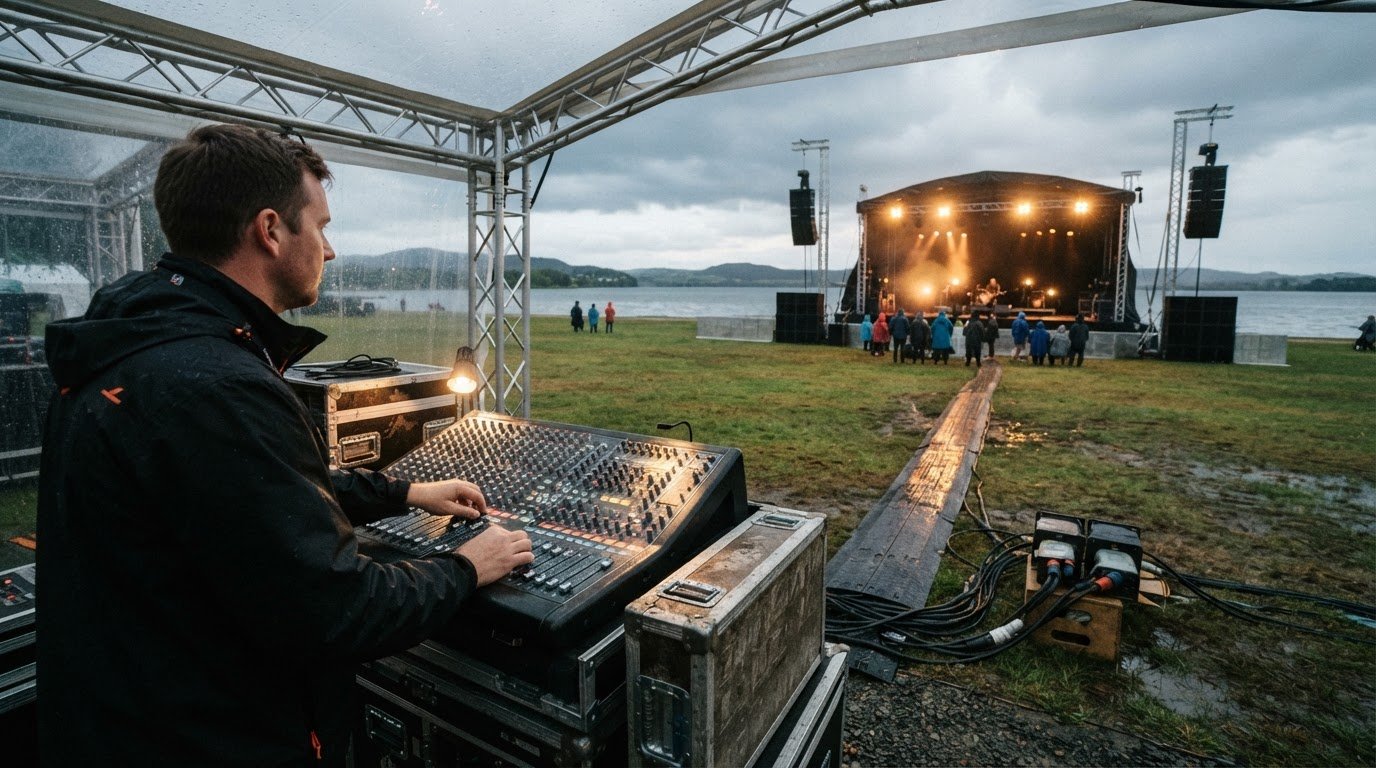
Temporary electrical infrastructure includes the distribution boards, cables and connection points that deliver power around an event site. For a New Zealand event, a qualified electrical installer should determine the connections, cable sizing, protective devices and grounding or bonding arrangements. The installation must be planned around the actual supply and circuits, not simply the number of appliances. A bespoke box can match the connectors and protection required by equipment such as lighting or audio systems. Keep boards accessible to technicians, stable and protected from weather and public traffic.
Circuit Protection Devices
Circuit protection devices help disconnect power when a fault or leakage current is detected. Breakers protect circuits against overloads and short circuits; residual current devices (RCDs) respond to current leakage. An RCD can cut power within milliseconds, and RCDs are available at sensitivities of 30, 100 and 300 milliamps. These ratings are not interchangeable instructions for every event. The qualified installer selects protective devices to suit the circuits and installation. Clearly identified circuits help technicians monitor the system and trace a fault without confusing one supply point with another.
Boards, Cabling and Cable Routes
Distribution boards divide the incoming supply into circuits for event areas, while cables carry power to each point of use. Choose a board for its input, circuit arrangement and suitable outlets, not socket count alone. Common event connector ratings include 16, 32, 63 and 125 amps; the required combination depends on the connected loads and supply. Confirm routes with the venue and production team. Route cables around pedestrian movement, vehicle access, emergency exits and areas exposed to rain. Where crossings are unavoidable, use cable ramps suited to the traffic: vehicle routes need more robust protection than pedestrian routes.
To reduce fuel use, emissions and generator noise, plan around lower-consumption equipment and coordinate operating hours, fuel arrangements and access. Position generators with exhaust direction and guest distance in mind. Noise-sensitive events may also need acoustic isolation.
How do I calculate total power draw for my event?
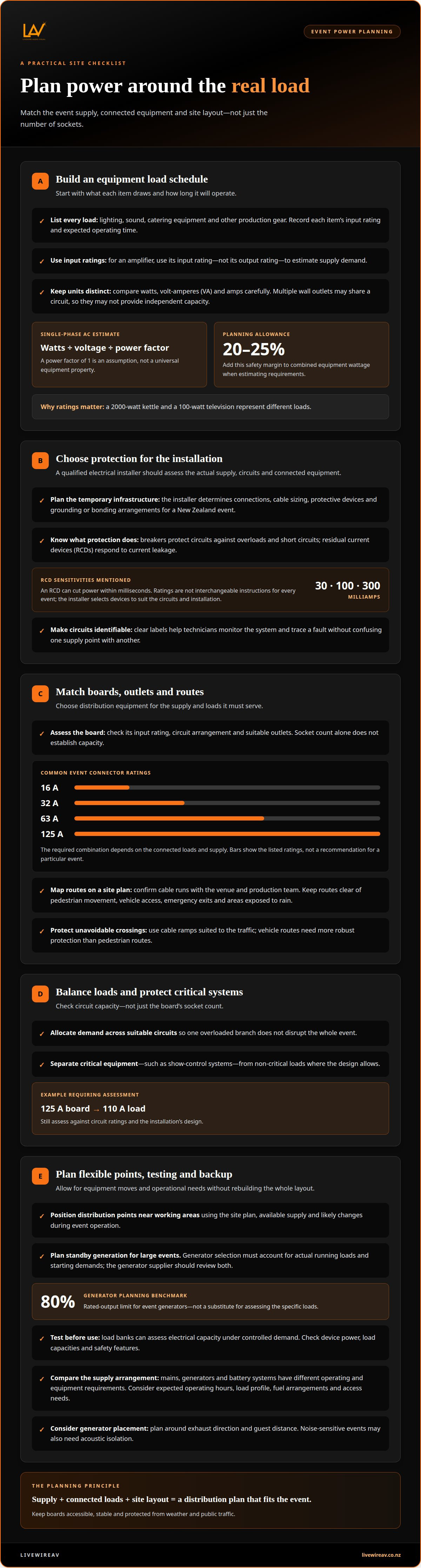
Start with an equipment schedule. Record each item’s power rating and operating time, then total the expected load. Compare the result with the venue supply and the input rating of each distribution unit.
Assessing Venue Capacity and Total Load
Venue capacity is the usable electrical supply available to the event, assessed against the equipment’s combined demand. Multiple wall outlets may share a circuit, so they do not necessarily provide independent capacity. List lighting, sound, catering equipment and other production loads using each item’s input rating and expected operating time. Keep watts, volt-amperes (VA) and amps distinct when comparing equipment and supply ratings.
For a single-phase AC estimate, divide watts by voltage and power factor. Treat a power factor of 1 as an assumption, not a universal equipment property. A kettle rated at 2000 watts illustrates why equipment schedules need actual ratings: a television rated at 100 watts presents a different load. Add a 20-25% safety margin to combined equipment wattage when estimating requirements.
Load Distribution and Critical Circuits
Load distribution allocates demand across suitable circuits so one overloaded branch doesn’t disrupt the whole event. Separate critical equipment, such as show-control systems, from non-critical loads where the design allows. A distribution board’s socket count alone doesn’t establish its capacity; compare its input rating with the connected load. For example, a 125 A board serving a 110 A load still needs assessment against circuit ratings and the installation’s design.
Large events should plan standby generation rather than rely on a single source. Generator selection must account for actual running loads and starting demands, and the generator supplier should review both before proposing capacity. The 80% rated-output limit is a planning benchmark for event generators, not a substitute for assessing the specific loads.
Load banks can test an installation’s electrical capacity under controlled demand. This helps assess whether equipment and circuits perform as intended before the event, including at festivals where production loads may vary. Test the distribution setup before use, including device power, load capacities and safety features.
Power costs depend on the supply arrangement. Mains power uses the venue’s available connection, while generators and battery systems bring different operating and equipment requirements. Compare expected operating hours, load profile, fuel arrangements and access needs, as these factors shape the overall cost.
Flexible power distribution points for changing equipment locations
Flexible distribution points put temporary power near working areas, allowing equipment to move without rebuilding the entire layout. Position them according to the site plan, available supply and likely changes during event operation.
Equipment Input Specifications
Equipment input specifications describe the electrical supply each device needs, including its input rating and connector. Collect the manufacturer’s details for every planned item. Use an amplifier’s input rating, not its output rating, because output does not show the power drawn from the supply.
Record specifications alongside each item’s location and use. If a stage monitor moves during production, for example, its input details help determine whether a nearby distribution point can serve it. Include catering equipment and temporary lighting in the same schedule, so a change in one area does not leave another out of the demand assessment.
Selecting Distribution Equipment
Suitable distribution equipment matches the available supply, connected equipment and site layout. Select points that serve planned positions and likely changes, while keeping connectors and circuit arrangements compatible with the equipment. A board’s socket count alone does not indicate its capacity.
When using a site across different venues, treat each layout as a fresh design. Venue supply, cable routes and equipment positions can vary, so equipment that worked at one event may need adjustment for another. Map production areas, catering locations and access routes before deciding where to install distribution equipment.
Flexible points can reduce the need to reroute long cable runs when a camera position, stage element or catering station shifts. Place them near practical work zones and mark their locations on the site plan. Keep routes clear of pedestrian flow, vehicle access and emergency exits. If the event layout changes, update the plan and check how revised positions affect connected demand and cable protection.
For concerts and large outdoor events, plan standby generators as backup rather than relying on a single power source. Separate critical loads where appropriate, and document which supply supports each system so teams can manage a fault or change without disrupting every event area.
Event power distribution basics
Event power distribution carries electricity from a venue supply or generator to separate areas, including stages, catering, lighting and backstage zones. The distribution plan matches each area’s demand with suitable circuits and capacity. An outdoor event does not automatically need a generator: the available local supply and equipment requirements determine whether one is needed.
Think of the system as a network, not a single connection. A qualified technician plans the available supply configuration, circuit layout and phase balancing. For example, a stage 120 metres from a generator presents a different cable-routing challenge from equipment beside the source. The site plan should show distances, access routes and where distribution points serve each zone.
Good planning also accounts for a failure in one part of the network. Where appropriate, separate critical and non-critical loads so a fault on one circuit does not affect the entire event. Large-scale events should have standby generators rather than depend on a single power source. Generator locations must account for level ground, weather protection, restricted access, exhaust direction, noise and refuelling.
Before operation, technicians should test the distribution setup and label circuits clearly. During the event, monitoring energy use and generation in real time can help teams identify changing demand and adjust operations. A five-second interruption during a keynote, headline act or televised presentation can be significant, so prioritise continuity for those systems. Keep technical access routes clear and document who can respond to faults.
For a coordinated event plan, map your event’s technical requirements across the site layout, supply and critical systems before bump-in.
LivewireAV: Full Technical Production
LivewireAV brings audio, video and lighting together through Full Technical Production for events where multiple systems need to work as one. This approach suits events with a stage programme, audience-facing screens and live sound, or production demands that change across the venue.
For conferences with remote presenters, Hybrid & Livestream Events can support the online component. LED Walls & Projection suit visual content that needs to be seen across the room, while Audio Line Array Systems support sound coverage for larger audiences. Matching these elements to the programme and site layout helps create a coordinated technical plan.
Share your event requirements with LivewireAV to discuss the production approach.
Carry the power plan through to show day
A useful power plan should evolve with the event programme. Treat changes to staging, content or equipment positions as production decisions with power implications, and keep the current site plan aligned with the technical schedule. This gives each team a shared reference for setup, operation and handover.
For power distribution planning for large events, bring the event brief, venue information and production requirements into one conversation. This helps turn technical decisions into a coordinated plan that supports the experience you are building, rather than treating power arrangements as a separate task.
LivewireAV can discuss how Full Technical Production fits your event’s requirements, including its programme and technical scope. Contact LivewireAV to plan event power and take the next step towards a well-coordinated event.
Frequently Asked Questions
What is a power distro box?
A power distro box is a distribution point that takes an incoming electrical supply and provides organised connections for multiple event systems. It can serve nearby equipment such as a stage monitor, lighting control and a screen, rather than requiring each system to have a separate route to the main supply. Its input and circuit capacity must suit the connected equipment, not just the number of available sockets.
Do I need a generator for my outdoor event?
An outdoor event does not automatically need a generator. The deciding factor is whether the venue’s available supply can support the event’s loads and locations. A site with usable mains power may not need a generator, while a remote stage or insufficient venue capacity may require another arrangement. Include supply access, cable distances, operating hours and critical equipment in the decision.
How much power does an LED wall need?
An LED wall’s power demand depends on its equipment specifications, not just its area or pixel pitch. Gather the input ratings for the wall’s components and include them in the event load schedule. Do not assume that two walls of similar size have identical supply needs. The equipment data and operating configuration determine the load to plan for.
What are the technical and safety requirements you need to understand?
Understand the event’s available supply, equipment input ratings, circuit allocation and cable routes. A qualified installer determines the connections, cable sizing, protective devices and grounding or bonding for the installation. Organisers also need a clear site plan, identified circuits and suitable technician access. Keep distribution equipment away from public traffic, protect cables at crossings, and include test records and safety documentation in event planning.
What is the difference between single-phase and three-phase power?
Single-phase and three-phase describe different supply configurations, which affect how electrical load is distributed across circuits. Three-phase supplies can serve equipment and distribution arrangements designed for that configuration; single-phase circuits serve compatible loads. For instance, a 63-amp three-phase supply may deliver up to 189 amps across its phases, but that isn’t a single-phase current figure. A qualified technician assesses phase balancing and compatibility.
What are the steps for planning power distribution at a large event?
For power distribution planning for large events, start by collecting the venue supply details, equipment input ratings and operating schedule. Map equipment zones and cable routes on the site plan, then assess capacity, circuit allocation and backup needs. Have a qualified installer design the connections and protection. Before the event opens, test the setup, label circuits and confirm who will monitor the supply and respond to faults.
Comments