Outdoor Event Technical Production: The 2026 Guide to Flawless Execution
The success of your outdoor event isn't determined when the first guest arrives; it's decided weeks earlier during the technical site visit. For many organisers, the transition from a controlled indoor ballroom to an open-air environment feels like a gamble against the elements. You've likely felt that familiar knot of anxiety regarding power draws for large-scale LED screens or the fear of audio simply vanishing into the breeze. It's a high-stakes environment where precision, composure, and preparation are the only real safeguards.
This 2026 guide to outdoor event technical production provides the expert insights you need to manage these complexities with total confidence. Steady. Methodical. Direct. We'll show you how to move from reactive troubleshooting to proactive, meticulous management. You'll gain a clear understanding of how to integrate high-resolution visual displays and audio line arrays into a seamless, weather-resilient package. We'll examine the critical role of site-specific planning, the logistics of robust power distribution, and the standards required to select a production partner who prioritises reliability over flashiness. Every detail is accounted for long before the first guest arrives.
Table of Contents
Defining Professional Outdoor Event Technical Production
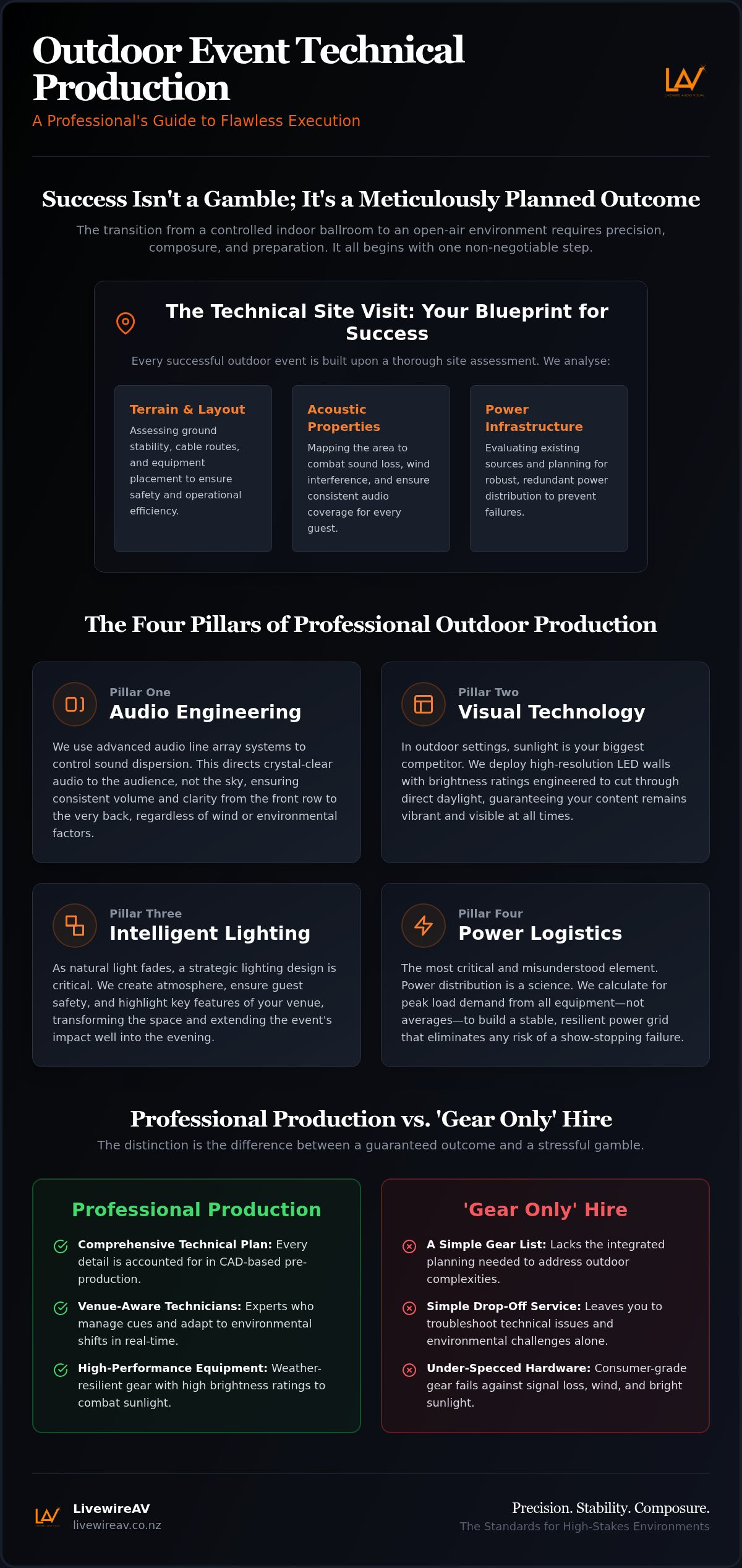
Professional outdoor event technical production is far more than a simple collection of hardware. It is a disciplined management process that transforms a vacant space into a high-functioning environment. While basic equipment hire involves dropping off gear, full-scale production ensures every component works in harmony. Precision. Stability. Composure. These are the standards required when there is no ceiling to hide behind and no walls to contain sound. In high-stakes environments, the distinction between a "gear list" and a "technical plan" is the difference between a stressful gamble and a guaranteed outcome.
A professional rig integrates four primary pillars to ensure success:
Audio engineering: Using line array systems to achieve uniform sound pressure across vast areas.
Visual technology: Deploying high-resolution LED walls that remain visible in direct sunlight.
Intelligent lighting design: Creating atmosphere and safety as natural light fades.
Power logistics: Calculating and distributing high-draw loads across expansive sites.
The Technical Director acts as the steady hand behind the scenes. They synchronise multiple departments under immense pressure, ensuring camera packages, vision switching, and audio cues align perfectly. It is a role defined by total technical control, where the goal is to remain invisible while the client’s work takes centre stage.
The Scope of Modern Outdoor Production
Modern production brings together audio, video, and lighting into one cohesive, venue-aware plan. It involves managing the invisible infrastructure that makes an event possible. Cabling, rigging, and signal distribution must be planned with meticulousness to survive both foot traffic and the elements. For corporate and sporting organisers, this level of preparation is essential for brand perception. A seamless execution suggests a brand that is reliable, disciplined, and modern. It moves the focus away from technical anxiety and onto the message being delivered.
Why 'Gear Only' Solutions Fail Outdoors
Dry hire or "gear only" approaches often fail because they lack the technical rigour required for open-air environments. Distances are greater outdoors, and signal loss is a constant threat. Under-speccing power leads to catastrophic failure when LED walls draw peak load during bright periods. Consumer-grade equipment simply cannot compete with 10,000 nits of sunlight, and basic microphones won't filter out a sudden 20-knot gust of wind. Expert operators are a non-negotiable requirement. They manage live cues and environmental shifts in real-time, ensuring the outdoor event technical production remains flawless regardless of external variables.
Managing the Technical Elements: Audio, Power, and Infrastructure
Outdoor environments are inherently volatile. Unlike the predictable acoustics of a theatre, open-air venues present a unique set of variables that require specific environmental engineering. Precision. Composure. Control. These are the traits of a successful outdoor event technical production. It’s not enough to simply move indoor equipment outside; every element must be hardened against the elements while maintaining broadcast-quality output. Success in these high-stakes environments is won through meticulous preparation and a refusal to leave technical outcomes to chance.
Audio Engineering for Open-Air Venues
Achieving crystal-clear sound across a vast field requires more than just volume. We utilise audio line array systems to control vertical dispersion, ensuring sound is directed at the audience rather than being lost to the sky. This technology allows us to maintain a consistent Sound Pressure Level (SPL) from the front row to the very back of the site. Our technicians account for atmospheric factors that many ignore. Wind can physically "bend" high frequencies, and temperature inversions can cause sound to skip over the audience entirely. By adjusting our digital processing to compensate for these gradients, we ensure every word is heard with absolute clarity, regardless of the breeze.
Power and Signal Reliability
Power is the lifeblood of any rig, yet it's often the most misunderstood component. Calculating the load requirements for high-draw LED walls and intelligent lighting rigs is a matter of strict mathematics. We don't rely on averages; we calculate for peak demand to ensure the system never falters during the most intensive parts of your programme. Whether drawing from the local grid or deploying silenced generators for remote sites, redundancy is built into the design. Signal integrity is equally vital. Over long distances, traditional copper cables suffer from latency and interference. We use fibre optic backbones for our full technical production services, providing zero-latency video and robust signal paths that remain unaffected by external electrical noise.
Infrastructure safety is a non-negotiable standard. Every screen, speaker, and light must be secured against variable wind loads. We use engineered rigging solutions and calculated ballast to ensure structural integrity in all conditions. Weatherproofing protocols are equally rigorous. We protect sensitive AV equipment using IP-rated enclosures and moisture-resistant signal paths. Moisture. Dust. Heat. We account for every environmental threat long before the first case is unloaded, allowing you to focus on the event while we maintain total technical control.
Outdoor LED Walls and Visual Clarity in High-Ambient Light
Visual clarity in an open-air environment is a matter of pure physics. When the sun is at its zenith, standard display technology fails. High-ambient light washes out contrast and renders traditional screens unreadable. This is where the technical rigour of outdoor event technical production becomes visible. To compete with direct sunlight, we utilise high-resolution LED walls specifically engineered for high-output performance. It is a standard requirement for any professional activation that demands the audience's full attention.
The primary metric for outdoor visibility is the 'nit', a unit of luminance. While a standard indoor screen might output 500 to 1,000 nits, an outdoor-rated LED wall must deliver between 5,000 and 10,000 nits to remain clear and punchy. Selecting the correct pixel pitch is equally critical. For large crowds, a pitch of 3.9mm to 4.8mm often provides the ideal balance between high-definition resolution and cost-effective scale. This ensures every guest has a front-row view regardless of their position on the site. Precision. Stability. Impact.
LED vs. Projection in Outdoor Settings
Projection technology, while versatile indoors, is rarely suitable for daytime outdoor applications. Even the most powerful projectors cannot overcome the sheer lumen count of the sun. Projection is typically reserved for night-time 'mapping' applications where the environment can be controlled. In contrast, LED walls offer superior brightness, reliability, and contrast ratios in any lighting condition. For a deeper look at selecting the right hardware, see our Conference LED Screen Hire NZ: The 2026 Technical Buying Guide.
Vision Switching and Live Camera Feeds
Dynamic content keeps a large crowd engaged. We integrate multi-camera packages and vision switching to provide a broadcast-quality experience on-site. This is particularly vital for sporting events or large corporate addresses where 'IMAG' (Image Magnification) is required. Low-latency processing is a non-negotiable standard. If the speaker's voice and their image on screen are out of sync by even a few frames, the audience's connection is lost. Our technical management ensures seamless transitions between live feeds, pre-recorded presentations, and sponsor loops. Precision. Speed. Clarity. We maintain total control over the vision path, ensuring the visual elements of your production are as stable as the ground they stand on.
The Technical Production Lifecycle: From Site Visit to De-rig
Flawless execution is never an accident. It is the direct result of a methodical, step-by-step lifecycle that begins months before the event date. In high-stakes environments, this structured approach provides the total technical control required to eliminate variables. Every phase of the outdoor event technical production lifecycle is designed to ensure stability and protect the client’s brand. Precision. Composure. Reliability. These are the standards we apply from the initial site assessment through to the final pack-out.
The Critical Technical Site Visit
We treat the technical site visit as a non-negotiable standard for reliability. It's during this phase that we identify potential signal interference or power 'dead zones' that could compromise the show. We assess the terrain for rigging stability and map out cable paths that ensure both signal integrity and guest safety. This early assessment allows our team to create a precise CAD design, mapping out the entire rig before a single case is loaded. For a detailed breakdown of this planning phase, read our guide on Outdoor Event Production NZ: The Technical Guide to Flawless Execution. It provides the logistical 'why' behind our rigorous approach to site-specific planning.
Once the CAD designs are finalised, pre-production begins. This involves prepping every rack, labelling every cable, and pre-configuring vision switching systems in a controlled environment. By the time we arrive on-site, the technical plan is a proven blueprint rather than a series of guesses. This level of preparation is what allows us to handle complexity while remaining invisible behind the scenes.
Seamless Bump-in and Operation
Bump-in logistics for outdoor sites require military precision. We organise our crews and transport schedules to meet tight venue access windows, ensuring heavy equipment like LED walls and audio line arrays are assembled safely. Once the rig is standing, we move through a rigorous 'Show Ready' checklist. We test every signal path, verify every backup system, and confirm that redundancy protocols are active. Everything is double-checked.
During the live operation, our technicians maintain a calm, composed presence. They manage high-pressure cues with the quiet confidence of experts who've seen it all before. This composure ensures that even if environmental conditions shift, the technical execution remains seamless. After the final applause, the de-rig is handled with the same meticulousness. We ensure a safe exit from the site and conduct a post-event analysis to verify every technical objective was met. If you're looking for a partner who prioritises this level of methodical planning, consider our full technical production solutions for your next project.
Partnering for Success: Why Technical Management Matters
The distinction between simple equipment hire and comprehensive technical management is often felt most acutely when a live challenge arises. Managed outdoor event technical production provides a single point of accountability that eliminates the friction of dealing with multiple vendors. This structure removes the risk of "finger-pointing" when complex systems must interface under pressure. One point of contact. One clear strategy. One guaranteed outcome. By centralising responsibility, we reduce the organiser's cognitive load, allowing them to focus on their guests while we maintain total control over the vision, sound, and power.
Venue-aware technicians are a critical asset in this collaborative partnership. They understand the nuances of national infrastructure, from local power grid limitations to the specific acoustic challenges of open-air sites. This deep technical knowledge ensures that the rig is not just functional, but optimised for the specific environment. Meticulous planning, as established in the technical lifecycle, prevents the need for costly "on-the-day" emergency fixes. When every cable path is mapped and every electrical load is calculated, there are no surprises. We act as the steady hand behind the scenes, ensuring the technology remains invisible so the client’s work can take centre stage.
Reliability Over Flashiness
In high-stakes environments, precision and composure are the most valuable commodities. We prioritise reliability over flashiness, understanding that a stable system is the foundation of a successful brand experience. This disciplined approach protects your reputation by ensuring the technical elements never become the story for the wrong reasons. For a deeper understanding of our standards, explore our guide on Premium Event Production New Zealand: The Guide to Flawless Technical Execution. It outlines the specialist mindset required for zero-failure environments where excellence is a standard requirement.
Tailored Proposals for National Events
Every large-scale project has unique requirements that generic packages cannot address. We move beyond "off-the-shelf" bundles to provide bespoke technical designs that align with your specific creative and logistical goals. Whether you're managing a complex sporting broadcast or a national corporate address, our team collaborates with you to ensure the technology supports the message without compromise. We focus on the outcomes of the technology, ensuring every element is modern, stable, and seamless. If you're ready to move from technical anxiety to total composure, contact LivewireAV for a tailored technical production proposal. We are the disciplined partner you need to ensure your next outdoor event technical production is executed with absolute precision.
Securing Your Event's Technical Future
Mastering the complexities of an open-air environment requires a shift from reactive equipment hire to proactive technical management. Success is built on the foundation of a meticulous technical site visit and the deployment of specialised LED wall and line array inventory. These are not just tools; they are the safeguards of your brand's reputation in a high-stakes setting. Precision. Composure. Stability.
With over 10 years of experience in high-pressure environments, our team provides the technical rigour needed for a zero-failure outcome. Every detail of your outdoor event technical production is overseen by expert on-site technicians who prioritise reliability above all else. This methodical approach ensures that the technology remains invisible while your message takes centre stage. You can move forward with the quiet confidence that your production is under total control.
Request a Bespoke Technical Production Proposal to begin planning your next seamless execution.
Frequently Asked Questions
What is the difference between event hire and technical production?
Basic event hire typically involves the delivery of hardware without on-site management. Professional outdoor event technical production provides a comprehensive service including system design, logistics, and live operation by experienced technicians. It ensures that audio, visual, and lighting elements work in harmony rather than as isolated components. This end-to-end management reduces organiser stress by providing a single point of technical accountability for the entire event lifecycle.
Can LED screens be used in direct sunlight for outdoor events?
Yes, provided the screens are specifically engineered for high-ambient light environments. Standard indoor displays will wash out in daylight, but our outdoor-rated LED walls deliver between 5,000 and 10,000 nits of brightness. This ensures visual clarity even in direct sunlight. Selecting the correct pixel pitch and brightness rating is essential for maintaining contrast and visibility for large crowds across open-air venues.
How do you manage sound quality in windy outdoor conditions?
Managing audio in the wind requires a combination of precision hardware and digital processing. We use line array systems to control sound dispersion, keeping the energy focused on the audience. Our technicians use digital signal processing to compensate for atmospheric factors like wind gusts and temperature gradients. Physical placement and robust rigging also play a role in ensuring consistent sound pressure levels across the entire site.
What are the power requirements for a large outdoor LED wall?
Power requirements vary based on the size and brightness of the screen, as high-output LED walls have a significant electrical draw. We perform precise load calculations during the pre-production phase to determine whether the site's existing grid can handle the peak demand. In remote locations, we deploy silenced, high-capacity generators. This methodical approach ensures your outdoor event technical production remains stable even during peak visual performance.
Is a technical site visit necessary for every outdoor event?
A technical site visit is a non-negotiable standard for any professional outdoor production. It allows our team to identify logistical constraints, power access points, and acoustic challenges before the bump-in begins. Assessing the terrain and potential signal interference early prevents costly on-the-day emergency fixes. This visit provides the data required for an accurate CAD design, ensuring every piece of equipment is positioned for optimal performance and safety.
How do you protect AV equipment from rain during a live production?
Protection begins with using IP-rated equipment designed for moisture and dust resistance. We utilise specialised weatherproofing covers for non-rated items and ensure all cable joins are elevated and sealed. Our infrastructure planning includes robust rigging and drainage considerations to prevent water pooling near sensitive electronics. This proactive approach ensures the show continues safely regardless of sudden changes in local weather conditions, maintaining total technical control at all times.
What is vision switching and why is it important for large events?
Vision switching is the process of selecting and mixing multiple camera feeds and digital content in real-time. It is vital for large-scale events where Image Magnification (IMAG) is required to give every guest a clear view of the stage. Our technicians manage seamless transitions between live speakers, presentations, and sponsor loops. This professional switching ensures a broadcast-quality experience that keeps the audience engaged throughout the entire programme.
Do you provide technical staff to operate the equipment during the event?
We provide a full team of expert operators and technicians to manage every technical aspect of the event. Our staff oversee audio levels, vision switching, and lighting cues to ensure a zero-failure environment. This on-site management allows organisers to focus on their guests with the confidence that the production is under total control. Our technicians are venue-aware professionals who thrive under the pressure of live cues and complex logistics.


Comments