AGM Webcast Services NZ: Practical Buying Guide 2026
An AGM webcast is a governance workflow, not just a camera feed. For a formal shareholder meeting, a platform can host the stream, but it does not automatically provide the production, interaction or technical support needed to keep proceedings running smoothly. When comparing AGM webcast services NZ, clarify who is responsible for each part before meeting day.
Reliability matters because a disruption can distract from the meeting and leave remote shareholders unsure how to participate. The practical challenge is to distinguish a software platform from a managed production service, then choose an approach that fits your meeting format, venue and audience.
This guide explains what professional AGM webcast production can include, what to compare across providers, and what to confirm about streaming, audience interaction and contingency plans. It also covers what to include in a technical run sheet, from camera coverage and vision switching to team roles, rehearsals and escalation steps. Ask the right questions early, and your team can plan a coordinated webcast for shareholders across New Zealand.
Table of Contents
What AGM webcast services in NZ include and exclude
AGM webcast services NZ can mean anything from access to a streaming platform to a production team coordinating the live broadcast. Start with the practical distinction: does your organisation need software to host the meeting, technical production to capture and stream it, or both?
A shareholder’s experience may start with receiving access details, joining the webcast and watching the meeting. If participation is part of the plan, shareholders may also submit questions or take part in other interactions. These features depend on the platform and agreed scope. Before the meeting, confirm what attendees will be able to do, how they will do it and who will manage each step.
A webcast distributes live audio and video over the internet. For a foundational overview of what a webcast is, see the linked explanation. The stream also depends on a suitable internet connection, which is separate from both the webcast platform and the production service. Clarify who supplies each part, then check that the access method and participation arrangements suit your shareholder audience.
What does an AGM webcast provider actually manage?
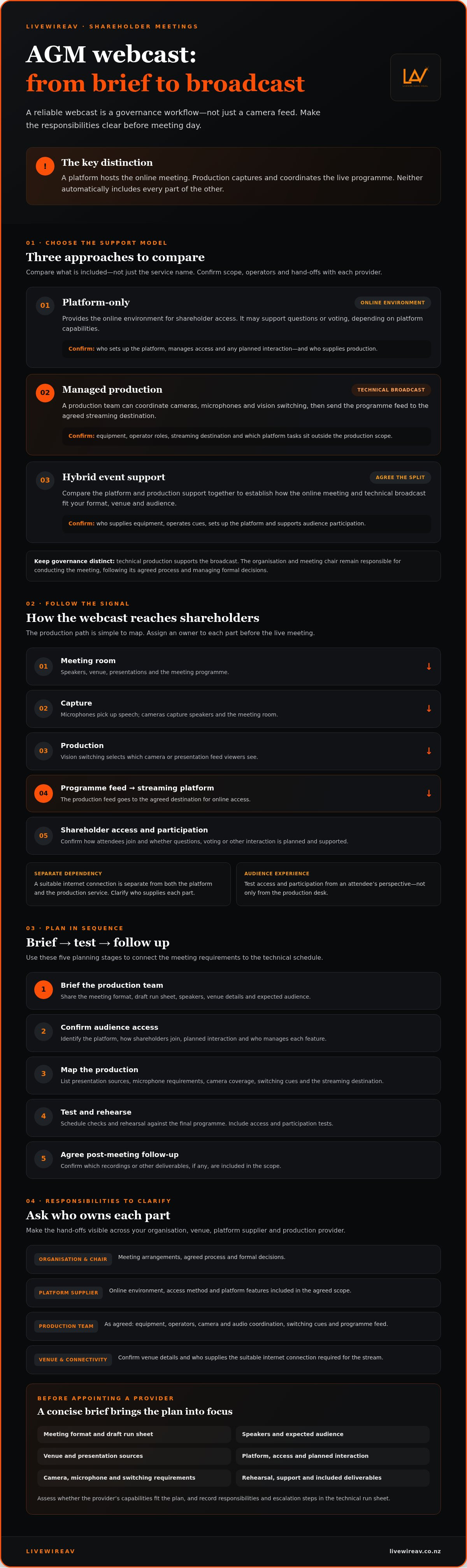
In a managed production, cameras capture the speakers and meeting room, microphones pick up speech, and vision switching selects which camera or presentation feed viewers see. The production team coordinates these elements with presenters, venue staff and the event organiser, then sends the programme feed to the agreed streaming destination. Ask the provider to specify the equipment, operator roles and destination in its proposed scope.
Technical production supports the broadcast, but it does not take over governance responsibilities. The organisation and meeting chair remain responsible for conducting the meeting, following its agreed process and managing formal decisions. Record that division of responsibility in the run sheet.
Is a webcast platform the same as webcast production?
No. A platform provides the online environment for access and may support features such as attendee questions or voting, depending on its capabilities. Production covers the cameras, audio, vision switching and technical crew needed to create the live programme. A board portal, such as Convene, is a separate type of software for board and governance workflows. It is not a camera crew or production service.
Check that the platform suits your AGM format and supports any required integrations. Separately confirm whether setup, streaming, audience support and planned interaction are included in the provider’s scope. Clear boundaries help your organisation, platform supplier, venue and production team understand what each needs to handle.
How an AGM webcast works: production, streaming and audience access
A dependable webcast is planned in stages, with responsibilities agreed before the live meeting. The signal path is straightforward: microphones and cameras capture the meeting, vision switching selects what viewers see, and the resulting programme feed goes to the streaming platform.
Align the production plan with the AGM format and timetable. The organisation remains responsible for its meeting arrangements, so check New Zealand's AGM requirements as part of planning. Then ensure the technical schedule supports the confirmed meeting date and programme.
From event brief to a tested webcast
A clear brief gives the production team the details it needs to plan the broadcast. Work through these steps with your provider:
Brief: Share the meeting format, draft run sheet, speakers, venue details and expected audience.
Confirm access: Identify the platform, how shareholders will join and any planned interaction, such as questions or voting. Check which features are available and who manages them.
Map the production: List presentation sources, microphone requirements, camera coverage, switching cues and the agreed streaming destination.
Test and rehearse: Schedule technical checks and rehearsal time against the final programme. Test access and participation from an attendee’s perspective, not only from the production desk.
Follow up: Agree in advance what happens after the meeting, including which recordings or other deliverables, if any, are included in the scope.
What happens during the live AGM webcast?
During the meeting, operators monitor sound, camera shots, presentation feeds and the outgoing stream. The production team follows agreed cues with the chair and presenters, switching between a speaker, a wider room view and slides as the programme requires. Clear cueing helps remote viewers follow the proceedings in the room.
Audience access needs its own checks. Confirm how shareholders will receive joining instructions, what device or browser requirements apply, and where they can get help if they cannot connect. If the meeting includes Q&A, polling or another interaction, establish who oversees it and how it fits into the chair’s process. Do not assume these functions are included simply because the platform offers them.
Ask each provider to explain its escalation and backup arrangements for the specific venue, connection and platform. The setup can differ between AGMs, so request clear roles and practical steps rather than relying on a general assurance. For organisations considering coordinated hybrid and livestream production, LivewireAV can scope camera packages, vision switching and technical production around the meeting format and venue.
Compare AGM webcast services in NZ: platform, production or hybrid support?
Compare responsibilities, not just feature lists. A platform may provide the online meeting space, while production support covers the people and equipment that create the live programme. Hybrid support also considers how the in-room meeting and remote audience work together. For AGM webcast services NZ, choose the model that matches your meeting’s complexity, audience needs and your team’s capacity to manage the details.
These are planning categories, not fixed packages. Providers define their scopes differently, so ask who supplies each item, operates cues, configures the platform and responds to attendee issues. The Ministry for the Environment’s guide to government best practices for virtual meetings offers useful considerations on choosing technology and supporting fair participation, although it addresses RMA hearings rather than AGMs.
When might a platform-only approach suit an AGM?
A platform-only approach may suit an organisation with platform expertise, straightforward camera and audio needs, and staff available to set up, test and operate the meeting. Check that your team also has capacity for rehearsal and troubleshooting. Before committing, confirm that the platform’s access and participation arrangements fit the AGM and the organisation’s governance requirements.
When should you consider managed production or hybrid support?
Several speakers, presentation cues or a challenging venue can increase the coordination required. A production team can bring cameras, vision switching and technical operation together for a composed webcast. Hybrid support also accounts for how the room and remote audience interact. For related planning considerations, see this hybrid conference AV setup guide.
Decision rule: The more complex the production and audience interaction, the more closely you should assess managed production or hybrid support. Keep the platform choice and governance requirements in view as well.
AGM webcast provider checklist: questions to ask before you appoint
A useful proposal makes responsibilities visible instead of leaving them to be worked out on the day. When comparing AGM webcast services NZ, use these questions to establish who owns each task across your organisation, venue, platform provider and production team.
Questions about scope, crew and technical preparation
What’s included? Ask which cameras, audio equipment, vision switching, operators and on-the-day technical support are in scope. Confirm what the venue or your organisation must supply.
Who manages the programme? Establish who maintains the technical run sheet, coordinates cues with presenters and communicates changes to the production team.
How are materials handled? Confirm when presentation files are due, how updates are managed and who checks that the correct versions are ready to use.
What preparation is planned? Ask what technical checks and rehearsal time are included, and what will be tested at the venue and through the chosen platform.
What happens if something changes or fails? Request the event-specific escalation and contingency procedures, including who makes decisions and who communicates with the chair or organiser.
Venue constraints can affect equipment placement, camera sightlines and connections. Share relevant venue details early, then ask how they shape the production plan. For broader planning considerations, see technical production planning for major events.
Questions about access, interaction and event follow-up
How do attendees join? Confirm who sends access details, how joining instructions are tested and where shareholders should go for technical help.
Which interactions are required? Specify whether the meeting needs questions, voting or other participation features. Confirm which provider is responsible for enabling and managing each one.
Are captions, recording or replay required? If so, ask whether each is included, who supplies it and what format or access arrangements apply. Do not assume availability from a platform feature list.
What will be delivered afterwards? Agree which files or records, if any, are included and who will receive them.
Keep governance decisions with the organisation. Confirm legal, notice, voting and record-keeping requirements with your advisers, then ensure the technical plan supports the approved process. A simple responsibility schedule can name the lead contact for each task and help prevent gaps between suppliers.
For a production scope shaped around your AGM format and venue, review LivewireAV’s event production services.
Plan an AGM webcast with a production partner across New Zealand
A concise production brief turns provider discussions into a workable plan. It gives the technical team a clear view of the meeting, audience and venue, while helping your organisation identify decisions that still need to be confirmed. When comparing AGM webcast services NZ, share the essentials first, then refine the production scope with the provider.
What to include in an AGM webcast brief
Set out the proposed date and format, such as an in-person meeting with a remote audience, alongside the draft programme, speaker count and expected audience profile. Add venue details, presentation requirements and any platform preference. If shareholders need to ask questions or use other interaction features, describe the intended process. Then confirm availability and responsibilities rather than assuming they are included.
Meeting: Proposed date, format, programme, speakers and key cues.
Audience: Expected attendee profile, access method and participation needs.
Venue and content: Room details, presentation sources and any relevant venue constraints.
People: Internal decision-makers, governance contacts, event organiser and technical points of contact.
Platform: Preferred option, required integrations and features to verify.
Identify who can approve changes to the run sheet, presentations and technical plan. Naming a contact for each area helps keep decisions moving and reduces the risk of conflicting instructions as the AGM approaches.
How LivewireAV can support the production discussion
LivewireAV provides event production services across New Zealand, including full technical production and hybrid and livestream events. Depending on the agreed scope, camera packages, vision switching and technical operators can be coordinated around the speakers, programme and venue so the online feed reflects the meeting clearly.
Use the brief to confirm which streaming destinations and platform integrations are supported, whether audience interaction features are included, and what contingency arrangements apply to your event. These details depend on the specific project and should be documented before appointment. LivewireAV is a potential production partner, not a board portal or standalone webcast platform.
If the AGM has broader technical requirements, this guide to audio visual support for large conferences may help you shape the discussion. Share your format, venue and priorities to discuss the scope and request a tailored proposal: Discuss your AGM webcast with LivewireAV.
Set your AGM webcast up for a composed meeting
A reliable webcast starts with a clear scope. Compare platform access with managed production, then decide what best fits your AGM format, audience and internal capability. Confirm who handles the equipment, platform setup, attendee support and any planned interaction.
Before appointing a provider, agree on the run sheet, technical roles, rehearsal and event-specific contingency arrangements. These details give your organisation and suppliers a shared plan, while keeping governance decisions with the appropriate people.
LivewireAV provides full technical production for events across New Zealand, alongside hybrid and livestream event services. Its camera packages and vision switching can be considered as part of a production scope shaped around your meeting. If you’re assessing AGM webcast services NZ, discuss your format, venue and technical requirements with a potential production partner.
Discuss your AGM webcast requirements with LivewireAV. With clear responsibilities and a considered technical plan, your team can approach meeting day with a shared understanding of what to expect.
Frequently Asked Questions
What are AGM webcast services?
AGM webcast services support the live broadcast of an annual general meeting to remote viewers. Depending on the scope, this may involve cameras, microphones, vision switching, technical operators and a streaming platform. Some providers supply production support; others provide software for the organisation to operate. Clarify who manages each part, including attendee access and planned interaction. The right scope depends on your meeting format, venue and audience.
Do we need a professional provider to webcast an AGM?
Not necessarily. An organisation with suitable equipment, platform expertise and staff available to set up, test and operate the webcast may manage a straightforward meeting internally. Professional production support may be useful when the AGM involves multiple speakers, presentation cues or a hybrid venue. Assess your team’s capacity to rehearse, monitor the stream and respond to technical issues, then choose a service model that suits the meeting.
Can shareholders ask questions during an AGM webcast?
Yes, if the chosen platform and meeting arrangements support it. Questions might be submitted through a platform feature and then managed according to the organisation’s meeting process. Confirm who monitors submissions, how questions reach the chair and how remote shareholders will be told to participate. Do not assume Q&A is included in a production proposal or available on every platform. Check the feature and test the attendee process beforehand.
How much do AGM webcast services cost in New Zealand?
There is no standard price for AGM webcast services in New Zealand. A provider’s proposal may depend on the production requirements, such as camera coverage, and requested features or integrations. Ask for a tailored quote against a written scope, then compare what each proposal includes: equipment, operators, platform setup, rehearsals and attendee support. Confirm any platform or third-party charges separately so you can assess the full event budget.
What internet connection is needed for an AGM webcast?
The connection needs to support the planned stream reliably, but the suitable setup depends on the venue, production configuration and platform requirements. Ask your production and platform providers what connection specifications they need, who will confirm venue connectivity and how it will be tested. Check stability and capacity under realistic event conditions rather than relying only on a general speed result. Agree on event-specific contingency arrangements in advance.
Should an AGM webcast be live or recorded?
A live webcast lets remote shareholders follow the meeting as it happens, while a recording may provide a way to view proceedings afterwards. Whether recording is appropriate depends on the organisation’s purpose, meeting process and requirements. Decide whether you need a live stream, a recording or both, and confirm the platform and production scope can support your plan. Check recording access, handling and any relevant governance obligations with your advisers.
What should we ask an AGM webcast provider before booking?
Ask what equipment, technical operators, rehearsal time and on-the-day support are included. Confirm who handles platform setup, attendee access, questions, voting and troubleshooting, and whether recording or replay is part of the scope. Request a clear division of responsibilities between your organisation, venue, platform provider and production team. Ask how testing, run-sheet changes and event-specific contingency procedures will be managed, then have governance or legal advisers confirm meeting requirements.


Comments